Fibres in concrete: how does fibre reinforcement work?

Fibres in concrete bridge cracks and keep load-bearing capacity after cracking. Crack bridging step by step, micro versus structural fibres, what changes in the mix, what fibres do not change and how residual strength is tested.
Fibres in concrete work by crack bridging: short steel, synthetic, glass or basalt fibres are spread through the whole mix, and when a crack opens, the fibres crossing it carry the tensile force across. Concrete with fibres keeps a residual strength after cracking and fails gradually instead of suddenly. Typical dosages: 25–50 kg/m³ steel or 0.5–6 kg/m³ synthetic fibre.
Fibre reinforced concrete (FRC, also called fibre concrete; in the UK the reinforcement itself is often called fibrous reinforcement) is concrete with loose fibres mixed into it. Because the fibres are distributed through the entire mass and in every direction, they are present exactly where a crack starts, not only where a designer has placed bars. The at-a-glance table further down summarises how each fibre type works.
Concrete with fibres versus plain and bar-reinforced concrete
Concrete fibres are short, loose fibres of steel, synthetic material (polypropylene), glass or basalt that are distributed through the fresh concrete during mixing. The result is a homogeneous material containing thousands to millions of small reinforcing elements per cubic metre, in every direction and at every location. Plain concrete has no reinforcement at all; bar-reinforced concrete has a limited number of large bars or a mesh in fixed positions.
In volume terms the fibre content is small, usually between 0.1 and 3% of the concrete. A worked example (calculated, indicative): 30 kg/m³ of steel fibre, at a density of 7,850 kg/m³, takes up about 0.4% of the volume, and 0.9 kg/m³ of polypropylene micro fibre, at 910 kg/m³, about 0.1%. Yet the polypropylene dose contains far more individual fibres, because polypropylene is almost nine times lighter than steel and micro fibres are much thinner.
That is precisely the fundamental difference from traditional reinforcement. Reinforcing steel is placed deliberately where the structural engineer expects tension; fibres are everywhere, and therefore exactly where a crack happens to form. To understand why that is so valuable, it helps to first look at the weak point of plain concrete.
Concrete is strong in compression, weak in tension
Concrete can carry enormous compressive forces, but in tension it is weak and brittle: the tensile strength is, indicatively, only around 10% of the compressive strength. As soon as the tensile stress exceeds the (low) tensile strength, a crack forms and unreinforced concrete fails almost immediately and without warning. For floors and beams the relevant measure is the flexural tensile strength: the tensile stress in the underside of a deflecting element at the moment the first crack forms.
Traditionally this is addressed with reinforcing steel at the locations where tension occurs. Fibre reinforcement tackles the same problem differently: instead of a few large bars, a large number of small fibres are distributed evenly throughout the entire concrete mass. How that approach compares with bars and mesh is covered in fibre concrete versus traditional reinforcement.
How fibres in concrete work: crack bridging in three stages
The core of fibre reinforcement is crack bridging. Every concrete mix shrinks during curing and responds to temperature changes and loading; wherever the tensile stress exceeds the tensile strength of the hardened cement paste, a micro-crack forms. Without reinforcement, such a micro-crack propagates unhindered into a visible, structural crack. In fibre reinforced concrete the process runs in three stages:
• Uncracked: as long as the concrete is uncracked, the matrix carries the load and the fibres are hardly strained. The first crack forms at about the same load as in plain concrete.
• Micro-cracking: thanks to the homogeneous distribution achieved during mixing, there are always fibres in the immediate vicinity of where a small crack starts. As soon as the crack plane reaches a fibre, that fibre begins to take up force: the tensile stress that was first concentrated at a single point is spread via the fibre across a larger volume of concrete, and crack growth slows down.
• Crack opening: the fibres crossing the crack tension across the crack faces and carry the tensile force from one side to the other. For the crack to open further, the fibres must be pulled out of the matrix. That pull-out costs energy, and it is precisely this energy absorption that makes the concrete fail gradually and in a controlled manner rather than all at once.
The result is countless small bridges instead of a single fracture plane. The bridging works through the anchorage and friction between fibre and concrete, which is why the shape and surface of the fibre matter as much as the quantity.
Three effects of crack bridging
• Delayed crack initiation: because the fibres act from the very first micro-cracks, it takes longer for a crack to become visible and structural.
• Limited crack width: where unreinforced concrete forms one wide crack, fibre reinforced concrete often develops several finer cracks that each carry less force. Finer cracks let through less water and fewer aggressive substances, which benefits the durability of the structure.
• Post-cracking behaviour: the characteristic from which fibre reinforced concrete derives its added value. Because fibres bridge crack faces, the concrete retains tensile capacity after cracking, instead of failing immediately as unreinforced concrete does.
Pull-out, not fracture: why fibre anchorage matters
The toughness of fibre concrete comes from fibres being pulled out gradually. A fibre that snaps releases its load abruptly and adds little toughness, so anchorage and fibre tensile strength have to be matched to the concrete.
Hooked-end steel fibres anchor mechanically: as the fibre is pulled out, the hook has to be straightened, which takes considerable force. In higher strength classes the concrete grips the fibre harder, so high-tensile fibres are used to prevent the fibre itself from breaking. MPZG HT+ 35/0.55, a high-tensile hooked steel fibre, has a datasheet tensile strength of 1,345 N/mm².
Synthetic macro fibres have no hook and rely on friction and their surface profile along the full embedded length. TwistR®, for example, uses a twisted structure for improved bonding. In both cases the aim is the same: fibres that slide out under control rather than break.
From brittle to ductile: residual strength after cracking
The most important property fibres add is called residual strength (or post-cracking strength): the load the concrete can still carry after the first crack has formed. In unreinforced concrete that residual strength is virtually zero. In fibre concrete a significant load-bearing capacity remains, because the fibres continue to bridge the crack. This translates into higher toughness, better impact resistance and gradual, predictable failure behaviour.
How high that residual strength is depends on the fibre type, the dosage and the combination of properties in the hardened concrete, not on a single isolated factor. That is exactly why fibre concrete is assessed with a standardised bending test, covered further on.
At the usual dosages, fibre concrete is 'softening': after cracking, the load it carries is lower than the cracking load, but it does not drop to zero. Only at high dosages or in special mixes can it be 'hardening', with the load rising further after the first crack. This is the behaviour that the letters in the fib classification describe (see the testing section below).
Micro fibres and macro fibres: two kinds of concrete reinforcement fibre
Fibres work at two different moments in the life of the concrete, and two types of fibre correspond to those moments.
• Micro fibres (thin, usually polypropylene, such as micro fibres against plastic shrinkage cracks) are mainly active in fresh concrete. They form a fine-meshed network that counters early-age shrinkage cracks in the first hours after pouring, when the concrete barely has any tensile strength yet. Typical dosage: 0.5–1 kg/m³. Fine polypropylene fibres are also used against explosive spalling in fire: they melt and leave channels through which water vapour pressure can escape. For very high-strength concrete (above C80/95), EN 1992-1-2 lists more than 2 kg/m³ of monofilament polypropylene fibres as one of the methods against spalling.
• Macro fibres (thicker, of steel or robust synthetic material, such as the structural macro fibres that take over the tensile force) do their work in hardened concrete. They provide the residual strength after cracking and can thereby contribute structurally to the load-bearing capacity.
Both types are sometimes combined (a hybrid solution), so that both early-age shrinkage cracking and behaviour under load are covered. An overview of all fibre types and their properties can be found in types of concrete fibres compared. Only macro fibres can count as structural fibres, as the next section explains.
What are structural fibres?
Structural fibres are macro fibres whose contribution to load-bearing capacity may be used in structural design. Under the European product standard these are steel fibres to EN 14889-1 and polymer macro fibres of class II to EN 14889-2. Synthetic micro fibres fall into class Ia (monofilament) or Ib (fibrillated) and are non-structural.
For structural use, the manufacturer declares under attestation system 1 the dosage in kg/m³ that gives a residual flexural strength of 1.5 MPa at a crack mouth opening (CMOD) of 0.5 mm and 1 MPa at a CMOD of 3.5 mm in the EN 14651 beam test. UK texts, including those of the Concrete Society, express the same criterion as central deflections of 0.47 mm and 3.0 mm. The declared dosage is a product value for the CE marking, not a design dosage: the dosage for a floor or slab follows from the structural design.
Indicative fibre properties according to the Concrete Society: steel fibres are 19–60 mm long, with an aspect ratio of 30–100 and a tensile strength of 345–1,700 N/mm²; macro synthetic fibres have a tensile strength in the order of 600 MPa and a modulus of around 10 GPa. How the two compare in practice is covered in steel fibres or synthetic macro fibres and in the article on structural synthetic fibre concrete. Wiking 4050 TR is an example of a polyolefin macro fibre, EN 14889-2 class II.
Steel fibres and synthetic fibres: difference in how they work
Steel fibres, for example hooked-end steel fibres for residual strength after cracking, are generally used to genuinely take up tensile forces and allow the structure to carry heavier loads; they therefore function as a form of reinforcement. Common dosages lie between 25 and 50 kg/m³.
Polypropylene fibres are added in far greater numbers, but at a much lower dosage by weight: indicatively 0.5–6 kg/m³, depending on whether they are micro or macro fibres. With micro fibres, the effect lies mainly in limiting (plastic) shrinkage cracks at an early stage of curing, before the concrete has reached its full strength; synthetic macro fibres additionally deliver residual strength in the hardened concrete and are immune to corrosion.
Much of the difference comes down to stiffness. Steel has an E-modulus of about 200 GPa, synthetic macro fibres roughly 5–15 GPa (indicative values). Steel therefore carries force at very small crack widths, while synthetic macro fibres mainly come into play at larger crack openings.
How each fibre type works: at a glance
The table below compares the working mechanism of the main fibre types: where they act, how stiff they are, at which crack width they carry tension and whether they can be used structurally. Tensile strength, density and price per type are covered in the full comparison of concrete fibre types; for basalt, stiffness and anchorage depend on the product, as with a wave-profile basalt macro fibre that anchors through its 3D wave profile.
| Fibre type | Works mainly in | Stiffness (E-modulus, indicative) | Carries tension from | Structural use |
|---|---|---|---|---|
| Steel (hooked-end, crimped) | Hardened concrete | approx. 200 GPa | Very small crack widths | Yes, EN 14889-1 |
| Synthetic macro (polypropylene, polyolefin) | Hardened concrete | approx. 5–15 GPa | Larger crack openings | Yes, EN 14889-2 class II |
| Synthetic micro (PP monofilament or fibrillated) | Fresh and early-age concrete | approx. 3–5 GPa | Micro-cracks in the first hours | No, EN 14889-2 class Ia/Ib |
| Glass (alkali-resistant) | Thin precast elements (GRC) | approx. 70–80 GPa | Small crack widths in thin sections | Mainly in precast GRC; glass fibres to EN 15422 |
| Basalt | Hardened concrete | Product-dependent (datasheet) | Depends on product and profile | Per manufacturer declaration; not covered by EN 14889 |
What determines how well fibres work?
Not every fibre dosage delivers the same result. Performance is determined by an interplay of factors:
• Dosage: the quantity of fibres per m³ of concrete. More fibres generally means more residual strength, up to a practical limit beyond which workability (and pumpability) decreases.
• Slenderness (aspect ratio): the ratio between length and diameter. More slender fibres bond and bridge more effectively, but are harder to mix in evenly.
• Fibre material and stiffness: stiff fibres such as steel already contribute substantially at small crack widths; more flexible synthetic fibres mainly deliver toughness and crack control at larger deformation.
• Anchorage and surface texture: profiled, ribbed or hooked fibres grip better in the matrix and pull out less easily than smooth fibres.
• Shape: single fibres (monofilament) and mesh-like, fibrillated fibres each have their own way of transferring force.
• Orientation and distribution: fibres work best when well distributed and favourably oriented relative to the crack direction.
• Maximum aggregate size: fibres should be clearly longer than the largest aggregate particle (indicatively at least twice as long), otherwise they cannot span between the stones.
• Concrete strength class: stronger concrete grips fibres harder, so fibre tensile strength and anchorage must match the concrete (see pull-out above).
What those numbers look like (calculated, indicative): a steel fibre with about 14,500 fibres per kg, such as MPZG HT+ 35/0.55, gives roughly 360,000 fibres per m³ at 25 kg/m³. A 12 mm polypropylene micro fibre with a diameter of 32 µm works out, from its length, diameter and a density of 0.91 g/cm³, at around 114 million fibres per kg, or roughly 100 million fibres per m³ at 0.9 kg/m³.
Practical guideline values per application can be found in concrete fibre dosages; with the fibre calculator you can work out the quantity required for your project straight away.
Fibre reinforced concrete mix: what changes when fibres go in
Fibres change the fresh concrete more than they change its compressive strength. The points that matter for a fibre reinforced concrete mix:
• Consistence: fibres reduce slump and flow, more so at higher dosages and with long steel fibres. Correct this with a plasticiser, never with extra water, which would cost strength and durability.
• Mix design: the mix needs enough paste to coat the fibres, and the maximum aggregate size is matched to the fibre length.
• Adding and mixing: preferably at the concrete plant. When fibres are added to the truck mixer on site, the Concrete Society advises mixing for approximately five minutes at optimum speed or a minimum of 100 drum revolutions. Add the fibres gradually to prevent fibre balls.
• Placing and finishing: according to the Concrete Society, fibre concrete can be placed, compacted and finished with the same methods as plain concrete. Pumping needs an adequate hose diameter.
How fibres are dosed and mixed in at production scale is covered in adding fibres at the concrete plant; the site side, from ordering to curing, in pouring fibre reinforced concrete.
What fibres do and don't change in concrete
A common misconception is that fibres make concrete stronger across the board. In reality, the gain lies almost entirely in the cracked stage and in behaviour under tension, not in compressive strength. That explains why fibre reinforced concrete performs particularly well against shrinkage, impact loading and cyclic loading, and why it is no miracle cure where higher compressive strength is the main requirement. What fibres do and don't do, per property:
| Property | Effect of fibres | Why |
|---|---|---|
| Compressive strength | Barely any effect | Compression is carried by the concrete matrix |
| Tensile and flexural tensile strength (uncracked) | Small effect | The first crack forms at about the same load as in plain concrete |
| Behaviour after cracking | Biggest gain | Fibres bridge the crack and keep carrying tension (residual strength) |
| Toughness and energy absorption | Strongly improved | Failure is gradual instead of sudden and brittle |
| Crack width | Finer, better-distributed cracks | Many fibres share the tensile force |
| Impact and fatigue resistance | Clearly higher | Energy is absorbed as fibres are pulled out |
| Durability | Better | Narrower cracks limit ingress of water and salts |
How fibre reinforced concrete is tested and designed
Because the added value lies in the cracked stage, fibre concrete is assessed on its residual strength, not just its compressive strength. The European standard EN 14651 prescribes a three-point bending test for this, on a beam with a sawn notch; during the test the crack mouth opening displacement (CMOD) is measured, and the limit of proportionality (LOP) and a series of residual strength values at set crack widths are determined. These residual flexural tensile strengths, fR1 to fR4, are read at a CMOD of 0.5, 1.5, 2.5 and 3.5 mm.
The fibres themselves fall under EN 14889: part 1 for steel fibres, part 2 for polymer fibres. What that standard and the associated CE marking mean is covered in EN 14889 and CE marking for fibre concrete.
For structural design, the fib Model Code 2010 classifies fibre concrete by its characteristic residual strength fR1k (for example 3.0 MPa) plus a letter from a to e for the ratio fR3k/fR1k, from a (0.5–0.7) up to e (1.3 or more). A class such as '3b' therefore tells the designer both strength and post-cracking behaviour in one code; the background is covered in our article on fib Bulletin 105. The second-generation Eurocode 2, EN 1992-1-1:2023, includes an informative annex (Annex L) for the design of steel fibre reinforced concrete.
In the UK, the usual references are the Concrete Society technical reports TR34 (concrete industrial ground floors), TR63 (design of steel fibre reinforced concrete) and TR65 (macro synthetic fibre reinforced concrete). In the Netherlands, structural engineers additionally work with the CUR Recommendations for fibre reinforced concrete, such as CUR Recommendation 111 for steel fibre concrete industrial floors on piles. This allows the contribution of the fibres to be substantiated in the calculation.
Does fibre reinforcement replace traditional reinforcement?
Sometimes entirely, sometimes partially: it depends on the application and the load. For ground-bearing floors, sprayed concrete and many precast applications, fibre reinforcement can replace steel mesh or bars. For heavily or dynamically loaded structures, the two are often combined, or bar reinforcement remains the leading solution. That trade-off is for the structural engineer to make, based on the design load and the demonstrated residual strength, not on material choice alone.
For the designer or contractor this means that fibre type, dosage and application must always be considered together. A fibre that works excellently against shrinkage cracks in a thin floor finish is not by definition suitable to replace structural reinforcement in a heavily loaded foundation, and vice versa. Which foundation types can be reinforced with fibres alone, and where bars remain necessary, is explained in the article on fibre reinforced concrete foundations.
Applications and costs in practice
Typical applications of fibre reinforced concrete are fibre reinforced industrial floors and ground-bearing slabs, precast yard slabs and precast concrete elements, sprayed concrete, agricultural floors and hard standings. There, its working principle pays off twice: less cracking during curing plus residual strength under service loading, without the placing and checking of mesh.
What that costs depends on fibre type and dosage: an indicative overview is given in what fibre reinforced concrete costs. Answers to the most common practical questions are collected in the frequently asked questions about fibre reinforced concrete.
Fibres in cement, mortar and screed, and how fibre cement differs
Fibres are not limited to structural concrete. In cement-based mortars and screeds, micro fibres limit plastic shrinkage cracking while the material is still fresh. A typical case is a sand cement screed, in which a fibrillated micro fibre for sand-cement screeds such as Profib provides plastic shrinkage crack control. The mechanism is explained in more detail under preventing plastic shrinkage cracks.
Fibre cement, sometimes called fibre reinforced cement, is a different product: thin sheets, slates and boards for cladding and roofing, factory-made from cement reinforced with cellulose and synthetic fibres. Older sheets of this kind were made with asbestos, which the UK banned in 1999. Fibre reinforced concrete, by contrast, is in-situ or precast concrete with loose fibres mixed in, used for floors, slabs, precast elements and sprayed concrete.
From working principle to fibre choice
Fibre reinforcement does not work by making concrete “stronger” in the usual sense, but by replacing brittle failure with tough, controlled behaviour. The fibres bridge cracks, keep them fine and well distributed, and retain load-bearing capacity precisely at the moment unreinforced concrete would give way.
Which fibre type and dosage are suitable depends on the application. More background on all fibre types and applications can be found in the pillar overview of fibre reinforced concrete; if you want to go straight to concrete advice for your project, the product finder guides you to the right fibre in a few questions.
Frequently asked questions
- What do fibres do in concrete?
- Fibres bridge cracks and carry the tensile force across them, so the concrete keeps a residual strength after cracking and fails gradually instead of suddenly. Micro fibres mainly limit plastic shrinkage cracks in the first hours after pouring; macro fibres of steel or synthetic material deliver residual strength and toughness in the hardened concrete. Compressive strength barely changes.
- What are concrete fibres?
- Concrete fibres are short, loose fibres mixed through fresh concrete as reinforcing elements. There are micro fibres (thin, usually polypropylene) against early-age shrinkage cracks and macro fibres (steel or robust synthetic material) that deliver residual strength in the hardened concrete. An overview per type is given in types of concrete fibres compared.
- What are structural fibres in concrete?
- Structural fibres are macro fibres whose residual strength may be used in structural design: steel fibres to EN 14889-1 and polymer macro fibres of class II to EN 14889-2. The manufacturer declares the dosage that gives 1.5 MPa at a CMOD of 0.5 mm and 1 MPa at a CMOD of 3.5 mm in the EN 14651 beam test. Micro fibres are not structural.
- What is residual strength?
- Residual strength (post-cracking strength) is the load fibre concrete can still carry after the first crack has formed, because the fibres continue to bridge the crack. In unreinforced concrete it is virtually zero. Residual strength is measured with the bending test according to EN 14651, in which residual strength values are determined at set crack widths (CMOD).
- Do fibres increase the compressive strength of concrete?
- Barely. Compression is carried by the concrete matrix, so fibres add little there; their gain lies after cracking, in residual strength, toughness and finer cracks. At high dosages workability drops, and if that is corrected with extra water instead of a plasticiser, the concrete can even lose strength.
- Can fibres replace steel mesh or rebar in concrete?
- Sometimes entirely, sometimes partially. In ground-bearing floors, sprayed concrete and much precast work, fibres can fully replace mesh or bars; in heavily or dynamically loaded structures, bar reinforcement often remains (partly) necessary. The structural engineer assesses this based on the design load and the demonstrated residual strength; see also fibre concrete versus traditional reinforcement.
- Do fibres help against shrinkage cracks?
- Yes, that is the domain of micro fibres. In the first hours after pouring, when the concrete barely has any tensile strength, thin synthetic micro fibres (dosage around 0.5–1 kg/m³) form a fine-meshed network that counters plastic shrinkage cracks. For crack control in the hardened concrete, macro fibres or a hybrid combination are required.
- Is fibre reinforced concrete the same as fibre cement?
- No. Fibre cement is a factory-made product: thin sheets, slates and boards of cement reinforced with cellulose and synthetic fibres, used for cladding and roofing. Fibre reinforced concrete is concrete with loose steel, synthetic, glass or basalt fibres mixed in, used for floors, slabs, precast elements and sprayed concrete. Fibres are also added to cement-based mortars and screeds.
- Do fibres show on the surface of the concrete?
- Some fibres can end up at the surface. Synthetic fibres can give a slightly hairy finish that wears off with use or can be burnt off; steel fibres at the surface of external slabs can leave small rust spots. Correct finishing limits this, such as well-timed power floating on a power-floated concrete floor and a dry-shake topping where specified. The result varies per mix and finish.
Share this article
Products mentioned
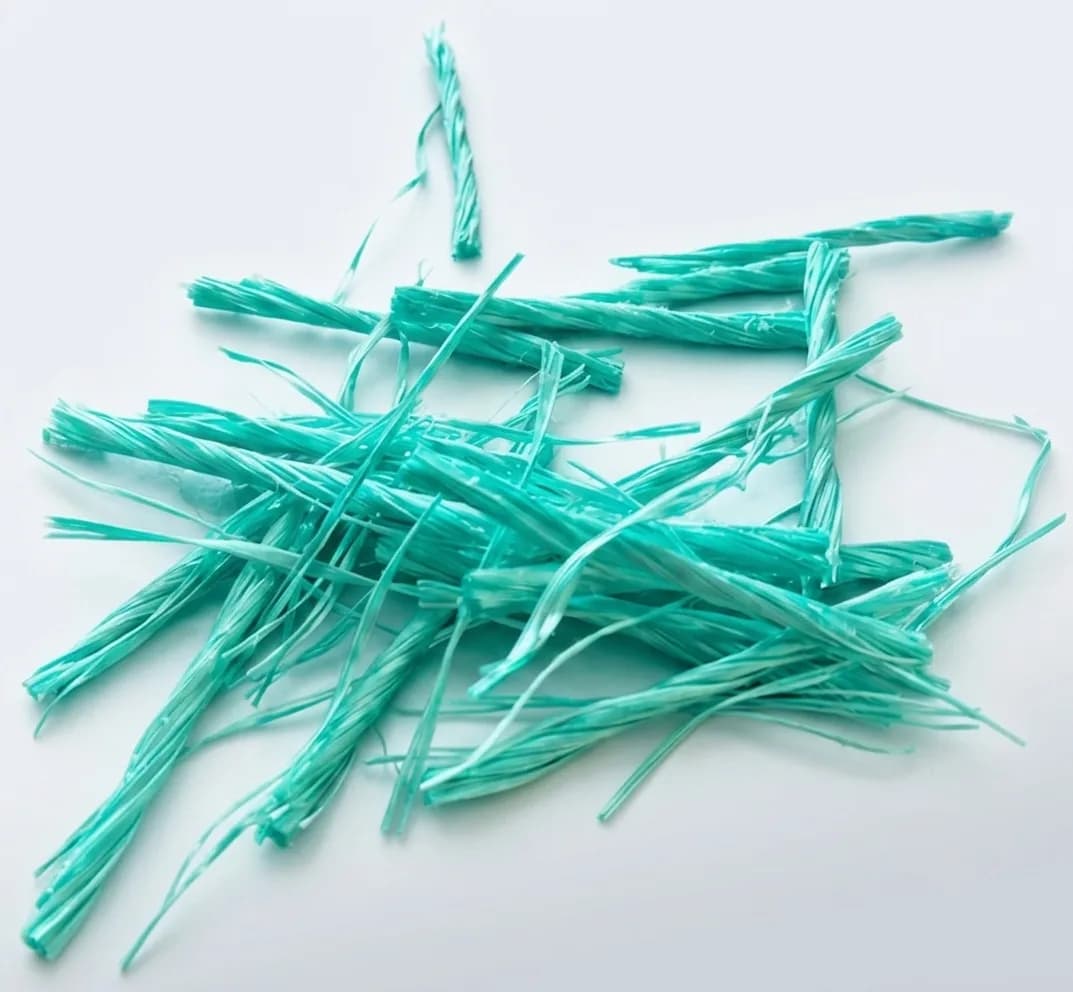 Most chosen
TwistR® GREEN HYBRID
High-performance synthetic macro fibres made from 100% polypropylene. Transforms concrete into a stronger composite material.
- TypeHybrid: twisted monofilament + fibrillating network fibre
- Material100% virgin polypropylene
- Length48 mm
- Dosage2.0 – 6.0 kg/m³
Pallet price on request
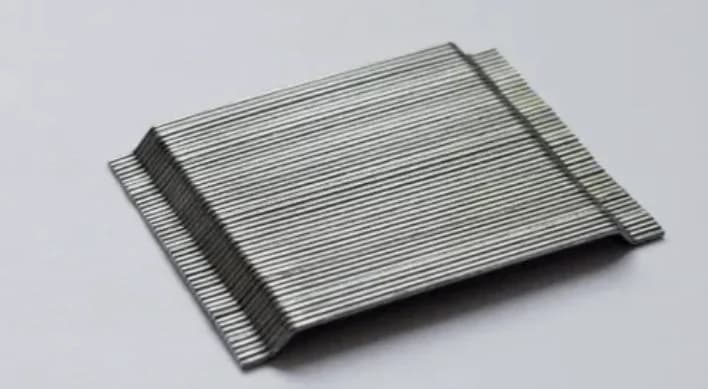
MPZG HT 35/0.55
High-tensile hooked steel fibres with aspect ratio 35/0.55. Maximum anchorage and ductility for heavily loaded structures.
- TypeCold-drawn hooked steel fibre (glued)
- Dimensions35 mm / Ø 0.55 mm
- Tensile strength1345 N/mm² ± 7.5%
- Modulus of elasticity200,000 N/mm²
Pallet price on request
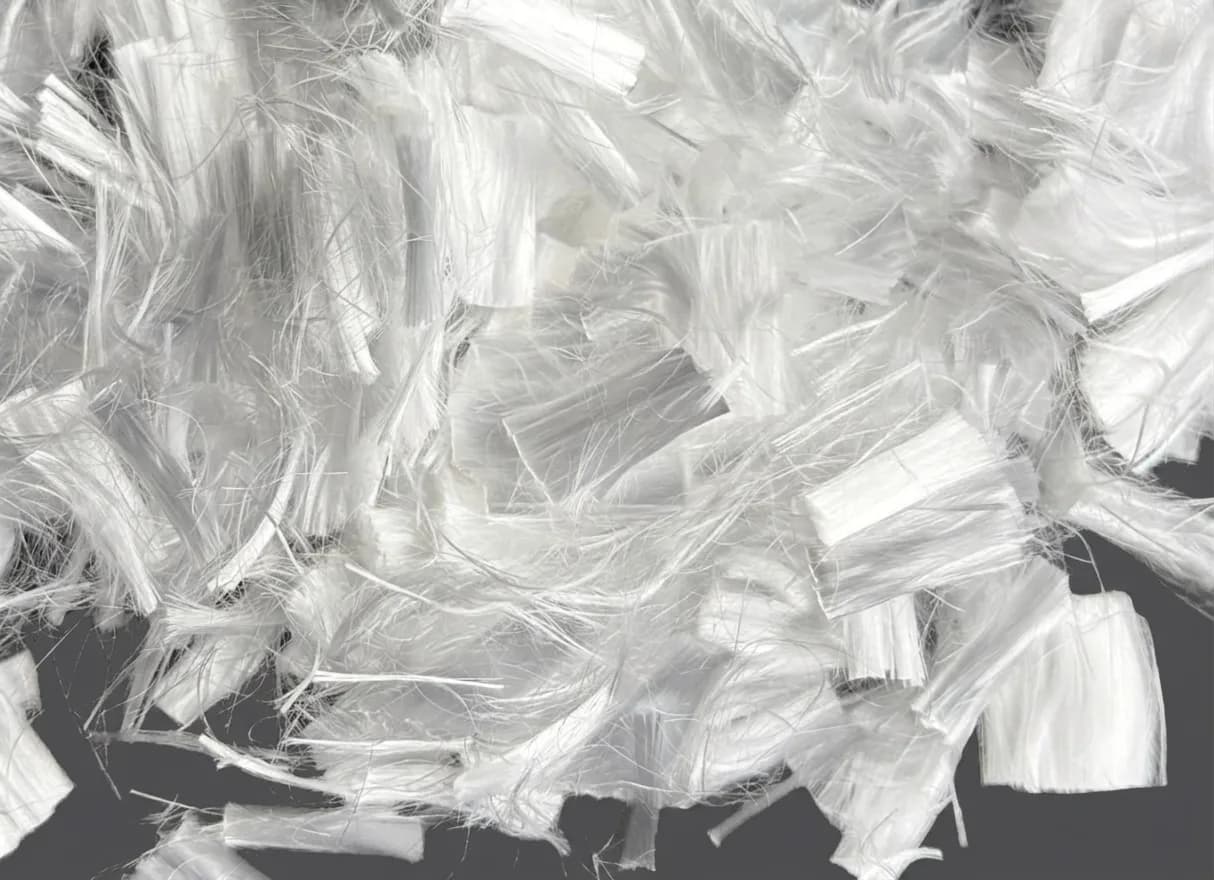
Promicro
Synthetic PP monofilament micro fibre against plastic shrinkage cracks. Homogeneous dispersion and better surface quality at a low dosage.
- TypePolypropylene monofilament (round cross-section)
- Length12 mm
- Equivalent diameter32 µm
- Linear density6.5 dpf
Pallet price on request