Power-floated concrete floor: price, drawbacks, finish and the role of fibre reinforcement

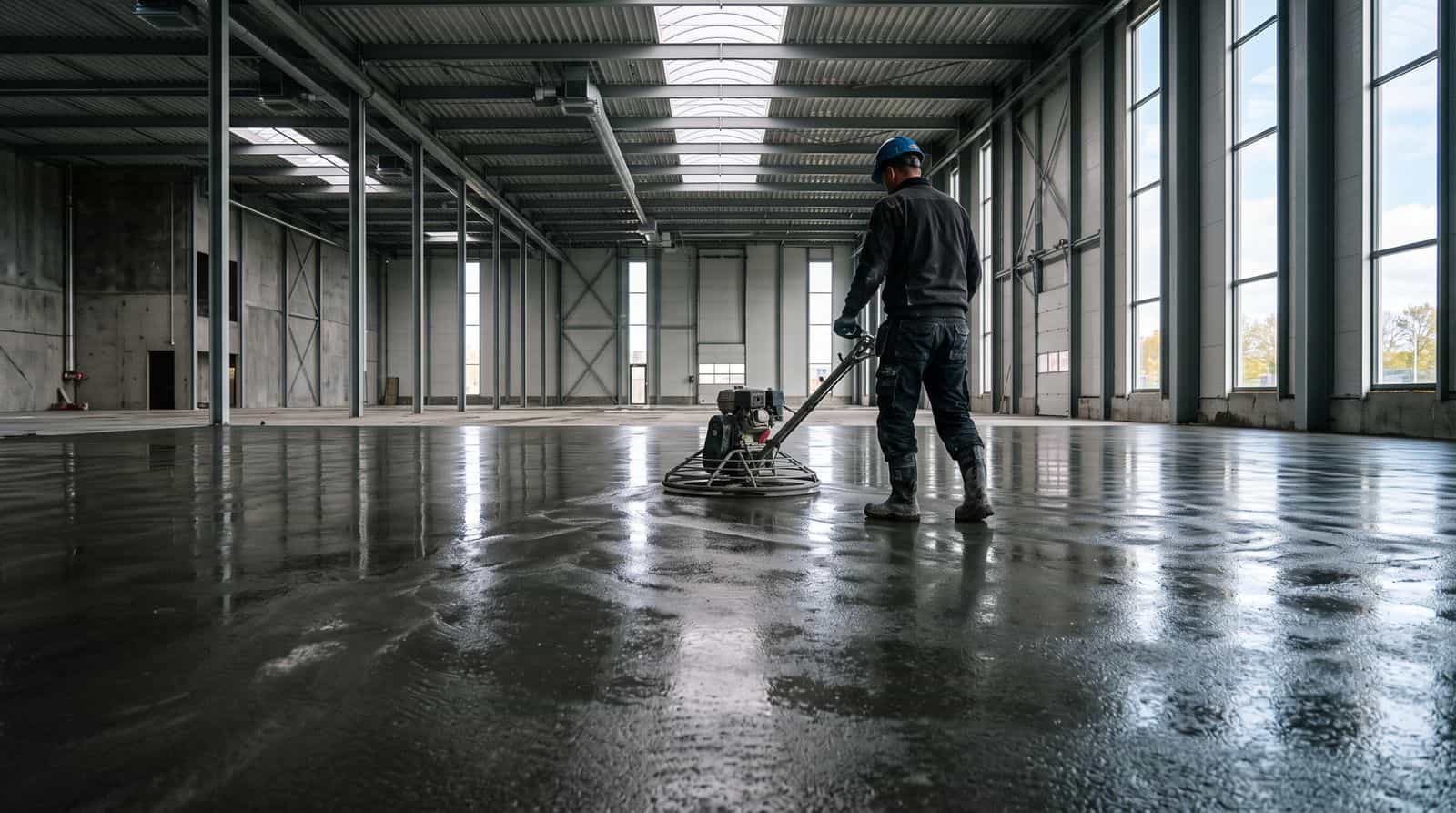
What power floating actually is, when the finisher starts after the pour, what a power-floated concrete floor costs per m² and why fibre reinforcement and power floating go so well together.
A power-floated concrete floor is a freshly poured concrete floor that is machine-finished with a power float, producing a single tight, dense and hard-wearing surface — with no separate screed. Power floating starts 2 to 6 hours after the pour; a poured and power-floated floor costs indicatively €45 to €90 per m² (2026 price level).
What is a power-floated concrete floor?
In a power-floated floor, the structural concrete slab is the finished surface. Directly after pouring and levelling, the surface is worked in several passes with a power float: a machine with rotating blades that compacts, closes and polishes the top layer. The result is a monolithic surface that is flat, low-dust and hard-wearing — the standard finish for industrial halls, workshops, garages and, increasingly, residential floors. In Flanders, much the same result is called a "gepolierde betonvloer"; in both cases it is the machine finishing of the fresh pour, not polishing after the event.
Power floating is therefore fundamentally different from laying a sand-cement screed: a screed is a separate, non-structural layer on top of the structural slab, whereas the power-floated floor is structure and finish in one. That floor-in-one-operation is called a monolithic floor; the full build-up with dosages and joint plan is set out in our article on the monolithic industrial floor. The adjacent flooring topics can be found within the pillar applications and target groups.
Because nothing goes over it, every square centimetre counts when finishing the concrete floor: the quality of mix, pour and float work is directly the final appearance. That is exactly why the choice of reinforcement — mesh or fibres — plays such a major role in power-floated floors, as becomes clear below.
Power floating a concrete floor: how the process runs after the pour
Power floating is all about timing. The concrete must have stiffened enough to carry the machine, yet still be plastic enough for the top layer to be closed. A typical timeline on a pour day:
• Pouring and levelling — the concrete is spread, compacted and brought to level and flatness with the screed rail or laser screed.
• Waiting (around 2–6 hours) — depending on temperature, mix and weather. Practical rule of thumb: power floating can begin as soon as a footprint indents only a few millimetres.
• First pass: floating — with float pans, the surface is ground flat and cement laitance is worked to the top.
• Subsequent passes: trowelling — with finishing blades set steeper with each pass, the top layer closes and the surface starts to shine. Large floors are worked with twin-rotor ride-on power floats.
• Curing — immediately after the final pass, a curing compound is applied or the floor is covered, so the young concrete does not dry out too quickly.
In cold weather this entire window shifts by hours — float work running late into the evening is the rule rather than the exception. Within 24 hours of the pour, the contraction joints are then sawn, to about a third of the slab depth. Which slab thickness suits which use, from garage to heavily loaded hall, is covered in how thick a concrete floor needs to be.
What does a power-floated concrete floor cost? Price per m²
The price depends on area (delivery and machine costs weigh heavily on small floors), slab thickness, flatness requirements and reinforcement. As an indication, 2026 price level and depending on the project:
• Plain concrete — around €110–165 per m³; for a 15 cm thick floor that converts to some €17–25 per m² in material.
• Power floating as a separate item — indicatively €10–20 per m² in labour and machine deployment, strongly dependent on area and required finish quality.
• Complete monolithic floor, poured and power-floated — around €45–90 per m², including concrete and finishing, excluding groundworks and foundation.
• Fibre reinforcement premium — a micro fibre dosage works out at less than €1 per m²; structural steel fibres come to in the order of €1–8 per m² at common dosages, offset by dropping the purchase and laying of reinforcement mesh.
If you want to know what the fibres cost for your floor size, the calculator works out concrete and fibre quantities directly; for a project price, request a quotation.
Drawbacks of a power-floated concrete floor — and what can be done about them
A power-floated floor is practical and hard-wearing, but no miracle cure. The drawbacks honestly listed:
• Shrinkage micro-cracks — concrete shrinks as it hardens; in a tight, glossy surface every hairline crack stands out. Plastic shrinkage cracks in the first hours can be prevented with a low dosage of micro fibres; drying shrinkage is managed with joints sawn in good time and proper curing.
• Slipperiness — a tightly trowelled surface becomes slippery when wet. Indoors that is rarely a problem; around dock doors, wash bays or outdoors, the floor is deliberately trowelled less tightly or lightly roughened.
• Colour variation and mottling — the slightly cloudy, nuanced grey is inherent to monolithic concrete. The shade differs per pour and per weather situation; anyone expecting a uniform colour as with a resin floor will be disappointed.
• Repairs remain visible — a power-floated floor has only one finishing moment. Cracks can be injected and patches repaired, but the repair always shows in the surface.
• Weather-dependent — wind, sun and low humidity on the pour day increase the risk of micro-cracking and shorten the floating window.
The common thread: most drawbacks revolve around cracking and surface quality — precisely the territory of fibre reinforcement. Why those cracks form in the first 24 hours and how to prevent them is covered at length in preventing plastic shrinkage cracks.
Why fibre reinforcement and power floating go so well together
Power-floated monolithic floors are quintessentially fibre reinforced, for three reasons directly related to the floating process.
No top mesh to obstruct the finisher
With traditional reinforcement, a mesh (or top mesh) lies a few centimetres below the surface — precisely in the zone where the power float works and where spacers can shift during the pour. A mesh that sits too high shows through in the surface or is even exposed during floating. Fibre reinforcement without a top mesh to obstruct the finisher, such as the structural synthetic fibre TwistR (2–6 kg/m³), arrives ready-mixed from the truck mixer: the formwork can close straight away, the pour is one continuous operation and the finisher has a homogeneous mix with no obstacles in the top layer.
Micro fibres protect the surface in the critical hours
Between the pour and the final floating pass, the fresh surface lies open for hours — the phase in which plastic shrinkage cracks form as soon as the surface dries out faster than the bleed water can replenish it. A micro fibre against plastic shrinkage during power floating such as Promicro (0.6–1.0 kg/m³) lays a network of millions of fine filaments through the concrete that absorbs those early tensile stresses. An added benefit finishers see immediately: the mix stays more cohesive, with less ponding and a denser, more tightly closed surface.
For power-floated fair-faced work, deliberately choose a monofilament micro fibre rather than a fibrillated one: loose, smooth 12 mm filaments disperse very finely and remain virtually invisible at the surface, whereas the mesh-like fibrillated fibre (strong in sand-cement and semi-dry mortar) can show more coarsely in ready-mixed concrete. The few synthetic fibres visible directly after floating wear away in the first weeks of use.
Steel fibres in a power-floated floor
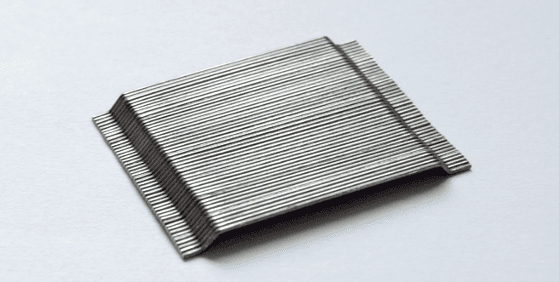
For heavily loaded power-floated floors — forklift traffic, pallet racking — steel fibres in a power-floated floor are the structural standard. A hooked-end high-tensile fibre such as the MPZG HT+ 35/0.55 (10–35 kg/m³, conforming to EN 14889-1) reinforces the entire volume, right into edges and corners where a mesh, because of the cover requirement, just fails to reach. With correct float work, the fibres are worked into the top layer and pressed below the surface; in practice, the steel fibre is often combined with a micro fibre, so that structural reinforcement and surface protection come together in one pour. And because steel fibres absorb the shrinkage stresses across the whole bay, larger bays can be poured with fewer sawn joints — every joint fewer is one less maintenance point in the tight surface.
Impregnate or coat a power-floated concrete floor?
Freshly power-floated concrete is dense, but not liquid-tight. Two common follow-up steps:
• Impregnating — an impregnation agent penetrates the pores and makes the floor resistant to dirt, oil and moisture without materially changing its appearance; the floor remains vapour-open. Common for garages, workshops and residential floors. It can usually be applied a few weeks after the pour, once the surface is sufficiently dry.
• Coating — an epoxy or PU coating forms a closed layer for chemical exposure or liquid-tightness (wash bays, food industry). A coating makes higher demands: the floor must have dried far enough (allow in the order of weeks to months, depending on thickness and climate) and the smooth power-floated surface is first roughened for adhesion.
For most power-floated floors, impregnating is the logical choice: it preserves the concrete look and is easy to repeat later. Choose a coating only if the conditions of use demand it — otherwise you are coating away the floor's key quality, its monolithic surface.
Power-floated indoors and outdoors
Everything above applies to indoor floors. Outdoors — terrace, driveway, garden path — extra rules apply: the surface is deliberately finished slightly rougher against slipperiness in rain, the slab gets a fall, and the reinforcement must withstand permanent moisture and frost exposure. Corrosion-free synthetic fibres have the advantage there; how to pour a power-floated concrete floor outdoors without reinforcement mesh, including thicknesses, colours and the difference from a chape, is covered in a separate article.
From pour plan to a tight floor
A good power-floated floor is made before the power float turns: a mix with controlled bleeding, a well-considered joint plan, curing straight after the final pass — and reinforcement that does not get in the way of the float work. The practical route: choose a monofilament micro fibre for surface quality and, depending on the loading, a structural synthetic or steel fibre for the reinforcing work; high point loads call for a calculation by the structural engineer. Check the dosage for your floor size with the calculator, or submit your pour plan via a quotation request — we advise free of charge on fibre type and dosage per floor.
Frequently asked questions
- What is a power-floated concrete floor?
- A power-floated concrete floor is a freshly poured concrete floor that is machine-finished straight away with a power float: rotating blades compact and close the top layer into a tight, hard-wearing surface. Structural slab and finish are a single whole — no separate screed is needed. In Flanders this is called a "gepolierde betonvloer"; see also our monolithic industrial floor.
- When can you start power floating after the pour?
- Usually 2 to 6 hours after the pour, depending on temperature, mix and weather. A practical rule of thumb: the concrete is ready for the first floating pass as soon as a footprint indents only a few millimetres. In cold weather that window shifts by hours. Curing follows immediately after the final pass, and the contraction joints are sawn within 24 hours.
- What are the drawbacks of a power-floated concrete floor?
- The main drawbacks: hairline shrinkage cracks stand out in the tight surface, the floor becomes slippery when wet, the colour is mottled and differs per pour, and repairs remain visible. Shrinkage cracks are largely preventable with micro fibres, joints sawn in good time and proper curing; slipperiness is countered by trowelling less tightly in risk areas.
- What does power floating a concrete floor cost per m²?
- As a separate item, power floating costs indicatively €10–20 per m² in labour and machine deployment; a complete monolithic floor, poured and power-floated, comes to around €45–90 per m² including concrete (2026 price level, depending on area, thickness and flatness requirements). Fibre reinforcement adds in the order of €1–8 per m², but saves the laying of reinforcement mesh. Request a quotation for a project price.
- Do you need to impregnate a power-floated concrete floor?
- It is not compulsory, but usually sensible: an impregnation agent penetrates the pores and makes the floor resistant to dirt, oil and moisture without changing the concrete look. It can be applied a few weeks after the pour, once the surface is sufficiently dry, and is easy to repeat later. An epoxy or PU coating is only needed for chemical exposure or liquid-tightness requirements.
- Do you see fibres at the surface of a power-floated floor?
- Hardly, with good workmanship. For fair-faced work, choose a monofilament micro fibre: those fine, smooth filaments remain virtually invisible at the surface, whereas a fibrillated fibre can show more coarsely. Steel fibres are worked into the top layer and pressed below the surface during floating. The few synthetic fibres visible directly after the pour wear away in the first weeks of use.
Products mentioned

Promicro
Synthetic PP monofilament micro fibre against plastic shrinkage cracks. Homogeneous dispersion and better surface quality at a low dosage.
- TypePolypropylene monofilament (round cross-section)
- Length12 mm
- Equivalent diameter32 µm
- Linear density6.5 dpf
Pallet price on request
MPZG HT+ 35/0.55
High-tensile hooked steel fibres with aspect ratio 35/0.55. Maximum anchorage and ductility for heavily loaded structures.
- TypeCold-drawn hooked steel fibre (glued)
- Dimensions35 mm / Ø 0.55 mm
- Tensile strength1345 N/mm² ± 7.5%
- Modulus of elasticity200,000 N/mm²
Pallet price on request
 Most chosen
TwistR® GREEN HYBRID
High-performance synthetic macro fibres made from 100% polypropylene. Transforms concrete into a stronger composite material.
- TypeHybrid: twisted monofilament + fibrillating network fibre
- Material100% virgin polypropylene
- Length48 mm
- Dosage2.0 – 6.0 kg/m³
Pallet price on request