Fibre reinforced concrete: frequently asked questions

The most frequently asked questions about fibre reinforced concrete — from fibre type, dosage and cost per m³ to cracking, power floating and standards. Each answer links through to the in-depth article.
Fibre reinforced concrete (also called fibre concrete) is concrete to which fibres of steel, plastic, glass or basalt are added as reinforcement during mixing. The fibres improve crack control, toughness and abrasion resistance; dosages run from around 0.6 kg/m³ (micro fibres) to 50 kg/m³ (steel fibres). Below we answer the questions contractors, floor layers and structural engineers ask us most — briefly, with a link through to the in-depth article.
Basics and how it works
This page is the reference work within our topic fibre reinforced concrete. Looking for depth? Follow the reading link for each question.
What exactly is fibre reinforced concrete?
Fibre reinforced concrete (FRC) is concrete to which small fibres are added during mixing to improve tensile strength, crack resistance and abrasion resistance. The terms fibre concrete and fibre reinforced cement are used interchangeably in practice; technically, the fibre reinforces the concrete, not just the cement. Millions of fibres together form a three-dimensional reinforcement throughout the entire cross-section. Read more: how fibre reinforcement works in concrete.
Do fibres fully replace traditional reinforcement?
Not always. For non-structural or lightly loaded applications — yard pavings, industrial floors, light foundations — fibres can often fully replace the reinforcement mesh. For heavily loaded, primarily structural elements such as bridges or multi-storey buildings, traditional reinforcement usually remains (partly) necessary. Structural work always requires a calculation by the structural engineer.
What are the advantages of fibre reinforced concrete?
• Reinforcement in a single operation — no mesh fixing, so lower labour costs and a faster programme; on projects such as the NDSM wharf and the cycle path in Wijckel, the saving ran to 46%.
• Crack control throughout the entire cross-section, including at the surface where a mesh never reaches.
• No corrosion risk with synthetic and basalt fibres, with a CO₂ footprint up to 98% lower for synthetic macro fibres than for traditional reinforcing steel.
• Higher abrasion and impact resistance, beneficial for floors and pavings.
What are the drawbacks of steel fibre concrete?
Steel fibre concrete has a relatively high dosage (typically 25–50 kg/m³), so the premium moves with the steel price. Fibres that reach the surface through wear can produce light rust spots — usually aesthetic, rarely structural. Exposed work and polished floors require attention on this point, and structural applications require a residual strength calculation (EN 14651). A comparison with synthetic and basalt alternatives can be found in types of concrete fibres compared.
Fibre types and dosage
Fibre type and dosage together determine the result — and the price tag. The main lines:
Which fibre type is best?
There is no universally best fibre type — it depends on the application. Steel fibre offers the highest structural strength per kilo, synthetic fibre is non-corrosive and effective against shrinkage cracks, and basalt fibre combines high strength with a low density and heat resistance up to around 700 °C. In doubt? Run through the selection guide — it filters by application and loading.
How many fibres go into a m³ of concrete?
• Steel fibres — around 25 to 50 kg/m³; for structural floors on piles, around 35 kg/m³ applies as a lower limit. Our CE-marked steel fibres to EN 14889-1 are calculated per project.
• Synthetic macro fibres such as the structural macro fibre TwistR — around 2 to 6 kg/m³.
• Micro fibres such as ProMicro — around 0.6 to 1.0 kg/m³ against plastic shrinkage cracks.
The exact value follows from loading, floor thickness and the desired result: see dosing concrete fibres.
What happens if I add too many fibres?
Too high a dosage can block the dosing equipment, reduce workability and lead to fibre balling — clumps that actually create weak spots in the concrete. So stick to your supplier's recommended dosage; beyond the practical limit, more is not better.
Costs
The cost question is twofold: what does the material cost per m³, and what does the saved operation deliver?
What does fibre reinforced concrete cost per m³?
For regular ready-mixed concrete you pay an indicative €110 to €165 per m³ in 2026, depending on strength class and region. On top of that comes the fibre premium: indicatively €12 to €65 per m³ for steel fibre and €15 to €45 per m³ for synthetic macro fibre, depending on dosage and fibre type. All ranges and worked examples are in what fibre reinforced concrete costs; use the calculator to run the numbers for your own project.
Is fibre concrete more expensive than traditional reinforced concrete?
Per m³ of material, the price can be comparable, slightly higher or slightly lower than with reinforcement mesh. The biggest saving lies in labour hours: there is no separate operation for placing and fixing reinforcement. At the total level, fibre concrete is therefore often cheaper — up to 46% in documented projects.
Applications and execution
From industrial floor to precast element: most execution questions come down to these.
What is fibre reinforced concrete used for?
The common applications are industrial and residential floors, yard and hardstanding pavings, foundations, patios, cycle paths, sprayed concrete and precast elements. Fibre concrete also appears in road renovation: in white topping along the N344, a 12 cm thick fibre reinforced concrete layer was cast directly over the existing asphalt. In short: wherever crack control, abrasion resistance or faster execution counts.
How thick does a fibre concrete floor need to be?
Indicatively: a patio on a sand bed around 15 cm, a power-floated residential floor with underfloor heating from around 7 cm (including pipes), and industrial floors usually 15 to 20 cm depending on loading. Fibres do not automatically make a floor thinner; they mainly replace the mesh within the same cross-section. For high point loads (racking), the structural engineer determines thickness and dosage together.
Is fibre concrete suitable for precast slabs and retaining walls?
Yes. Fibre concrete slabs and precast concrete elements are even a growth market: in the factory, the dosage can be controlled precisely and the labour-intensive fixing work disappears. For a precast internal wall with structural synthetic fibre, the Environmental Cost Indicator drops from €17.51 to €1.13 (−93%). Concrete retaining walls are widely produced in steel fibre concrete; because a retaining wall retains soil and is therefore structural, a calculation is always required.
Can fibre reinforced concrete be power-floated or polished?
Yes, fibre concrete is power-floated daily. With the right dosage and good mixing, power floating presses the fibres below the top layer; micro fibres even produce a denser, higher-quality surface. Any visible synthetic fibres can be burnt off after curing or wear away by themselves. For polished exposed floors with steel fibre, discussing the desired appearance beforehand is sensible, because of possible rust spots at the surface.
Can fibre concrete be pumped?
Yes, with the right dosage the concrete remains readily pumpable. At higher dosages, an adjusted, slightly softer consistency may be needed to safeguard workability. Always tell the pump supplier that it concerns fibre concrete.
Can I have fibres added to an existing concrete order?
Yes, fibres are added during the mixing process at the ready-mix plant. When ordering, specify the fibre type and dosage — for example 4 kg/m³ macro fibre or 30 kg/m³ steel fibre — and state the application, so the plant can adjust the consistency. How the plant doses the fibres and what belongs on your order is explained in adding fibres at the concrete batching plant.
Cracks, corrosion and service life
The durability questions: what do cracks mean, and what about rust?
Are cracks in a concrete floor harmful?
Fine hairline cracks up to around 0.2 to 0.4 mm are normal in concrete and usually harmless; the Eurocode applies similar limits per exposure class. Cracks only become a risk when they widen and give moisture and chlorides access to reinforcing steel — then corrosion and spalling concrete threaten. Fibres keep cracks finely distributed and narrow. Why that prevents corrosion is explained in corrosion of reinforcing steel.
Does steel fibre rust as fast as reinforcement bars?
Steel fibre that is fully embedded in the concrete is protected comparably to traditional reinforcement. The big difference: a rusting loose fibre of a few centimetres cannot cause continuous damage the way a corroding reinforcement bar can. Fibres that end up at the surface can show light local rust spots — usually an aesthetic point, rarely a structural problem.
Is fibre reinforced concrete suitable for outdoor applications?
Yes. For damp or chloride-laden environments — coastal areas, agricultural floors with manure, salted pavings — synthetic or basalt fibre is actually a better choice than steel fibre, because the corrosion risk is then completely absent.
Standards, strength class and quality
Finally, the formal side: classes, certification marks and inspection.
What strength class does fibre reinforced concrete have?
Fibres do not fundamentally change the compressive strength — and hence the strength class such as C20/25 or C30/37; you simply order fibre concrete in the usual classes. What fibres do add is residual strength after cracking, determined with the bending test to EN 14651. Structural fibres carry CE marking to EN 14889-1 (steel) or EN 14889-2 (polymer).
How is quality controlled?
For structural applications, the dosage and fibre distribution are checked by sampling during production, comparable to the regular checks on water-cement ratio and strength class. With steel fibre, fibres are sometimes visible afterwards at the surface; with synthetic fibre hardly at all; wash-out tests on fresh concrete demonstrate the actual dosage.
Do I need a reinforcement calculation?
For non-structural applications, usually not. As soon as fibres (partly) take over the role of traditional reinforcement — floors on piles, retaining walls, load-bearing elements — a calculation based on the residual strength class is required, carried out by the structural engineer together with the fibre supplier.
Question not covered?
Every situation is different: subgrade, loading and finish together determine fibre type and dosage. Run through the selection guide for initial direction, calculate your project with the calculator, or request personal dosage advice — we are happy to advise free of charge on fibre type, dosage and execution.
Frequently asked questions
- What is fibre concrete?
- Fibre concrete is the common short name for fibre reinforced concrete: concrete to which fibres of steel, plastic or basalt are added during mixing. Millions of fibres form a three-dimensional reinforcement that controls cracking and increases toughness. Dosages run from 0.6 kg/m³ (micro fibres) to 50 kg/m³ (steel fibres). See how fibre reinforcement works.
- What are the drawbacks of steel fibre concrete?
- The dosage is relatively high (25–50 kg/m³), so the price moves with the steel price, and fibres at the surface can produce light rust spots — a particular consideration for exposed floors. Structural work requires a residual strength calculation to EN 14651. Non-corrosive alternatives are covered in types of concrete fibres compared.
- What does fibre reinforced concrete cost per m³?
- Indicatively (2026 price level): ready-mixed concrete costs €110–165 per m³; steel fibre adds €12 to €65 per m³, synthetic macro fibre €15 to €45 per m³. The saved fixing operation often reduces total costs considerably — up to 46% in documented projects. Worked examples: what fibre reinforced concrete costs.
- How thick does a fibre concrete floor need to be?
- Indicatively: a patio around 15 cm, a power-floated residential floor with underfloor heating from around 7 cm, industrial floors usually 15–20 cm depending on loading. Fibres mainly replace the reinforcement mesh within the same cross-section; for high point loads, the structural engineer determines thickness and dosage together.
- Are cracks in a concrete floor harmful?
- Hairline cracks up to around 0.2 to 0.4 mm are normal and usually harmless. Wider cracks give moisture and chlorides access to reinforcing steel, resulting in corrosion and damage. Fibre reinforcement keeps cracks finely distributed and narrow, slowing this mechanism down — see corrosion of reinforcing steel.
- What is fibre reinforced concrete used for?
- The main applications are industrial and residential floors, yard pavings, foundations, patios, cycle paths, sprayed concrete and precast elements such as slabs and retaining walls. Fibre concrete is also used in road renovation (white topping, such as the 12 cm thick concrete layer over asphalt along the N344). Wherever crack control or faster execution counts, it is a serious alternative.
Share this article
Products mentioned
 Most chosen
TwistR® GREEN HYBRID
High-performance synthetic macro fibres made from 100% polypropylene. Transforms concrete into a stronger composite material.
- TypeHybrid: twisted monofilament + fibrillating network fibre
- Material100% virgin polypropylene
- Length48 mm
- Dosage2.0 – 6.0 kg/m³
Pallet price on request
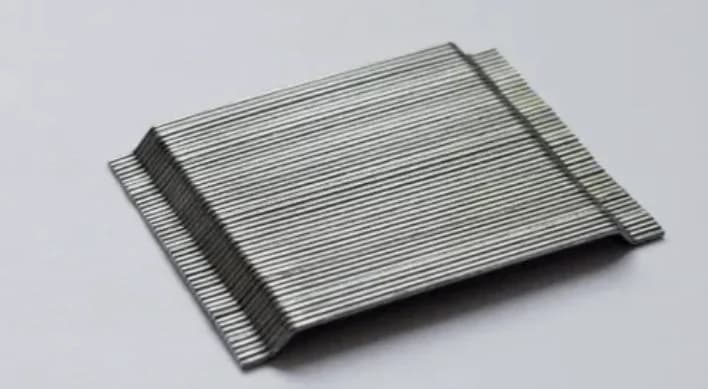
MPZG HT 35/0.55
High-tensile hooked steel fibres with aspect ratio 35/0.55. Maximum anchorage and ductility for heavily loaded structures.
- TypeCold-drawn hooked steel fibre (glued)
- Dimensions35 mm / Ø 0.55 mm
- Tensile strength1345 N/mm² ± 7.5%
- Modulus of elasticity200,000 N/mm²
Pallet price on request
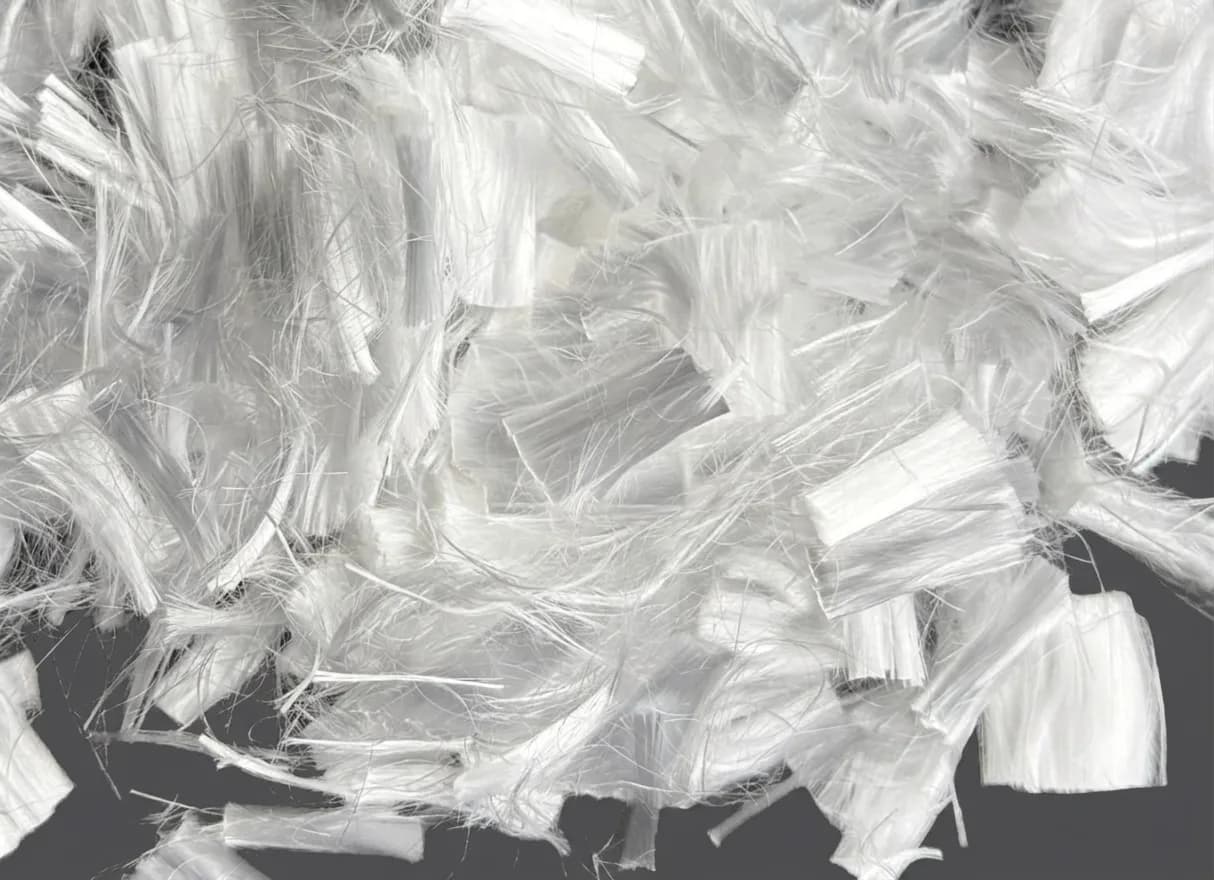
Promicro
Synthetic PP monofilament micro fibre against plastic shrinkage cracks. Homogeneous dispersion and better surface quality at a low dosage.
- TypePolypropylene monofilament (round cross-section)
- Length12 mm
- Equivalent diameter32 µm
- Linear density6.5 dpf
Pallet price on request