Fibre reinforced concrete cost in 2026: concrete price per m³ with and without fibres

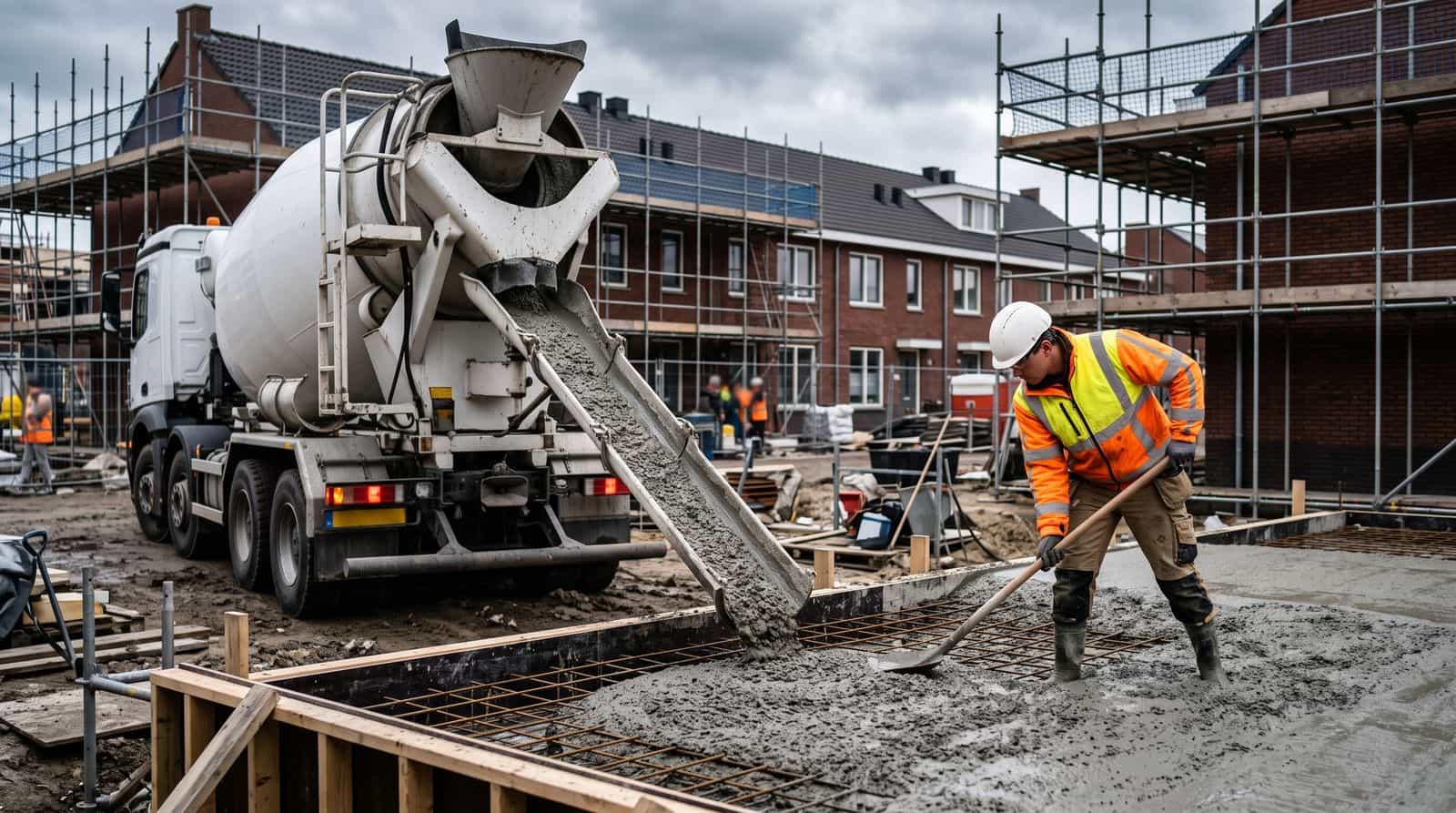
What does fibre reinforced concrete cost in 2026? A price table with the cost of a cubic metre of concrete per strength class, the fibre surcharge per fibre type and pump costs, plus a 100 m² worked example against reinforcement mesh.
Fibre reinforced concrete costs an indicative €125 to €230 per m³ at 2026 price levels, excluding pumping and labour. That is the price of ready-mixed concrete, €110 to €165 per m³ depending on strength class, region and volume, plus a fibre surcharge of around €12 to €65 per m³ for steel fibre or €15 to €45 for synthetic macro fibre.
Including labour, the total cost is often comparable to or lower than concrete with reinforcement mesh, because laying and tying the mesh is no longer needed. The table and the worked example below show where that difference comes from.
Concrete and fibre reinforced concrete price per m³ in 2026: the overview
The guide prices below are based on the Dutch market and apply to ready-mixed concrete from the concrete plant, including regular delivery within the region (updated: September 2026). Outside the Netherlands, for example in the UK, local price levels apply. Do not carry them straight over into a quotation: exposure class, consistency, travel time and volume purchased can make a difference of tens of euros per cubic metre.
All amounts are indicative, 2026 price level and dependent on project and supplier. For the cost side of fibre reinforcement in a broader sense, more background can be found in the pillar on fibre reinforced concrete.
| Concrete or surcharge | Application or dosage | Indicative price |
|---|---|---|
| C20/25 ready-mixed concrete | Light foundation work, blinding | €110–€130 per m³ |
| C25/30 ready-mixed concrete | Foundations and floors in housing | €120–€140 per m³ |
| C28/35 ready-mixed concrete | Industrial floors, yard paving | €130–€150 per m³ |
| C30/37 ready-mixed concrete | Heavier structural work | €140–€165 per m³ |
| Steel fibre surcharge | 10–35 kg/m³, depending on fibre type and calculation | + €12–€65 per m³ (moves with the steel price) |
| Synthetic macro fibre surcharge | 2–6 kg/m³ | + €15–€45 per m³ |
| PP micro fibre surcharge (against shrinkage cracks) | 0.6–1.0 kg/m³ | + a few euros per m³ |
| Fibre reinforced concrete in total | Base concrete plus steel or synthetic macro fibre | €125–€230 per m³ |
| Concrete pump (if needed) | Depends on pump type and deployment time | €150–€600 per pour |
What determines the cost of a cubic metre of concrete?
The price of a cubic metre of concrete is not a fixed figure, but the sum of a handful of dials the concrete plant can turn:
• Strength class — more cement means a higher price per cubic metre; the difference between C20/25 and C30/37 runs up to some €30–€40 per m³.
• Exposure class and consistency — concrete for external applications (for example XC4, XF4) or a softer, more pumpable mix costs extra.
• Volume purchased — below around 5 m³ many plants charge a small-load surcharge; on large project volumes, economies of scale can be achieved.
• Transport distance and waiting time — a long travel time or a truck mixer kept waiting on site is charged per quarter of an hour.
• Raw material market prices — cement and steel prices fluctuate, affecting both the base price and the steel fibre surcharge.
Anyone comparing only on the bare price per cubic metre misses half the story: it is precisely the surcharges and the labour around it that determine what a concrete floor ultimately costs.
Pouring concrete: what comes on top of the m³ price?
The price for pouring concrete consists of more than the concrete alone. On top of the m³ price, allow for:
• Pumping costs — if pouring with a concrete pump; this applies just as much to traditionally reinforced concrete, incidentally.
• Labour for pouring and finishing — levelling, screeding and, where required, power floating the floor. For the cost of a power floated concrete floor per m², finishing included, see our separate breakdown.
• Formwork and preparation — edge formwork, sheeting and insulation fall outside the concrete price.
• Surcharges — truck mixer waiting time, small loads or delivery outside regular hours.
How such a pour proceeds in practice — from ordering to curing — is covered in the complete guide to pouring fibre reinforced concrete.
Fibre concrete price: the surcharge per m³ by fibre type
With fibre reinforced concrete, the reinforcement is already in the mix: the concrete plant adds the fibres during mixing. The surcharge per m³ depends almost entirely on fibre type and dosage, and the sum is simple: dosage in kg per m³ multiplied by the price per kilo of the fibre. That is why a heavier dosed steel fibre mix and a lightly dosed synthetic macro fibre mix can end up at a similar price per cubic metre.
Steel fibre concrete
Steel fibres cost indicatively €1.15 to €1.80 per kg. At the customary dosage of 25–35 kg per m³, the surcharge thus comes to roughly €30 to €65 per m³; with modern high-tensile fibres the dosage can, depending on the calculation, come down to 10–20 kg/m³, taking the surcharge from around €12 per m³ upwards. Some projects also require a slightly softer consistency to place the fibres properly, which can add a small extra surcharge. Cost-efficient steel fibres per kg such as the MPZG HT+ 35/0.55 (± 14,500 fibres per kg, EN 14889-1) extract more performance from every kilo thanks to their end hooks, which pushes the price per m³ down at equal requirements. The full breakdown, from the steel fibre price per kg to the dosage per application, is in our article on steel fibre concrete.
Synthetic fibres
Synthetic fibres (polypropylene) are applied at much lower dosages than steel fibre. Here the distinction between two types matters: micro fibres against plastic shrinkage cracks are dosed at just 0.6 to 1.0 kg per m³ and therefore cost only a few euros per cubic metre, while structural macro fibres such as TwistR are dosed at 2.0 to 6.0 kg/m³. Per kilo, synthetic macro fibre typically costs several times as much as steel fibre, but because far fewer kilos go in, the surcharge for synthetic macro fibres per m³ comes to an indicative €15 to €45 (the current price per kilo is on the product page). That is comparable to steel fibre, but without sensitivity to the steel price, non-corrosive and with a considerably lower CO₂ footprint. For structural applications of macro fibres or steel fibre, a calculation by the structural engineer is always part of the reinforcement plan: fibres do not fully replace traditional reinforcement in every situation.
Worked example: a 100 m² floor with fibres or reinforcement mesh
Take an industrial floor of 100 m², 15 cm thick: that is 15 m³ of concrete. In C25/30, the base concrete costs indicatively 15 × €130 = around €1,950. The reinforcement comes on top (all amounts indicative, 2026 price level):
• Reinforcement mesh variant: mesh at €4–7 per m² plus 5–10% overlap loss, spacers at €0.50–1 per m² and laying at €3–5 per m²: together around €770 to €1,370, and half a day to a full day of labour before pouring can begin.
• Steel fibre variant (high-tensile, 20 kg/m³): 300 kg at €1.15–1.80 is around €345–€540 on the total; the reinforcement operation is eliminated entirely and pouring can start immediately.
• Synthetic macro fibre variant (3 kg/m³): 45 kg of fibre, indicatively around €335 on the total (roughly €22 per m³, the lower end of the macro fibre range); just as quick to execute, and only 45 kg of fibre goes with each truck instead of hundreds of kilos of steel.
Converted to the price per cubic metre of concrete, the mesh variant in this example adds around €50 to €90 per m³ (materials plus laying), against roughly €23 to €36 per m³ for the steel fibre variant and about €22 per m³ for synthetic macro fibre, before any extra for a softer mix or a structural calculation. That is the core of the comparison between the price of traditionally reinforced concrete and fibre reinforced concrete on a ground-bearing floor.
On material alone, reinforcement mesh can work out cheaper at very large quantities of steel, and for heavy structural work (additional) traditional reinforcement sometimes remains necessary. Practical experience shows that the total cost — material plus labour — of the two methods often differs little, but that fibre reinforcement wins on speed and flexibility. In a recent project with foundations for tree and planter boxes, a net 1,500 kg of reinforcing steel was saved and the design was converted to fibre reinforcement within two days, including approval from the municipality. The full comparison is set out in fibre concrete versus reinforcement mesh. Want to know what this means for your own project? Run the total costs for your floor through our savings calculator.
Where does the real saving lie?
The direct material surcharge for fibres tells only part of the story. The biggest saving usually lies not in the material, but in:
• Labour hours — no separate operation for delivering, cutting, positioning and tying reinforcement mesh.
• Lead time — shorter preparation time in the formwork, and therefore earlier pouring and earlier handover.
• Fewer failure costs — incorrectly positioned reinforcement is a well-known failure cost item; with fibre concrete that source of error does not exist.
That gain is greatest on large, relatively flat surfaces. It is no coincidence that fibre reinforcement has therefore become standard for industrial floors, where forklift traffic and large pour surfaces come together.
Factors that influence the price of fibre concrete
• Fibre type — steel, synthetic or basalt each have their own price build-up per kg ánd per m³.
• Dosage — more heavily dosed mixes for heavier loading cost more.
• Project size — economies of scale can be achieved at larger volumes.
• Region and raw material prices — steel prices in particular fluctuate, directly affecting the steel fibre surcharge.
• Additional requirements — such as a reinforcement study or calculation based on the reinforcement plan, often needed for macro fibres or steel fibre in structural applications.
Buying smart: how to request the right price
An exact quotation for (fibre reinforced) concrete is always bespoke, but four questions will quickly get you a comparable offer: ask for the price per strength class ánd exposure class, have all surcharges (pump, waiting time, small loads) priced in explicitly, have the fibre dosage determined on the basis of the actual loading, and always compare on total cost including labour — not just on the bare m³ price. As a rule of thumb: allow for a fibre surcharge of a few to a few tens of euros per m³, which is often (partly) recouped through lower labour costs and faster execution.
Also working on roads or pavements? Then have a look at what fibre reinforced asphalt costs per m². For a tailored project price, including fibre advice and dosage, request a quotation.
Frequently asked questions
- How much does fibre reinforced concrete cost per m³?
- Allow indicatively for €125 to €230 per m³ (2026 price level): a base price of €110–€165 per m³ depending on the strength class, plus a surcharge of €12 to €65 per m³ for steel fibre or €15 to €45 for synthetic macro fibre. The exact price depends on dosage, fibre type and project size; see also the price build-up of steel fibre concrete.
- What does pouring a cubic metre of concrete cost including a pump?
- On top of the concrete price of indicatively €110–€165 per m³ come pumping costs of around €150–€600 per pour (depending on pump type and deployment time) and labour for pouring and finishing. For small quantities below around 5 m³, plants often charge a small-load surcharge. All amounts are indicative and project-dependent; pumping costs apply just as much to traditionally reinforced concrete.
- Is fibre reinforced concrete more expensive than concrete with reinforcement mesh?
- The ready-mixed concrete itself costs more per m³ with fibres, because the reinforcement is already in the mix. On total cost, however, the two methods often differ little: with fibre concrete, the entire operation of delivering, cutting, positioning and tying mesh is eliminated. Especially on large, flat surfaces such as industrial floors, fibre reinforcement therefore works out comparable or cheaper, and execution is faster. In the 100 m² example above, mesh plus laying adds around €50 to €90 per m³ of concrete, against roughly €22 to €36 per m³ for the fibres. With the savings calculator you can run the numbers for your own project.
- What determines the cost of the fibre reinforcement itself?
- The cost of fibre reinforcement is dosage times price per kilo. Steel fibre costs around €1.15–1.80 per kg at dosages of 10–35 kg per m³; synthetic macro fibre costs several times as much per kilo but is dosed at only 2–6 kg/m³, and micro fibre at just 0.6–1.0 kg/m³. The steel fibre price moves with the steel price. High-tensile fibres with better anchorage extract more performance from every kilo, so a lower dosage suffices at equal requirements.
- Why do concrete prices per m³ vary so much between suppliers?
- Because the price per cubic metre is the sum of strength class, exposure class, consistency, transport distance and volume purchased. Two quotations for 'C25/30 concrete' can therefore differ by tens of euros per m³, for example due to a small-load surcharge or a longer travel time. So always compare on the total price including surcharges, pouring and reinforcement — not just on the bare concrete price.
Share this article
Products mentioned
 Most chosen
TwistR® GREEN HYBRID
High-performance synthetic macro fibres made from 100% polypropylene. Transforms concrete into a stronger composite material.
- TypeHybrid: twisted monofilament + fibrillating network fibre
- Material100% virgin polypropylene
- Length48 mm
- Dosage2.0 – 6.0 kg/m³
Pallet price on request
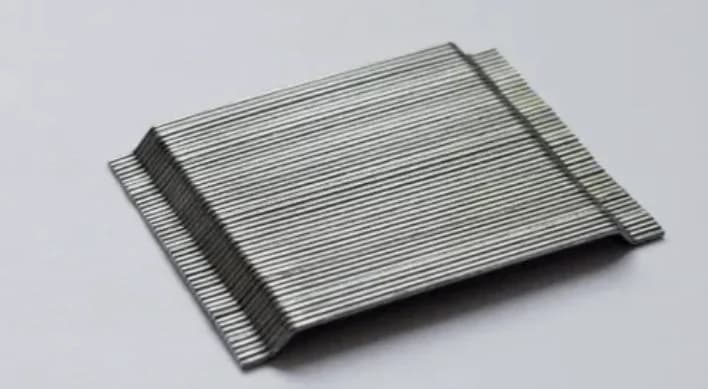
MPZG HT 35/0.55
High-tensile hooked steel fibres with aspect ratio 35/0.55. Maximum anchorage and ductility for heavily loaded structures.
- TypeCold-drawn hooked steel fibre (glued)
- Dimensions35 mm / Ø 0.55 mm
- Tensile strength1345 N/mm² ± 7.5%
- Modulus of elasticity200,000 N/mm²
Pallet price on request