Sand cement screed: thickness, drying time, cost and preventing cracking with shrinkage fibre

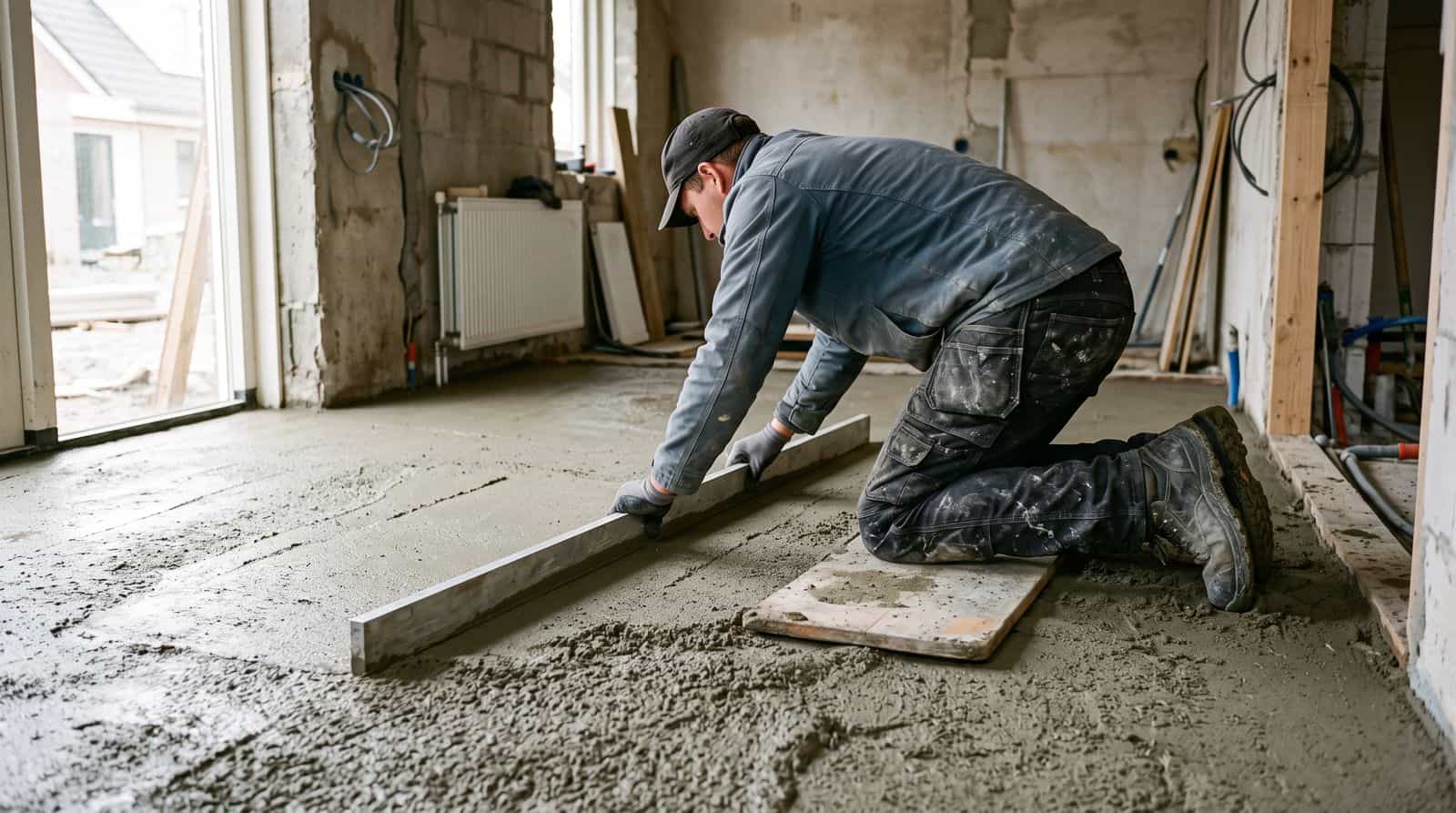
Everything about the sand cement screed: which thickness per type, how long it needs to dry, what laying it costs and how shrinkage fibre limits cracking.
A sand cement screed is a finishing floor of sand, cement and water applied on top of the structural floor as a level base for tiles, parquet or vinyl. Guide values: thickness 25–80 mm depending on the type, drying time around 1 week per centimetre, price indicatively €10–25 per m² (2026 price level). Shrinkage fibre limits cracking during drying.
What is a sand cement screed?
A sand cement screed — also called a cement screed, and in Belgium a chape — is a semi-dry mix of sand, cement and water applied on top of an underlying load-bearing floor. The screed smooths out irregularities, bridges level differences and conceals underfloor heating or electrical pipework. It is the most widely used subfloor in Dutch residential and commercial construction, in both new build and renovation.
Do not confuse the screed with a monolithically finished concrete floor: with a power-floated concrete floor, the structural floor itself is the final finish, whereas a screed is always a separate layer on top of the structural floor. By method of application we distinguish three types:
• Bonded screed — applied directly to the (roughened and primed) structural floor; structural floor and screed act together.
• Unbonded screed — on a separating layer of foil; the screed moves independently of the substrate.
• Floating screed — on an insulation layer (thermal or acoustic); no contact anywhere with the structural floor or walls.
This article belongs to the pillar applications and target groups, where you will also find the adjacent flooring topics.
How thick does a sand cement screed need to be?
The right thickness depends on the type of screed and the loading. Common guide values for housing (for heavier floor loads, the structural engineer or screed layer calculates a thicker layer):
• Bonded screed — 20 to 50 mm
• Unbonded screed (on foil) — at least 50 mm
• Floating screed (on insulation) — at least 65 mm
• Screed with underfloor heating — at least 65 mm in total, with at least 25–30 mm cover above the pipes
The 65 mm limit is not arbitrary: a thinner floating screed lacks the stiffness of its own to accommodate deformation of the insulation layer. For floating screeds thinner than 65 mm, it is therefore recommended to apply crack-control mesh in combination with fibre reinforcement — the mesh then also helps with any compression of the insulation. If the screed lies on a firm, barely compressible insulation layer, fibre reinforcement alone can suffice, because no deformation occurs and the reinforcement only needs to control the shrinkage.
Exactly how a floating screed is built up — edge strips, insulation choice, acoustic requirements — is covered in the separate article. The combination with heating pipes demands extra attention to thermal movement; see underfloor heating and fibre concrete.
Sand-to-cement ratio: the mix
The classic cement screed ratio is 1 part cement to 4 or 5 volume parts sharp (river) sand. A 1:4 mix gives a stronger floor and is used for heavier loading or thinner layers; 1:5 is common for standard housing. The most important quality factor is not the cement content but the water: a sand cement screed is worked semi-dry — just enough water to form a mouldable ball that does not slump.
The more mixing water, the greater the drying shrinkage and thus the cracking risk. A plasticiser (an admixture that improves workability without extra water) reduces the water demand and with it the shrinkage. Fibres are added in the same mixing stage: on screed projects, the screed layer doses shrinkage fibre at 0.9–1.0 kg per m³ of mortar, straight into the mixer or the forced-action mixer of the pump.
Laying a cement screed: how the pour proceeds
Laying the screed (in practice more "spreading" than pouring — the mix is semi-dry) follows fixed steps:
• Preparation — structural floor clean and dust-free; for bonded a cement slurry bonding coat (primer), for unbonded foil, for floating insulation plus edge strips along all rising elements.
• Setting out levels — with a laser and level markers or narrow guides of mortar, so the floor comes up to level everywhere.
• Mixing and transport — on small projects with a screed mixer, on larger ones with a pump that carries the mortar tens of metres and storeys high.
• Spreading and levelling — the mortar is distributed between the guides, compacted and drawn flat with a long straightedge.
• Rubbing up — the surface is closed with a float for an even, flat skin.
• Curing — keep moist for the first few days and avoid draughts, so the floor does not dry out too quickly and unevenly.
An experienced team lays 100 to 150 m² of housing screed a day this way. Laying it yourself is feasible for small areas, but flatness (a class tied to the finish) and the correct water dosage are exacting — mistakes can only be corrected afterwards by levelling compound or grinding.
Drying time of a sand cement screed: allow 1 week per centimetre
The rule of thumb for the drying time of a sand cement screed: 1 week per centimetre of thickness for the first 4 cm, and 2 weeks per centimetre above that. A 65 mm floating screed thus needs around 4 + 5 = 9 weeks before it may receive a vapour-tight finish. The floor can be walked on after 24 to 48 hours, and lightly loaded (storage, erecting partition walls) after about a week.
That long drying time is about residual moisture, not strength. Vapour-open finishes (tiles in adhesive) can go down earlier; vapour-tight finishes such as vinyl, resin floors and parquet generally require a residual moisture content of no more than around 2.0% (carbide method/CM measurement), often 1.8% with underfloor heating — always follow the finish supplier's instructions. With underfloor heating a heat-up protocol also applies: warming the floor up and cooling it down in steps before finishing, so thermal shrinkage stress is released in a controlled way.
Speeding up drying is possible only to a degree: ventilating (no draughts), dehumidifiers after the first week, or a rapid-drying screed mortar. What does not work: heating hard in the first days — the surface then dries faster than the core can release moisture, resulting in curling and cracks.
What does a sand cement screed cost per m²?
Indicative prices for having a sand cement screed laid, including material and labour (2026 price level, depending on region, area and accessibility):
• Bonded screed 30–50 mm — €10 to €18 per m²
• Unbonded screed 50 mm — €12 to €20 per m²
• Floating screed 65–70 mm — €15 to €25 per m² (excluding the insulation layer)
• Surcharge for small areas (< 40 m²) — expect a higher m² price due to fixed delivery and start-up costs
The choice of reinforcement barely affects the price, but it does affect the labour: crack-control mesh has to be laid out, overlapped and set on spacers. Screed fibres instead of crack-control mesh go into the mixer and, at a dosage of 0.9–1.0 kg/m³ and a 65 mm thick floor, cost less than €0.20 per m² in material — a negligible item in the total price that also saves laying time. If you want to know the fibre costs for your project exactly, request a quotation with your area and floor build-up.
Preventing cracking: shrinkage fibre, mesh or both?
During drying the screed loses moisture and shrinks — a normal, unavoidable part of the hardening of cement-bound mortars. The problem is not the shrinkage itself, but the stress that arises where the floor cannot shrink freely: at edges that are restrained, or on an insulation layer that moves unevenly. That stress discharges itself in cracks. In the first hours after laying, plastic shrinkage caused by overly rapid evaporation also plays a role; how you control that early phase is covered in preventing plastic shrinkage cracks.
How shrinkage fibre works
Shrinkage fibre consists of fine polypropylene fibres added to the mortar during mixing, distributing themselves evenly throughout the entire volume — unlike crack-control mesh, which sits at one height in the floor. As soon as a micro-crack forms anywhere, the fibres bridge the crack face on the spot. Cracks still occur, but stay so narrow that they are invisible and harmless. A fibrillated micro fibre for sand cement screeds such as Profib contains around 100,000 fibres per kilogram: at 1 kg/m³ there is fibre everywhere in the floor within a few millimetres of every potential crack plane.
Fibre and mesh: complementary, not competitors
According to manufacturers, shrinkage fibre counts as secondary reinforcement: it does not replace crack-control mesh in all cases, but strengthens its effect. The practical rules:
• Underfloor heating and floating screeds — adding fibre is standard here, because of thermal movement and an insulation layer that can move with the floor.
• Floating screed thinner than 65 mm — combine crack-control mesh with fibres; the mesh also accommodates deformation of the insulation.
• Floating screed on firm, barely compressible insulation — fibre reinforcement alone can suffice.
• Screeds of 6 cm or thicker — under current practice, crack-control reinforcement (a mesh) is required, unless a plasticiser reduces the mixing water and with it the shrinkage.
Neither method prevents cracking completely; both limit the crack width — the difference between invisible hairline cracks and unsightly, visible cracks. Additional measures remain necessary: keeping the floor moist for the first few days, movement joints for large areas, and possibly shrinkage-reducing admixtures (SRA), which in field research reduce shrinkage by 30–40% — a supplementary measure, not a replacement. If it concerns a structural floor rather than a screed, macro fibres come into the picture; see when synthetic fibre concrete is the right choice.
Chape: the same floor, Belgian name
In Flanders the sand cement screed is called a chape (from the French chape de mortier). Technically there is no difference: a chape is also a semi-dry sand-cement mix spread as a finishing layer over the structural floor or insulation, with the same thicknesses, drying times and shrinkage issues. Anyone in Belgium ordering "chape with fibres" or "reinforced chape" thus gets exactly this application — Dutch Fiber Trading supplies the same screed fibres to Dutch and Belgian screed layers and chapists alike.
Which fibre do you choose for your screed?
For sand cement screeds, two micro fibres are relevant, both at a dosage of around 1 kg per m³ of mortar:
• Profib — fibrillated PP tape fibre (6 and 12 mm), the screed fibre par excellence: its branched structure anchors mechanically in the semi-dry mortar and distributes itself homogeneously. Supplied in boxes of 10 kg — enough for around 10 m³ of mortar.
• Promicro — monofilament PP micro fibre (12 mm, fibre class 1a to EN 14889-2), the choice when a finer surface quality matters alongside shrinkage control, at 0.6–1.0 kg/m³.
Torn between the two, or want to know how many boxes your project needs? The selection guide works it out in a few steps, or request a quotation directly with your area, thickness and floor build-up.
Frequently asked questions
- How thick does a sand cement screed need to be as a minimum?
- That depends on the type: a bonded screed can start from 20 mm, an unbonded screed on foil requires at least 50 mm and a floating screed on insulation at least 65 mm. With underfloor heating, 25–30 mm of cover above the pipes also applies. For heavier loading, the structural engineer determines a greater thickness; see also the build-up of a floating screed.
- How long does a sand cement screed need to dry?
- Rule of thumb: 1 week per centimetre of thickness up to 4 cm, and 2 weeks per centimetre above that. A 65 mm screed therefore dries for around 9 weeks before it may receive a vapour-tight finish (vinyl, parquet, resin floor) — always measure the residual moisture with a carbide (CM) test, guide value no more than around 2.0%. It can be walked on after 24 to 48 hours.
- What does a sand cement screed cost per m²?
- Indicatively €10 to €25 per m² including labour (2026 price level): bonded 30–50 mm around €10–18, floating 65–70 mm around €15–25 per m², excluding insulation. Small areas are more expensive per m² due to fixed start-up costs. Shrinkage fibre adds less than €0.20 per m² at 0.9–1.0 kg/m³; request a quotation for your project size.
- What is chape?
- Chape is the Flemish name for the sand cement screed: a semi-dry mix of sand, cement and water applied as a level finishing layer on the structural floor or insulation. Technically, chape and cement screed are identical — the same ratios (1:4 to 1:5), thicknesses, drying times and shrinkage sensitivity, and therefore also the same fibre solutions against cracking.
- Does shrinkage fibre replace the mesh in a screed?
- Not always. Shrinkage fibre counts as secondary reinforcement: on a firm, barely compressible insulation layer fibre alone can suffice, but for floating screeds thinner than 65 mm and for floors of 6 cm or thicker (without plasticiser), crack-control mesh alongside the fibre remains recommended. A fibrillated screed fibre limits the crack width throughout the entire floor volume; the mesh provides resistance at the point of greatest stress.
- Can I lay a cement screed myself?
- For small areas you can: mix 1 part cement to 4 or 5 parts sharp sand to a semi-dry consistency, set out the levels with guides, draw the mortar flat with a straightedge and close the surface with a float. The pitfalls are too much mixing water (extra shrinkage) and insufficient flatness for the finish. Add fibres in the mixer and keep the floor moist for the first few days against cracking.
Products mentioned
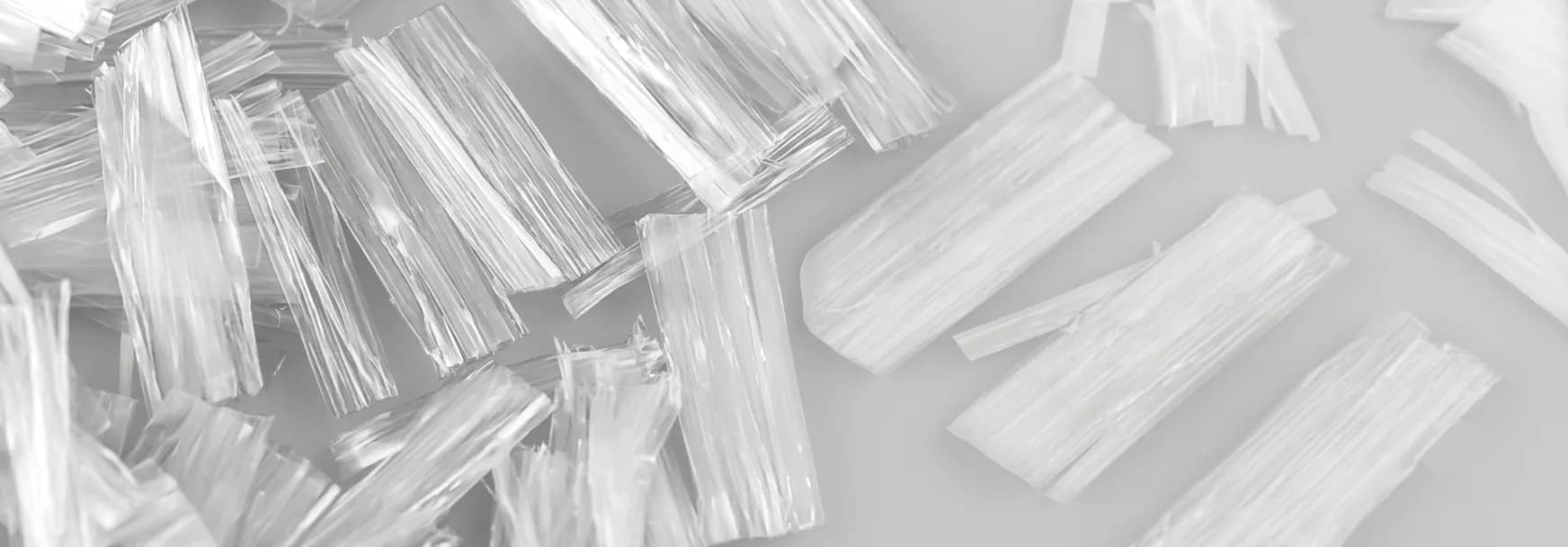
Profib
Fibrillated PP micro fibre for plastic shrinkage crack control, strong in sand-cement screeds. Disperses homogeneously through the concrete.
- TypePolypropylene (fibrillated tape)
- Length6 and 12 mm
- Number of fibres per kg100,000
- Tensile strength370 MPa
Pallet price on request
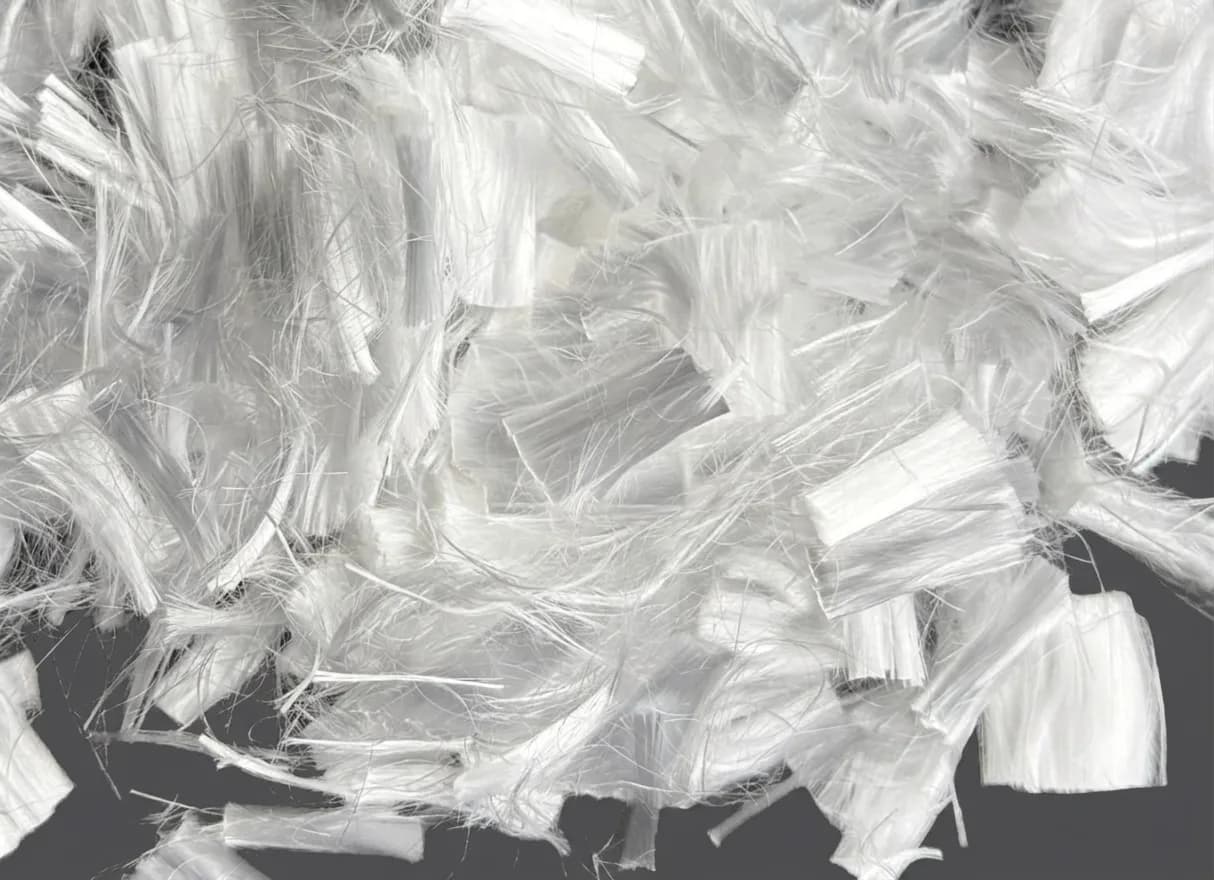
Promicro
Synthetic PP monofilament micro fibre against plastic shrinkage cracks. Homogeneous dispersion and better surface quality at a low dosage.
- TypePolypropylene monofilament (round cross-section)
- Length12 mm
- Equivalent diameter32 µm
- Linear density6.5 dpf
Pallet price on request