Reinforced industrial floors: the monolithic concrete floor with fibres


Forklift traffic, racking legs and continuous transport place high demands on reinforced industrial floors. Mesh or fibres, floor thickness, dosage, joints and price per m² for a monolithic concrete floor at a glance.
Reinforced industrial floors are concrete slabs, mostly ground-bearing, that carry forklift traffic and racking loads with the help of steel mesh, steel fibres or structural synthetic fibres. In warehouses and distribution centres they are usually built as a monolithic concrete floor: poured in a single operation and immediately finished by machine, so that the structural slab and the wearing surface form one whole. With steel fibres (typically 25 to 35 kg per m³), the laying of reinforcement mesh is eliminated and larger floor bays with fewer joints become feasible. That makes the monolithically poured, fibre reinforced floor the standard solution for industrial and warehouse floors.
What is a monolithic floor?
Monolithic literally means: made from one piece. With a monolithic floor, pouring, compacting, levelling and machine finishing (power floating) are carried out in one continuous operation. No separate screed or finishing layer is applied on top: the poured concrete is the finished floor. How that power floating works in detail and which finish levels are possible is covered in our article on the power-floated concrete floor.
The key characteristics of a monolithic floor:
• Flatness — machine power floated, suitable for racking and internal transport; higher flatness classes are achievable with laser screed equipment.
• Wear resistance — the top layer is densified during power floating, producing a dense, hard-wearing surface without any additional coating.
• One material, one operation — no bonding problems between structural slab and wearing layer, and a shorter construction time than a floor with a separate finishing layer.
• Directly reinforceable with fibres — because the floor is poured in one go, the concrete plant mixes the reinforcement (steel or synthetic fibres) through the mix in advance.
Within the knowledge centre on fibre reinforced concrete, the industrial floor is by far the most common application — and not without reason, as becomes clear below.
The loading on an industrial concrete floor
An industrial floor in a distribution centre, assembly hall or warehouse has to cope with three kinds of loading at once: point loads from racking legs (with tall pallet racking quickly several tonnes per leg), dynamic loading from forklift trucks with hard wheels, and frequent temperature fluctuations from incoming and outgoing transport, for example at dock doors or cold stores.
This combination makes industrial floors susceptible to precisely the failure mechanisms that fibre reinforcement protects against: cracking from shrinkage and loading, spalling of edges at joints, and surface wear. Moreover, a crack or damaged joint edge in a logistics floor is not a cosmetic problem: forklift wheels hammer every defect further apart, driving up maintenance costs and damaging equipment. For existing floors that already show this kind of damage, the repair methods are explained in our guide to concrete floor crack repair.
How are reinforced industrial floors built? Mesh, fibres or a combination
Concrete is strong in compression but weak in tension. The reinforcement in an industrial floor therefore has two jobs: controlling cracks from shrinkage and temperature movement, and carrying the bending stresses under wheel and racking loads once the concrete has cracked. For reinforced flooring in warehouses and production halls, four approaches are common:
• Steel mesh (reinforcing fabric). One or two layers of welded mesh on spacers or chairs. Proven and straightforward to calculate, but fixing the mesh is labour-intensive and, because of the concrete cover, the steel sits away from the slab edges and corners that forklift wheels load hardest. Sizes and weights are listed in reinforcement mesh: sizes, weights and alternatives.
• Steel fibres. Usually 25 to 35 kg/m³ in warehouse floors, mixed in at the concrete plant and spread through the full slab depth. The floor design is based on the residual flexural strength of the mix, tested to EN 14651.
• Structural synthetic (macro) fibres. Typically 2 to 6 kg/m³. They do not corrode and are mainly used for light to medium loading and for floors exposed to moisture, such as in food production or agriculture. The differences are compared in steel fibres or synthetic macro fibres.
• Hybrid reinforcement. Fibres throughout the slab plus local bar reinforcement under heavily loaded racking legs, at re-entrant corners or over piles, always to the structural engineer's design. For very large jointless areas, a post-tensioned slab is a specialist alternative.
Which design guide applies depends on the country. In the UK, concrete industrial ground floors are usually designed to Concrete Society Technical Report 34 (TR34), which covers slab design with mesh or fibres, the joint layout and the flatness classes for racking and forklift aisles. In the Netherlands, CUR Recommendation 111 has long been the design guideline for steel fibre concrete industrial floors on piles, while the fib Model Code and fib Bulletin 105 provide the international design basis for fibre reinforced concrete. How fibres and bar reinforcement compare beyond floors is set out in fibre reinforced concrete vs traditional reinforcement.
Why use fibres in a monolithic industrial floor?
Stronger corners and edges. In traditionally reinforced floors, the edge of a floor bay — for example at a joint transition — is a known weak point: because of the required concrete cover, the reinforcement mesh sits just where the load does not act. Fibres are distributed homogeneously throughout the entire concrete volume, right into corners and edges, which demonstrably limits spalling from forklift traffic.
More durable surface. Fibres control surface micro-cracking and limit spalling, so the surface stays intact for longer. The ultimate wear resistance of the top layer is determined mainly by the concrete quality and the finish (densifying and polishing); fibres are a complement to that, not a substitute.
Fewer joints. Because fibres control shrinkage cracking throughout the whole floor bay, larger bays can be poured with fewer sawn joints — every joint that is eliminated is one less maintenance point and one less bump for internal transport.
Faster construction. Fixing and aligning reinforcement mesh on a large floor quickly takes several working days; fibres arrive ready-mixed from the concrete truck. How much time and money that saves is calculated in fibre concrete versus reinforcement mesh.
For heavily loaded floors, steel fibres for heavily loaded industrial floors such as the MPWG HT+ 60/0.75 are the first choice: hooked-end high-tensile fibres that qualify as structural reinforcement in accordance with EN 14889-1 and whose residual strength is tested to EN 14651.
Floor thickness and fibre dosage per load class
The right combination of floor thickness and fibre dosage always follows from a calculation, which also takes the bearing capacity of the subbase into account. As an indication, the following practical values apply to monolithic industrial floors on a well-compacted subbase:
• Light storage and pedestrian traffic — floor thickness approx. 120–150 mm; steel fibre approx. 20–25 kg/m³ or structural synthetic fibre approx. 2–4 kg/m³.
• Forklift traffic up to approx. 2.5 tonnes — floor thickness approx. 150–180 mm; steel fibre approx. 25–30 kg/m³.
• Heavy forklifts and pallet racking — floor thickness approx. 180–220 mm; steel fibre approx. 30–35 kg/m³, with localised additional reinforcement under heavily loaded racking legs.
• Heavy transport and external yards — floor thickness approx. 200–250 mm; dosage and fibre type based on a structural calculation.
These values are indicative; the usual bandwidth for steel fibre concrete lies between 25 and 50 kg/m³. Why the thickness depends so strongly on subbase and loading is explained in how thick should a concrete floor be; the dosing methodology per fibre type is set out in our practical dosing guidelines. With the calculator you can work out the quantity of fibres needed for your floor area straight away.
Joints or jointless: the movement joint in a concrete floor
Two types of joint occur in a concrete floor, and the distinction is essential for the design:
• Contraction joint (sawn joint) — sawn within about 24 hours of pouring, it forces the inevitable shrinkage crack into a straight, controllable line. Without fibres, bays are typically sawn at around 5 to 6 metres.
• Movement joint — a continuous joint that structurally separates floor bays from each other and from columns, walls and pad foundations, so the floor can move freely under shrinkage and temperature differences. These joints remain necessary in a fibre floor at transitions and around penetrations.
This is where fibre reinforcement makes the biggest practical difference: because steel fibres absorb the shrinkage stresses throughout the whole bay, sawn-joint spacings can be increased considerably. In practice, with higher steel fibre dosages, even jointless floor bays of up to around 40 by 40 metres are achieved — provided the design, the mix and the curing are geared to it. Fewer joints means less joint maintenance, less vibration in internal transport and less damage to forklift wheels.
What does a monolithic floor cost? Price per m²
The price of a monolithic, power-floated industrial floor depends on the floor thickness, the fibre dosage, the floor area (delivery and pouring capacity weigh heavily on small floors) and the required flatness class. As an indication, 2026 price level and depending on the project:
• Monolithic industrial floor, poured and power floated: approx. €45 to €90 per m², including concrete and finishing, excluding foundations and groundworks.
• Surcharge for steel fibre reinforcement: with steel fibres at roughly €1.10 to €1.85 per kg and a dosage of 25–30 kg/m³, around €28 to €56 per m³ of concrete, depending on fibre type and steel price. For a 180 mm thick floor that works out at roughly €5 to €10 per m². The full concrete price per m³, with and without fibres is set out in a separate overview.
• Savings: set against that is the elimination of purchasing, transporting and laying reinforcement mesh, plus a shorter construction time.
On balance, the total construction cost of a fibre floor for industrial applications is often comparable to or lower than that of the same floor with mesh, and the fibre floor is ready sooner. A complete cost breakdown with worked examples can be found in steel fibre concrete: price, dosage and applications; for a project-specific price, request a quotation.
Which fibre type for which floor?
• Heavy industrial floors with intensive forklift traffic or tall racking — steel fibre offers the highest residual strength and wear resistance; the hooked-end MPWG HT+ 60/0.75 is our heaviest-duty fibre for this (dosage 10–35 kg/m³, depending on the calculation).
• Floors exposed to moisture or chemicals, such as in the food industry or the agricultural sector — structural synthetic fibre eliminates any risk of surface corrosion; TwistR fibres for industrial floors are dosed at 2 to 6 kg/m³.
• Any monolithic floor that must be finished to a high standard — micro fibres for a sleek surface finish such as Promicro (0.6–1.0 kg/m³) prevent plastic shrinkage cracks in the first hours after pouring and produce a denser surface; they are often combined with steel or macro fibres.
• Corrosion-free reinforcement in aggressive environments — basalt fibre combines high tensile strength with corrosion resistance and heat resistance up to around 700 °C.
Note: micro fibres provide no structural residual strength and therefore do not replace reinforcement mesh; steel or macro fibres are needed for that.
From drawing to poured floor
When pouring an industrial floor, little changes in the process itself with fibres: the concrete plant mixes the fibres through the mix in advance, after which pouring, compacting and power floating proceed as with any monolithic floor. Dosage, mixing and curing do deserve attention, however — a properly executed pouring plan is part of the design for larger, low-joint bays.
For very heavy point loads, such as tall racking systems, a calculation by the structural engineer remains necessary. Fibres do not fully replace traditional reinforcement in every situation; under heavily loaded racking legs, fibre reinforcement is often combined with locally placed additional reinforcement. That such a conversion can be done quickly is proven by the project at the NDSM wharf in Amsterdam: there, a complete design was converted from steel reinforcement to fibre reinforcement within two days — including approval from the municipality — with a net saving of 1,500 kg of reinforcing steel and a 98% CO₂ reduction on the reinforcement component as the result.
Unsure between fibre types or dosages for your floor? Run your project through the calculator or submit your floor build-up to us via a quotation request — we work alongside you from the first drawing.
Frequently asked questions
- What exactly is a monolithic floor?
- A monolithic floor is a concrete floor that is poured in a single operation and immediately finished by machine (power floated). The structural slab and the wearing surface form one whole; a separate screed is not needed. The result is a flat, hard-wearing floor widely used as an industrial and warehouse floor, usually reinforced with steel or synthetic fibres instead of reinforcement mesh.
- How are industrial concrete floors reinforced?
- With steel mesh, steel fibres (usually 25 to 35 kg/m³), structural synthetic macro fibres (usually 2 to 6 kg/m³) or a combination of fibres with local bar reinforcement. In many ground-bearing warehouse floors, fibres replace the mesh; for piled slabs and very heavy point loads, the structural engineer determines the mix of fibres and bars. The choice between the two fibre types is explained in steel fibres or synthetic macro fibres.
- How thick should a monolithic industrial floor be?
- As an indication: 120–150 mm for light storage, 150–180 mm for forklift traffic up to around 2.5 tonnes and 180–220 mm for heavy forklifts and pallet racking. The final thickness follows from a calculation that also takes the subbase into account — see how thick should a concrete floor be for the full reasoning.
- What does a monolithic floor cost per m²?
- Indicatively, a monolithic, power-floated industrial floor costs around €45 to €90 per m², including concrete and finishing (2026 price level, depending on thickness, area and flatness requirements). Steel fibre reinforcement adds roughly €5 to €10 per m² for a 180 mm floor, but saves the labour of laying reinforcement mesh. Request a quotation for a project price.
- Are movement joints needed in a fibre reinforced concrete floor?
- Yes, movement joints remain necessary at transitions to columns, walls and pad foundations so the floor can move freely. Sawn (contraction) joints, however, can be greatly reduced: steel fibres absorb the shrinkage stresses, making larger bays possible — in practice up to around 40 by 40 metres jointless — provided the design and curing are geared to it.
- Can steel fibres fully replace reinforcement mesh in an industrial floor?
- For most industrial floors, yes: steel fibres at dosages of around 25–35 kg/m³ fully replace the reinforcement mesh and score better on edge strength and construction speed. For very heavy point loads, such as tall racking systems, a calculation by the structural engineer is required; locally, additional reinforcement under racking legs may still be needed. See also fibre concrete versus reinforcement mesh.
Share this article
Products mentioned
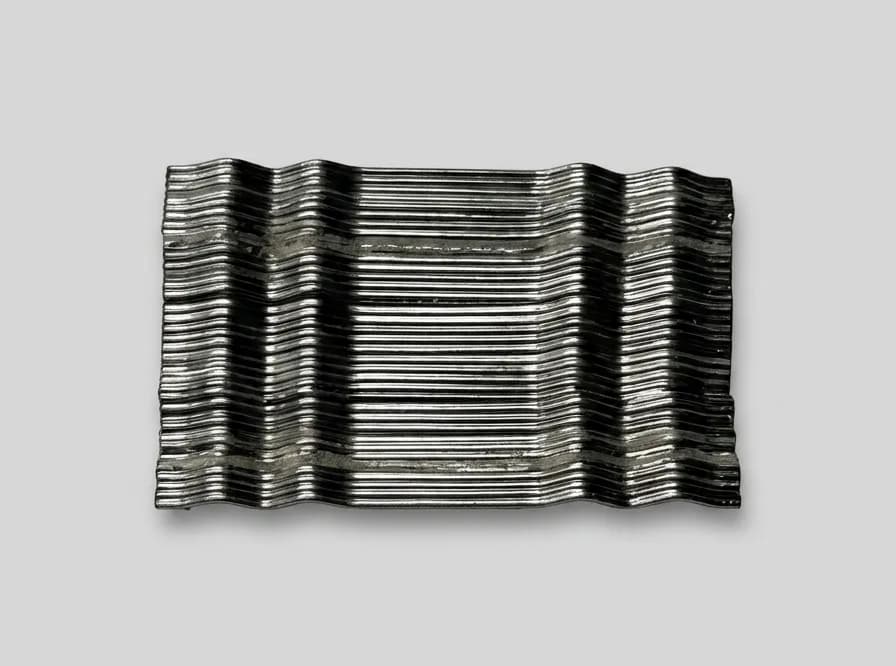
MPWG HT+ 60/0.75
MPWG HT+ 60/0.75: glued hooked-end steel fibres, 60 mm long, Ø 0.75 mm, tensile strength 2100 N/mm². For heavily loaded floors, tunnels and precast.
- TypeCold-drawn hooked steel fibre (glued)
- Dimensions60 mm / Ø 0.75 mm
- Tensile strength2100 N/mm² ± 7.5%
- Modulus of elasticity210,000 N/mm²
Pallet price on request
 Most chosen
TwistR® GREEN HYBRID
High-performance synthetic macro fibres made from 100% polypropylene. Transforms concrete into a stronger composite material.
- TypeHybrid: twisted monofilament + fibrillating network fibre
- Material100% virgin polypropylene
- Length48 mm
- Dosage2.0 – 6.0 kg/m³
Pallet price on request

Promicro
Synthetic PP monofilament micro fibre against plastic shrinkage cracks. Homogeneous dispersion and better surface quality at a low dosage.
- TypePolypropylene monofilament (round cross-section)
- Length12 mm
- Equivalent diameter32 µm
- Linear density6.5 dpf
Pallet price on request
Also read
- Power floated concrete floor: process, cost per m², specification and fibre reinforcement
- How thick should a concrete floor be? Slab thickness for garages, houses, sheds and industrial floors
- Fibre concrete vs reinforcement mesh: the difference in time and cost