Pouring fibre reinforced concrete: the complete guide

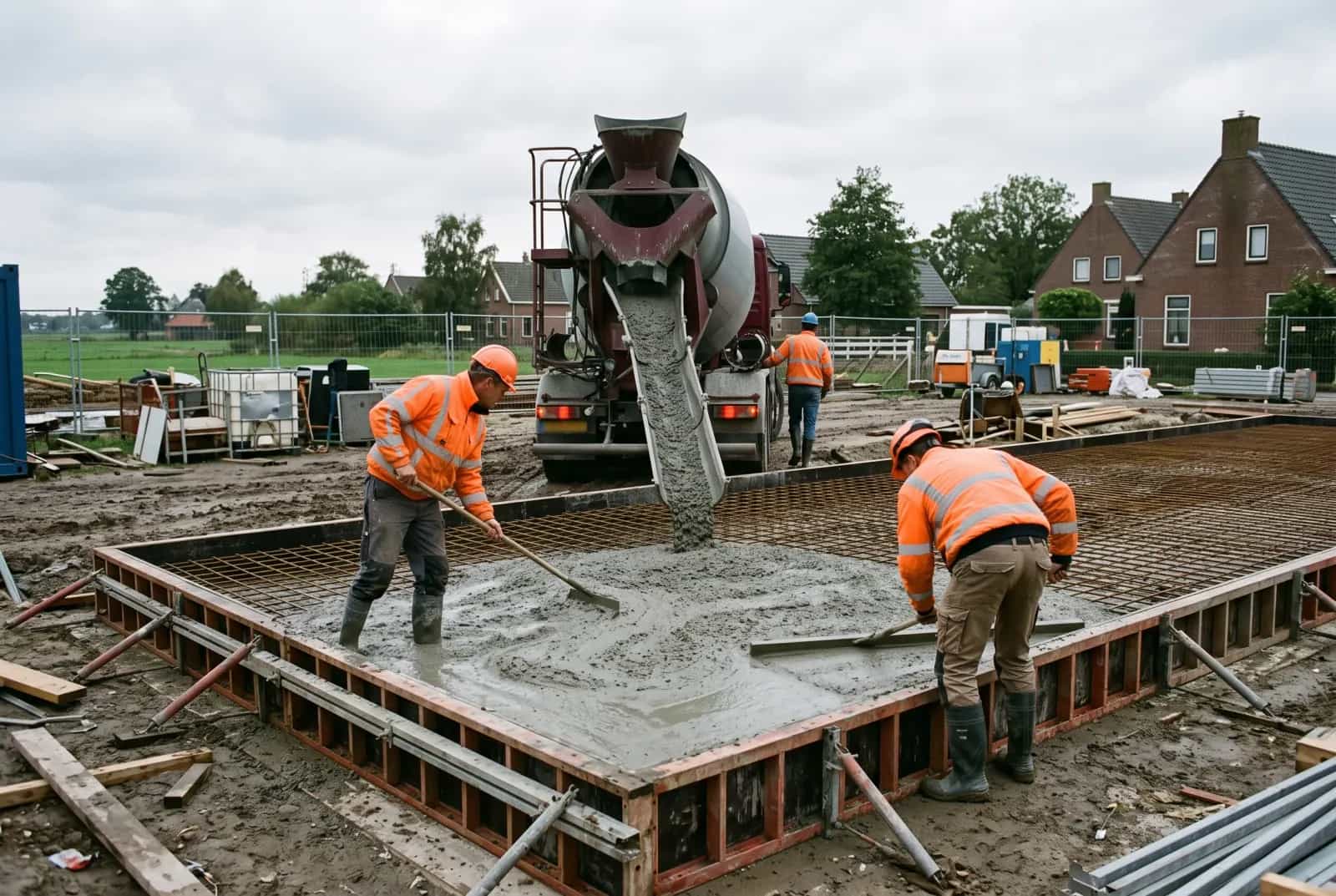
Pouring fibre reinforced concrete, from defining the goal to curing: dosage, ordering from the concrete plant, pouring with a pump, drying times and pouring in frost.
Pouring concrete with fibre reinforcement proceeds largely like a regular pour: the reinforcement is already in the mix, so fixing steel and laying mesh is eliminated. Steel fibre is typically dosed at 25–50 kg/m³, synthetic fibre at 0.5–2.5 kg/m³. At 20 °C the concrete can be walked on after 24–48 hours and reaches its design strength after 28 days.
What is different about a pour with fibre reinforced concrete?
With fibre reinforced concrete, the fibres are blended into the mixer at the concrete plant. What arrives on site is simply ready-mixed concrete — only with the reinforcement homogeneously distributed through the mix. That saves preparation: no reinforcement mesh to position, no spacers, no risk of a mesh sinking to the bottom of the floor during the pour.
For the pouring crew little changes. Pumping, screeding and power floating are done in the same way; only the consistency and the pouring plan need to be agreed with the plant in advance. This guide walks through the whole process step by step, including the questions that most often come up in practice: ordering, pumping, drying time and pouring in frost.
Step 1: define the purpose of the structure
Before choosing a fibre type, it must be clear what the fibres are supposed to do:
• Structural strength (for example, replacing reinforcement mesh in an industrial floor) → steel fibre or macro synthetic fibre.
• Shrinkage crack control in the early curing phase → micro synthetic fibre.
• Corrosion resistance in a damp or chemically loaded environment → synthetic or basalt fibre.
• A combination of requirements → often a hybrid solution of several fibre types.
Unsure between fibre types? The selection guide translates your application, floor thickness and loading into a suitable fibre recommendation in a few steps.
Step 2: choose fibre type and dosage
The right dosage depends on the loading, the floor thickness and the intended result. For steel fibre the customary dosage usually lies between 25 and 50 kg/m³; for synthetic fibre typically between 0.5 and 2.5 kg/m³. If you want to replace mesh entirely, choose a structural macro fibre for your pour or a steel fibre conforming to EN 14889. If the primary concern is cracking in the first hours after the pour, then micro fibres against shrinkage cracks at around 0.6–0.9 kg/m³ are the logical choice.
For structural applications — where fibres replace traditional reinforcement — a reinforcement study or calculation is required; the fibre supplier carries this out together with a structural engineer. The full bandwidths per fibre type and application can be found in the practical dosing guidelines for concrete fibres.
Step 3: consult your structural engineer
For non-structural applications (yard pavements, light foundations, screeds), fibre reinforcement is often directly applicable. For primarily structural elements — heavily loaded floors, foundations under buildings or bridges — consultation with a structural engineer is essential to determine whether, and how much, traditional reinforcement remains necessary alongside the fibres. Fibres do not fully replace bar reinforcement in all cases; the design rules for this are set out in, among others, EN 14651 (residual flexural strength values) and BRL 9320.
Step 4: order ready-mixed concrete from the concrete plant
Fibres are added during mixing at the concrete plant — so it is a regular order of ready-mixed concrete, not a separate operation on site. Virtually every plant can handle fibres; how that dosing and mixing works in practice is covered in our article on adding fibres to concrete at the batching plant. Pass on everything in one go when ordering, and you avoid discussion on the day of the pour:
• Strength class and exposure class — for example C20/25 XC1 for an internal floor (follows from your structural engineer's advice).
• Fibre type and dosage — brand, type and kg/m³, as specified in the fibre recommendation.
• Consistency class — with fibre concrete often one class softer (for example F4/F5) for good workability.
• Quantity in m³ — length × width × thickness plus a 5–10% margin; the calculator works this out for you together with the fibre dosage.
• Placing method — pouring with a pump or directly from the truck, and the required delivery rate.
• Pour date and access — can a truck mixer (around 30–40 tonnes) reach the site?
Ordering concrete with a pump: pumpability of fibre concrete
Ordering concrete with a pump is perfectly possible with fibre concrete: both steel fibres and macro synthetic fibres are pumpable, provided the dosage and consistency are matched to each other. In practice, fibre concrete requires a slightly softer consistency for pumping and a hose diameter of at least 100 mm; the plant matches this to fibre type and length. Synthetic fibres are usually the least critical here thanks to their low weight.
A concrete pump (truck-mixer pump or separate pump with operator) costs indicatively a few hundred euros per deployment (2026 price level, depending on pump type, boom length and region) — which, incidentally, applies just as much to traditionally reinforced concrete. For smaller volumes on an easily accessible site, pouring directly from the truck chute can be cheaper.
Step 5: prepare the subbase and formwork
Because no reinforcement mesh needs to be positioned, the preparation time is shorter than with traditional reinforcement. The subbase, however, ís critical: flat, load-bearing and well compacted, with stable formwork at the right height for screeding.
Pouring a concrete floor on sand
Anyone pouring a concrete floor on sand must allow for water extraction: the mixing water of the fresh concrete drains away into the sand layer, causing the concrete to lose water too quickly at the underside, which can lead to early cracking. Therefore always install a separation layer — usually 0.2 mm PE sheeting with generous overlaps — regardless of the chosen reinforcement type. The sheeting also acts as a vapour retarder. Compact the sand bed well beforehand and keep it slightly moist in warm weather so the sheeting does not shift during the pour.
Step 6: the pour itself
Fibre reinforced concrete can, provided it is correctly dosed, simply be poured, screeded and power floated — even pouring steel fibre concrete hardly differs from a regular pour, although the crew wears gloves against protruding fibres. Distribute the concrete evenly and vibrate or screed it thoroughly; the fibres orient themselves in all directions through the mix as you do so. For a smooth, dense finish, power floating the concrete floor starts once the concrete has stiffened enough to carry the machine, and correct float work presses the fibres below the surface. On larger floors, work in pour bays and saw contraction joints within 24 hours of the pour — fibres limit shrinkage cracks, but do not replace a proper joint plan.
Preferably plan the pour between 5 and 25 °C. In summer heat, the mixing water evaporates at the surface faster than the concrete can bleed; in that case pour early in the day and protect the surface immediately with curing compound or sheeting.
Pouring concrete in frost: is it possible?
Pouring concrete in frost is possible, but only with precautions. Below 5 °C cement hydration slows considerably and around freezing point it virtually stops; if the mixing water freezes before the concrete has built up around 5 N/mm² of compressive strength, the damage is permanent. The rules of thumb for a winter pour:
• Never pour onto a frozen subbase or against frozen formwork.
• Order winter-grade concrete: the plant heats the mixing water and can use cement with a higher heat of hydration or a hardening accelerator.
• Cover the fresh concrete immediately with insulating blankets or mats, so its own heat of hydration is retained.
• Keep the concrete frost-free for at least 3 days and strike the formwork later than usual.
Fibres change none of these rules, but micro fibres do help absorb the early shrinkage stresses during the slow first days of hardening.
Step 7: curing
Curing — protecting against drying out too quickly, frost and premature loading — does not differ fundamentally from traditional concrete. Keep the surface moist or covered for at least 5–7 days (sheeting, curing compound or keeping it wet). Fibres demonstrably limit shrinkage cracks in this phase, but they do not replace careful curing: surface dehydration will otherwise still lead to crazing and dusting.
Drying time and hardening of concrete: how long should you allow?
Hardening (curing) and drying are two different processes. Hardening is the chemical reaction between cement and water that builds up the strength; drying is the evaporation of surplus moisture, and that takes far longer. The practical milestones at around 20 °C:
• 12–24 hours — the concrete has set; sawing contraction joints can (and must) be done in this window.
• 24–48 hours — walkable for light site traffic.
• 7 days — around 70% of the final compressive strength; light loading possible.
• 28 days — the strength class (design strength) in accordance with EN 206 is reached; full loading in consultation with the structural engineer.
• 4–8 weeks or longer — drying time for floor finishes: rule of thumb around 1 week of drying per centimetre of floor thickness before a vapour-tight finish can be applied.
Lower temperatures stretch all these periods; at 5 °C strength development proceeds roughly half as fast as at 20 °C.
Rapid-hardening concrete and accelerated pour cycles
If the floor needs to carry load sooner, the plant can supply rapid-hardening concrete: a mix with a higher cement content, a lower water-cement ratio or a hardening accelerator. With this, a floor can sometimes take heavier loads after just a few days. The downside: faster heat development and more shrinkage, which actually increases the cracking risk — precisely the situation in which micro fibres earn their keep. Always have the combination of accelerator and fibre dosage coordinated by the plant or the supplier.
What does pouring concrete cost?
Indicatively, 2026 price level and depending on project and region: regular ready-mixed concrete costs around €110–€165 per m³. Add the fibre surcharge — up to around €45 per m³ for steel fibre at customary dosages, usually lower for synthetic fibre — plus any pumping costs. Set against that, the costs of laying mesh, fixing steel and the associated labour hours are eliminated. A full cost comparison with traditional reinforcement can be found in what does fibre reinforced concrete cost?
Common mistakes to avoid
• A dosage too low for the intended loading — always have this calculated.
• No consultation with the structural engineer for structural applications.
• The wrong fibre choice for the environment — for example steel fibre in an environment with a lot of moisture and chlorides, where corrosion is a point of attention.
• No sheeting when pouring on sand, causing the concrete to lose water too quickly at the bottom.
• Insufficient coordination with the concrete plant on consistency and pumpability.
• Loading too early or applying a vapour-tight finish too early — respect the hardening and drying times above.
From planning to pour
Having fibre reinforced concrete poured is essentially a regular concrete pour, with the key difference that the reinforcement is already in the mix. The keys to a successful result: the right fibre type, a properly calculated dosage and timely coordination with the structural engineer and the concrete plant. The answers to the most common practical questions are collected in the frequently asked questions about fibre reinforced concrete. Already know what you need? Request a no-obligation quotation for your mix — we calculate the dosage for your pour free of charge.
Frequently asked questions
- How long must concrete harden before you can walk on it?
- At around 20 °C, concrete can be walked on by light site traffic after 24 to 48 hours. After 7 days around 70% of the final compressive strength is reached, and after 28 days the full design strength in accordance with EN 206. In cold weather all these stages take longer; full loading always in consultation with the structural engineer.
- Can fibre reinforced concrete be poured with a concrete pump?
- Yes. Steel fibres and macro fibres such as TwistR pump well when dosage and consistency are matched — in practice a slightly softer mix and a hose diameter from 100 mm. State when ordering that you will be pouring with a pump, and the concrete plant will adjust the mix accordingly.
- Can you pour concrete in frost?
- Only with precautions: never pour onto a frozen subbase, order winter-grade concrete with heated mixing water and cover the fresh concrete immediately with insulating blankets. Fresh concrete must not freeze before it has around 5 N/mm² of compressive strength; keep it frost-free for at least three days and allow for slower strength development.
- What do you specify when ordering ready-mixed concrete with fibres?
- Strength and exposure class, fibre type with dosage in kg/m³, consistency class, the number of cubic metres with a 5–10% margin, and whether you are pouring with a pump. The calculator works out the quantity of concrete and fibres for you; the plant blends the fibres through the mix during production.
- What does pouring concrete cost per cubic metre?
- Indicatively (2026 price level): regular ready-mixed concrete costs €110–€165 per m³. Fibre reinforcement adds up to around €45 per m³ for steel fibre, usually less for synthetic fibre; pumping costs are extra. Set against that, fixing steel and laying mesh are eliminated, saving labour and lead time. Exact prices are project-dependent — request a quotation.
Share this article
Products mentioned

Promicro
Synthetic PP monofilament micro fibre against plastic shrinkage cracks. Homogeneous dispersion and better surface quality at a low dosage.
- TypePolypropylene monofilament (round cross-section)
- Length12 mm
- Equivalent diameter32 µm
- Linear density6.5 dpf
Pallet price on request
 Most chosen
TwistR® GREEN HYBRID
High-performance synthetic macro fibres made from 100% polypropylene. Transforms concrete into a stronger composite material.
- TypeHybrid: twisted monofilament + fibrillating network fibre
- Material100% virgin polypropylene
- Length48 mm
- Dosage2.0 – 6.0 kg/m³
Pallet price on request