Adding fibres to concrete at the batching plant: ordering, dosing and mixing

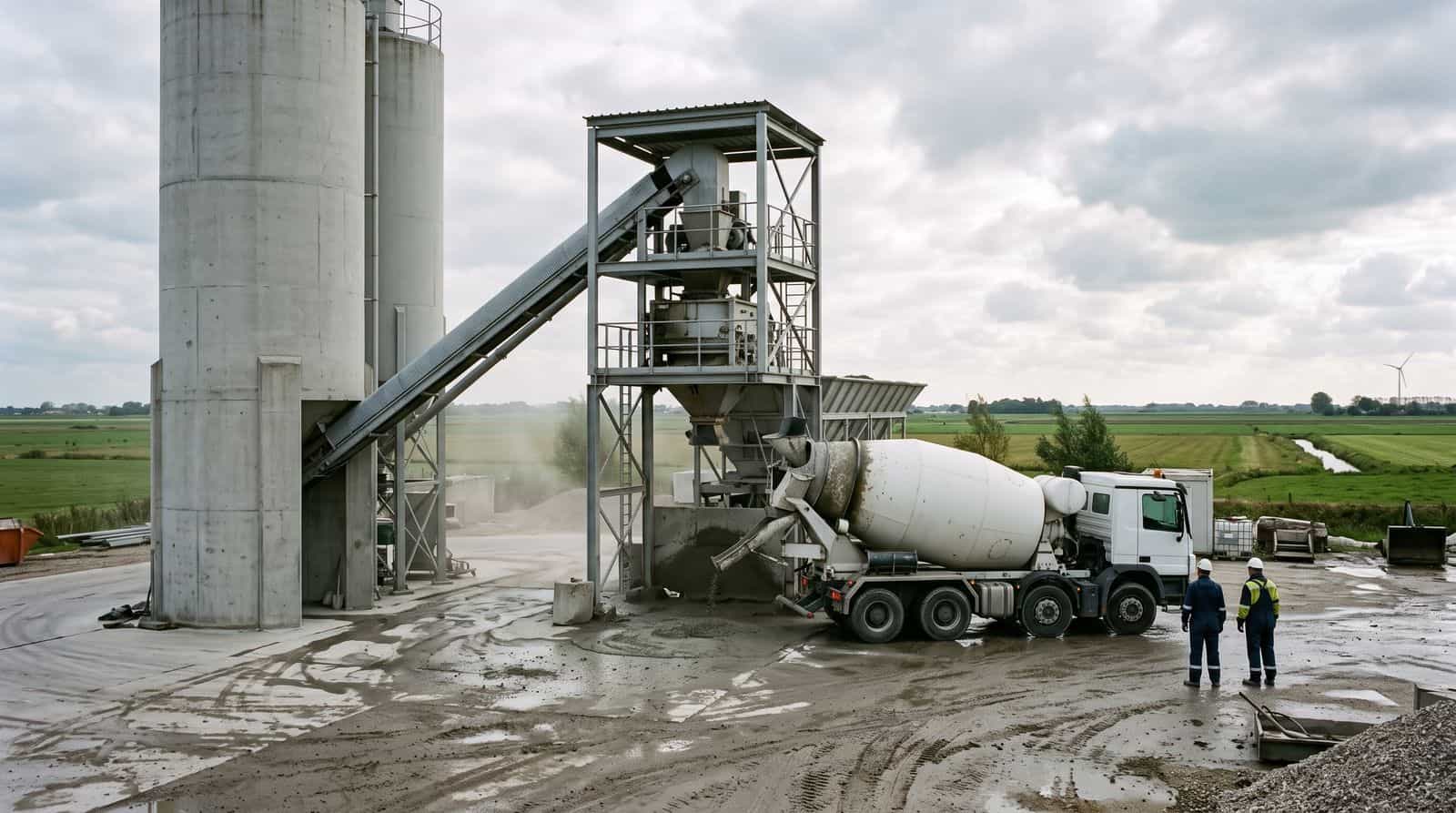
How are fibres added to concrete? At the batching plant or in the truck mixer, with the right mixing time, dosage per fibre type and dosing equipment, plus what to specify when you order fibre-reinforced ready-mixed concrete.
Adding fibres to concrete is best done at the batching plant: the fibres are weighed per batch and fed in with the aggregate, so they spread evenly. Added in the truck mixer on site, they need about five minutes of extra mixing at full drum speed, at least around 100 drum revolutions. Usual dosages: steel 25–50 kg/m³, synthetic macro 2–6 kg/m³, micro 0.6–1.0 kg/m³.
When you order fibre-reinforced ready-mixed concrete, you specify the fibre type and dosage alongside the volume, strength class and exposure class, and the concrete batching plant blends the fibres into the mix during production. For the plant itself, integrating fibres into production needs only a modest investment, starting with pre-packed bags.
What does a concrete batching plant do?
A batching plant produces ready-mix concrete: a fresh mixture of cement, water, sand, gravel and any admixtures, composed to a fixed mix design per strength and exposure class. The mix is delivered ready to pour (hence the term ready-mixed concrete) and driven to site by truck mixer, typically 8 to 12 m³ per load. Because fresh concrete remains workable for only a limited time after production (as a rule of thumb one and a half to two hours, depending on temperature and any retarders), the driving distance between plant and project is a hard planning factor.
For fibre-reinforced concrete, the plant is the logical place to add the reinforcement: the fibres are weighed and mixed under controlled conditions, with the same process monitoring as the rest of the mix design. That fundamentally distinguishes fibre reinforcement from traditional reinforcement, which is tied and placed on site as a separate work stage.
Fixed plant or mobile batching plant?
Alongside the fixed plant there is the mobile batching plant: a relocatable mixing installation set up on or near the project. That option is mainly of interest for large, continuous offtake (think infrastructure projects running to thousands of cubic metres) or on locations with no batching plant nearby, where the driving time would jeopardise workability. For a mobile plant the same applies: dosing fibres is perfectly feasible, provided the process includes a weighing point at which the fibres are measured out per batch.
For regular projects, a fixed plant within roughly 30 to 45 minutes' driving distance is the starting point. If you are looking for a batching plant nearby that can supply fibre-reinforced concrete, ask explicitly about experience with your fibre type. Not every plant keeps every fibre in stock, but virtually every plant can blend in supplied fibres to specification.
Adding fibres to concrete: at the plant or in the truck mixer?
At the plant is the preferred route. The fibres are weighed per batch and fed in together with the sand and gravel, on the aggregate belt or straight into the plant mixer, before water and cement complete the mix. The sand and gravel rub the fibres apart and spread them through the whole volume. Steel fibres should not go into an empty mixer on their own; for every fibre type, follow the sequence the fibre supplier states, because the advice differs per fibre type.
If the fibres only go in at the truck mixer, for smaller quantities or top-up deliveries, the drum needs extra mixing time; the steps are set out below.
The moment of addition matters because it directly determines homogeneity. A fibre added too late, or tipped in all at once too quickly, can ball up; a fibre that travels along with the aggregate distributes itself almost automatically.
Whichever route you choose, agree a method statement for the fibre addition beforehand: who adds the fibres, where and how, the mixing time afterwards and the visual check for fibre balls before discharge. The Concrete Society advises exactly that for fibres added to the truck mixer. It is more than paperwork: a fibre ball that reaches the pump can block the line.
The table compares the four common methods. The usual dosage in kg/m³ per fibre type follows in the section on fibre admixtures below.
| Method | Typical use | How the fibres go in | Mixing after addition | Points to watch |
|---|---|---|---|---|
| At the plant, pre-packed bags | Occasional fibre orders; macro and micro fibres | Bags per batch onto the aggregate or into the mixer; open bags unless the packaging is stated to be degradable | Normal batch mixing time, extended if the trial mix shows clumps | Number of bags per m³ on the delivery ticket |
| At the plant, dosing machine | Regular production, steel fibre, structural work | Weighed automatically per batch onto the aggregate belt or into the mixer | Normal batch mixing time | Calibrate the doser; record kg per batch |
| In the truck mixer on site | Small quantities, top-ups, plants without a doser | Opened bags (or degradable bags) or a fibre integration machine into the turning drum, a few at a time | About 5 minutes at full drum speed and at least 100 revolutions; steel fibre never less than 5 minutes, longer with a full load | Method statement; check for fibre balls before discharge |
| In a small site mixer | Patios, small bases, repairs | Sprinkled gradually into a mix that already has its normal consistency | 3–5 minutes extra | Never into the dry mix; no extra water |
Adding fibres in the truck mixer on site: step by step
When the fibres have to go into the truck mixer on site, for example with a small quantity or a plant without its own doser, this sequence keeps the risk of fibre balls low:
• Check the fibre type and dosage against the order before the truck arrives and work out the number of bags: kg/m³ × m³ in the drum gives the kilos to add (4 kg/m³ in an 8 m³ load is 32 kg, so 32 bags of 1 kg).
• Run the drum at mixing speed. Agitation speed during the drive does not count as mixing time.
• Add the fibres gradually, one or a few bags at a time (open the bags unless the packaging is stated to be degradable), never the full dose in one go.
• After the last fibres, mix at full speed for at least around 100 drum revolutions, which at normal mixing speeds takes about five minutes or more; for steel fibre never less than five minutes.
• With a part load (less than about half the drum), first bring the concrete up to the discharge opening, add the fibres on top and then wind it back down, so the fibres do not stick to the empty drum wall.
• Check the first discharge for fibre balls and even distribution before pumping or placing.
• Do not add water to restore workability; ask the plant for a plasticiser instead (see the section on admixtures under mix design below).
Glued steel fibres and macro fibres packed per bag suit site addition best. Even so, dosing at the plant remains the preferred route, because there the fibres are weighed per batch and recorded.
Adding fibres to concrete in a small site mixer
For a patio, a shed base or a repair, the concrete is often mixed on site in a small drum mixer. This is how to add fibres to concrete in that situation: mix the batch to its normal workable consistency first, then sprinkle the fibres in over one to two minutes while the mixer turns and mix three to five minutes longer than usual. Scale the kg/m³ dosage to the batch volume: 0.9 kg/m³ of micro fibre in a 0.1 m³ batch is about 90 g. Fibres added to a dry mix or all at once form balls, and extra water weakens the concrete and increases shrinkage.
For more than a few cubic metres, order ready-mixed concrete with the fibres dosed at the plant. Practical detail for small jobs is covered in synthetic fibres for a concrete patio and fibres in a sand cement screed.
Fibre admixtures for concrete: types, dosages and standards
UK ready-mix suppliers often list fibres as a "fibres admixture", next to plasticisers and retarders on the order form. Strictly speaking, fibres are not a chemical admixture. EN 206 treats fibres as a separate constituent of concrete: steel fibres are specified to EN 14889-1 and polymer fibres to EN 14889-2 (class Ia micro monofilament, class Ib micro fibrillated, class II macro fibres), while chemical admixtures fall under EN 934-2.
The practical consequence: specify fibres by type and kg/m³, together with the manufacturer's declaration of performance, rather than as a generic additive. What that documentation covers is explained in EN 14889 and CE marking for fibre concrete.
| Fibre type | Usual dosage | Main purpose | How it is usually added | Example from our range |
|---|---|---|---|---|
| Steel fibre (hooked-end, often glued) | Typically 25–50 kg/m³; high-tensile fibres from about 10 kg/m³ (structural: per calculation) | Residual flexural strength; industrial floors, foundations, tunnels | Weighed onto the aggregate belt or via a doser/blower; glued bundles separate during mixing | MPZG HT+ 35/0.55 (datasheet: 10–35 kg/m³) |
| Synthetic macro fibre | 2–6 kg/m³ | Replaces mesh in floors, yards and precast | Bags per m³ or a doser, together with the aggregate | TwistR, Wiking 4050 TR |
| Micro fibre, PP monofilament | 0.6–1.0 kg/m³ | Plastic shrinkage cracks, surface quality | Sachet or bag per m³, in the sequence the supplier states | Promicro |
| Micro fibre, PP fibrillated | 0.9–1.0 kg/m³ | Shrinkage cracks in screeds | Per batch into the mixer | Profib |
| Chopped basalt fibre | 0.6–1.0 kg/m³ | Crack reduction in concrete and mortar | Per batch into the mixer | Basalt Chopped |
Alkali-resistant glass fibres are the fifth type, used mainly in glassfibre reinforced concrete (GRC) products and thin precast elements and less often in ready-mixed concrete.
Which fibre suits which job is set out in types of concrete fibres compared. For structural floors the main decision is between steel fibres or synthetic macro fibres; for surface quality it comes down to micro fibres against plastic shrinkage cracks. The dosages in the table are guide values; how to fine-tune them per application is explained in the practical dosage guidelines for concrete fibres.
Ordering fibre-reinforced ready-mix concrete: what to specify
Ordering ready-mix concrete with fibres differs from a regular order on only one point: you specify the fibre reinforcement just as precisely as the strength class. The plant needs:
• Quantity in m³: length × width × thickness plus a 5–10% margin.
• Strength class and exposure class: for example C20/25 XC1 for an indoor floor, as advised by your structural engineer.
• Fibre type and dosage: brand, type and kg/m³. The usual ranges per fibre type are set out in the dosage guidelines for concrete fibres: steel fibre 25–50 kg/m³, synthetic macro fibre 2–6 kg/m³, micro fibre 0.6–1.0 kg/m³.
• Consistency class: with fibre concrete often one class softer (for example F4/F5) for good workability.
• Placement method: pump, skip or chute, so the plant can tailor the mix accordingly.
• Who adds the fibres and how: at the plant (preferred) or on site under an agreed method statement.
In the UK, ready-mixed concrete is specified to BS 8500-1 alongside BS EN 206; the fibre type and dosage in kg/m³ are added to that specification.
On cost, allow indicatively (Dutch market, 2026 price level) €110–€165 per m³ for the concrete itself, plus a fibre surcharge of around €12–€65 per m³ for steel fibre or €15–€45 for synthetic macro fibre. How the steel fibre surcharge follows from dosage and price per kg is worked out in steel fibre concrete prices per m³. A full breakdown is given in what does fibre-reinforced concrete cost? The complete journey from order to curing, including drying times and a pour plan, is covered step by step in the complete guide to pouring fibre-reinforced concrete.
Pumping ready-mix concrete: does that work with fibres?
Yes. Placing ready-mix concrete by pump works well with fibre concrete: both steel fibres and synthetic macro fibres are pumpable, provided dosage and consistency are matched to each other. In practice that means a slightly softer consistency and, as a rule, a line diameter of at least 100 mm; for longer steel fibres some fibre suppliers advise 120–125 mm. As an indicative rule of thumb, keep the fibre length to roughly half to 60% of the line diameter. Synthetic fibres are the least critical thanks to their low weight.
Fibre balls that form before the pump are a common cause of blockages, so check the first discharge visually. State in your order that you will be pumping: the plant will then tune the mix and fibre length accordingly, and you avoid blockages at reducers.
Choosing a concrete supplier for fibre work
Not every concrete supplier has the same level of experience with fibres. When choosing, look at three points: demonstrable references with your fibre type, a dosing solution that actually delivers the specified kg/m³, and certified production so the mix design is assured. Also ask whether the plant includes the fibre's CE declaration of performance (to EN 14889) with the delivery ticket; for structural work, the structural engineer will want to see that documentation. What else to look for on the fibre side of the chain is covered in how to choose a fibre reinforcement supplier.
Dosing: from pre-packed bags to a dosing installation
For the plant, the key question is how the correct quantity of fibre reliably gets into the mixer per batch. Accurate dosing is no formality:
• Too low a dosage fails to deliver the intended effect (crack control, structural residual strength), and that cannot be corrected afterwards.
• Too high a dosage can clog the dosing installation and reduce the workability of the mix.
For occasional use, manual dosing via pre-packed bags with a fixed weight per batch is sufficient, an approach that requires virtually no investment. Macro fibres are often packed per bag: TwistR is supplied in 1 kg bags, so two to six bags per m³ cover its dosage range of 2–6 kg/m³. Micro fibres work the same way: Promicro at 0.6–1.0 kg/m³ comes in 900 g sachets, so one sachet per m³ gives about 0.9 kg/m³.
For structural production, plants invest in a dosing installation that automatically weighs and feeds per batch. Indicatively (Dutch market, 2026 price level, depending on capacity and fibre type): a semi-automatic fibre doser with weighing unit from around €10,000–€25,000, a fully automatic dosing line linked to the mixing control system around €25,000–€75,000. For concrete with synthetic fibres, no major modification of the existing mixing installation is usually needed, which keeps the investment threshold low, certainly set against the margin on a more specialised product.
Between the bag and the fully automatic line sits the fibre dosing machine: a separate unit that feeds the fibres at a controlled rate, either at the plant or at the truck mixer.
Fibre dosing machines and fibre integration machines
A fibre integration machine is a dosing unit that feeds loose fibres (usually steel) at a controlled rate straight into the truck mixer or the plant mixer, so the fibres enter the drum gradually instead of bag by bag. That steady flow is what prevents fibre balls at higher dosages.
At batching plants the same kind of equipment usually goes by the name fibre dosing machine or fibre doser. The common types:
• Conveyor-belt dosers that drop the fibres onto the aggregate belt, so they enter the mixer together with the sand and gravel.
• Weighing dosers linked to the batch control system, which record the kilos of fibre per batch for the delivery ticket.
• Fibre blowers for steel fibre, which blow the fibres through a hose into the mixer or truck mixer.
• Mobile integration machines that load fibres into truck mixers at the plant or on site, for example for large floor pours.
When choosing, look at which fibre types the machine handles (loose or glued steel, synthetic macro, micro), its weighing accuracy and batch record, its capacity against your pour rate, and how it deals with dust and empty bags. For synthetic fibres packed per bag, a machine is often unnecessary at low volumes.
Mix design and homogeneous mixing
Adding fibres often calls for a slight adjustment of the rest of the mix, especially in the fines (sand and filler content), to ensure optimum coating and bonding of the fibres. Plants that work with fibres structurally therefore develop their own mix design variants per fibre type and dosage, including the slightly softer consistency that finishers ask for with fibre concrete.
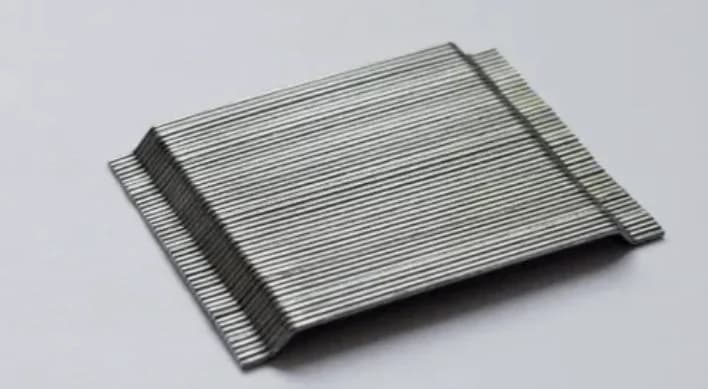
A good fibre neither sinks nor floats out of the mix and does not form balls during mixing. That depends on the fibre itself and on the mixing settings (mixing time, mixing sequence). The delivery form helps here: glued steel fibres such as the MPZG HT+ 35/0.55 are held together in compact strips with water-soluble glue, dose as small packets and only come apart during mixing. They distribute more evenly than loose fibres and prevent balling at high aspect ratios.
For new fibre types, a trial mix is the standard: mix first, check visually for homogeneity and workability, and only then include it in the regular production programme.
Admixtures in fibre-reinforced concrete: superplasticiser, not extra water
Fibres make fresh concrete stiffer and more cohesive: the slump drops, and it drops further with higher dosages and longer fibres. The plant restores workability with a plasticiser or superplasticiser to EN 934-2, not with extra water, because extra water lowers strength and increases shrinkage. For the same reason, never add water on site to make fibre concrete flow. What else fibres change in fresh and hardened concrete is explained in how fibre-reinforced concrete works.
Other admixtures are used as normal, such as a retarder for long transport or an air-entraining agent for freeze-thaw exposure; check their compatibility in the trial mix. And when a supplier puts a "fibres admixture" on the order, that means the fibres themselves, not a chemical product (see the section on fibre admixtures above).
Quality control on the fibre dosage
For structural applications, plants use spot checks during production to verify that the specified dosage is actually in the mix, for example by washing out a sample of fresh concrete and weighing the recovered fibres. For steel fibre, this wash-out test on fresh and hardened concrete is standardised in EN 14721. That is comparable to the regular checks on water-cement ratio and strength class, and it ties in with the documentation duty: the fibre's performance per dosage is recorded in the CE documentation to EN 14889, and the structural residual strength of the mix is determined to EN 14651.
At discharge, a visual check for fibre balls complements the laboratory check. Together with the method statement and the batch record on the delivery ticket, that gives a closed chain from order to pour.
For buyers, this is the verifiable difference between "there are fibres in it" and an assured reinforcement function: for structural work, always ask for the dosing record on the delivery ticket.
What does fibre-reinforced concrete deliver for the plant?
Within the applications and target groups of fibre reinforcement, the batching plant is a link that wins on both sides: the buyer gets reinforcement without steel fixing, the plant a product with more margin. In concrete terms:
• Value added product: steel and synthetic fibres are offered by many plants as an addition to their regular ready-mix concrete, an extra service that contributes to customer retention and revenue per cubic metre.
• Modest investment: certainly for synthetic fibres the threshold is low, with pre-packed bags to start with and a dosing installation once the volume justifies it.
• Knowledge advantage: plants that build up experience with fibre types, mix design adjustments and dosages stand out to contractors looking for a reliable partner for fibre-reinforced concrete. That knowledge is harder to copy than a per-cubic-metre price.
Ordering fibres for your plant or project
If you are starting out with fibre-reinforced ready-mix as a plant, begin with one or two proven fibre types and a trial mix per mix design. The technical specifications per fibre (dosages, performance classes and CE documentation) are bundled in the datasheets. If you want to know which dosage suits a specific mix design and application, request dosing advice for your mix design: you will receive advice per fibre type, including a delivery form (bulk, big bag or pre-packed bags) matched to your dosing method.
Frequently asked questions
- How do you add fibres to concrete?
- Preferably at the batching plant, where the fibres are weighed per batch and fed in with the aggregate. On site, add them to the turning truck mixer a few opened bags at a time, then mix at full drum speed for at least around 100 drum revolutions, about five minutes or more (for steel fibre never less than five minutes). In a small mixer, add them to a mix that already has its normal consistency and mix three to five minutes longer. Never add extra water.
- How long should you mix concrete after adding fibres?
- In a truck mixer: at least around 100 drum revolutions at full speed after the last fibres, which at normal mixing speeds takes about five minutes or more; for steel fibre never less than five minutes. Agitation speed during the drive does not count. At the plant, with the fibres added together with the aggregate, the normal batch mixing time is usually enough, confirmed by a trial mix. In a small site mixer: three to five minutes extra.
- Can you add fibres to ready-mixed concrete on site?
- Yes, under an agreed method statement. Add the fibres gradually to the turning drum, mix at full drum speed for the extra mixing time the method statement sets and check for fibre balls before pumping. Dosing at the plant remains preferred for weighing control and homogeneity. Glued steel fibres and macro fibres packed per bag are the most suitable for site addition.
- Is fibre an admixture?
- Strictly speaking, no. In UK trade language fibres are often sold as a "fibres admixture", but technically they are a separate constituent. EN 206 lists fibres apart from admixtures; steel and polymer fibres are covered by EN 14889-1 and EN 14889-2, chemical admixtures by EN 934-2. Specify fibres by type and dosage in kg/m³, not as a generic additive.
- What is a fibre integration machine?
- A dosing unit that feeds loose fibres, mostly steel, at a controlled rate into the truck mixer or plant mixer, so the fibres enter gradually and do not ball. It is used at plants without a fixed doser or for large pours; a weighing doser linked to the batch control system is the stationary alternative.
- How much fibre do you add per m³ of concrete?
- Indicatively: steel fibre 25–50 kg/m³, synthetic macro fibre 2–6 kg/m³ and micro fibre 0.6–1.0 kg/m³. Structural dosages follow from the structural engineer's calculation. The dosages per application are worked out in the concrete fibre dosage guidelines.
- What is ready-mix concrete?
- Ready-mix concrete (in British usage usually ready-mixed concrete) is fresh concrete that a batching plant mixes to a fixed mix design from cement, water, sand, gravel and admixtures, and delivers ready to pour by truck mixer (typically 8–12 m³). You specify strength class, exposure class and consistency; fibre reinforcement can be blended straight into production as an extra specification, so no separate reinforcement work stage is needed on site.
- Can every batching plant supply fibre-reinforced concrete?
- In principle, yes: virtually every plant can blend in fibres to specification, even ones it does not keep in stock. The difference lies in experience and dosing accuracy: plants that process fibres structurally have a dosing installation and adapted mix designs. Ask for references with your fibre type and for a dosing record on the delivery ticket; see also how to choose a supplier.
- What does fibre-reinforced ready-mix concrete cost per m³?
- Indicatively (Dutch market, 2026 price level): regular ready-mix concrete costs €110–€165 per m³, depending on strength class and region. The fibre surcharge is around €12–€65 per m³ for steel fibre or €15–€45 for synthetic macro fibre, depending on dosage. In return, steel fixing and mesh laying are eliminated. A full overview is given in what does fibre-reinforced concrete cost?
- When is a mobile batching plant worthwhile?
- For large, continuous offtake or remote project locations where the driving time from a fixed plant threatens workability (as a rule of thumb, fresh concrete remains workable for only one and a half to two hours). A mobile plant then mixes on or near the works. Fibres can be dosed there too, provided there is a weighing point per batch at which the kg/m³ is measured out under control.
Share this article
Products mentioned
 Most chosen
TwistR® GREEN HYBRID
High-performance synthetic macro fibres made from 100% polypropylene. Transforms concrete into a stronger composite material.
- TypeHybrid: twisted monofilament + fibrillating network fibre
- Material100% virgin polypropylene
- Length48 mm
- Dosage2.0 – 6.0 kg/m³
Pallet price on request
MPZG HT 35/0.55
High-tensile hooked steel fibres with aspect ratio 35/0.55. Maximum anchorage and ductility for heavily loaded structures.
- TypeCold-drawn hooked steel fibre (glued)
- Dimensions35 mm / Ø 0.55 mm
- Tensile strength1345 N/mm² ± 7.5%
- Modulus of elasticity200,000 N/mm²
Pallet price on request

Promicro
Synthetic PP monofilament micro fibre against plastic shrinkage cracks. Homogeneous dispersion and better surface quality at a low dosage.
- TypePolypropylene monofilament (round cross-section)
- Length12 mm
- Equivalent diameter32 µm
- Linear density6.5 dpf
Pallet price on request

Profib
Fibrillated PP micro fibre for plastic shrinkage crack control, strong in sand-cement screeds. Disperses homogeneously through the concrete.
- TypePolypropylene (fibrillated tape)
- Length12 mm
- Number of fibres per kg100,000
- Tensile strength370 MPa
Pallet price on request