EN 14889 explained: EN 14889-1, EN 14889-2 and CE marking for fibre concrete

EN 14889-1 and EN 14889-2 in plain terms: steel fibre groups, polymer fibre classes, conformity system 1 or 3, what the CE label and Declaration of Performance must state, the UK position (BS EN 14889, CE or UKCA) and a five-step document check.
EN 14889 is the harmonised European standard for fibres in concrete, mortar and grout: EN 14889-1 covers steel fibres and EN 14889-2 polymer fibres. Both parts date from 2006 and set the definitions, declared properties and conformity rules behind CE marking. Structural fibres need attestation system 1, with a notified body and a declared dosage for residual strength.
CE marking against EN 14889 became possible in June 2007, and the coexistence period with national rules ended on 1 June 2008. Since the Construction Products Regulation (EU 305/2011) became fully applicable on 1 July 2013, CE marking together with a Declaration of Performance (DoP) has been mandatory throughout the EU for fibres covered by the standard. The table below sets out the two parts side by side.
EN 14889 at a glance: EN 14889-1 vs EN 14889-2
The two parts follow the same logic but classify different materials. This is how they compare on the points that matter when you read a CE label or a DoP:
| Aspect | EN 14889-1 | EN 14889-2 |
|---|---|---|
| Full title | Fibres for concrete, Part 1: Steel fibres, definitions, specifications and conformity | Fibres for concrete, Part 2: Polymer fibres, definitions, specifications and conformity |
| Current edition | EN 14889-1:2006 (UK: BS EN 14889-1:2006) | EN 14889-2:2006 (UK: BS EN 14889-2:2006) |
| Fibre material | Steel | Polymers such as polypropylene and polyolefin |
| Classification | Groups I to V by production method (I = cold-drawn wire) | Class Ia micro monofilament, Ib micro fibrillated (both < 0.30 mm), class II macro (> 0.30 mm) |
| Typical role | Structural reinforcement: floors, foundations, precast, sprayed concrete | Class I: plastic shrinkage control; class II: structural residual strength |
| Key declared properties | Shape, length, diameter, aspect ratio, tensile strength, consistence | Polymer type, shape, length, equivalent diameter, tensile strength (class II), consistence |
| Structural performance | Declared dosage (kg/m³) for 1.5 MPa at CMOD 0.5 mm and 1.0 MPa at CMOD 3.5 mm | Same requirement for fibres declared for structural use |
| Attestation (AVCP) | System 1 structural, system 3 other uses | System 1 structural, system 3 other uses |
One point to keep in mind when reading the table: the declared dosage is a comparison value measured in a reference concrete, not a design dosage for your project. The section on the CE label below explains the difference.
What does EN 14889 cover?
Anyone who uses fibres as reinforcement in concrete runs into EN 14889. The standard specifies requirements for fibres for structural or non-structural use in concrete, mortar and grout, including sprayed concrete, flooring, precast, in-situ and repair concrete. It lays down the definitions, the properties a manufacturer must declare and the rules for assessing conformity, in two parts:
• EN 14889-1: steel fibres made from drawn wire, cut sheet and other steel forms, divided into groups by production method.
• EN 14889-2: polymer fibres, for example of polypropylene or polyolefin, divided into classes by form and diameter.
The standard defines structural use as the use of fibres designed to contribute to the load-bearing capacity of a concrete element. That definition decides which conformity system applies and whether the fibre's performance may be used in the structural calculation.
Because EN 14889 is harmonised under the Construction Products Regulation (CPR, EU 305/2011), CE marking is a legal requirement rather than a choice, and the manufacturer records the declared performance in the Declaration of Performance.
Note what conformity does and does not prove. EN 14889 says that the fibre itself performs as declared; it says nothing about the finished fibre concrete, which is governed by EN 206 and by the structural design. This article belongs to our topic overview on sustainability, standards and innovation; a concise overview of all relevant standards can be found on our standards page.
Which fibres fall outside EN 14889?
EN 14889 only covers steel and polymer fibres. Basalt fibres, fibres made from recycled tyre steel and composite macro fibres made from a combination of materials fall outside its scope; such fibres can be CE marked through a European Technical Assessment (ETA) issued against a European Assessment Document (EAD). Alkali-resistant (AR) glass fibres for glassfibre reinforced concrete fall outside EN 14889 as well and have their own standard, EN 15422.
For these fibres, ask which technical specification the CE marking and DoP refer to, and check that any declared residual strength has been tested to EN 14651. Our comparison of types of concrete fibres shows where basalt and glass sit alongside steel and polymer.
EN 14889-1: steel fibre groups I to V and declared properties
EN 14889-1 classifies steel fibres by the way they are made. The standard distinguishes five groups:
• Group I: cold-drawn wire.
• Group II: cut sheet.
• Group III: melt-extracted.
• Group IV: shaved cold-drawn wire.
• Group V: milled from blocks.
For structural work, group I is the usual choice, because cold-drawn wire delivers a high and consistent tensile strength. For each steel fibre, the manufacturer declares, among other properties:
• Shape: straight or deformed (for example with hooked ends), and whether the fibres are supplied loose or glued into bundles.
• Coating, if any.
• Length, diameter and aspect ratio (length divided by diameter).
• Tensile strength and modulus of elasticity.
• Effect on consistence: the Vebe time of the reference concrete at a stated dosage.
• For structural use, the effect on strength, expressed as the declared dosage for a given residual strength.
Steel fibres to EN 14889-1 such as the MPZG HT+ 35/0.55 are cold-drawn steel fibres with hooked ends, glued into bundles, 35 mm long with a diameter of 0.55 mm. For heavier structural work there are the MPWG HT+ 50/0.90 and the MPWG HT+ 60/0.75. The hooked ends anchor the fibre mechanically in the concrete matrix, which feeds directly into the residual strength that remains available after cracking.
Whichever steel fibre you choose, for structural use, check that system 1 is stated on the CE label and in the DoP of the fibre you order. That entry, not the product name, is what allows the fibre to count in the structural calculation.
EN 14889-2: polymer fibre classes Ia, Ib and II
EN 14889-2 classifies polymer fibres by their physical form and diameter. Class I covers micro fibres with a diameter smaller than 0.30 mm, subdivided into class Ia (monofilament) and class Ib (fibrillated). Class II covers macro fibres with a diameter greater than 0.30 mm.
The distinction is more than a formality. Micro fibres mainly control plastic shrinkage cracks in young concrete, but deliver no structural residual strength. A class Ia micro fibre such as Promicro, a 12 mm monofilament with an equivalent diameter of 32 µm, is therefore dosed at 0.6 to 1.0 kg/m³ against shrinkage cracking, not as a replacement for reinforcement; see our article on preventing plastic shrinkage cracks. Macro fibres do provide residual strength: they are used where a flexural strength after cracking is required and can thereby fulfil a structural function. A class II macro fibre to EN 14889-2, such as the Wiking 4050 TR, a 48 mm polyolefin monofilament with a diameter of 700 µm dosed at 2 to 6 kg/m³, is an alternative to reinforcing steel in floors and pavements.
For polymer fibres, the manufacturer declares, among other properties:
• The base polymer (or blend) and the shape: straight or deformed, monofilament or fibrillated.
• Length, equivalent diameter, linear density and aspect ratio.
• For class II: tensile strength and modulus of elasticity.
• Melting point and ignition point.
• Effect on consistence and, when the fibre is declared for structural use, the effect on strength.
Polymers such as polypropylene and polyolefin are not affected by the alkalis in cement paste and do not corrode.
Anyone considering fibre reinforcement as a replacement for traditional reinforcing steel therefore needs class II macro fibres or steel fibres, not class I micro fibres. Whether steel fibres or synthetic macro fibres suit your project better depends on loads, exposure and the required residual strength. How the fibre types otherwise relate to one another is covered in our overview of types of concrete fibres.
Conformity system 1 or 3: which regime applies when?
EN 14889 has two systems for the assessment and verification of constancy of performance (AVCP). Which one applies depends on the intended use the manufacturer declares:
| Aspect | System 1 | System 3 |
|---|---|---|
| Intended use | Structural: fibres contribute to load-bearing capacity | Non-structural, e.g. plastic shrinkage control, fire behaviour |
| Initial type testing | Under a notified certification body | By a notified laboratory |
| Factory production control | Certified and periodically audited by the notified body | Manufacturer only, no third-party surveillance |
| What you receive | Certificate of constancy of performance (body number on the label) plus DoP | DoP from the manufacturer |
| Counts in the structural calculation? | Yes, with the declared residual strength | No |
Under system 1, a notified product certification body determines the product type, carries out the initial inspection of the factory and its factory production control (FPC), and then keeps the FPC under continuous surveillance through periodic audits. Under system 3, a notified laboratory carries out the type testing, while the manufacturer alone runs the production control, without third-party surveillance.
When the post-crack (residual) strength of the fibre concrete is used in the structural design, the fibres must be certified under system 1 and the CE label must state that they are intended for structural use.
In practice, that means:
• Pile-supported industrial floor, foundation slab, load-bearing pavement with reduced or replaced reinforcement: structural, so system 1.
• Monolithic ground-bearing floor where fibres replace the shrinkage mesh: residual strength is required, so system 1.
• Micro fibres against plastic shrinkage cracking in screeds or decorative concrete: no structural function, so system 3 is sufficient.
• Sprayed concrete with a temporary function: depends on the specification; where there is a structural role, system 1 again.
Compliance with the standard confers a presumption of fitness for the uses stated with the CE marking. For structural fibre reinforcement, system 1 is therefore the signal to look for: a fibre marked only under system 3 must not be counted in the structural calculation.
What must the CE label and the DoP state?
The CE label of a concrete fibre is more than a logo. For a fibre for structural use (system 1), the label and the Declaration of Performance state at least:
• Name and address of the manufacturer, plus the last two digits of the year in which the CE marking was first affixed.
• The certificate number and the four-digit identification number of the notified body.
• The standard reference (EN 14889-1 or EN 14889-2) and the intended use (structural use in concrete, mortar or grout).
• Group (steel fibres) or class (polymer fibres), shape and bundling (loose or glued), fibre length, diameter and tensile strength.
• The effect on the consistence of the concrete at the stated dosage.
• The key line for structural use: the declared dosage at which the fibre achieves a residual flexural strength of 1.5 MPa at a crack mouth opening displacement (CMOD) of 0.5 mm and 1.0 MPa at a CMOD of 3.5 mm.
That effect on strength is determined in a standard reference concrete to EN 14845-1, using the notched beam test of EN 14845-2, which follows the same set-up as the EN 14651 bending test. A CMOD of 0.5 mm corresponds to a central deflection of about 0.47 mm, and a CMOD of 3.5 mm to about 3.0 mm; UK documents often quote the deflection values.
In practice, the declared dosage is the most useful comparison tool: two fibres with the same CE marking can differ considerably in the dosage needed to achieve the same residual strength, and thus in cost per cubic metre.
Declared dosage is not a design dosage
That comparison value is not a design dosage: EN 14889 sets no minimum dosage for any application.
The dosage in your project follows from the design (slab thickness, subgrade, loads and concrete class) and, where required, from beam tests on the actual mix. In design, the residual strength at small crack widths (CMOD 0.5 mm, fR1) mainly governs serviceability, and the values at larger crack widths the ultimate limit state: fR3 at CMOD 2.5 mm in the fib Model Code and EN 1992-1-1 Annex L, and fR4 at CMOD 3.5 mm in TR34 floor design. Translating this into dosages per application is covered in our practical guidelines for dosing concrete fibres; the design framework behind residual strength classes is explained in our article on the fib Model Code and Bulletin 105.
Checking the CE certificate and DoP: step-by-step
This is how you verify in five steps whether a fibre's paperwork matches your application:
• Step 1: request the Declaration of Performance (DoP) and, for fibres declared for structural use (system 1), the certificate of constancy of performance. A reliable supplier provides these without hesitation.
• Step 2: check the standard part: steel fibre under EN 14889-1, synthetic fibre under EN 14889-2.
• Step 3: check the AVCP system: for structural work it must state system 1, with the number of the notified body. Look up that four-digit number in the European Commission's NANDO database to confirm the body is notified for this standard, and check that the certificate number on the label matches the certificate you received.
• Step 4: compare the declared dosage for the required residual strength with the dosage in the quotation. If the offered dosage is lower, ask for substantiation with EN 14651 test reports.
• Step 5: make sure fibre class, dosage and residual strength appear in the contract and on the delivery tickets, so that the structural engineer and the building control body can verify what is actually in the concrete.
What changes under the new Construction Products Regulation?
The new Construction Products Regulation, (EU) 2024/3110, entered into force on 7 January 2025, and most of its provisions apply from 8 January 2026. Existing harmonised standards such as EN 14889 remain the basis for CE marking until they are replaced under the new regulation, so for fibre buyers nothing changes for now: CE marking plus a DoP. Standards issued under the new regulation will bring a combined declaration of performance and conformity, digital product information and declared environmental characteristics.
EN 14889, EN 206 and EN 14651: fibre, concrete and test
CE marking of the fibre is step one; the concrete itself falls under EN 206, the European concrete standard, complemented nationally by BS 8500 in the UK and NEN 8005 in the Netherlands. EN 206 establishes general suitability for steel fibres conforming to EN 14889-1 and polymer fibres conforming to EN 14889-2. The producer records the fibre content per batch, and the delivery ticket states the fibre type and content, or the performance class of the fibre concrete. That is why fibres are best added at the plant under controlled conditions; how that works is explained in our article on fibres at the concrete plant.
Fibre content and distribution can be checked on fresh concrete: EN 14721 for steel fibres, and EN 14488-7 (the sprayed concrete method) for polymer fibres.
For performance measurement, the framework refers to EN 14651: the three-point bending test on a beam with a sawn notch, measuring the residual flexural strength at increasing crack opening. The international design framework that classifies fibre concrete into performance classes also builds on this test; how that works is explained in our article on the fib Model Code and Bulletin 105 as the international standard. The second-generation Eurocode 2, EN 1992-1-1:2023, contains Annex L with design rules for steel fibre reinforced concrete based on EN 14651 residual strengths.
Note that CE marking covers product performance only, not environmental performance. For tenders in which CO₂ or the Dutch environmental cost indicator (MKI) carries weight, EPDs and other declarations come on top: see our overview of sustainability certification for fibre materials.
EN 14889 in the UK: BS EN 14889, CE or UKCA and Concrete Society guidance
In the UK the standard is published by BSI as BS EN 14889-1:2006 and BS EN 14889-2:2006. The technical content is identical to the European parts; the BS prefix only marks the national publication.
In Great Britain, construction products covered by a designated standard need CE or UKCA marking. In 2024 the UK government extended the recognition of CE marking for construction products indefinitely, with at least two years' notice of any phase-out, so CE-marked fibres with a DoP can be used on British sites.
Design guidance commonly used alongside the standard comes from the Concrete Society:
• TR34: concrete industrial ground floors, design and construction.
• TR63: guidance for the design of steel-fibre-reinforced concrete.
• TR65: guidance on the use of macro-synthetic-fibre-reinforced concrete.
The concrete itself is specified to BS EN 206 together with BS 8500. Whatever marking is on the bag, ask for the DoP and, for fibres declared for structural use, the certificate of constancy of performance before the fibre goes into the mix.
CUR Recommendation 111: the Dutch assessment framework for steel fibre concrete
In the Netherlands, steel fibre concrete floors are also assessed against a national framework: CUR Recommendation 111, "Steel fibre concrete industrial floors on piles: design and construction", in its revised edition of March 2019. The recommendation extends the usual calculation methods for structural concrete with calculation methods for steel fibre concrete and serves as the framework for structural engineers and building control.
A worked example: for structural floors on piles, a fibre content of around 35 kg/m³ is taken as the minimum. For an industrial floor of 2,000 m² and 200 mm thickness (400 m³ of concrete), that means some 14 tonnes of steel fibre, a quantity the concrete plant must add dosed and registered per batch. The exact design always follows from the calculation to the recommendation.
For comparison: steel fibre dosages for industrial floors typically range between 20 and 40 kg/m³ (indicative), whereas structural synthetic macro fibres typically need only a few kilograms per cubic metre. You determine the right value together with your structural engineer. Fibres do not fully replace traditional reinforcement in every situation, and structural work always requires a calculation; more on floor design can be found in fibre reinforced concrete for industrial floors.
How to choose a fibre with the right paperwork
The standards logic summarised: first determine whether your application is structural. If so, look for a steel fibre under EN 14889-1 or a class II macro fibre under EN 14889-2, both with conformity system 1, and check the declared dosage against the required residual strength. For shrinkage crack control, a class I micro fibre under system 3 is sufficient.
Product pages list the standard where it applies. Before you order, ask us for the Declaration of Performance and, for fibres declared for structural use, the certificate of constancy of performance of the specific fibre. See also our datasheets and certificates pages. What else to check with a supplier is set out in choosing a fibre reinforcement supplier.
Unsure which fibre suits your project and assessment framework? Use the selection guide, calculate your dosage with the calculator, or directly request a quotation with standards substantiation.
Frequently asked questions
- What is EN 14889?
- EN 14889, "Fibres for concrete", is the harmonised European standard for fibres used in concrete, mortar and grout. It was published in 2006 in two parts: EN 14889-1 for steel fibres and EN 14889-2 for polymer fibres. It sets the definitions, the properties a manufacturer must declare and the conformity rules, and is the basis for the CE marking and Declaration of Performance of concrete fibres.
- What is EN 14889-1?
- EN 14889-1 is part 1 of the standard: steel fibres, definitions, specifications and conformity. It divides steel fibres into groups I to V by production method, with group I (cold-drawn wire) the usual choice for structural work. The manufacturer declares the geometry, tensile strength and effect on consistence and, for structural use, the dosage that achieves 1.5 MPa at CMOD 0.5 mm and 1.0 MPa at CMOD 3.5 mm.
- What is EN 14889-2?
- EN 14889-2 is part 2 of the standard: polymer fibres. Class Ia (micro monofilament) and class Ib (micro fibrillated) have a diameter below 0.30 mm; class II macro fibres are thicker than 0.30 mm. Only class II fibres declared for structural use under system 1 can count in a structural calculation.
- What is the difference between EN 14889-1 and EN 14889-2?
- The material and the basis of classification. EN 14889-1 applies to steel fibres and groups them by production method; EN 14889-2 applies to polymer fibres and classifies them by form and diameter. The CE logic is the same for both parts: a declared dosage for residual strength when the fibre is intended for structural use, and conformity system 1 (structural) or 3 (other uses).
- Is CE marking mandatory for concrete fibres?
- Yes. EN 14889 is a harmonised standard under the European Construction Products Regulation. CE marking against it became possible in June 2007 and the coexistence period ended on 1 June 2008; since the CPR became fully applicable on 1 July 2013, fibres for concrete, mortar and grout must carry CE marking and come with a Declaration of Performance (DoP) when placed on the EU market. In Great Britain, CE marking remains recognised alongside UKCA.
- What is the difference between system 1 and system 3 in EN 14889?
- System 1 applies to structural use: a notified certification body determines the product type, certifies the factory production control and keeps it under surveillance, and its number appears on the label. System 3 applies to non-structural use: a notified laboratory carries out the type testing and the manufacturer alone runs production control. Only system 1 fibres may count in the structural calculation.
- Is BS EN 14889 the same as EN 14889?
- Yes. BS EN 14889-1:2006 and BS EN 14889-2:2006 are the UK adoptions published by BSI, with technical content identical to the European standard; the BS prefix only marks the national publication. In the UK, design guidance for fibre concrete is found in the Concrete Society reports TR34, TR63 and TR65.
- What does class II mean for synthetic fibres?
- Class II comprises polymer fibres with a diameter greater than 0.30 mm: the macro fibres. Only this class can deliver residual strength after cracking and thus fulfil a structural function, provided it is declared for structural use under conformity system 1. An example is the Wiking 4050 TR, a polyolefin macro fibre to EN 14889-2 class II. Micro fibres (class I) only control plastic shrinkage cracking.
- Does EN 14889 cover basalt or glass fibres?
- No. EN 14889 covers only steel and polymer fibres. Basalt, recycled steel and composite fibres can be CE marked through an ETA based on an EAD; alkali-resistant glass fibres for glassfibre reinforced concrete have their own standard, EN 15422. Ask which specification the DoP refers to.
- What is CUR Recommendation 111?
- CUR Recommendation 111 (revised edition March 2019) is the Dutch assessment framework for steel fibre concrete in industrial floors on piles. The recommendation supplements the usual concrete calculation methods with calculation rules for steel fibre concrete and is used by structural engineers and building control. For structural floors on piles, a fibre content of around 35 kg/m³ applies as the lower limit, depending on the calculation.
- Can CE-marked fibres replace all conventional reinforcement?
- Not automatically. CE marking under system 1 demonstrates that the fibre delivers a declared residual strength, but whether fibres can fully or partially replace traditional reinforcement follows from the structural calculation: in the Netherlands, for steel fibre floors on piles, to CUR Recommendation 111. Where tensile stresses are high or continuous reinforcement is required, a combination of fibres with starter bars or mesh remains common.
Share this article
Products mentioned
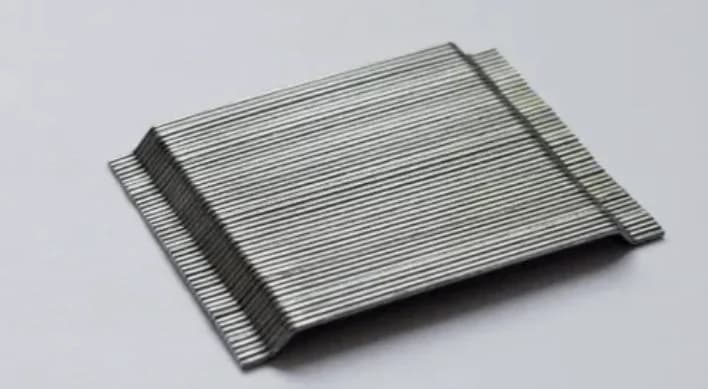
MPZG HT 35/0.55
High-tensile hooked steel fibres with aspect ratio 35/0.55. Maximum anchorage and ductility for heavily loaded structures.
- TypeCold-drawn hooked steel fibre (glued)
- Dimensions35 mm / Ø 0.55 mm
- Tensile strength1345 N/mm² ± 7.5%
- Modulus of elasticity200,000 N/mm²
Pallet price on request
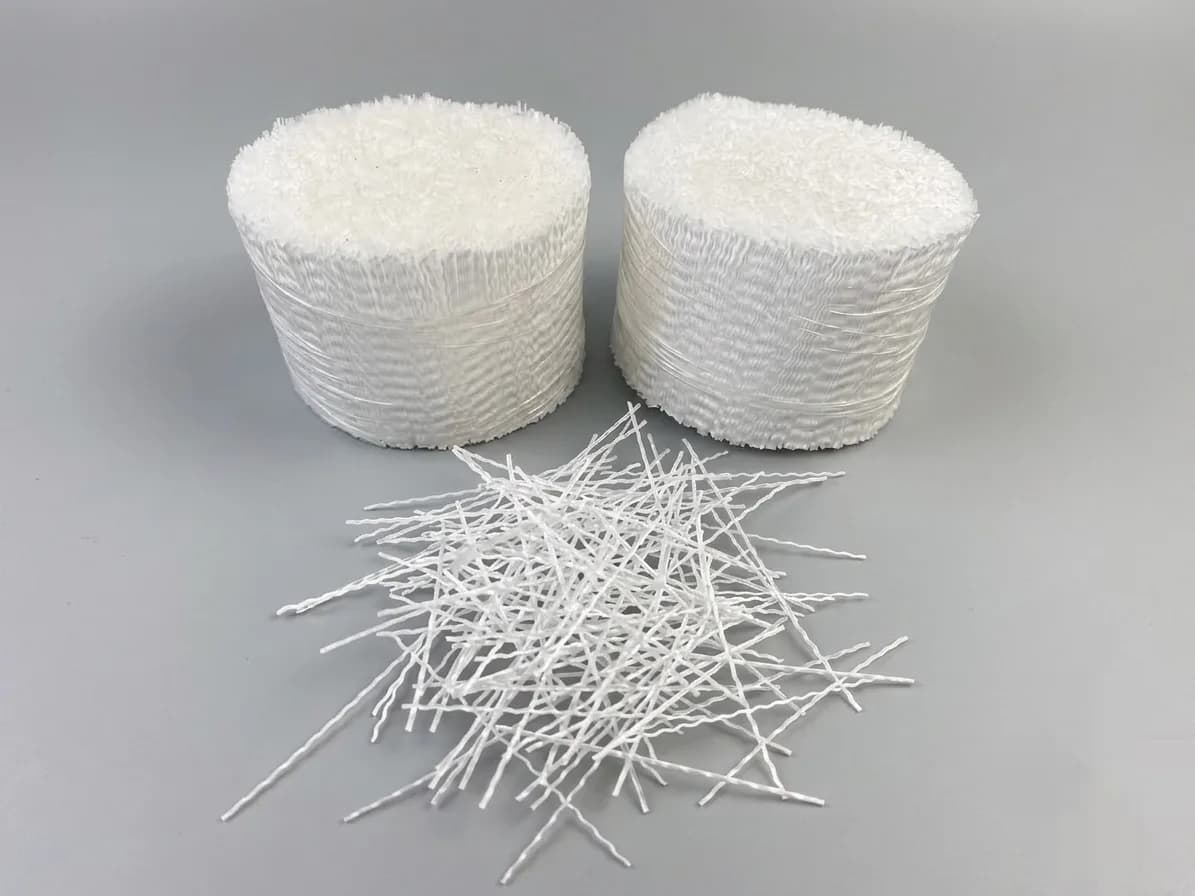
Wiking 4050 TR
High-performance polyolefin macro fibre, ideally suited to rough floors — a strong and cost-effective alternative to steel reinforcement.
- TypePolyolefin macro fibre (monofilament)
- Length48 mm
- Diameter700 µm
- Tensile strength557 MPa
Pallet price on request

Promicro
Synthetic PP monofilament micro fibre against plastic shrinkage cracks. Homogeneous dispersion and better surface quality at a low dosage.
- TypePolypropylene monofilament (round cross-section)
- Length12 mm
- Equivalent diameter32 µm
- Linear density6.5 dpf
Pallet price on request