Concrete fibre dosage: practical guidelines per fibre type

Too few fibres and the effect fails to materialise, too many and workability suffers. Dosing guidelines per fibre type and application, plus the calculation steps from residual strength requirement to kilos per m³.
The dosage of concrete fibres depends on fibre type and application: steel fibre typically 25–50 kg/m³, synthetic macro fibre 2–6 kg/m³ and polypropylene micro fibre 0.6–1.0 kg/m³. For structural applications the dosage is calculated from the required residual strength in accordance with EN 14651; for shrinkage crack control a standard dosage from the supplier is usually sufficient.
What determines the right dosage?
The right dosage is decisive for the result of fibre reinforced concrete: too few fibres and the intended effect fails to materialise, too many and workability is at risk. Four factors drive the choice:
• Fibre type — steel, synthetic (macro or micro) or basalt each have a different density and mode of action, and therefore a different customary dosage. An overview of the differences can be found in our article on the types of concrete fibres.
• Fibre parameters — length, diameter, shape and bond behaviour. Above all, the ratio of length to diameter (the l/d ratio or aspect ratio) partly determines the performance per kilo.
• Application and intended effect — structural strength, shrinkage crack control or fire resistance each call for a different dosage. How fibres actually absorb those forces is explained in how fibre reinforcement works in concrete.
• Mix design — a correct adjustment of the concrete mix (particularly in the fines) is needed for optimal encapsulation and bonding of the fibres.
Dosing guidelines per fibre type
The guide values below are customary bandwidths from practice. For structural work, the exact dosage always follows from a calculation — a rule of thumb is no substitute for a structural engineer.
Steel fibre: 25–50 kg/m³
For steel fibre concrete (SFRC), a customary dosage is around 25 to 50 kg/m³, corresponding to roughly 0.3 to 0.65 per cent by volume of the concrete mix. Higher dosages are possible for more heavily loaded applications. For walls, for example, steel fibres 40 to 60 mm long with a diameter of 0.6 to 0.9 mm are often used — cold-drawn, galvanised steel wire fibres with end hooks for extra anchorage.
High-tensile hooked-end steel fibres such as the MPZG HT+ 35/0.55 with a steel fibre dosage of 10–35 kg/m³ often reach the same performance class at a lower dosage than standard fibres thanks to their high tensile strength — saving kilos, mixing time and money.
When ordering, also pay attention to the delivery form: glued steel fibres are held together in small combs with a water-soluble adhesive. They dose as compact bundles, come apart during mixing and therefore distribute more evenly than loose fibres — particularly for fibres with a high l/d ratio, this is an effective measure against balling.
Synthetic macro fibre: 2–6 kg/m³
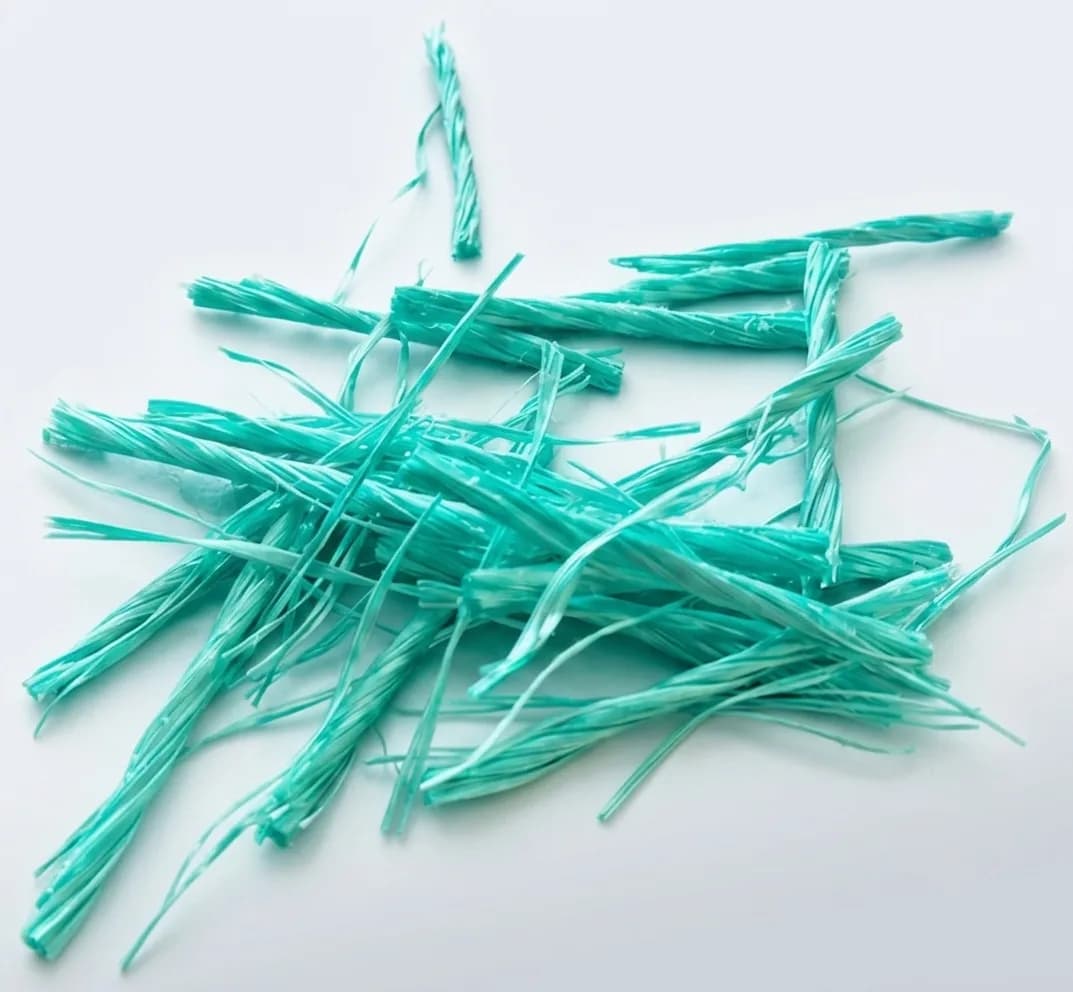
Structural synthetic fibres such as the TwistR macro fibre with a dosage of 2–6 kg/m³ can fully or partly replace traditional reinforcement. Because polypropylene is more than eight times lighter than steel, a few kilos per m³ already yields an enormous number of fibres. The exact dosage differs per product and application and is determined on the basis of the intended reinforcement plan; the performance per dosage is documented in the CE documentation in accordance with EN 14889-2. Whether synthetic fibre reinforcement is a better choice than steel, and whether a micro or a macro fibre suits your project, depends mainly on the loading and on the type of cracking you want to control.
Micro fibre: 0.6–1.0 kg/m³
Polypropylene micro fibres are applied in much larger numbers but at a much lower total weight: typically between 500 and 2,500 grams per m³, depending on product and purpose. The fibres are very thin and around 10 to 20 mm long, and are particularly effective against plastic shrinkage cracks in the first hours after pouring — thanks to the enormous number of fibres introduced per m³.
There are two versions. A monofilament micro fibre consists of loose, smooth filaments; Promicro is dosed at just 0.6–1.0 kg/m³ and improves surface quality at the same time. A fibrillated micro fibre such as Profib (0.9–1.0 kg/m³) has a mesh structure that opens up in the mix and anchors mechanically — strong in sand-cement screeds.
Basalt fibre
Basalt fibres (chopped or as a wavy macro fibre) sit between micro and macro synthetic fibres in terms of dosage, depending on version and purpose. They combine high tensile strength with heat resistance up to around 700 °C, which makes them interesting for applications with elevated temperature requirements. For basalt, always consult the product-specific dosing advice.
Guide values per application
Indicative starting points per application — the final dosage follows from the calculation:
• Industrial floor (power floated, on a sand bed) — steel fibre 25–35 kg/m³ or macro fibre 3–5 kg/m³, depending on point loads and bay size.
• Foundation slab / heavily loaded floor — steel fibre 30–50 kg/m³; structural calculation mandatory.
• Screed (sand-cement) — fibrillated micro fibre 0.9–1.0 kg/m³ against shrinkage cracks; no structural function.
• Precast elements — macro fibre around 3 kg/m³ or steel fibre according to calculation; fibres here often replace (part of) the mesh and save handling in the factory (see fibre reinforcement in precast concrete elements).
• Retaining wall / wall — steel fibre 40–60 mm long, usually combined with edge reinforcement; dosage follows from the structural engineer's calculation.
How the dosage is then applied in practice — big bags, dosing equipment, mixing time — is covered in the complete guide to pouring fibre reinforced concrete.
Steel fibre aspect ratio: the l/d ratio explained
The aspect ratio of a steel fibre is the length divided by the diameter. Worked example: a fibre 35 mm long and 0.55 mm thick has an l/d ratio of 35 ÷ 0.55 ≈ 64; a fibre of 60 mm by 0.75 mm comes out at 80.
The higher the l/d ratio, the more anchorage length and typically the better the performance per kilo of fibre — a higher aspect ratio can therefore make a lower dosage possible. The downside: long, thin fibres are harder to mix in and more prone to balling. Glued fibres and an adjusted mixing regime overcome that. In practice, then, you do not choose 'the highest l/d', but the combination of aspect ratio and dosage that achieves the required performance class with a workable mix.
How to calculate steel fibre concrete: from requirement to dosage
Anyone wanting to calculate steel fibre concrete or fibre reinforced concrete works through four steps in practice:
• Step 1: establish the requirements — based on loading, subbase and bay layout, the structural engineer determines what residual strength (post-crack flexural strength) the concrete must deliver.
• Step 2: choose the performance class — that residual strength is expressed in the flexural test in accordance with EN 14651, in which the residual strength is measured at various crack widths.
• Step 3: read off the dosage — the fibre supplier translates the required class into kilos per m³ for the specific fibre using performance charts and dosing software. The same requirement can therefore result in a lower dosage with a high-tensile fibre with a high aspect ratio than with a standard fibre.
• Step 4: verify workability — check that the dosage suits the consistency, aggregate grading and mixing process of the concrete plant, if necessary with a trial mix.
For a non-structural shrinkage reinforcement calculation this process is not needed: a standard dosage of micro fibre or a light macro fibre dosage in accordance with the product data sheet is sufficient there. Want an indication in advance? Calculate the required kilos per m³ with our calculator — and for the cost side per dosage, read steel fibre concrete: price, dosage and applications.
Why too many fibres is a problem
A higher dosage does not automatically mean a better result. An excessive dosage can cause problems such as blockage of the dosing equipment at the concrete plant, reduced workability of the fresh concrete and an increased risk of fibre balling during mixing — which creates weak spots in the concrete instead of stronger ones.
Alongside the right quantity, homogeneous distribution is at least as important. A good fibre does not sink or float out of the mix and does not form balls during mixing; this is determined partly by the mixing process at the concrete batching plant and the quality of the fibre itself. If in doubt about the distribution, have a wash-out test carried out on a sample of the fresh mix — this makes it possible to verify the actual fibre content per m³.
What does fibre reinforcement cost per kg?
The price per kilo says little without the dosage alongside it: steel fibre is cheaper per kilo than synthetic fibre, but you need 25–50 kg/m³ of it compared with 2–6 kg/m³ of macro fibre or less than 1 kg/m³ of micro fibre. Indicatively (2026 price level, depending on project and steel price), the surcharge for steel fibre concrete at a dosage of 25–30 kg/m³ lies between a few euros and around €45 per m³ on top of the concrete price. Therefore always compare quotations on price per m³ at the same performance class, not on price per kilo of fibre.
From guide value to final recipe
Use the bandwidths in this article as a starting point: first determine the goal (structural or shrinkage control), choose the fibre type and check the dosage against the application. For structural work, that always includes a calculation by the structural engineer; fibres do not fully replace traditional reinforcement in every situation.
You can work out a first indication of quantities and costs yourself with the calculator. Want a tailored dosage for your project? Request a quotation with dosing advice — we work with you all the way from the residual strength requirement through to the mixing advice for the concrete plant.
Frequently asked questions
- How many kg of steel fibre goes into a m³ of concrete?
- Customary is 25 to 50 kg of steel fibre per m³ of concrete, roughly 0.3 to 0.65 per cent by volume. Lightly loaded floors sit at the lower end of that bandwidth, heavily loaded foundation slabs at the upper end. High-tensile fibres with a high aspect ratio, such as the MPZG HT+ 35/0.55, often achieve the same performance class at a lower dosage.
- When is shrinkage reinforcement needed?
- Shrinkage reinforcement is needed as soon as a concrete floor or wall must be able to shrink freely without random cracking: with large undivided bays, thin floors, screeds and fast-drying conditions. For plastic shrinkage (the first hours) a micro fibre at 0.6–1.0 kg/m³ is sufficient; for longer-term drying shrinkage, the structural engineer calculates shrinkage reinforcement or a macro fibre dosage based on bay size and thickness.
- Can I calculate steel fibre concrete myself?
- An indication, yes: with the calculator you can work out the required kilos per m³ and the associated costs. The definitive structural calculation — from residual strength requirement via the EN 14651 flexural test to dosage — is a job for a structural engineer together with the fibre supplier, who uses performance charts and dosing software per fibre type for this.
- What is the difference between monofilament and fibrillated micro fibres?
- A monofilament micro fibre consists of loose, smooth filaments that distribute very finely through the mix and also improve surface quality; dosage around 0.6–1.0 kg/m³. A fibrillated micro fibre has a mesh structure that opens up during mixing and anchors mechanically — making it extra effective in sand-cement screeds, at around 0.9–1.0 kg/m³. Both are made of polypropylene and work against plastic shrinkage cracks.
- Why are steel fibres supplied glued?
- Glued steel fibres are held together in small combs with a water-soluble adhesive. Those bundles dose easily, come apart during mixing and therefore distribute more evenly through the fresh concrete than loose fibres. Particularly for fibres with a high l/d ratio (long and thin), this considerably reduces the risk of balling.
Share this article
Products mentioned
 Most chosen
TwistR® GREEN HYBRID
High-performance synthetic macro fibres made from 100% polypropylene. Transforms concrete into a stronger composite material.
- TypeHybrid: twisted monofilament + fibrillating network fibre
- Material100% virgin polypropylene
- Length48 mm
- Dosage2.0 – 6.0 kg/m³
Pallet price on request
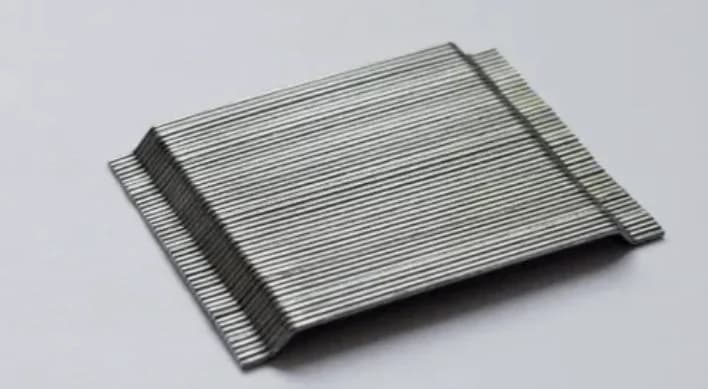
MPZG HT 35/0.55
High-tensile hooked steel fibres with aspect ratio 35/0.55. Maximum anchorage and ductility for heavily loaded structures.
- TypeCold-drawn hooked steel fibre (glued)
- Dimensions35 mm / Ø 0.55 mm
- Tensile strength1345 N/mm² ± 7.5%
- Modulus of elasticity200,000 N/mm²
Pallet price on request
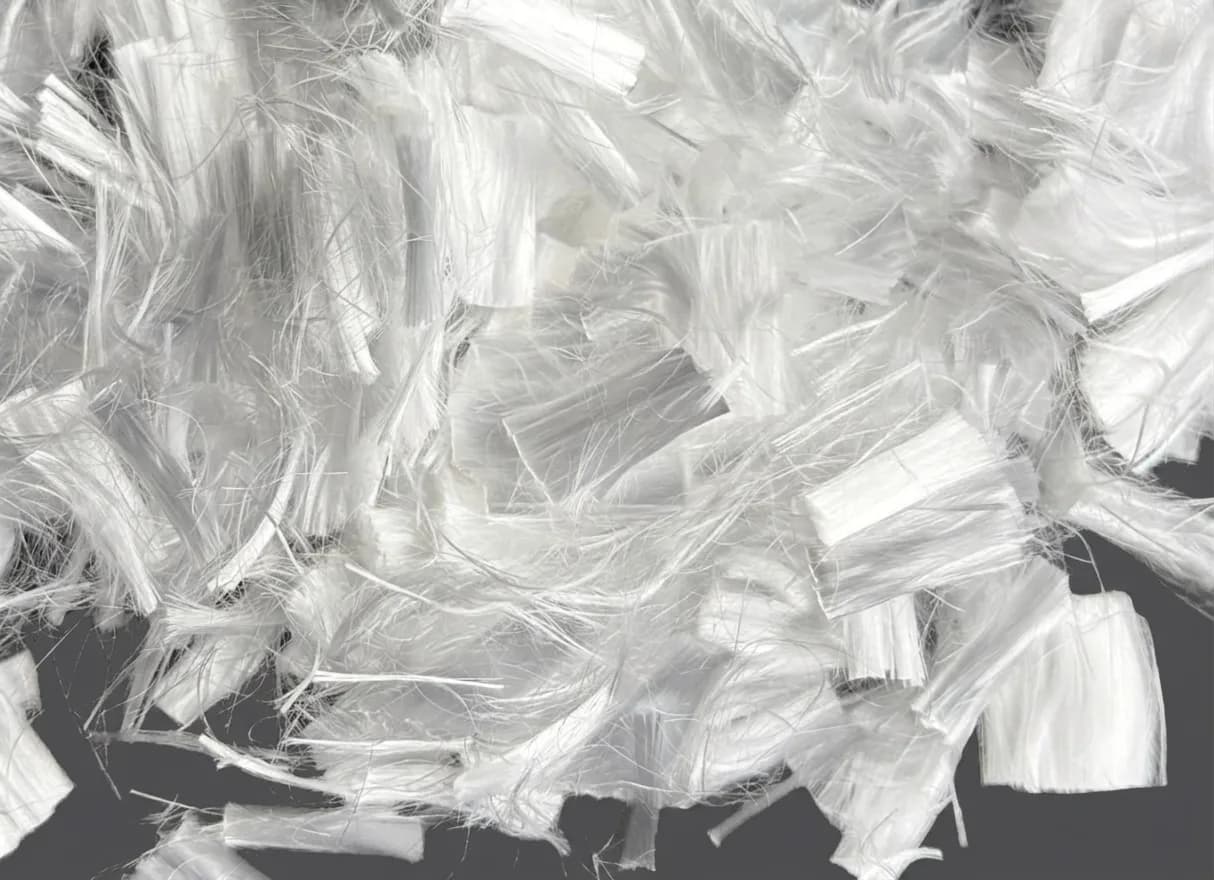
Promicro
Synthetic PP monofilament micro fibre against plastic shrinkage cracks. Homogeneous dispersion and better surface quality at a low dosage.
- TypePolypropylene monofilament (round cross-section)
- Length12 mm
- Equivalent diameter32 µm
- Linear density6.5 dpf
Pallet price on request