Synthetic fibre concrete: when is it the right choice?

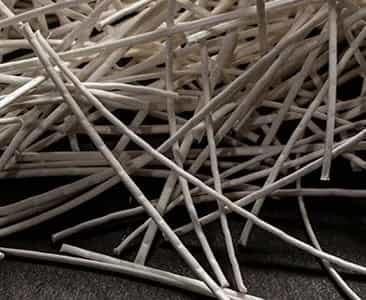
Synthetic fibre concrete comes in two flavours: micro fibres against plastic shrinkage (0.6–1.0 kg/m³) and structural macro fibres (2–6 kg/m³). Here is how you choose the right fibre and mix for floor, screed or paving.
Synthetic fibre concrete is standard concrete with polypropylene or polyolefin fibres added to the mix, sometimes shortened to synthetic concrete. There are two types: micro fibres (0.6–1.0 kg/m³) against plastic shrinkage cracks and macro fibres (2–6 kg/m³) as a structural alternative to mesh in floors and pavings. The fibres do not rust and the mix stays pumpable.
What is synthetic fibre concrete?
Synthetic fibre concrete is concrete to which synthetic fibres have been added during mixing, usually polypropylene (PP) or polyolefin; the fibres themselves are called synthetic fibre reinforcement. The fibres distribute themselves homogeneously through the mix and work at every point in the cross-section, whereas a reinforcement mesh only works at the level where it lies. The EN 14889-2 standard divides synthetic fibres for concrete into two classes: class I for micro fibres and class II for structural macro fibres.
That distinction is essential, because the two types do fundamentally different things. A micro fibre of 12 mm by 32 µm cross-section controls plastic shrinkage in the first hours after pouring, but makes no structural contribution. A macro fibre of 48 mm by 0.7 mm cross-section bridges actual cracks and takes up tensile force after cracking — and can thereby replace the reinforcement mesh in many floors and pavings. Anyone ordering “synthetic fibres for concrete” without making this distinction risks a floor with the wrong fibre type.
Both types share one property that sets them apart from steel: they are non-corrosive. No rust stains on exposed floors, no attacked reinforcement under moisture exposure and no cover requirement from a corrosion perspective. More background on how fibres work in concrete can be found in our pillar on fibre reinforced concrete.
Synthetic concrete or polymer concrete?
The term synthetic concrete is used for two different materials. In floor, paving and screed work it normally means what this article covers: ordinary cement-bound concrete with synthetic fibres in the mix. It can also mean polymer concrete (also called resin concrete), in which a resin such as epoxy, polyester or methyl methacrylate replaces cement as the binder. Polymer concrete is used mainly for precast products such as drainage channels, and for thin overlays and fast-curing repairs; it is not supplied as ready-mixed concrete from a batching plant.
Micro fibres: shrinkage fibres for the first 24 hours
Freshly poured concrete loses moisture to its surroundings while it still has hardly any tensile strength. The result is plastic shrinkage cracking: fine, often erratic cracks that form in the first hours, especially with wind, sun and large flat surfaces. Micro fibres — also called shrinkage fibres — form in that phase a fine-meshed network of millions of fibres per cubic metre that absorbs the early tensile stresses. How that mechanism works exactly is covered in preventing plastic shrinkage cracks.
There are two forms of micro fibre:
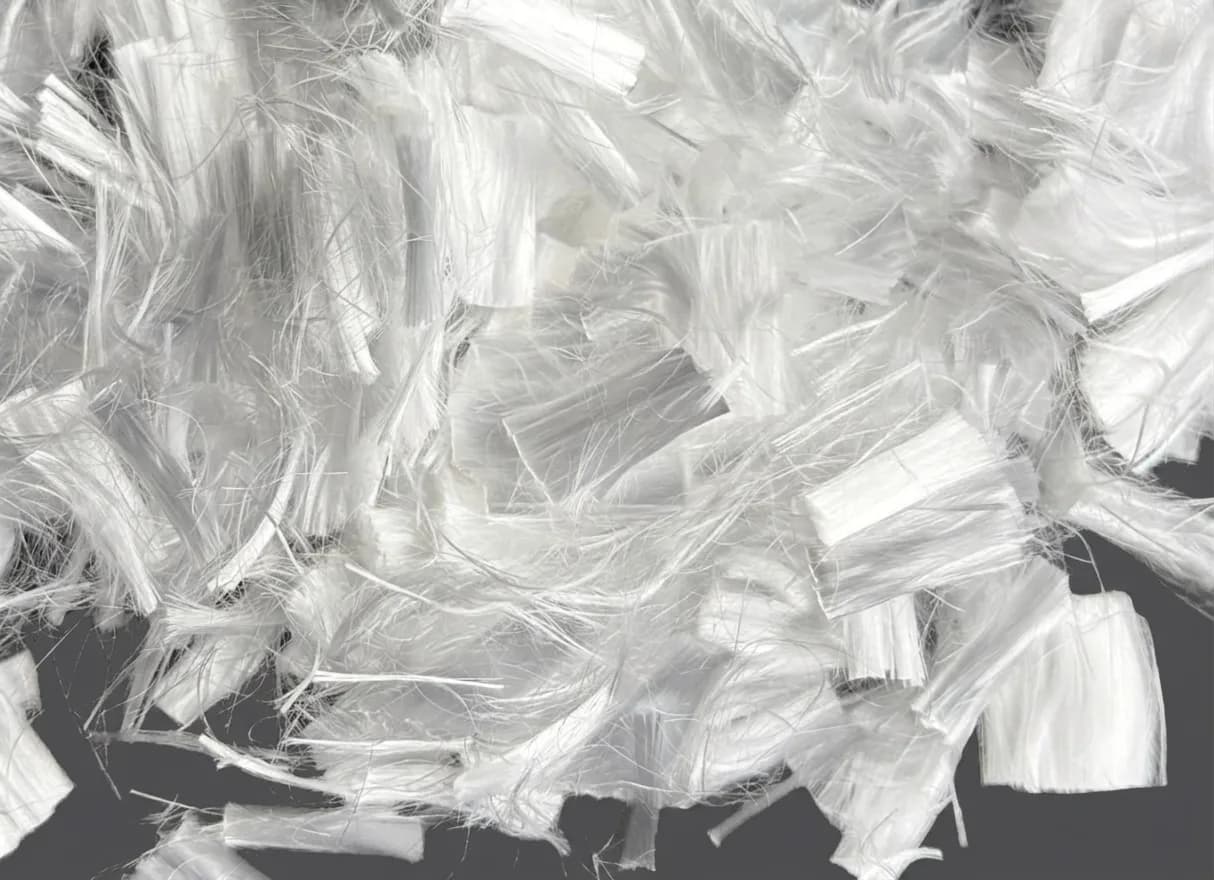
• Monofilament micro fibre — single, smooth fibres with a round cross-section (such as Promicro: 12 mm long, 32 µm thick, fibre class 1a according to EN 14889-2). They disperse very finely through the mix and are the most effective against fine shrinkage cracks; they also improve surface quality.
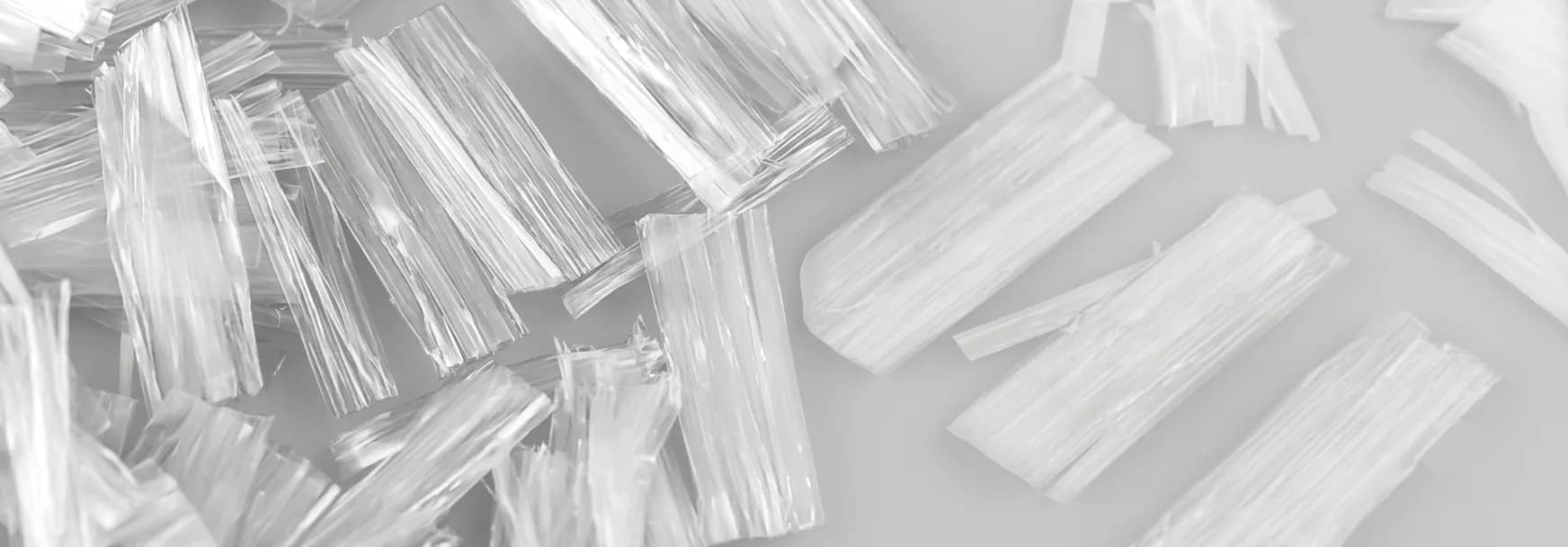
• Fibrillated polypropylene fibre — tape fibres with a mesh structure (such as Profib, 6 and 12 mm). The network bonds more strongly to the hardened cement paste and therefore performs well in leaner mixes such as sand-cement screeds.
The dosage is low for both: 0.6–1.0 kg per m³. For a screed of 60 m² at 6 cm thick (3.6 m³ of mortar) you need about 2.2 to 3.6 kg of fibres: a small intervention that sharply reduces the risk of shrinkage cracks during the critical first day. Important to know: a PP micro fibre against plastic shrinkage does not replace structural reinforcement. If that is what you expect, you need a macro fibre.
Macro fibres: structural synthetic fibres
Structural synthetic macro fibres (EN 14889-2 class II) are a different calibre: thicker fibres of around 48 mm that keep transferring force after cracking, comparable to the role of a reinforcement mesh in a ground-bearing floor. They are dosed at 2–6 kg/m³, depending on loading, slab thickness and sub-base. How that residual strength after cracking arises is explained in how structural fibres work in concrete.
Within our programme these are two fibres, each with its own profile:
• TwistR® — a hybrid polypropylene macro fibre with a twisted structure made of 100% virgin PP. The twisted shape anchors itself mechanically in the concrete matrix. TwistR is widely used in industrial floors, cycle paths and yard pavings, with up to 98% CO₂ reduction compared with steel reinforcement (CE marked, with EPD).
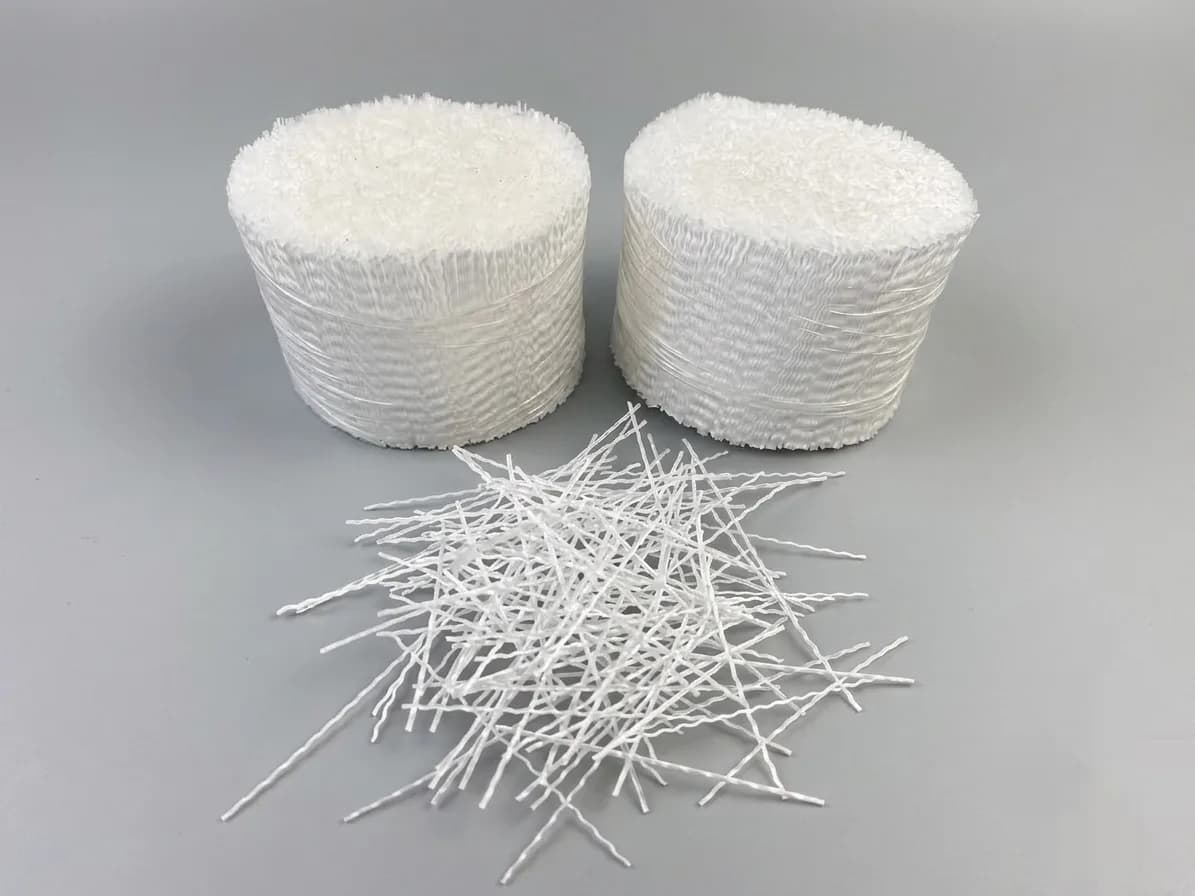
• Wiking 4050 TR — a polyolefin macro fibre for demanding floors: 48 mm long, 700 µm thick, tensile strength 557 MPa. Resistant to both acids and alkalis, and thereby ideally suited to agricultural floors, greenhouse floors and other rough, chemically exposed applications.
In practice, a macro fibre such as TwistR delivers a double benefit on floors and pavings: the fixing and placing of mesh is eliminated, so pouring can start as soon as the sub-base is ready, and the fibres work through the full slab thickness. At the NDSM Werf in Amsterdam, for example, the foundations of the tree and flower planters were reinforced with TwistR alone, without steel reinforcement, and on the N344 cycle path in Barneveld a 12 cm TwistR concrete pavement was laid over the existing asphalt.
Synthetic fibre concrete mix: dosage per fibre type
The right dosage depends on application and mix; the table below gives guideline values as a starting point.
For comparison: steel fibres are dosed at 25–50 kg/m³ for comparable structural applications. That difference comes from the specific weight (synthetic weighs 0.91 g/cm³, steel over 7.8), so 3 kg of synthetic fibre represents many times the number and distribution of steel fibres. Want to know what that means in cost? The savings calculator compares the cost of TwistR fibre reinforcement with traditional steel mesh reinforcement per m² and per project; dosages for steel and basalt fibres per application are in the concrete fibre dosage guidelines.
| Fibre type | Function | Dosage | Typical use |
|---|---|---|---|
| Monofilament PP micro fibre | Shrinkage crack control | 0.6–1.0 kg/m³ | Concrete floors, screeds, precast |
| Fibrillated PP micro fibre | Shrinkage crack control | 0.9–1.0 kg/m³ | Sand-cement screeds, concrete floors |
| Synthetic macro fibre | Structural, light loading | 2–3 kg/m³ | Lightly loaded floors and pavings |
| Synthetic macro fibre | Structural, heavier loading | 4–6 kg/m³ | Industrial and warehouse floors |
Ordering and mixing synthetic fibre concrete
• Order it ready-mixed: put the fibre type and the dosage in kg/m³ on the order, and the plant adds the fibres during batching. How plants handle this is covered in fibres at the concrete plant.
• Adding fibres on site: add them gradually to the truck mixer with the drum at full mixing speed, then keep mixing for four to five minutes (rule of thumb, follow the datasheet) so the fibres disperse without balling.
• Workability: macro fibres reduce the slump of the mix; the plant corrects this with a plasticiser. Do not add water on site, because extra water lowers strength and increases shrinkage. Micro fibres at 0.6–1.0 kg/m³ have only a limited effect on workability.
• Pumping and finishing: a mix with up to around 6 kg/m³ of synthetic fibre can be pumped, placed and finished with the usual equipment; power floating with macro fibres needs a little extra care (see below).
When is synthetic fibre the right choice?
Synthetic fibre reinforcement is the logical choice when one or more of these points apply:
• Corrosion is a risk — external floors, hydraulic works, damp livestock housing or exposed floors where rust specks from steel fibres at the surface are unacceptable.
• Shrinkage crack control comes first — screeds, patios and large flat surfaces; here a micro fibre often suffices. For outdoor applications such as patios there is also the freeze-thaw advantage, see synthetic fibres for patio floors.
• Chemical exposure — manure acids and cleaning agents in agricultural applications do not attack polyolefin fibres.
• Pumpability — at dosages up to around 6 kg/m³ the mix remains readily pumpable; ideal where the concrete is placed by pump.
• Light and safe working — no heavy mesh to lift or set, no cutting edges; relevant from small renovation floors to large pours without a crane.
• Magnetically neutral — for floors with induction loops or sensitive equipment, non-magnetic reinforcement is a hard requirement that synthetic meets by nature.
Synthetic fibre concrete floors: which fibre for which floor?
For a synthetic fibre concrete floor, the fibre type follows from what the floor has to do. As a guide:
• Garage, shed or workshop floor on a sub-base: a macro fibre at 2–3 kg/m³ takes over the role of the light mesh. The slab thickness per use is covered in how thick a concrete floor should be.
• Industrial and warehouse floors: a macro fibre at 4–6 kg/m³, or steel fibre for very high point loads and intensive forklift traffic; the floor designer sets the dosage. In the UK, Concrete Society TR34 is the usual design guide for industrial ground floors, and TR65 covers macro synthetic fibre concrete. More in fibre reinforced industrial floors.
• Agricultural floors (livestock housing, silage clamps, yard paving): a polyolefin macro fibre that is not attacked by manure acids or cleaning agents.
• Power-floated floors: synthetic fibre concrete can be power floated like plain concrete; with macro fibres a few fibre ends may remain visible at the surface, so agree the finish in advance. See power-floated concrete floor.
• Screeds: a micro fibre, see the next section.
Whatever the floor, fibres do not replace a sound sub-base, joints at the right spacing and proper curing: a fibre concrete floor cracks less, provided the basics are right.
Synthetic fibres in the screed
The biggest everyday application of synthetic fibres is not the spectacular industrial floor, but the ordinary screed — known in Flanders as the chape. Sand-cement screeds are mixed lean and dry out over a large surface: exactly the conditions in which plastic shrinkage cracks form. Fibres for the screed are therefore almost always micro fibres; the fibrillated variant is preferred here because the network bonds better in lean mortar.
The dosage is 0.9–1.0 kg per m³ of mortar. For an average residential storey of 50 m² at 6 cm screed thickness, that is around 3 m³ of mortar and thus roughly 3 kg of fibres: a small material cost compared with breaking out and repairing a cracked screed. How to build up and finish the screed further is covered in our article on the sand-cement screed.
Note: a floating screed that lies on insulation and carries heavier loads (for example underfloor heating with natural stone) may call for a macro fibre or additional reinforcement. If you are unsure which type suits your floor build-up, go through the product finder — it advises based on application, thickness and loading.
And what about steel fibre?
For heavily mechanically loaded floors — think of assembly halls with intensive forklift traffic or high point loads from racking — steel fibre offers more structural value per kilogram, thanks to the much higher modulus of elasticity and tensile strength of steel. Synthetic macro fibres win on corrosion resistance, weight, ease of handling and CO₂ footprint. The full trade-off, including cost per m² and standard performance according to EN 14651, can be found in steel fibres vs synthetic macro fibres.
One caveat applies to every fibre type: fibres do not always fully replace traditional reinforcement. For self-supporting or structurally designed elements (beams, walls, heavily loaded foundations), a calculation by the structural engineer remains necessary — the engineer determines whether fibres replace, supplement or combine with the reinforcement.
How to choose the right fibre type
The choice can be summed up in three questions. One: does the fibre only need to control shrinkage or also take up force after cracking? Shrinkage → micro fibre; force → macro fibre. Two: how rough or chemically exposed is the application? Agricultural and acidic environments → polyolefin (Wiking 4050 TR, see agricultural concrete reinforcement for dosages per application); industrial floors and pavings → TwistR. Three: is it a screed? Then a fibrillated or monofilament micro fibre at 0.6–1.0 kg/m³ is almost always the answer.
View the full overview of synthetic and steel fibres for concrete with specifications and datasheets, or request a quote with your floor area and application — we will calculate the dosage and the number of boxes for you.
Frequently asked questions
- What is synthetic concrete?
- In floor and paving work the term usually means synthetic fibre concrete: ordinary concrete with polypropylene or polyolefin fibres in the mix, either micro fibres against shrinkage cracks or macro fibres as a replacement for mesh. Occasionally it refers to polymer (resin) concrete, in which a resin replaces cement as the binder; that is a different material, used mainly for precast drainage channels and repairs.
- Is synthetic fibre concrete suitable for floors?
- Yes. A macro fibre at 2–3 kg/m³ replaces light mesh in ground-bearing floors such as garage and shed floors; industrial floors take 4–6 kg/m³, or steel fibre for very high point loads. Screeds use a micro fibre at 0.6–1.0 kg/m³. Suspended or structurally designed floors always need a calculation by the structural engineer.
- How are synthetic fibres added to a concrete mix?
- Normally the concrete plant adds them during batching, based on the fibre type and dosage on your order. On site, fibres can be added to the truck mixer with the drum at full mixing speed, followed by four to five minutes of extra mixing (rule of thumb, follow the datasheet). Correct any loss of workability with a plasticiser, not with water.
- What is the difference between micro fibres and macro fibres?
- Micro fibres (around 12 mm, dosage 0.6–1.0 kg/m³) control plastic shrinkage cracks in the first hours after pouring, but make no structural contribution. Macro fibres (around 48 mm, 2–6 kg/m³) are EN 14889-2 class II fibres that take up tensile force after cracking and can thereby replace a reinforcement mesh in floors and pavings.
- How much synthetic fibre goes into a m³ of concrete?
- For shrinkage control, 0.6–1.0 kg of micro fibre per m³ suffices. Structural synthetic macro fibres are dosed at 2–6 kg/m³: 2–3 kg for lightly loaded floors and pavings, 4–6 kg for industrial floors with heavier loading. The exact dosage depends on slab thickness, sub-base and loading; request a quote with your floor area and application and we will work out the dosage for your project.
- Do synthetic fibres fully replace the reinforcement mesh?
- In many ground-bearing floors, pavings and precast elements, yes: a structural macro fibre at the right dosage takes over the role of the mesh there. For self-supporting or structurally designed elements, a calculation by the structural engineer remains necessary — the engineer determines whether fibres replace or supplement the traditional reinforcement.
- Are synthetic fibres suitable for a screed?
- Yes, this is in fact the most common application. For a sand-cement screed you use a fibrillated or monofilament PP micro fibre at 0.6–1.0 kg per m³ of mortar. The fibres prevent plastic shrinkage cracks during drying; for heavily loaded floating screeds a macro fibre may be required.
- What does synthetic fibre reinforcement cost?
- Indicatively (2026 price levels, depending on project and volume): micro fibres at 0.6–1.0 kg/m³ add only a few euros per cubic metre of concrete, and structural macro fibres at 2–6 kg/m³ add roughly €15–45 per m³, depending on the dosage. In return, with macro fibres the steel fixing, mesh and placing time are eliminated. The full build-up is in fibre reinforced concrete cost per m³; current prices per kilo are on the product pages.
- Do synthetic fibres rust in concrete?
- No. Polypropylene and polyolefin are non-corrosive and fully alkali resistant in the concrete environment. So no rust stains form at the surface and there is no cover requirement from a corrosion perspective — an important advantage over steel fibres for exposed floors, external floors, hydraulic works and damp agricultural environments.
Share this article
Products mentioned
 Most chosen
TwistR® GREEN HYBRID
High-performance synthetic macro fibres made from 100% polypropylene. Transforms concrete into a stronger composite material.
- TypeHybrid: twisted monofilament + fibrillating network fibre
- Material100% virgin polypropylene
- Length48 mm
- Dosage2.0 – 6.0 kg/m³
Pallet price on request
Wiking 4050 TR
High-performance polyolefin macro fibre, ideally suited to rough floors — a strong and cost-effective alternative to steel reinforcement.
- TypePolyolefin macro fibre (monofilament)
- Length48 mm
- Diameter700 µm
- Tensile strength557 MPa
Pallet price on request
Promicro
Synthetic PP monofilament micro fibre against plastic shrinkage cracks. Homogeneous dispersion and better surface quality at a low dosage.
- TypePolypropylene monofilament (round cross-section)
- Length12 mm
- Equivalent diameter32 µm
- Linear density6.5 dpf
Pallet price on request
Profib
Fibrillated PP micro fibre for plastic shrinkage crack control, strong in sand-cement screeds. Disperses homogeneously through the concrete.
- TypePolypropylene (fibrillated tape)
- Length12 mm
- Number of fibres per kg100,000
- Tensile strength370 MPa
Pallet price on request
Also read
- Steel fibres or synthetic macro fibres? How to choose the right reinforcement
- Preventing shrinkage cracks in concrete: micro fibres in practice
- Sand cement screed: thickness per type, drying time, mix ratio, cost and crack control with shrinkage fibre