Fibre reinforced concrete foundations: when do fibres replace mesh?

From garden rooms to raft slabs: fibre reinforced concrete foundations replace the mesh and cages with steel or synthetic fibres. Which foundation types suit fibres, how to pour, and where the limit lies.
Fibre reinforced concrete foundations use steel fibres (around 20–35 kg/m³) or synthetic macro fibres (3–6 kg/m³), mixed in at the concrete plant, instead of mesh or cages. For light to medium-duty foundations, such as garden rooms, lighting columns, raft slabs and yard paving, the fibres often replace the reinforcement entirely. Heavy structural work still needs bars to a structural engineer's calculation.
Reinforcement in a foundation absorbs the tensile forces from uneven settlement of the ground and from point loads of the structure above. Fibres do that throughout the whole volume of the concrete, so there is nothing to cut, tie or set on spacers. Below: which foundation types suit fibres, steel or synthetic, a pouring plan, detailing, a case study and indicative costs.
Why does a concrete foundation need reinforcement?
Concrete is excellent at carrying compression, but under tension it fails at roughly one tenth of that compressive strength. Yet a concrete foundation is constantly subjected to tensile stresses. The ground settles unevenly, the structure above bears down in concentrated fashion on pads or strips, and in external applications temperature fluctuations and sometimes traffic loading are added on top. Without reinforcement the concrete cracks under those stresses, and cracks in a foundation ultimately compromise the stability and watertightness of the entire structure.
A reinforced foundation solves this by adding a material that does absorb the tensile forces. Traditionally that means reinforcement mesh (for floor slabs and strips) or tied cages (for beams and pads) made of reinforcing steel. Fibre reinforcement does the same in a different way: millions of short fibres are mixed in by the concrete truck and distribute themselves randomly throughout the entire volume. The crack-bridging mechanism behind this is set out in how fibre reinforcement works in concrete; how the two principles compare is explained in detail in fibre reinforced concrete versus traditional reinforcement.
Fibre reinforcement in the foundation: steel fibres or synthetic?
Two fibre types are most commonly used for foundations, both CE-marked in accordance with EN 14889 and with a demonstrable residual flexural strength to EN 14651:
• Steel fibres — hooked-end, drawn steel wire fibres such as the MPZG HT+ 35/0.55, a hooked-end steel fibre with high tensile strength. Typical dosage for foundation applications: 20–35 kg/m³. The end hooks anchor themselves in the concrete matrix and deliver the highest post-crack capacity — the logical choice for heavier strips, pads and foundation slabs. More on dosages and rates can be found in our overview of steel fibre concrete: dosage and price per m³.
• Synthetic macro fibres — such as TwistR, a synthetic macro fibre as a corrosion-free alternative, made of 100% polypropylene with a twisted structure. Typical dosage: 3–6 kg/m³. Synthetic fibres do not rust, which makes them suitable for foundations in permanent contact with moisture or groundwater, and they are considerably lighter to transport and handle.
In both cases an entire operation is eliminated: no mesh or cages need to be delivered, cut, tied and set on spacers. The reinforcement comes ready-mixed from the truck. Around service penetrations and earthing points — places where mesh is awkward to fit — the fibre reinforcement is simply present everywhere in the concrete.
Steel fibre reinforced foundations: slabs, rafts, pads and strip footings
Steel fibre reinforced foundations work best where the foundation behaves as a slab: ground-bearing slabs, raft foundations under garages and outbuildings, and heavier yard slabs. The Concrete Society notes that steel fibres are also increasingly used in pile-supported ground floor slabs, replacing much and in some designs all of the conventional reinforcement. That is always a designed solution, not a like-for-like swap.
Strip footings and trench fill for low-rise housing are often poured as plain (mass) concrete in UK practice, because the concrete there works mainly in compression. Fibres are then not a structural requirement, but they do limit early shrinkage and settlement cracking. Pads and ground beams that carry bending need a design: fibres alone, or fibres combined with bars in the tension zone.
For design guidance in the UK, Concrete Society Technical Report 34 covers concrete industrial ground floors, including fibre reinforced ground-supported and pile-supported slabs, TR63 the design of steel fibre reinforced concrete and TR65 the use of macro-synthetic fibre reinforced concrete. The fibres themselves are declared under BS EN 14889-1 (steel) and BS EN 14889-2 (polymer), explained in EN 14889 and CE marking for fibre concrete. For a side-by-side comparison of both fibre families, see steel fibres versus synthetic macro fibres.
Which foundation type is suitable for fibre reinforcement?
Not every foundation lends itself equally well to full replacement of the traditional reinforcement. As a rule of thumb per foundation type:
• Foundation for a garden room, shed or outbuilding: suitable. Fibres fully replace the mesh.
• Foundations for lighting columns, road signs and street furniture: suitable. A proven application in the public realm.
• Foundations for tree and planter boxes: suitable. See the case study further on.
• Foundation under yard paving and hard landscaping: suitable. Evenly distributed loading is a good match for fibres.
• Foundation as a floor slab or raft under a light structure (garage, shed, ground-bearing extension): suitable to combined. Often entirely on fibres, with fibres plus edge reinforcement at higher loads.
• Pads and beams with limited spans: combined. Fibres for crack control, with localised bar reinforcement where the structural engineer identifies tension zones.
• Reinforced strip foundation (strip footing) under housing: combined. Fibres can take over part of the reinforcement, but the continuous longitudinal bars usually stay. Plain trench fill is usually designed without reinforcement.
• Foundations under multi-storey buildings, basements, piled foundations with moment-resisting connections: not without a calculation. Here traditional reinforcement remains the basis, possibly supplemented with fibres against shrinkage cracks.
The limit lies at concentrated tensile forces and structural cross-sections designed for bending moments. Fibres do not always fully replace traditional reinforcement; structural work calls for a calculation by the structural engineer. For the background to all these considerations, the pillar page on fibre reinforced concrete is the starting point.
Pouring a foundation with fibre reinforcement: step by step
Pouring a foundation with fibre concrete is largely the same as a traditional pour. The biggest difference is what you no longer have to do: lay reinforcement. The step-by-step plan:
• Step 1: determine type and dimensions. Choose strip, slab or pads based on the structure and the bearing capacity of the ground. If in doubt about slab thickness, read how thick a concrete floor should be — the same logic applies to foundation slabs.
• Step 2: excavate and compact. Dig down to frost-free or load-bearing depth (in the Netherlands 60–80 cm is customary for strips; a slab on well-compacted sand can be shallower). Compact the sand bed in layers and apply a membrane or blinding layer where needed.
• Step 3: set the formwork and mark the pour level. With fibre concrete there are no spacers or mesh supports to place — the formwork can be closed up straight away.
• Step 4: order the fibre concrete. The concrete plant doses the fibres mechanically into the mixer, so the distribution is homogeneous. Specify the strength class (usually C20/25 to C30/37 for foundations; in the UK often a designated mix to BS 8500), the exposure class and the agreed fibre type with dosage. Which dosage suits which fibre type and application is set out in our concrete fibre dosage guidelines.
• Step 5: pour and compact. Pour in a single operation and compact with a poker vibrator; the fibres distribute themselves through the volume. Fibre concrete can be pumped and placed normally.
• Step 6: finish and cure. Level the foundation, cover it against drying out and keep the surface moist for at least a week. An extended version of this process, including planning and common mistakes, is set out in the complete guide to pouring fibre reinforced concrete.
Example: a concrete foundation for a garden room or shed
A foundation for a garden room of, say, 3 × 4 metres is a typical case where fibre reinforcement fully replaces the mesh. A foundation slab 12–15 cm thick in C20/25 with 3–4 kg/m³ of synthetic macro fibre or around 20 kg/m³ of steel fibre carries a timber or masonry garden room with ease. For a slab of over 1.5 m³ that saves not only the reinforcement mesh itself, but above all the cutting to size, laying and setting of it — easily half a day's work for a self-builder.
A note on rapid-set concrete: bags of fast-drying concrete mix are handy for individual small pads under a shed floor on bearers, but they contain no reinforcement and are not suitable for pouring a load-bearing slab or strip. For anything larger than a pad, dosed fibre concrete from the truck is the more reliable and, per cubic metre, cheaper route.
Thickness and detailing of the reinforcement in a foundation
With traditional reinforcement, the detailing is critical. The cover, the layer of concrete between the reinforcement and the outer face, must be 25 to 50 mm depending on the exposure class to prevent corrosion, and more where the concrete is cast against the ground: Eurocode 2 recommends at least 40 mm on blinding and 75 mm directly against soil. Mesh (usually Ø6 to Ø10 mm) must sit at the right height in the cross-section, overlap by at least 30 to 50 times the bar diameter, and requires starter bars and hooks at corners and connections. Every detail that goes wrong on site — mesh sagged too low, cover too small, lap too short — directly costs capacity or durability.
Fibre reinforcement has none of those detailing risks. Because the fibres are present throughout the volume, there are no cover requirements for the fibres themselves, no lap lengths and no corner starter bars. The thickness of the foundation is therefore not determined by the space the reinforcement needs, but purely by the loading: 10–12 cm suffices for light slabs, while 15–25 cm is used for more heavily loaded strips and slabs. In hybrid solutions — fibres plus local bars — the classic detailing rules naturally still apply to the steel part.
Case study: 1,500 kg of reinforcing steel saved
In a municipal project, the foundations for tree and planter boxes were converted from traditional steel reinforcement to fibre reinforcement. The result: a net saving of 1,500 kg of reinforcing steel and a CO₂ reduction of 98% on the reinforcement component (the reinforcement itself, not the entire foundation) compared with steel reinforcement. Converting the design took just two days, including approval from the municipality.
That ratio is no exception: because fibre dosages per cubic metre are a fraction of the weight of mesh and cages, the saving carries through on every foundation in material, transport and emissions. How to quantify that gain yourself — useful for MEAT tender plans and the CO₂ performance ladder — is set out step by step in the worked example of CO₂ savings with fibre reinforcement.
What does fibre reinforcement for a foundation cost?
Indicatively (2026 price level, depending on project and volume): synthetic macro fibre at 3–6 kg/m³ adds roughly €15–45 per cubic metre of concrete, steel fibre at foundation dosages around €25–60 per m³. Set against that, reinforcement mesh including cutting, laying and setting quickly costs €10–20 per m² of floor area and requires its own operation with labour hours. For light to medium-duty foundations, fibre concrete therefore usually works out both cheaper and faster on balance; the break-even point varies per design.
Want to weigh it up for your own foundation? Use the selection guide to find the right fibre type, or request a quotation straight away with the dimensions of your foundation. We advise free of charge on fibre type and dosage, and liaise with your structural engineer or concrete plant where needed.
Frequently asked questions
- Can you use fibre reinforced concrete for foundations?
- Yes, for light to medium-duty foundations: slabs and rafts under garden rooms, garages and outbuildings, pads for lighting columns and street furniture, and yard paving. Steel fibres at around 20–35 kg/m³ or synthetic macro fibres at 3–6 kg/m³ then replace the mesh or cages entirely. Reinforced strip footings under housing, pads and beams that carry bending, and multi-storey foundations combine fibres with bar reinforcement, to a structural engineer's calculation.
- Can a foundation do without reinforcement?
- Sometimes. A small individual pad under a light, non-load-bearing item can, and strip footings and trench fill under low-rise housing are often designed as plain (mass) concrete in UK practice, because they work mainly in compression. A foundation that has to bridge uneven settlement, spread point loads or carry bending, such as a slab, raft or ground beam, needs reinforcement: traditional steel or fibre reinforcement. Unreinforced concrete cracks under those stresses, and cracks in a foundation undermine the stability and watertightness of everything built on it.
- How much steel fibre does a foundation need per m³?
- For foundation applications the steel fibre dosage typically lies between 20 and 35 kg/m³, depending on loading, slab thickness and fibre type. A hooked-end high-tensile fibre such as the MPZG HT+ 35/0.55 delivers more post-crack capacity per kilo than a standard fibre, so the dosage can come out lower. The exact dosage follows from the calculation; for a first indication, send us the dimensions and loading of your foundation via a quotation request.
- Steel or synthetic fibres for a foundation: which do I need?
- Choose steel fibres, such as the MPZG HT+ 35/0.55, for heavier strips, pads and foundation slabs where the highest post-crack capacity counts. Choose a synthetic macro fibre such as TwistR where the foundation stays wet or sits in groundwater, because it cannot corrode, and where light handling matters. Micro fibres only control plastic shrinkage cracking and do not replace reinforcement.
- Is fibre concrete suitable for the foundation of a garden room?
- Yes. A foundation slab of 12–15 cm in C20/25 with 3–4 kg/m³ of synthetic macro fibre or around 20 kg/m³ of steel fibre carries a garden room or shed with ease, without reinforcement mesh. That saves the cutting, laying and setting of mesh — easily half a day's work for a self-builder. Bags of rapid-set concrete are only suitable for individual small pads, not for a load-bearing slab.
- Do fibres replace the reinforcement in every foundation?
- No. For light to medium-duty foundations with evenly distributed loading, fibres often fully replace the mesh and cages. For primarily structural foundations — multiple storeys, basements, moment-resisting connections — traditional reinforcement remains the basis and fibres are at most used in addition, against shrinkage cracks. For structural work, always have the choice substantiated with a calculation by the structural engineer.
- What does fibre reinforcement cost compared with reinforcement mesh?
- Indicatively (2026 price level): synthetic macro fibre adds roughly €15–45 per cubic metre of concrete, steel fibre at foundation dosages around €25–60 per m³. Reinforcement mesh including labour quickly costs €10–20 per m² and requires its own operation. For light to medium-duty foundations, fibre concrete therefore usually works out cheaper on balance; request a quotation for a project-specific comparison.
Share this article
Products mentioned
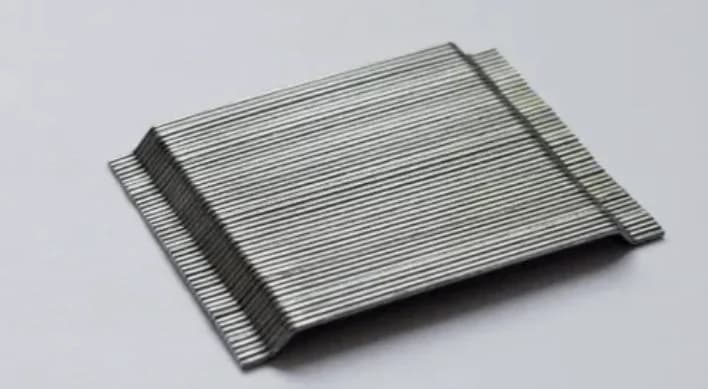
MPZG HT 35/0.55
High-tensile hooked steel fibres with aspect ratio 35/0.55. Maximum anchorage and ductility for heavily loaded structures.
- TypeCold-drawn hooked steel fibre (glued)
- Dimensions35 mm / Ø 0.55 mm
- Tensile strength1345 N/mm² ± 7.5%
- Modulus of elasticity200,000 N/mm²
Pallet price on request
 Most chosen
TwistR® GREEN HYBRID
High-performance synthetic macro fibres made from 100% polypropylene. Transforms concrete into a stronger composite material.
- TypeHybrid: twisted monofilament + fibrillating network fibre
- Material100% virgin polypropylene
- Length48 mm
- Dosage2.0 – 6.0 kg/m³
Pallet price on request