fib Bulletin 105: the international standard for fibre reinforced concrete

For anyone working seriously with fibre reinforced concrete, fib Bulletin 105 is indispensable. It compiles the up-to-date design knowledge that Model Code 2020 left open — and bridges to Eurocode 2 and CUR Recommendation 111.
fib Bulletin 105 is the state-of-the-art report of the International Federation for Structural Concrete (fib) on fibre reinforced concrete, published at the end of 2022. It compiles the international design knowledge — from residual strength and limit states to UHPFRC — that Model Code 2020 covers only briefly, making it the most complete design basis for structural engineers working with fibre concrete.
What is fib Bulletin 105?
At the end of 2022, fib Bulletin 105 was published by the International Federation for Structural Concrete (fib), the international concrete federation that also publishes the Model Codes. The report contains the current state of knowledge on Fibre Reinforced Concrete (FRC) — deliberately not limited to steel fibre concrete, but covering multiple fibre types, including synthetic macro fibres.
The report characterises fibre reinforced concrete through its post-cracking behaviour: because fibres bridge crack faces, the concrete retains tensile strength after cracking. Unreinforced concrete loses its tensile strength almost immediately upon cracking; fibre concrete retains a measurable residual strength. That single mechanism underpins every structural design with fibres — and is therefore the thread running through the entire bulletin.
For Dutch practice this matters because the knowledge centre theme sustainability, standards and innovation converges here: without broadly supported design rules, fibre concrete remains confined to non-structural applications, however well the material performs.
Why Model Code 2020 needed this report
Before fib Bulletin 105, there was no comprehensive, internationally supported reference work devoted specifically to designing with fibre reinforced concrete. Model Code 2010 was the first to introduce a usable FRC classification; Model Code 2020 continues that line, but does not treat the subject in the depth that practice now demands. Over the past decade, fibre concrete has moved on from shrinkage control in floors to (semi-)structural elements — and that shift calls for detailed design rules, worked examples and assessment frameworks.
Bulletin 105 fills exactly that gap: it is not a standard with binding requirements, but the reference document to which structural engineers, checkers and clients point when substantiating design decisions. Anyone who writes 'design in accordance with fib guidelines' in a specification or calculation is, in practice, leaning on this bulletin.
Residual strength: the core concept behind every fibre concrete design
All the design rules in fib Bulletin 105 revolve around the residual strength of fibre concrete after cracking. This is determined with the bending test to EN 14651: a notched prism of 150 × 150 × 550 mm is loaded in three-point bending, measuring the residual flexural tensile strengths fR,1 to fR,4 at increasing crack widths (CMOD from 0.5 to 3.5 mm).
Based on those test values, the fib system classifies the fibre concrete: a strength class based on fR,1k (the characteristic residual strength at small crack width) plus a letter a to e for the ratio fR,3k/fR,1k, which indicates whether the material loses strength at larger crack widths (softening) or retains it (hardening). A designation such as '3c' therefore tells a structural engineer at a glance what the material does after cracking.
Important to realise: the residual strength is not a product property of the fibre alone, but of the combination of fibre + dosage + concrete mix. The same fibre yields a different class at 20 kg/m³ than at 35 kg/m³. Practical pointers per application can be found in our article on the dosage of concrete fibres.
What does the report cover?
fib Bulletin 105 addresses, among other things:
• The influence of fibre properties (material, length, anchorage, tensile strength) on the mechanical performance of the concrete.
• Methods for determining the mechanical properties of fibre concrete, with EN 14651 at the centre.
• Design in both the serviceability limit state (SLS) and the ultimate limit state (ULS) — the two main categories in which structural concrete is assessed.
• Durability aspects, fire safety and mix design.
• Strengthening of existing structures and seismic design.
• Worked design examples, from analytical hand calculations to advanced non-linear finite element analyses (NLFEA).
• Practical examples of Ultra-High Performance Fibre Reinforced Concrete (UHPFRC), in both the civil and building sectors.
UHPFRC: where the laboratory becomes practice
A dedicated chapter section is devoted to UHPFRC — ultra-high performance concrete with fibres, with compressive strengths indicatively above 150 N/mm² and fibre contents of around 2 to 3 per cent by volume, a multiple of common fibre concrete. UHPFRC enables slender, material-efficient structures: thin bridge decks, precast elements and repair layers that are not feasible with traditional reinforced concrete.
For the Dutch market, UHPFRC is above all a signal of the direction fibre reinforcement is taking; it features prominently in our overview of five trends in fibre reinforcement. The day-to-day work — industrial floors, foundations, precast — takes place in the regular FRC domain for which Bulletin 105 provides the design rules.
How does fib Bulletin 105 relate to Eurocode 2 and NEN-EN 1992?
Eurocode 2 (implemented in the Netherlands as NEN-EN 1992) is the legally anchored design standard for concrete structures — but the generation currently designated in building regulations contains no design rules for fibre reinforced concrete. Structural engineers wanting to include fibres structurally in their calculations therefore had to fall back on guidance outside the Eurocode: the fib Model Code, CUR Recommendations and, indeed, fib Bulletin 105.
That is changing. The new generation of Eurocode 2 (EN 1992-1-1, published in 2023) includes an annex for steel fibre reinforced concrete that brings designing with fibres inside the Eurocode system for the first time. National implementation — with the accompanying national annex — will follow over the coming years. The design philosophy of that annex leans heavily on fib thinking: the same residual strength classes, the same test method (EN 14651), the same limit state approach.
In practical terms this means: anyone designing today to fib Bulletin 105 and the Model Code classification will align almost seamlessly with the new NEN-EN 1992. The bulletin is therefore not a stopgap that will disappear, but the knowledge base on which the coming Eurocode generation builds — and it remains the more in-depth reference work alongside the more compact standard text.
Product standard, design guideline or recommendation: who does what?
Around fibre concrete, multiple standards and guidelines circulate, each covering a different part of the chain. The division of roles in one overview:
• EN 14889-1/-2 — product standard for the fibre itself: requirements for steel fibres (part 1) and polymer fibres (part 2), the basis for CE marking. Says nothing about the design of the structure.
• EN 14651 — test standard: prescribes how the residual strength of a fibre concrete mix is measured.
• CUR Recommendation 111 — Dutch design guideline for steel fibre concrete industrial floors on piles; for years the document with which structural steel fibre concrete was calculated in the Netherlands, but limited to that field of application.
• fib Model Code & fib Bulletin 105 — international design basis for the full FRC spectrum: from floors to walls, precast and strengthening of existing structures.
• NEN-EN 1992 (Eurocode 2) — the statutory design standard; gradually incorporates fibre concrete into the formal standard structure via the new annex.
In short: EN 14889 ensures that the fibre demonstrably performs, fib Bulletin 105 describes how you design a structure with that fibre. What CE marking and systems 1 and 3 mean for your choice of material is covered in our article on EN 14889 and CE marking for fibre concrete; all the standards at a glance can be found in the standards overview.
What does this mean for your project?
The impact of fib Bulletin 105 differs per role in the construction process.
For structural engineers
The bulletin offers a broadly supported, internationally recognised basis on which to substantiate design decisions — including worked calculation examples for SLS and ULS. That is directly usable towards Building Control or a checking bureau requesting substantiation for a design outside the CUR 111 field of application. It remains essential that you calculate with residual strength values from EN 14651 tests on the actual mix; structural steel fibres to EN 14889-1 are therefore supplied with declared performance data as a starting point.
For contractors and floor layers
You do not need to know the bulletin by heart, but it does determine what the structural engineer will require of your mix: a residual strength class rather than merely 'x kg of fibres per m³'. So ask your supplier for performance data per dosage and record the chosen class in the specification. That prevents disputes at handover — the test beams are then the yardstick, not the dosing ticket.
For clients and supervisory authorities
The report signals that fibre reinforced concrete is a mature, scientifically substantiated technology — not a niche without a normative basis. Anyone admitting or prescribing fibre concrete in a tender can point to Bulletin 105 as the assessment framework. Combined with the environmental gains of slenderer construction (less steel, less concrete), that also strengthens the sustainability score; see our article on sustainability certification of fibre materials.
Practical example: the BetonBallon concept
That the building sector is already working with this knowledge is shown by the BetonBallon concept, to which the report refers among others: a three-storey office building in Schijndel, built with fibre reinforced sprayed concrete. Not a floor or pavement layer, but a load-bearing building — an application that would not have passed assessment without a sound design basis for post-cracking behaviour. It illustrates the essence of Bulletin 105: fibre reinforced concrete has moved on from crack control to structure.
From report to specification: how to apply it
Want to put fib Bulletin 105 to practical use in a project? Three steps that prove themselves in practice:
• Have the structural engineer specify the required residual strength class (for example based on fR,1k and fR,3k), not just a fibre dosage.
• Choose a fibre with CE marking under EN 14889-1 (steel) or EN 14889-2 (synthetic) and declared performance; anyone wanting to design structurally with macro fibres instead of steel can follow the same classification system with hybrid synthetic macro fibres.
• Record how the residual strength will be demonstrated: EN 14651 tests on the project mix, or documented earlier test results for an identical recipe.
Unsure which fibre and dosage suit your application? The selection guide sets you on your way in a few questions, and for project-specific advice with performance data you can request a quotation. Fibres do not, incidentally, fully replace traditional reinforcement in every situation: structural work always requires a calculation by the structural engineer.
Frequently asked questions
- What is fib Bulletin 105?
- fib Bulletin 105 is a state-of-the-art report by the International Federation for Structural Concrete (fib), published at the end of 2022. It compiles the international knowledge on designing with fibre reinforced concrete: from residual strength determination to EN 14651 to assessment in SLS and ULS, durability, fire safety and UHPFRC. It is not a binding standard, but the reference document with which structural engineers substantiate design decisions for fibre concrete.
- What is the difference between fib Bulletin 105 and Model Code 2020?
- The fib Model Code is the overarching model code for concrete structures and treats fibre concrete only briefly within it. fib Bulletin 105 works that subject out in full: background, determination methods, calculation examples up to and including non-linear finite element analyses. In practice you use the Model Code for the framework and Bulletin 105 as the in-depth reference work for designing with fibre reinforced concrete.
- May I design structurally with fibre concrete to Eurocode 2 in the Netherlands?
- The currently designated generation of NEN-EN 1992 contains no design rules for fibre concrete; structural engineers therefore substantiate designs via CUR Recommendation 111 (industrial floors on piles), the fib Model Code and fib Bulletin 105. The new Eurocode 2 generation (EN 1992-1-1:2023) does include an annex for steel fibre concrete; after national implementation, fibre concrete will thereby gain a formal place in the standard.
- What is the residual strength of fibre concrete?
- Residual strength is the tensile strength that fibre concrete retains after it has cracked, because fibres bridge the crack faces. It is measured with a bending test to EN 14651, determining the residual flexural tensile strengths fR,1 to fR,4 at increasing crack widths. On that basis the mix is assigned a residual strength class — the design value with which the structural engineer verifies the design.
- Does fib Bulletin 105 replace CUR Recommendation 111?
- No. CUR Recommendation 111 remains the Dutch design guideline for steel fibre concrete industrial floors on piles and is directly usable for that field of application. fib Bulletin 105 is broader: it covers the full spectrum of fibre reinforced concrete, including walls, precast, strengthening of existing structures and UHPFRC. For applications outside the CUR 111 domain, the bulletin is therefore the appropriate substantiation.
- What is UHPFRC?
- UHPFRC stands for Ultra-High Performance Fibre Reinforced Concrete: ultra-high strength concrete with fibres, with compressive strengths indicatively above 150 N/mm² and fibre contents of around 2 to 3 per cent by volume. It enables very slender structures, such as thin bridge decks and repair layers. fib Bulletin 105 describes practical examples in both the civil and building sectors.
Share this article
Products mentioned
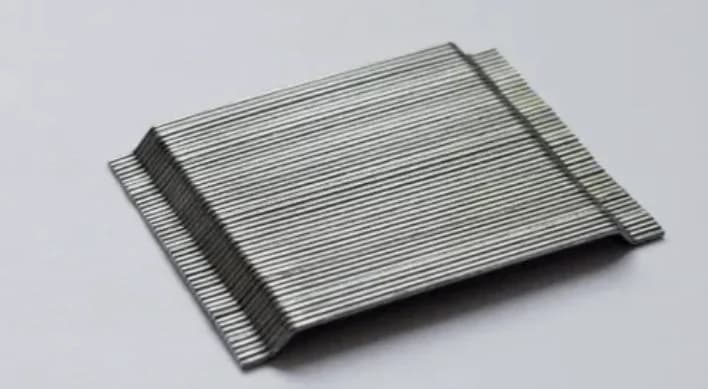
MPZG HT 35/0.55
High-tensile hooked steel fibres with aspect ratio 35/0.55. Maximum anchorage and ductility for heavily loaded structures.
- TypeCold-drawn hooked steel fibre (glued)
- Dimensions35 mm / Ø 0.55 mm
- Tensile strength1345 N/mm² ± 7.5%
- Modulus of elasticity200,000 N/mm²
Pallet price on request
 Most chosen
TwistR® GREEN HYBRID
High-performance synthetic macro fibres made from 100% polypropylene. Transforms concrete into a stronger composite material.
- TypeHybrid: twisted monofilament + fibrillating network fibre
- Material100% virgin polypropylene
- Length48 mm
- Dosage2.0 – 6.0 kg/m³
Pallet price on request