Fibre reinforced concrete vs traditional reinforcement: which do you choose when?

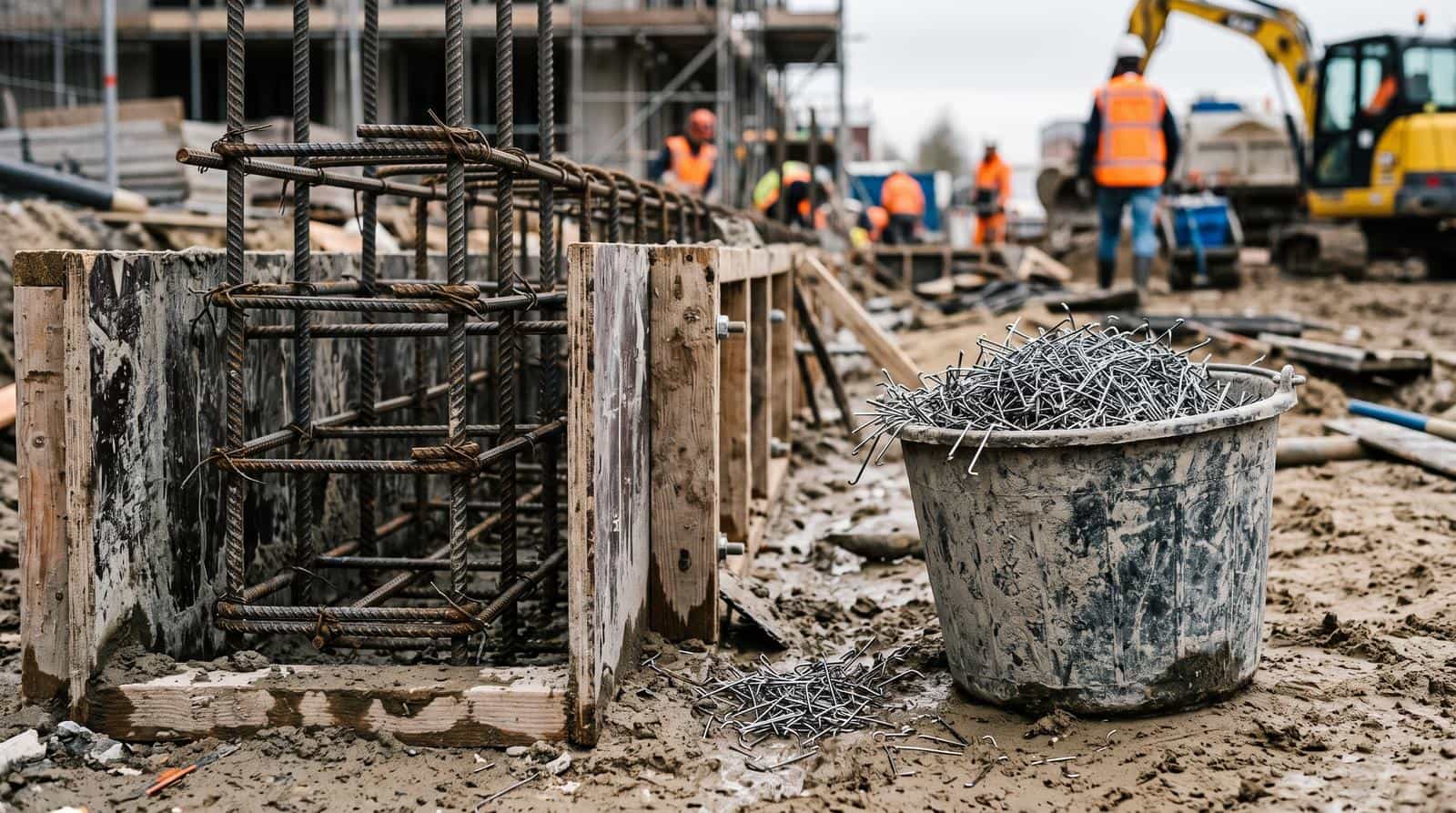
Fibre reinforcement or bars and mesh? Both resist the tensile forces concrete itself lacks. This decision guide sets out differences, costs and applications per project type.
Concrete reinforcement resists the tensile forces that concrete itself cannot handle: the tensile strength of concrete is only around 10% of its compressive strength. That can be done with traditional reinforcing steel (bars, mesh, cages) or with fibre reinforcement distributed throughout the entire mix. For floors, pavings and light foundations, fibres often suffice; for bridges and multi-storey buildings, bar reinforcement remains the basis.
What is concrete reinforcement and why does concrete need it?
Concrete is strong in compression, but weak in tension. A common concrete grade such as C30/37 achieves a compressive strength of 30 to 37 N/mm², while the tensile strength lingers around 2 to 3 N/mm². As soon as bending, shrinkage or point loads cause tensile stresses, unreinforced concrete cracks. Reinforcement — from classic reinforcing steel to modern fibres — takes over those tensile forces and keeps cracks closed or distributes them into harmless hairline cracks.
Reinforced concrete is thereby a composite: concrete provides the compressive capacity, the reinforcement the tensile capacity. Traditionally that is done with B500-grade reinforcing steel (yield strength 500 N/mm²), placed in the formwork as bars, mesh or tied cages at calculated positions. Fibre reinforcement tackles the same problem differently, as you can read in how fibre reinforcement works in concrete.
Traditional reinforcement: bars, mesh and cages
Traditional concrete reinforcement is positioned in the right place before pouring — usually where the highest tensile stress is expected — and works as a continuous, coherent whole. The three main forms:
• Reinforcing bars — loose B500 bars in diameters from 6 to 40 mm, tied on site into the required arrangement; maximum design freedom, but also the most labour hours.
• Reinforcement mesh and mesh fabric — prefabricated welded mesh for flat elements such as floors and walls; faster than loose bars, but with sawing, cutting and lap losses. Dimensions and weights can be found in the overview of reinforcement mesh sizes, which also covers the alternatives.
• Reinforcement cages — three-dimensionally tied cages for beams, columns, pad foundations and retaining walls; almost always the domain of the structural engineer.
Reinforcing steel must be protected with concrete cover — depending on the exposure class, some 20 to 50 mm of concrete between steel and outside air. That cover partly determines the minimum structural thickness and is at the same time the weak spot: wherever cover or crack control falls short, corrosion begins.
Fibre reinforcement: reinforcement straight from the mixer
Fibre reinforcement works fundamentally differently: millions of loose fibres are distributed randomly throughout the entire concrete volume during mixing. Instead of targeted reinforcement at calculated positions, a uniform strengthening arises through the whole cross-section — including in places where a mesh or bar would never sit.
Performance is standardised: fibres carry CE marking according to EN 14889 (part 1 for steel fibres, part 2 for polymer fibres) and the structural contribution is measured as residual flexural tensile strength according to EN 14651. Common dosages: steel fibres 25 to 50 kg/m³, structural synthetic macro fibres around 2 to 6 kg/m³, PP micro fibres against plastic shrinkage 0.5 to 2.5 kg/m³.
Within those categories there are large differences in performance. A structural macro fibre that replaces tied rebar such as TwistR combines corrosion-free performance with a twisted shape for maximum anchorage, while a high-tensile steel fibre with hooked ends such as the MPZG HT+ 35/0.55 is used where heavily loaded floors demand maximum residual strength and ductility.
Steel fibre concrete vs reinforced concrete: the key differences
Comparing steel fibre concrete and reinforced concrete is in effect comparing two philosophies of force transfer:
• Positioning — traditional reinforcement sits exactly where the calculation places it; fibres are everywhere, including where unforeseen loading occurs.
• Installation — tied rebar requires delivery, positioning, anchoring and inspection; fibres come ready-dosed out of the concrete mixer, without a separate work stage.
• Cracking behaviour — fibre concrete distributes stress across many fine hairline cracks; reinforced concrete concentrates cracks between the bars, with wider cracks if the reinforcement is too coarsely spaced.
• Corrosion — synthetic and basalt fibres do not rust; steel fibres at the surface can at most give cosmetic rust spots, but cause no expansive damage like corroding bars.
• Design calculation — for heavily loaded, primarily structural elements, bar reinforcement has the longest design and standardisation tradition; fibre concrete is increasingly given full recognition via the residual strength classes of the fib Model Code.
• Structural capacity — for very heavy, concentrated loads (bridges, multi-storey buildings), deliberately placed bar reinforcement still delivers the highest capacity.
In summary: fibres win on installation speed, uniform protection and corrosion-free performance; traditional reinforcement wins on calculable, targeted strength under heavy concentrated loads and on decades of design methods and practical experience.
Which do you choose when? Decision guide per application
The rules of thumb below give a first steer per application. All the underlying articles are collected in the pillar overview of fibre reinforced concrete.
• Industrial or monolithic concrete floor — fibre reinforcement; for heavy point loads from racking, steel fibre — see the dosage and prices of steel fibre concrete.
• Screed — micro fibres or a light macro fibre dosage instead of an anti-crack mesh.
• Patio, yard paving or parking floor — fibre reinforcement; no corrosion risk with synthetic fibre, so suitable for outdoors.
• Reinforced foundation under light to medium loading (shed, warehouse, house extension) — fibre reinforcement, often without or with greatly reduced tied rebar.
• Retaining wall — hybrid: fibres for crack control, bar reinforcement for the primary moments; always with a calculation.
• Precast elements — steel fibre can be dosed precisely in the factory and saves fixing time per element.
• Bridge, viaduct or multi-storey building — traditional reinforcement as the basis, possibly supplemented with fibres.
Unsure between fibre types? With the product finder you can identify the right fibre type within two minutes for your application, and the fibre calculator works out the required dosage straight away.
Hybrid reinforcement: fibres plus reduced bar reinforcement
In practice it is less and less an either-or question. In hybrid reinforcement, fibres take care of the fine crack control and the transfer of diffuse stresses (shrinkage, temperature), while a reduced amount of bar reinforcement provides the primary bending moments. International guidelines such as fib Bulletin 105 describe how the residual strength of fibre concrete may be included in such a combined design, allowing the structural engineer to demonstrably omit bars.
What that delivers in concrete terms was shown by a municipal project: the foundation for tree and planter boxes was converted from traditional steel reinforcement to fibre reinforcement. The result: a net 1,500 kg of reinforcing steel saved, a 98% CO₂ reduction on the reinforcement portion and a design conversion time of just two days, including approval from the municipality.
What does reinforced concrete cost — and what do you save with fibres?
Standard ready-mixed concrete costs indicatively €110 to €165 per m³ (2026 price levels, depending on strength class and region). The reinforcement costs come on top of that, and they differ sharply per method:
• Traditional reinforcement — material cost of the reinforcing steel plus the largest item: labour hours for delivering, cutting, fixing, positioning and inspecting.
• Steel fibre — an additional cost on the concrete price that at 25 to 30 kg/m³ can rise to around €45 per m³, without a separate work stage on site.
• Synthetic macro fibre — thanks to the low dosage (2 to 6 kg/m³), generally a lower direct additional cost per m³ than steel fibre.
The real saving of fibre concrete rarely lies in the material, but in labour hours, lead time and the elimination of failure costs from incorrectly positioned reinforcement. The full calculation for floors is set out in fibre concrete versus reinforcement mesh: time and cost; a broader price overview can be found in what fibre reinforced concrete costs.
Corrosion: the Achilles heel of reinforcing steel
Corrosion protection of reinforcing steel rests on two pillars: sufficient concrete cover and keeping cracks closed. As soon as carbonation or chlorides (de-icing salt, marine climate) reach the steel, it starts to rust and expand — the concrete spalls off and concrete decay sets in. That is precisely why standards prescribe thicker cover and stricter crack width requirements for aggressive exposure classes, making structures thicker and more expensive. How carbonation of concrete and chloride ingress break down the passive layer around the steel is explained step by step in a separate article.
Fibre reinforcement bypasses this mechanism in two ways. Synthetic and basalt fibres are immune to corrosion, so the cover requirement as corrosion protection lapses and thinner cross-sections become possible. And because fibres keep cracks finely distributed and narrow, in hybrid structures they also protect the remaining reinforcing steel: the narrower the crack, the more slowly moisture and chlorides penetrate.
How to make the choice for your project
Fibre reinforcement is not a universal replacement for traditional concrete reinforcement, but in many applications it is a faster, cheaper and equally effective alternative. Follow this order:
• Determine the application and loading — flat, evenly loaded elements are fibre candidates; concentrated, primarily structural loads require (also) bar reinforcement.
• Check the structural requirements — load-bearing work always requires a calculation by the structural engineer, including for fibre concrete or hybrid reinforcement.
• Choose the fibre type and dosage — via the product finder and the calculator, or ask us for project-specific dosage advice with EN 14651 substantiation.
Frequently asked questions
- What is reinforcement in concrete?
- Reinforcement is the strengthening material that takes up the tensile forces in concrete. Concrete has a tensile strength of only around 10% of its compressive strength and cracks without reinforcement under bending or shrinkage. Traditionally, concrete reinforcement consists of steel (bars, mesh, cages); modern fibre reinforcement distributes millions of steel, synthetic or basalt fibres through the entire mix.
- Can fibre concrete fully replace traditional concrete reinforcement?
- Often yes for floors, pavings, screeds and lightly to moderately loaded foundations. For primarily structural elements such as bridges, beams and multi-storey buildings, bar reinforcement remains the basis, possibly supplemented with fibres for crack control. For load-bearing work, always have the choice substantiated by a structural engineer, based on the residual strength according to EN 14651.
- What does reinforced concrete cost?
- Indicatively (2026 price levels): ready-mixed concrete costs €110 to €165 per m³, plus the reinforcement costs. With steel fibre that is an additional cost of up to around €45 per m³ without extra labour; with traditional reinforcement, material plus fixing hours come on top. See the price overview of fibre reinforced concrete for the full breakdown per method.
- Is a reinforced foundation always necessary?
- Virtually every foundation needs reinforcement against bending and shrinkage stresses, but that does not have to be tied rebar. For light to medium-weight foundations — sheds, warehouses, extensions — fibre reinforcement often suffices entirely, with a shorter build time as a bonus. For heavy or tension-loaded foundations, the structural engineer determines whether (additional) bar reinforcement is required.
- How is reinforcing steel protected against corrosion?
- By sufficient concrete cover (20 to 50 mm, depending on the exposure class) and by keeping cracks narrow, so that moisture and chlorides do not reach the steel. If that protection fails, the steel rusts, expands and concrete decay sets in. Corrosion-free synthetic or basalt fibres bypass this risk; in hybrid structures, fibres additionally protect the steel by keeping cracks finely distributed.
Share this article
Products mentioned
 Most chosen
TwistR® GREEN HYBRID
High-performance synthetic macro fibres made from 100% polypropylene. Transforms concrete into a stronger composite material.
- TypeHybrid: twisted monofilament + fibrillating network fibre
- Material100% virgin polypropylene
- Length48 mm
- Dosage2.0 – 6.0 kg/m³
Pallet price on request
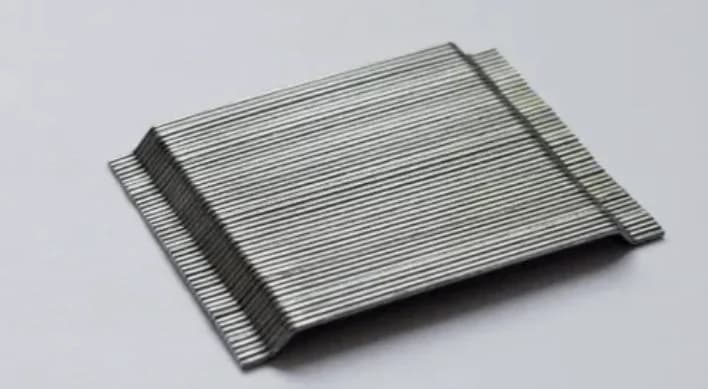
MPZG HT 35/0.55
High-tensile hooked steel fibres with aspect ratio 35/0.55. Maximum anchorage and ductility for heavily loaded structures.
- TypeCold-drawn hooked steel fibre (glued)
- Dimensions35 mm / Ø 0.55 mm
- Tensile strength1345 N/mm² ± 7.5%
- Modulus of elasticity200,000 N/mm²
Pallet price on request
Also read
- Fibre concrete vs reinforcement mesh: the difference in time and cost
- Steel fibre price: cost per kg and per m³, dosage and applications of steel fibre concrete
- Fibre reinforced concrete cost in 2026: concrete price per m³ with and without fibres