Fibres for precast concrete elements: types, dosage and production gains

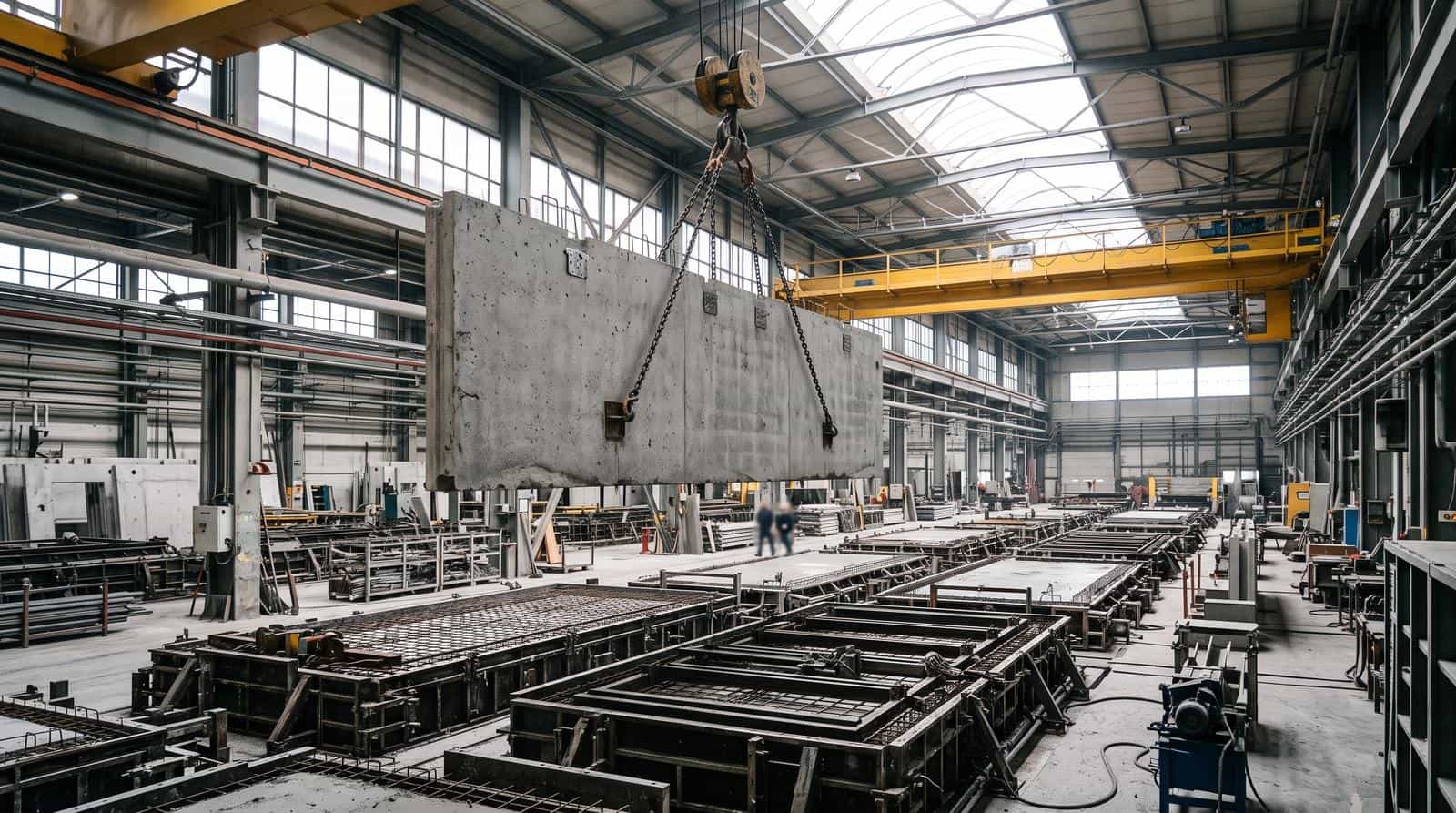
Which fibres for precast concrete? Precast fibres compared: synthetic macro, steel, micro, basalt and AR glass, with indicative dosages per element type. Fibres replace mesh, speed up production and cut the ECI of a precast internal wall by 93%.
Fibres for precast concrete fall into five main types: synthetic macro fibres (indicatively 2 to 6 kg/m³) for walls, stairs and small units; steel fibres (10 to 40 kg/m³, by calculation) for pipes, tunnel segments and heavily loaded elements; micro fibres (0.6 to 1.0 kg/m³) against plastic shrinkage; basalt for heat-exposed elements; and AR glass for thin façade panels.
In fibre reinforced precast concrete, the fibres replace the traditional reinforcement mesh wholly or largely. That saves, indicatively, 30 to 90 minutes of steel fixing and inspection per element and lowers the Environmental Cost Indicator sharply: for a precast internal wall from €17.51 to €1.13 ECI, a saving of 93%. Only lifting provisions and any edge reinforcement usually remain steel in liftable elements.
Precast fibres compared: which fibre for which element?
The right precast fibre depends on what the element has to carry, how thin it is and whether the face stays visible. The table gives indicative ranges per fibre type; the dosage for a specific element always follows from the performance it has to deliver.
| Fibre type | Typical length | Indicative dosage | Role in the element | Typical precast elements | DFT example |
|---|---|---|---|---|---|
| Synthetic macro fibre (PP, EN 14889-2 class II) | 38 to 50 mm | 2 to 6 kg/m³ | Replaces mesh; residual strength after cracking; rust-free | Internal and party walls, stairs, retaining walls, small units | TwistR (48 mm) |
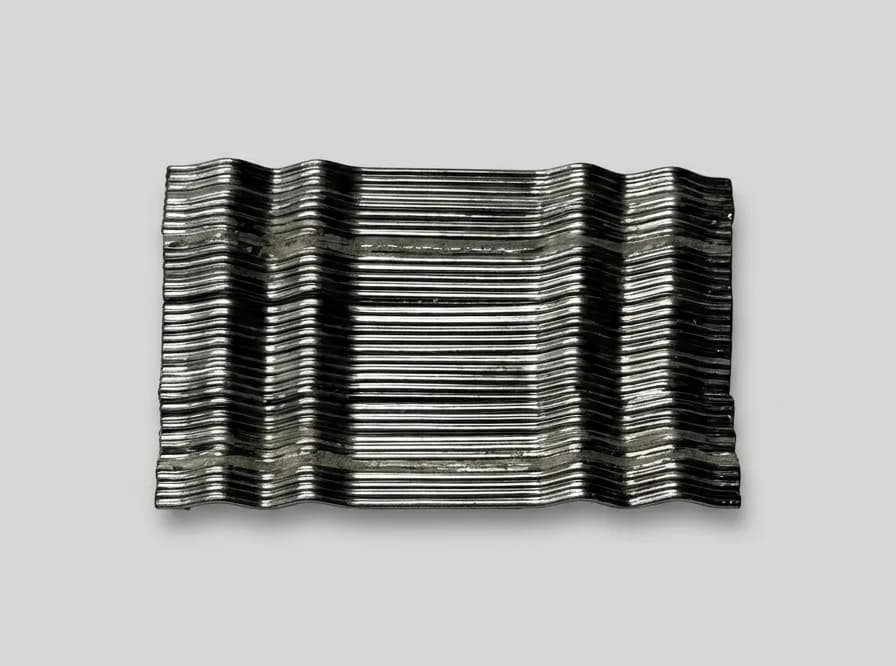
| Steel fibre with hooked ends (EN 14889-1) | 35 to 60 mm | 10 to 40 kg/m³, by calculation | High residual strength for structural loads | Pipes, manholes, tanks, tunnel segments, load-bearing slabs | MPWG HT+ 50/0.90, MPZG HT+ 35/0.55 |
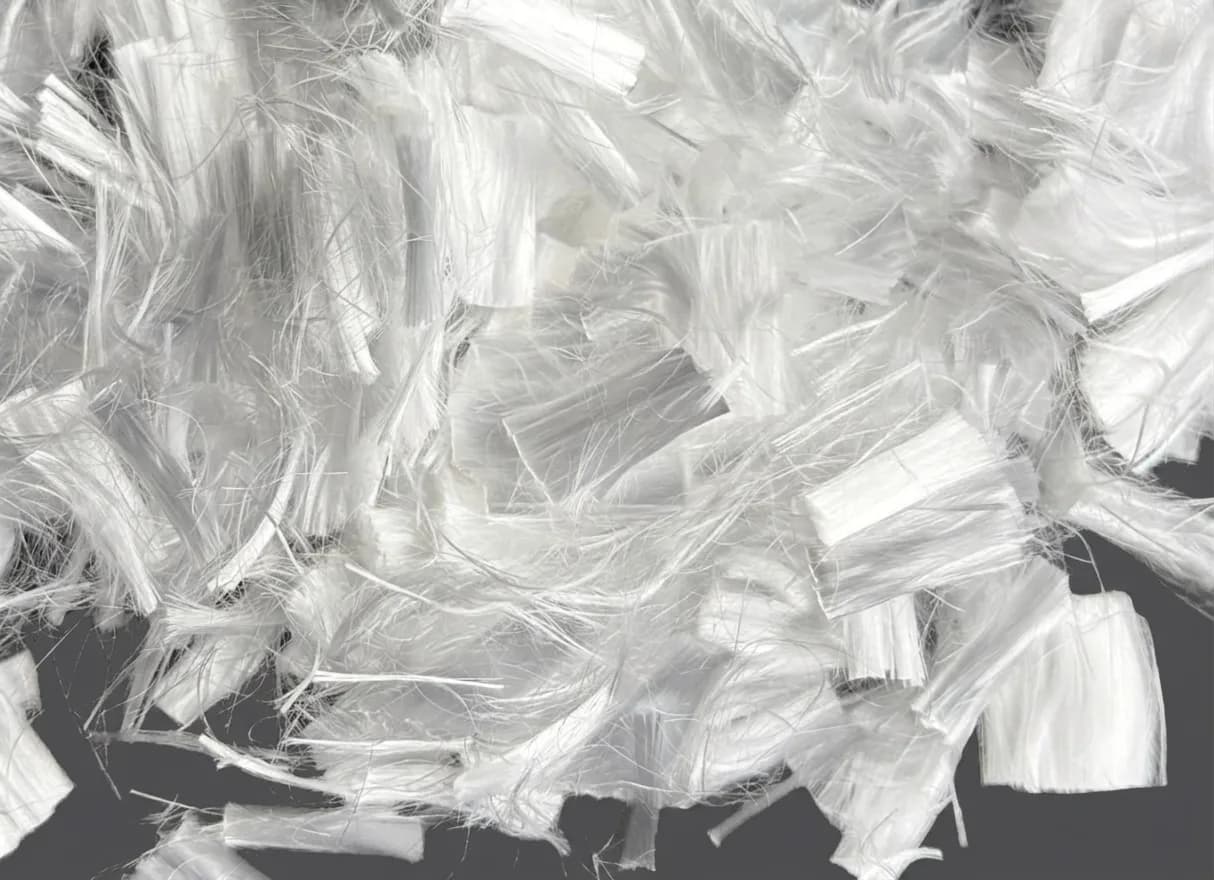
| Micro fibre (PP, EN 14889-2 class Ia) | 6 to 19 mm | 0.6 to 1.0 kg/m³ | Against plastic shrinkage cracks and edge chipping; not structural | Thin and visible elements, alongside a macro fibre | Promicro (12 mm) |
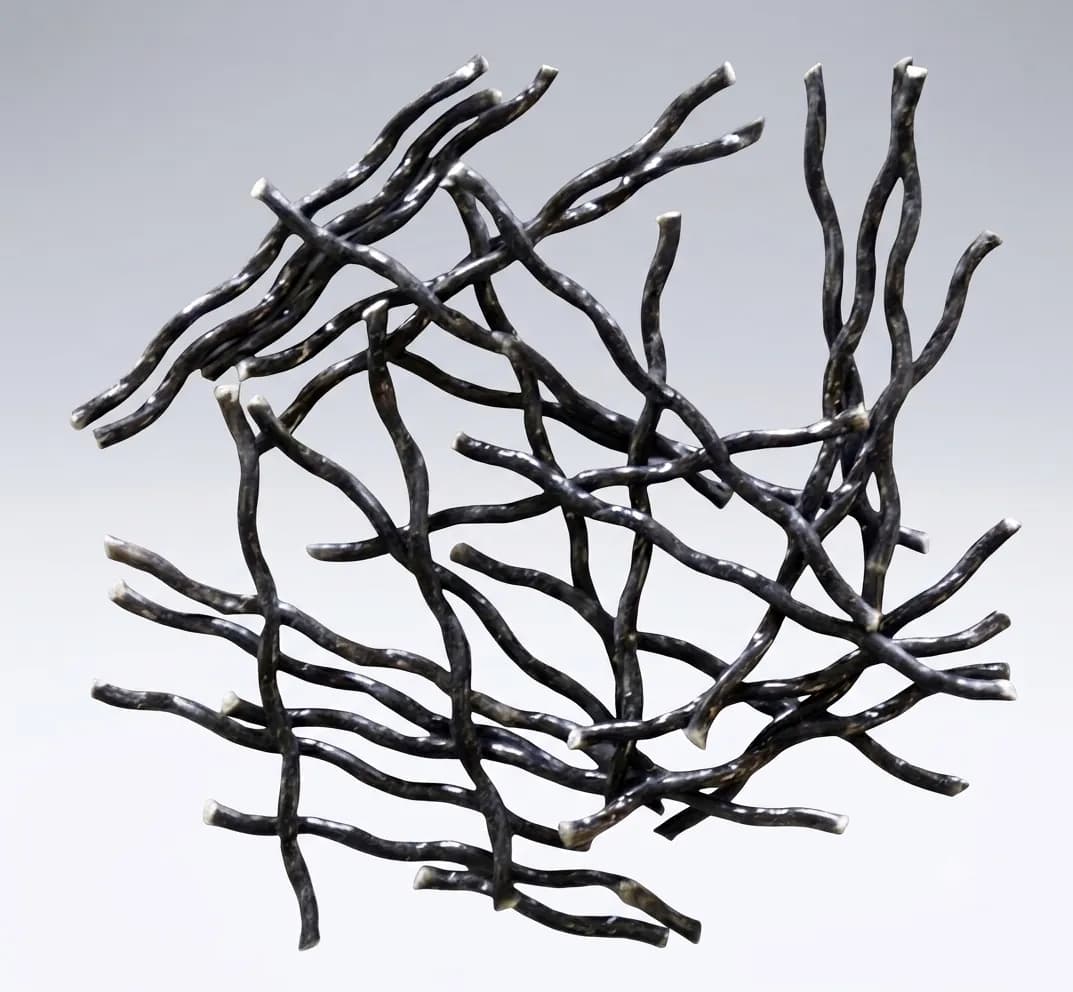
| Basalt macro fibre | 50 mm | By mix design | Rust-free, chemically inert, high temperature resistance | Edge beams (hybrid), ballast blocks, elements with temperature requirements | Basalt Wave |
| AR glass fibre (GRC) | Chopped strands | 4.5 to 5% by weight (sprayed), 2 to 3.5% (premix) | High strength in thin sections | Architectural façade panels and cladding | Not in the DFT range |
• Synthetic macro fibre: a synthetic macro fibre such as TwistR GREEN HYBRID is the first choice for walls, non-load-bearing floor slabs, stairs and external works units. TwistR is a 48 mm hybrid macro fibre of 100% virgin polypropylene (a twisted monofilament plus a fibrillating network fibre), dosed at 2.0 to 6.0 kg/m³ and supplied with CE marking and an EPD: structural, rust-free and with the greatest ECI gain.
• High-tensile steel fibre: steel fibres for precast elements such as the MPWG HT+ 50/0.90 (50 mm, double hooked ends, tensile strength 2,100 N/mm², performance class 56, 10 to 35 kg/m³) deliver the high residual strengths that heavily loaded elements such as load-bearing floor slabs, beams and tunnel segments demand. Dosages and prices per m³ are in steel fibre concrete: applications, dosage and price.
• Shorter steel fibre: for thinner sections and tunnel segments, a 35 mm hooked-end fibre such as the MPZG HT+ 35/0.55 (35 mm, Ø 0.55 mm, 10 to 35 kg/m³) is an option; the choice between a 35 mm and a 50 mm fibre depends on the section thickness and the residual strength the element requires.
• Micro fibre: a micro fibre for precast surfaces such as Promicro, a 12 mm polypropylene monofilament of EN 14889-2 class Ia dosed at 0.6 to 1.0 kg/m³, limits plastic shrinkage cracks and improves surface quality. It is not a mesh replacement; in structural elements it works alongside a macro fibre or bar reinforcement.
• Basalt fibre: Basalt Wave (50 mm, 3D wave profile) for edge beams, bridge elements and elements with temperature requirements, as a mineral, rust-free alternative with a high temperature resistance.
For thin architectural façade panels, alkali-resistant (AR) glass fibre is the established choice (glass fibre reinforced concrete, GRC); it is not part of our range, and how it relates to the other fibre types is set out in steel, synthetic, glass and basalt fibres compared. Whether steel or synthetic suits a particular element best is a trade-off between residual strength, corrosion, weight and ECI, covered in full in steel fibres or synthetic macro fibres. General dosage rules and calculation steps are in concrete fibre dosage per fibre type.
The performance of steel and polymer fibres is declared under EN 14889 (part 1 for steel, part 2 for polymer fibres); for structural applications, the residual strength is determined with the beam test to EN 14651. When selecting fibres, always ask for those performance values, so the structural engineer works with validated figures.
What is fibre reinforced precast concrete?
Fibre reinforced precast concrete is concrete cast in a factory mould in which short fibres, mixed in with the other constituents, take over all or part of the reinforcement mesh, so the reinforcement sits throughout the whole cross-section of every element.
Precast concrete itself is cast in a controlled factory environment rather than on the construction site. The elements (walls, floor slabs, stairs, retaining walls, beams and bridge sections) are produced in steel moulds, cured, stored and transported just in time to the site. That offers clear advantages over in-situ concrete: execution does not depend on the weather, no scaffolding or pouring crews are needed on site, and the build time is shorter thanks to serial production.
Within that tightly organised process, traditional reinforcement has remained a strikingly labour-intensive step. Reinforcement mesh and bars have to be transported and stored, reinforcement drawings read, cages tied, spacers placed and the cover checked: exactly the kind of manual work prefabrication aims to take out of the building process. Fibre reinforcement tackles that last manual link: the reinforcement goes into the mixer as fibre and thereby sits automatically throughout the full cross-section of every element.
Why fibre reinforcement suits precast concrete so well
• Optimised production process: structural fibres largely replace the traditional reinforcement in precast internal walls, for example; at most, steel edge reinforcement and lifting provisions remain necessary to tilt and lift the element safely.
• Higher production speed: no time is lost tying and positioning reinforcement mesh, so capacity per mould and per day increases. In large-scale, serial production that gain per element adds up fast.
• Slimmer, lighter elements: with precast façade elements, transport and craneage are a considerable cost item. Where no mesh needs covering, fibre reinforcement, like prestressing, enables slimmer cross-sections and so limits the weight per element.
• No cover errors: fibres are distributed throughout the entire volume, so a shifted mesh or too little cover above the reinforcement simply cannot occur. That lowers failure costs and the risk of concrete decay through corrosion over the service life.
• Less handling damage: fibres throughout the volume hold edges and corners together during demoulding, tilting, stacking and transport, so fewer elements are chipped or rejected.
• 3D reinforcement: the fibres also work in directions a single mesh layer does not cover, for example through the thickness of a wall or at the re-entrant corners of a staircase.
Prefabrication is thus one of the strongest applications within our overview of applications and target groups for fibre reinforcement.
Types of precast concrete element and the role of fibres
Not every element lends itself equally well to fibre reinforcement. The overview below runs through the common precast concrete elements, from simple to heavily structural.
Precast concrete walls and internal walls
Precast concrete walls (internal walls, party walls and fire walls) are the classic fibre application. The loading is predominantly distributed across the plane, so structural macro fibres can largely replace the reinforcement mesh. A free-standing precast concrete wall as a boundary fence or façade plinth also falls into this category. For fire walls, fibres are particularly relevant: polypropylene fibres improve behaviour in fire by forming melt channels that counteract spalling of the concrete.
Precast concrete floors
In a precast concrete floor (solid floor slabs and the structural toppings of system floors), fibres control shrinkage cracking and can replace part of the mesh reinforcement. For load-bearing floor slabs with bending as the governing load, a calculation by the structural engineer remains decisive for the ratio of fibres to bar reinforcement; producing entirely mesh-free is not always feasible here.
Stairs and balconies
Precast concrete stairs are poured in complex moulds in which bending and fixing mesh takes relatively long. Fibres reach every part of that awkward geometry without extra work. The ECI comparison below also shows that the concrete staircase yields some of the greatest environmental gains: 79% lower environmental costs compared with traditional reinforcement.
Retaining walls and precast concrete blocks
Concrete retaining walls (the L- and T-shaped units used for earth retention, silage clamps and yard layouts) are almost always supplied precast and are a growth market for fibre reinforcement: fibres in the base and the stem limit shrinkage cracks and increase impact resistance during daily loading and unloading work. Precast concrete blocks (stacking blocks, often cast from leftover concrete) also benefit from fibres: they increase edge stability without any reinforcement having to go into the leftover concrete. More detail is in precast concrete retaining walls: types, dimensions and prices.
Small precast units: fence posts, copings and kerbs
Fence posts, copings, kerbs and similar small precast concrete units are cast in large numbers in simple moulds, where tying a small cage for every unit takes a relatively large amount of time. A synthetic macro fibre, alone or with a micro fibre for crisp edges, replaces the light mesh, cannot corrode near the surface and makes the units less prone to chipping. For slender units that carry bending, such as fence posts under wind load or lintels, the structural engineer checks whether fibres alone suffice or a bar is still needed.
Precast bridge elements and infrastructure
A precast concrete bridge, from cycle and foot bridges to edge beams and fibre-reinforced overlays on existing bridge decks, places high demands on durability: de-icing salt, moisture and frost make corrosion of reinforcing steel the dominant failure factor here. Fibre reinforced precast concrete rusts little or not at all, enabling slimmer edge beams and thinner overlays. For edge beams and bridge sections with elevated temperature or durability requirements, a basalt fibre for precast and edge beams is a mineral alternative: its 3D wave profile anchors optimally in the concrete matrix and the fibre has a high temperature resistance. When replacing timber bridge decks, fibre concrete is one of the three common options; the trade-off is covered in replacing a timber bridge deck: composite, plastic or fibre concrete.
Pipes, manholes, tanks and tunnel segments
Steel fibre concrete has been used for decades in precast pipes, manhole rings, tanks and tunnel lining segments. In Europe, EN 1916 covers steel fibre concrete pipes alongside unreinforced and reinforced ones, and in the United States ASTM C1765 is a dedicated product standard for steel fibre reinforced concrete pipe. Manufacturer reference projects indicatively mention around 25 kg/m³ of steel fibre for pipes and segments and around 40 kg/m³ for tanks; the actual dosage always follows from the calculation. The fibres also protect the edges and corners of segments during demoulding, handling and installation.
For septic tanks, inspection chambers and pits where corrosion is the main concern, synthetic macro fibres are used instead. To limit explosive spalling in a tunnel fire, polypropylene micro fibres are the established measure, at a dosage set by the fire design and usually higher than for shrinkage control: they melt and leave channels through which vapour pressure can escape. Basalt does not melt at those temperatures and is no substitute for them. Basalt Wave does list tunnels among its applications, for its temperature resistance and because it cannot corrode.
Façade panels and architectural concrete
For architectural façade panels, glass fibre reinforced concrete (GRC) is also used. It contains alkali-resistant (AR) glass fibre at around 4.5 to 5% by weight in sprayed GRC and 2 to 3.5% in premix, which gives the thin section a high flexural and tensile strength. That allows thin-walled panels that weigh far less than conventional precast panels, in almost any shape, colour and surface texture, including complex 3D forms, which makes GRC suitable for façade cladding where low weight and aesthetics come first. Where heat resistance counts alongside aesthetics, basalt fibre is the mineral alternative. For the visible faces of conventional precast elements, a micro fibre such as Promicro helps limit plastic shrinkage cracks on the surface.
Production gains: what does fibre reinforcement save per element?
The business case for fibres in the precast factory revolves around labour hours and lead time per element, and that gain can be made concrete per production line:
• Reinforcement labour: tying, placing and checking a mesh or cage takes indicatively 30 to 90 minutes for an average wall element; more for complex geometry such as stairs. Fibres are dosed into the mixer in a few minutes per batch, regardless of how many elements are poured from that batch.
• Mould occupancy: without reinforcement assembly in the mould, the mould can be poured again sooner; over a week of production that means more elements per mould.
• Logistics: no storage bay for mesh and bars, no internal crane movements for reinforcement packages and no waiting on the reinforcement supplier when designs change.
• Failure costs: cover errors and shifted mesh disappear as grounds for rejection; the fibre dosage is registered per batch and is thereby directly traceable in quality control.
The exact gain varies by factory and element type, so base your own calculation on the current reinforcement hours per element.
ECI worked example: precast internal wall and concrete staircase
For Dutch tenders with environmental requirements (the MPG for buildings, the ECI or MKI for infrastructure), fibre reinforcement in precast is one of the quickest levers to pull. LCA-substantiated field examples with structural synthetic fibre (dosage around 3 kg/m³) show a substantial saving on the Environmental Cost Indicator compared with traditional reinforcement:
• Precast internal wall: ECI with traditional reinforcement €17.51, with synthetic fibre €1.13: a saving of 93%.
• Concrete staircase: ECI with traditional reinforcement €52.54, with synthetic fibre €10.82: a saving of 79%.
The explanation is simple: polypropylene is more than eight times lighter than steel, so a dosage of 2 to 6 kg of macro fibre per m³ replaces tens of kilograms of reinforcing steel, together with the steel production and transport behind it. With TwistR GREEN HYBRID, a 48 mm hybrid macro fibre of 100% virgin polypropylene with a twisted monofilament for anchorage, supplied with an EPD, this gain per element can be carried through into the project's environmental performance calculation. How you set up that calculation and what gain is realistic is covered in lowering MPG and ECI with fibre reinforcement.
Designing fibre reinforced precast elements: residual strength, lifting and limits
Structural fibre concrete is designed on its residual flexural strength after cracking. That strength is measured with the notched beam test to EN 14651, which yields the residual strength values fR1 and fR3. The fib Model Code 2010 and fib Bulletin 105 describe how designers use those values; in the UK, the Concrete Society reports TR63 (steel fibres) and TR65 (macro synthetic fibres) are the usual guidance. The second-generation Eurocode 2 (EN 1992-1-1:2023) includes an annex for steel fibre reinforced concrete design. Bear in mind that the dosage a supplier declares under EN 14889 is a minimum for CE marking, not a design dosage.
One nuance belongs in every conversation about fibre reinforced precast: the lifting phase. An element lies horizontally in the mould and is then tilted and lifted by lifting anchors, and those concentrated forces around anchors and edges are often more governing than the loading in the final situation. That is why liftable elements usually keep steel lifting provisions and local edge reinforcement, even when the rest of the element is fully fibre reinforced.
For heavily loaded, load-bearing precast elements, a static calculation to the applicable Eurocodes determines the extent to which fibres can replace the traditional reinforcement. Fibres are a fully fledged reinforcement medium, but the degree of replacement is always an outcome of the calculation, not of the brochure. Prestressed elements such as hollow-core slabs and long beams, as well as columns, keep their prestressing or bar reinforcement; there, fibres can at most supplement it.
Fibres in the precast factory: dosing and ordering
The changeover in the factory is limited: fibres are supplied in dissolvable bags or big bags and added to the mixer by hand or via a dosing machine, with a short extra mixing time for homogeneous distribution. Batch registration of the dosage fits into existing quality control. What the supply, dosing and mixing logistics look like in practice is described in fibres at the concrete plant: ordering and production integration; the process in a precast factory is virtually identical.
Mix design, workability and surface finish
Fibres reduce the slump or flow of the mix, macro and steel fibres more than micro fibres. Compensate with a superplasticiser rather than extra water, and check flow and fibre distribution in a trial batch; that matters all the more with self-compacting precast mixes. Compaction works with the usual external or table vibration.
On the surface, flexible synthetic fibres can show on trowelled or exposed faces; after hardening, they can be removed by brief flaming. Steel fibres at the surface can leave small rust spots, which are cosmetic only; for visible architectural faces, a synthetic or basalt fibre avoids this. Background on the mechanism is in how fibres work in concrete.
Ideally, start with a trial pour for each element type: one batch with the intended dosage, assessed for workability, surface and (for structural work) residual strength. For project-specific dosage advice and a price quotation per element type, you can request a quotation based on your element drawings.
Frequently asked questions
- What are the best fibres for precast concrete?
- That depends on the element. A synthetic macro fibre (2 to 6 kg/m³, such as TwistR) suits walls, stairs, retaining walls and small units; a hooked-end steel fibre (10 to 40 kg/m³, by calculation) suits pipes, tanks, tunnel segments and load-bearing elements; a micro fibre (0.6 to 1.0 kg/m³) limits shrinkage cracks. AR glass is used for thin façade panels, and basalt where temperature or chemical resistance counts. Always ask for CE marking to EN 14889 and residual strength values to EN 14651.
- What is fibre reinforced precast concrete?
- Fibre reinforced precast concrete is a factory-cast concrete element in which fibres mixed into the concrete take over all or part of the reinforcement mesh. The reinforcement is spread through the whole cross-section, so there is no mesh to fix and no cover to get wrong. Lifting provisions and any edge reinforcement usually remain steel.
- Can fibres replace steel reinforcement in precast concrete?
- In non- or lightly load-bearing elements such as internal walls, stairs and retaining walls, structural fibres replace the reinforcement mesh largely to fully. Liftable elements keep steel lifting provisions and often local edge reinforcement, because the lifting phase produces governing point loads. For load-bearing elements, a calculation in accordance with the Eurocodes determines the degree of replacement. Prestressed elements such as hollow-core slabs, and columns, keep their prestressing or bars; fibres can at most supplement them.
- How much fibre is used in precast concrete per m³?
- For synthetic macro fibres such as TwistR, indicatively 2 to 6 kg/m³, with around 3 kg/m³ in the ECI examples cited. Steel fibres are dosed according to the structural calculation, indicatively 10 to 40 kg/m³; manufacturer references mention about 25 kg/m³ for pipes and segments and 40 kg/m³ for tanks. Micro fibres go in at 0.6 to 1.0 kg/m³. The exact dosage follows from the required residual strength to EN 14651; see concrete fibre dosage per fibre type.
- How much does fibre reinforcement reduce the environmental impact of precast concrete?
- LCA-substantiated field examples show, for a precast internal wall, a drop in ECI from €17.51 to €1.13 (a 93% saving) and, for a concrete staircase, from €52.54 to €10.82 (79%). The gain comes mainly from a few kilograms of polypropylene fibre replacing tens of kilograms of reinforcing steel; see also lowering MPG and ECI with fibre reinforcement.
- Are fibres suitable for precast retaining walls?
- Yes. Concrete retaining walls are almost always produced precast and benefit doubly from fibres: fewer shrinkage cracks in the base and stem, and higher impact resistance during daily loading and unloading work. For greater retained heights, the structural engineer calculates the combination of fibres and bar reinforcement. A full overview is in concrete retaining walls: types and prices.
- Do fibres show on the surface of precast elements?
- Mould faces usually come out clean. On trowelled or exposed faces, flexible synthetic fibres can show; once the concrete has hardened, they can be removed by brief flaming. Steel fibres at the surface can cause small rust spots, which are cosmetic only. For visible architectural faces, choose a synthetic or basalt fibre and test the finish on a trial element.
- How much time do fibres save per precast element?
- Indicatively, 30 to 90 minutes of tying, placing and inspection work per average wall element is eliminated, while dosing fibres takes only a few minutes per batch. In addition, the mould becomes available sooner, the storage and internal logistics of reinforcement mesh disappear, and cover errors vanish as grounds for rejection. Fewer elements are also rejected for chipped edges after demoulding and transport. The exact gain differs per factory and element type.
Share this article
Products mentioned
 Most chosen
TwistR® GREEN HYBRID
High-performance synthetic macro fibres made from 100% polypropylene. Transforms concrete into a stronger composite material.
- TypeHybrid: twisted monofilament + fibrillating network fibre
- Material100% virgin polypropylene
- Length48 mm
- Dosage2.0 – 6.0 kg/m³
Pallet price on request
MPWG HT+ 50/0.90
High-tensile hooked steel fibres with aspect ratio 50/0.90. Maximum anchorage and ductility for heavily loaded structures.
- TypeCold-drawn hooked steel fibre (glued)
- Dimensions50 mm / Ø 0.90 mm
- Tensile strength2100 N/mm² ± 7.5%
- Performance class56
Pallet price on request
Basalt Wave
Wave-profile basalt fibre for excellent bonding in the concrete matrix. High temperature resistance for demanding constructive applications.
- TypeBasalt macro fibre (wave-profile 3D)
- Length50 mm
- DiameterØ 1.2 mm
- Strand tex2000 tex
Promicro
Synthetic PP monofilament micro fibre against plastic shrinkage cracks. Homogeneous dispersion and better surface quality at a low dosage.
- TypePolypropylene monofilament (round cross-section)
- Length12 mm
- Equivalent diameter32 µm
- Linear density6.5 dpf
Pallet price on request
Also read
- Concrete retaining walls: types, dimensions, concrete grade, prices and fibre reinforced precast
- MPG calculation: lowering a building's environmental performance with fibre reinforcement
- Timber bridge deck replacement: composite, plastic or fibre reinforced concrete?