Asphalt maintenance: measures, costs and extending service life

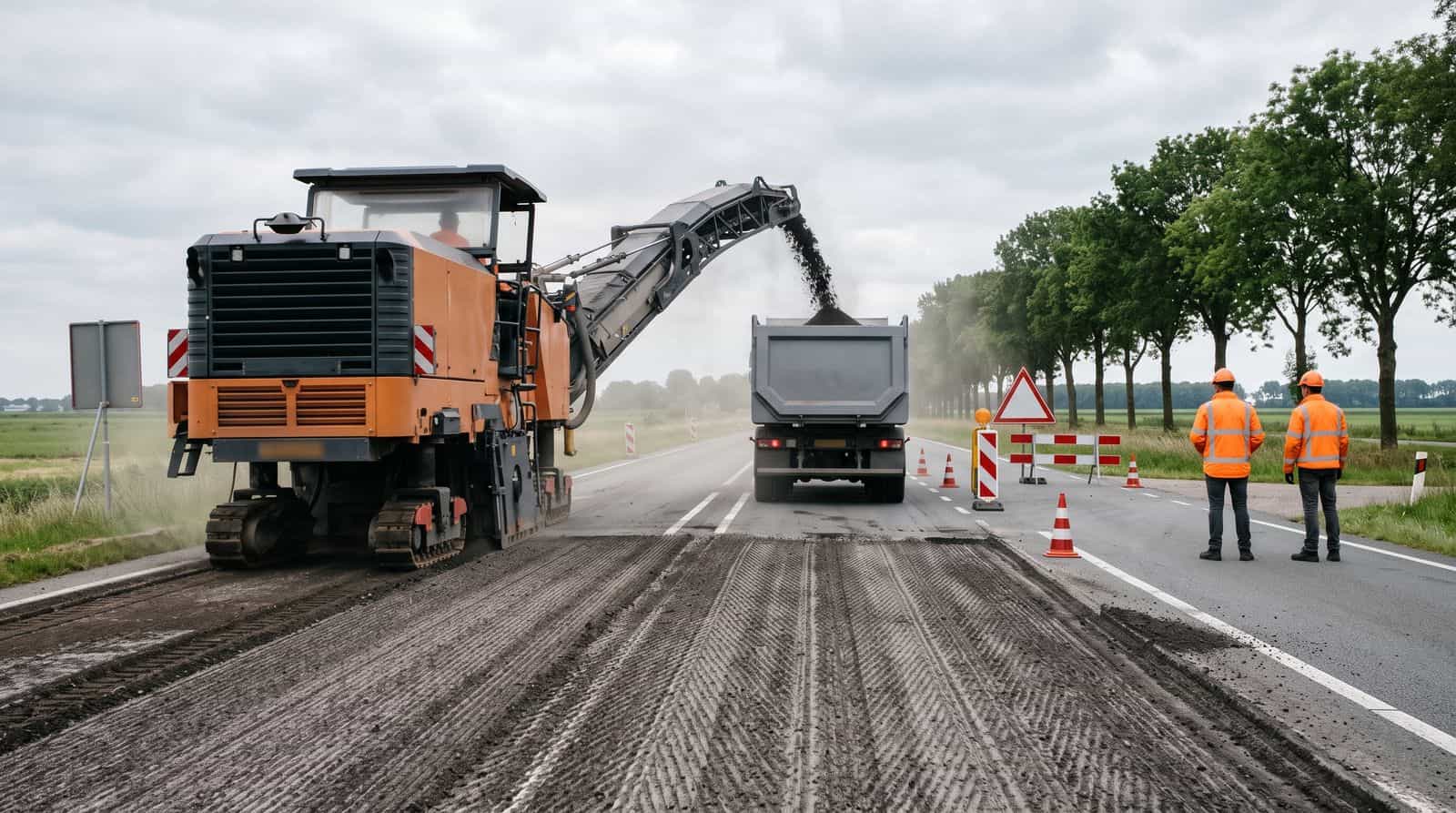
From surface dressing to milling and a new surface course: all asphalt maintenance measures with indicative costs per m² — and how fibre reinforcement stretches the maintenance cycle by years.
Asphalt maintenance covers all the measures that keep an asphalt pavement in condition: from a light surface dressing (indicatively €3 to €8 per m²) to milling and a new surface course (€15 to €30 per m²). A surface course lasts on average 12 to 15 years; fibre reinforcement can extend the service life of the road surface by up to 50%.
How long does asphalt last?
The service life of asphalt varies per layer and per mixture. The surface course — the top 3 to 5 centimetres — wears fastest; binder and base courses generally last several surface-course cycles, provided the structure stays dry and load-bearing. Indicative service lives for the surface course, depending on loading and subgrade:
• DAB (dense asphalt concrete) — around 15 years on averagely loaded municipal and provincial roads.
• SMA (stone mastic asphalt) — around 12 to 16 years on more heavily loaded routes; wear-resistant thanks to its high crushed stone content.
• ZOAB (porous asphalt) — around 11 years; the open structure that drains water and dampens noise makes the surface course more susceptible to ravelling.
Those averages hide large differences. A quiet residential street sometimes reaches 20 years or more, while a roundabout or junction with twisting lorry traffic can need major maintenance within 10 years. Heat also weighs on service life: how a hot road surface softens the bitumen and accelerates deformation is explained in heat-resistant asphalt and rutting.
Recognising asphalt damage: from ravelling to rutting
Effective road maintenance starts with the right diagnosis: each type of damage has its own mechanism and therefore its own measure. The four most common forms of asphalt damage:
• Ravelling — the surface loses stones, often the first sign that the binder is ageing; the governing damage particularly for porous asphalt.
• Cracking — thermal cracks, reflective cracks growing through from an old base course, and edge damage along the pavement edges.
• Rutting — deepened wheel tracks caused by permanent deformation of the mixture; what exactly happens and which solutions exist is covered in rutting: causes and solutions.
• Potholes and frost damage — water enters the structure through cracks and bursts the asphalt apart during freeze-thaw cycles.
Local asphalt repairs are expensive per square metre: because of fixed costs such as transport and mobilising the paving crew, a small repair area quickly costs two to three times as much per m² as a full road section. Repairs are moreover symptom control once the layer is structurally worn — at that point the trade-off shifts to overlaying or replacement.
Maintenance measures: from light to heavy
Road authorities work with a ladder of measures: the earlier in the service life you intervene, the lighter and cheaper the measure. All amounts below are indicative (2026 price level, excluding traffic measures, depending on project and area).
Minor maintenance and surface dressing
As long as the damage is confined to the surface, light measures suffice: filling potholes, sealing cracks or applying a surface treatment (surface dressing) with emulsion and chippings for around €3 to €8 per m². An asphalt rejuvenator — an agent that makes aged, hardened bitumen supple again — falls into the same category: it stretches the service life of a surface course by a few years, but only works at the surface. Against structural cracking or rutting, a rejuvenator solves nothing.
Overlaying: a new surface course over the existing one
With asphalt overlaying, a new surface course is applied directly over the existing pavement, without milling — indicatively €10 to €25 per m², depending on layer thickness and area. It is fast and produces no milling waste. There are two points of attention: the pavement ends up a few centimetres higher (connections, gullies and edge restraints must allow for that) and cracks in the old layer can grow through the new surface course as reflective cracks. Overlaying therefore pays off mainly on road sections where the damage consists of ageing and ravelling, not ongoing cracking.
Milling and replacing the surface course: major maintenance
The classic major maintenance: the old surface course is milled off (around €5 to €15 per m², including removal) and replaced with a new one. Milling plus a new surface course together costs indicatively €15 to €30 per m²; if the binder course has to go too, €30 to €50 per m². The reclaimed asphalt is reused as granulate in new mixtures. This is also the natural moment to make the new layer better than the old one — for example with fibre reinforcement, see below.
Full reconstruction
If the foundation is also worn out or the subgrade is the problem, only a full reconstruction remains: indicatively €75 to €150+ per m², plus earthworks and a lengthy closure. In virtually every management plan, reconstructions are the item you postpone as long as possible with timely minor and major maintenance — which is exactly why systematic multi-year planning pays off.
Multi-year road maintenance plan: rational road management
Municipalities and water boards manage roughly 125,000 of the approximately 140,000 kilometres of paved road in the Netherlands, and road maintenance is one of the largest items in their management budgets. Rational road management according to the CROW methodology brings order to this: periodic visual road inspection, translating damage patterns into quality levels and programming measures in a multi-year road maintenance plan — before light damage escalates into heavy damage.
The core of such a multi-year plan is calculating in cost per m² per year instead of cost per intervention. Postponement seems to save money, but a missed surface dressing of a few euros per m² ends up years later as a reconstruction costing many times that. How to include fibre reinforcement concretely in specifications and framework contracts is covered in fibre reinforcement for municipal road management.
For motorways the same logic applies at larger scale: Rijkswaterstaat replaces porous asphalt surface courses on average every 11 years or so, and at the same time faces a historically large replacement and renovation challenge. Why extending service life is a top priority there is explained in the biggest maintenance challenge ever.
Extending service life with fibre-reinforced asphalt
All the measures above address damage that has already occurred. The structural lever sits in the mixture itself: extending the service life of asphalt by executing the surface course as fibre-reinforced asphalt at every major maintenance. Aramid fibres — dosage indicatively ~0.05%, around 500 grams per tonne of asphalt, depending on mixture and application — form a three-dimensional reinforcement in the mixture that slows crack growth and rutting. A fibre such as AsphaltX requires no change to the asphalt mix design or the equipment: the fibres are added to the mixture at the plant.
Research within the European FIBRA project provides the bandwidth: a service-life extension of the road surface of up to 50%, and of the asphalt layer itself of up to 200%, depending on fibre type and application. On the A73 trial section near Roermond, surface courses with aramid fibres on standard bitumen perform equivalently to the PMB reference, at a 15 to 20 °C lower production temperature and an MKI more than 10% lower — which means fibres can on balance be a cost-neutral alternative to PMB. In practice the approach has been applied on, among others, the provincial road N337 along the IJssel and on 6 kilometres of binder course on the Varsseveldseweg in Doetinchem.
For the multi-year plan, fewer maintenance cycles thanks to fibres have a directly calculable effect. If fibre reinforcement shifts the surface-course cycle from 12 to 18 years, one full intervention per road section disappears over a 30-year planning horizon — at 10,000 m² and €20 per m², nearly €200,000, plus one less closure with traffic disruption. The additional cost stays well below that: for a 5 cm surface course it comes to around 60 grams of fibre per m². What that means per square metre next to the regular asphalt price is calculated in what asphalt costs per m².
From maintenance plan to execution
The practical route: map the residual service life and damage pattern per road section, choose the lightest measure that fits, and at every planned major maintenance weigh up whether the new surface course should be fibre-reinforced — the fibres then ride along on work that is happening anyway. More background on mixtures, standards and case studies can be found in the pillar fibre-reinforced asphalt. If a maintenance project is on your programme, request a quotation with your tonnage and mixture type — we will work out the dosage and the expected cycle extension in concrete terms for you.
Frequently asked questions
- How long does asphalt last?
- An asphalt surface course lasts indicatively 12 to 15 years: DAB around 15 years, SMA 12 to 16 years and porous asphalt (ZOAB) around 11 years. Binder and base courses last several surface-course cycles. Heavy or twisting traffic, a soft subgrade and heat shorten the cycle; fibre reinforcement can extend the service life of the road surface by up to 50%.
- What does asphalt maintenance cost per m²?
- Indicatively (2026 price level): a surface dressing or surface treatment costs €3 to €8 per m², overlaying €10 to €25 per m², milling plus a new surface course €15 to €30 per m², surface plus binder course €30 to €50 per m², and a full reconstruction €75 to €150+ per m². Traffic measures and diversions come on top of that.
- What is asphalt overlaying?
- With overlaying, a new surface course is applied directly over the existing pavement without milling first. That is faster and cheaper (indicatively €10 to €25 per m²), but the road ends up a few centimetres higher and cracks in the old layer can grow through as reflective cracks. It pays off mainly with ageing and ravelling, not with structural cracking.
- What does an asphalt rejuvenator do?
- An asphalt rejuvenator makes aged, hardened bitumen at the surface supple again, slowing ravelling and giving the surface course a few extra years. The agent only works superficially: against structural damage such as rutting or ongoing cracks it does not help — then overlaying or milling and replacement is needed.
- How does fibre reinforcement extend the service life of asphalt?
- Aramid fibres such as AsphaltX form, at around 500 grams per tonne of asphalt (~0.05%, depending on mixture and application), a three-dimensional reinforcement that slows cracking and rutting. FIBRA research shows a service-life extension of the road surface of up to 50%; over 30 years that quickly saves a full maintenance cycle per road section.
- When should asphalt be replaced rather than repaired?
- As soon as damage is structural — ongoing cracking, rutting or large-scale ravelling — local repair is symptom control and, per m², two to three times as expensive as working section by section. Milling and applying a new surface course is then more rational; if the foundation is also worn out, a full reconstruction follows.
Products mentioned
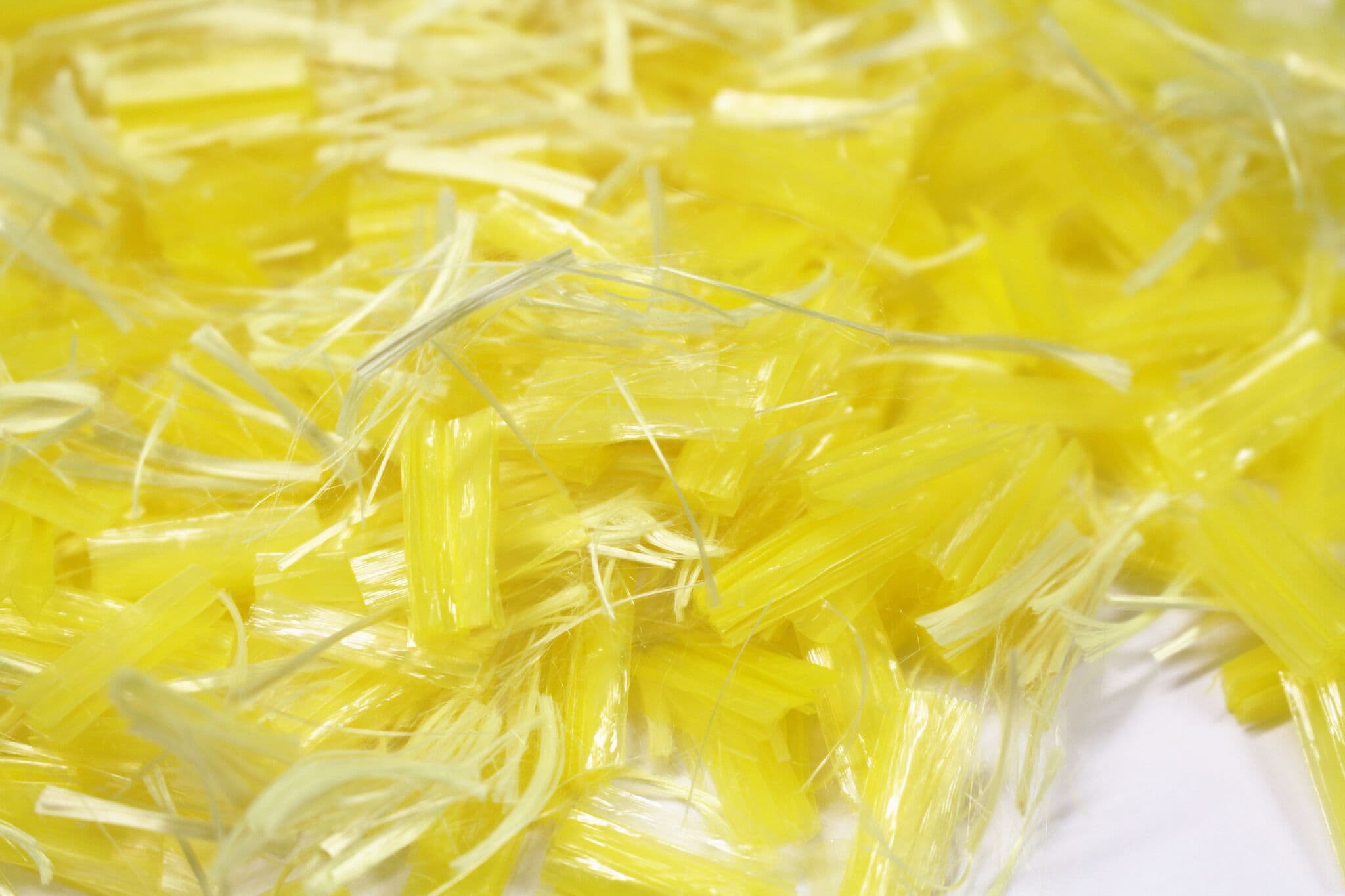
AsphaltX®
2000 filaments per aramid strand — 45% more than competitors. Lowest CO₂ footprint, European manufacturing, proven on the N337.
- TypeAramid (Twaron®) + polyolefin fibre blend
- Length± 19 mm
- Tensile strengthTwaron 3000 MPa · polyolefin 483 MPa
- Specific gravityTwaron 1.45 · polyolefin 0.91 g/cm³