A73 case study: results of the FIBRA research

On the A73 near Roermond, BAM and Rijkswaterstaat built a trial section with four porous asphalt mixtures within the FIBRA project, on top of a demonstration garden with sustainable base layers. The full set-up, measurement results and conclusions.
On the A73 trial section near Roermond, BAM and Rijkswaterstaat have been testing fibre-reinforced two-layer porous asphalt (ZOAB) within the European FIBRA project since August 2020. The outcome so far: surface courses with aramid and PAN fibres on standard bitumen perform on the road as well as the PMB reference, at a 15-20 °C lower production temperature and an MKI (environmental cost indicator) more than 10% lower (cradle-to-gate).
Why a trial section on the A73?
FIBRA was a European CEDR research project involving five research institutions and two industrial partners from six countries — in the Netherlands BAM and Rijkswaterstaat — set up to close the knowledge gaps that made road authorities reluctant to apply fibre-reinforced asphalt more widely. The full background, objectives and participants are covered in our article on the FIBRA project.
The A73 was no random choice. On a two-kilometre stretch near Roermond, BAM Infra Nederland had already built a demonstration garden for sustainable asphalt, the outcome of the Sustainable Asphalt competition launched by Rijkswaterstaat. The fibre trial section built on that: one location where sustainable base layers and fibre-reinforced surface courses are monitored under identical, heavy traffic loading.
The test location: southbound carriageway directly after Tunnel Swalmen
The trial section was built in the last week of August 2020 on the southbound carriageway of the A73, directly after Tunnel Swalmen near Roermond. The stretch has two traffic lanes and a hard shoulder and handles around 50,000 vehicles per working day — a representative, heavily loaded trunk road, exactly the field of application in which fibre reinforcement has to prove itself.
Sustainable base layers: 80 and 95% reuse
In the base layer of the two-layer porous asphalt, BAM Infra applied two sustainable asphalt mixtures, each with its own combination of reuse and reduced production temperature:
• Base layer mixture 1 — 80% reclaimed asphalt; production temperature 115 °C.
• Base layer mixture 2 — 95% reclaimed asphalt; production temperature 105 °C.
For comparison: conventional asphalt is generally produced well above 160 °C. The demonstration garden thus shows that high reuse percentages and considerably lower production temperatures are technically feasible in the base layer of a trunk road — a direct contribution to Rijkswaterstaat's circularity and climate objectives.
Four surface course mixtures in two-layer porous asphalt
The fibre test itself sat in the surface course. Two-layer (also called double-layer) porous asphalt combines a coarse, strongly draining lower layer with a fine top layer; it is precisely that open top layer that is susceptible to ravelling — stones coming loose from the surface under traffic loading. What porous asphalt is exactly, and why the open structure is both the strength and the weakness of this surface, is explained in our article on porous asphalt (ZOAB).
The trial section consisted of four variants of the same top layer of a two-layer porous asphalt (2L-PA 8):
• Section 1 — reference with PMB (Styrelf 65/105-80 A AP); 330 m; chainage 23.600-23.270.
• Section 2 — reference with penetration bitumen and cellulose fibre; 350 m; chainage 23.270-22.920.
• Section 3 — polyacrylonitrile fibre (PAN, Panacea), 0.15% of the mixture weight; 350 m; chainage 22.920-22.570.
• Section 4 — aramid fibre (Twaron 1080), around 0.05% or roughly 500 grams per tonne, depending on mixture and application; 320 m; chainage 22.570-22.250.
The two fibre mixtures used a standard penetration bitumen instead of the more expensive polymer modified bitumen. The central research question: can fibres take over the role of polymer modification in an open surface course on a heavily loaded motorway?
Results of the trial section
The sections were measured extensively, both in the laboratory and on the road. The key measurements per topic are listed below.
Production temperature and processing
• Production temperature — PMB reference: around 181 °C; fibre mixtures: around 159-165 °C (15-20 °C lower).
• Production rate — PMB reference: 145-150 tonnes/hour; fibre mixtures: around 130 tonnes/hour (manual fibre dosing per bag).
The lower temperature saves energy at the asphalt plant and limits fumes during installation. The fibre mixtures were also easier to work by hand than the hotter PMB mixture, and no fibre clusters or other production or processing problems were observed — without any modification to existing production or paving equipment.
Mechanical performance
All four mixtures comfortably met the Dutch requirements for water drainage (Becker test), longitudinal evenness and scuffing resistance. The laboratory figures for indirect tensile strength (ITS) of the PMB reference versus the aramid variant:
• ITS dry — PMB reference: 0.72 MPa; aramid fibre: 0.578 MPa.
• ITS wet — PMB reference: 0.63 MPa; aramid fibre: 0.446 MPa.
• ITSR (moisture sensitivity) — PMB reference: 88%; aramid fibre: 77%.
So the PMB reference scores slightly better on tensile strength in the laboratory — but that difference did not translate into any noticeable difference in real-world performance on the road. A detailed interpretation of these figures, including cost and recycling, can be found in the comparison between aramid fibres and PMB.
Ravelling and scuffing resistance
Ravelling is the governing damage mechanism of porous asphalt, so scuffing resistance received extra attention. During the first three weeks after opening, the fibre-reinforced sections (particularly PAN and aramid) actually performed slightly better than the PMB reference: scuffing resistance 0.555 for the aramid section versus 0.517 for the reference in week 3. After three months of traffic loading, all four sections were visually in good condition, without visible damage or stone loss.
Noise: CPX measurements
CPX measurements after twelve weeks showed negligible differences between the four mixtures: 92.8 dB(A) for the PMB reference versus 92.5 dB(A) for the aramid section (light vehicles, right-hand lane). The left-hand lane was consistently around 1.2 dB(A) lower — a wear effect of heavy traffic on the right-hand lane, unrelated to the reinforcement type. Fibre reinforcement therefore does not come at the expense of the noise performance of the two-layer porous asphalt; more on this in fibre-reinforced asphalt and noise reduction.
Environmental impact: LCA and MKI
• MKI cradle-to-gate — PMB mixture: highest environmental impact, more than 10% difference from the fibre variants.
• MKI cradle-to-grave — the difference narrows to less than 4% over the full life cycle.
The cradle-to-grave difference is smaller because that calculation also includes maintenance and end of life. For tenders in which the environmental cost indicator counts via DuboCalc and EMVI, the gain on the production side — lower temperature, standard bitumen, better recyclability of the reclaimed asphalt — remains directly demonstrable.
Monitoring since August 2020
The trial section has now been in place for well over five years. BAM is monitoring the sections long-term in cooperation with Rijkswaterstaat, with video inspections in year 2 and year 5 after construction, in addition to Rijkswaterstaat's regular annual monitoring programme of visual inspection and scuffing resistance. This produces a measurement series that goes far beyond the usual handover inspection — exactly what is needed to substantiate the service-life claims of fibre-reinforced asphalt. Road authorities who want to contribute to such validation themselves can read in help validate the asphalt of the future how a trial section is set up on their own network.
Conclusions of the FIBRA research
The research on the A73 produced three main conclusions:
• Porous asphalt can successfully be reinforced with synthetic fibres — both polyacrylonitrile and aramid — instead of polymer modification; both fibre types contribute positively to the strength and stiffness of the mortar.
• Real-world performance (scuffing resistance, noise, water drainage, evenness) is equivalent to the standard PMB mixture, at a 15-20 °C lower production temperature and a lower environmental impact.
• No modifications to existing production or paving equipment were needed, and the business case shows the fibre route to be cost-neutral compared with PMB in the Dutch situation at a comparable service life.
That makes the A73 case study one of the most thoroughly documented practical trials of fibre-reinforced asphalt in Europe, and strong substantiation for aramid and PAN fibre in porous asphalt on heavily loaded trunk roads.
From trial section to your project
The fibre technology from the A73 research is no longer a laboratory concept. With AsphaltX, aramid fibre-reinforced asphalt in practice — based on the same Twaron aramid technology — the approach is applied today on provincial roads, business parks and construction roads; on the N337 between Zwolle and Deventer it delivered 50% less rutting and 30% less cracking over 8 kilometres compared with the reference section. If you are considering fibre reinforcement for a surface course or maintenance project, we will work through the figures with you free of charge, covering mix design, dosage and the expected MKI gain.
Sources
• CEDR FIBRA project, Deliverable 5.1 "Scaling up of the production process and implementation of test sections" and Deliverable 6.2 "Exploitation Strategy Plan", 2021.
• Rijkswaterstaat/BAM Infra Nederland, demonstration garden for sustainable asphalt A73 (Sustainable Asphalt competition).
• Dutch Fiber Trading (dutchfibertrading.com).
Frequently asked questions
- Which fibres were tested on the A73 trial section?
- Two synthetic fibre types: a polyacrylonitrile fibre (PAN, Panacea) at a dosage of 0.15% of the mixture weight, and an aramid fibre (Twaron 1080) at around 0.05% — roughly 500 grams per tonne, depending on mixture and application. Both were compared with two references: a mixture with PMB and a mixture with penetration bitumen and cellulose fibre. The test was part of the European FIBRA project.
- What is two-layer (double-layer) porous asphalt?
- Two-layer porous asphalt (ZOAB) is very open asphalt concrete in two layers: a coarse, strongly draining lower layer topped by a fine top layer (a 2L-PA 8 on the A73). The combination drains rainwater quickly and reduces tyre noise, but the open top layer is susceptible to ravelling. Read more in our article on porous asphalt.
- Does fibre-reinforced porous asphalt perform as well as porous asphalt with PMB?
- On the road, yes: scuffing resistance, noise, water drainage and evenness were equivalent on the A73, and all mixtures comfortably met the Dutch requirements. In the laboratory the PMB reference scored slightly higher on indirect tensile strength (0.72 versus 0.578 MPa dry), but that difference did not translate into real-world performance. The fibre mixtures were also produced 15-20 °C cooler.
- Does fibre reinforcement make the road surface louder?
- No. CPX measurements twelve weeks after construction showed negligible differences: 92.5 dB(A) for the aramid section versus 92.8 dB(A) for the PMB reference on the right-hand lane. The largest measured difference was not between the mixtures but between the lanes: the more heavily loaded right-hand lane was around 1.2 dB(A) higher than the left-hand lane.
- How long will the A73 trial section be monitored?
- The trial section has been in place since the last week of August 2020 and is being monitored long-term by BAM and Rijkswaterstaat, with video inspections in year 2 and year 5 after construction. In addition, Rijkswaterstaat's regular annual monitoring programme continues, with visual inspections and scuffing resistance measurements on all four sections.
Share this article
Products mentioned
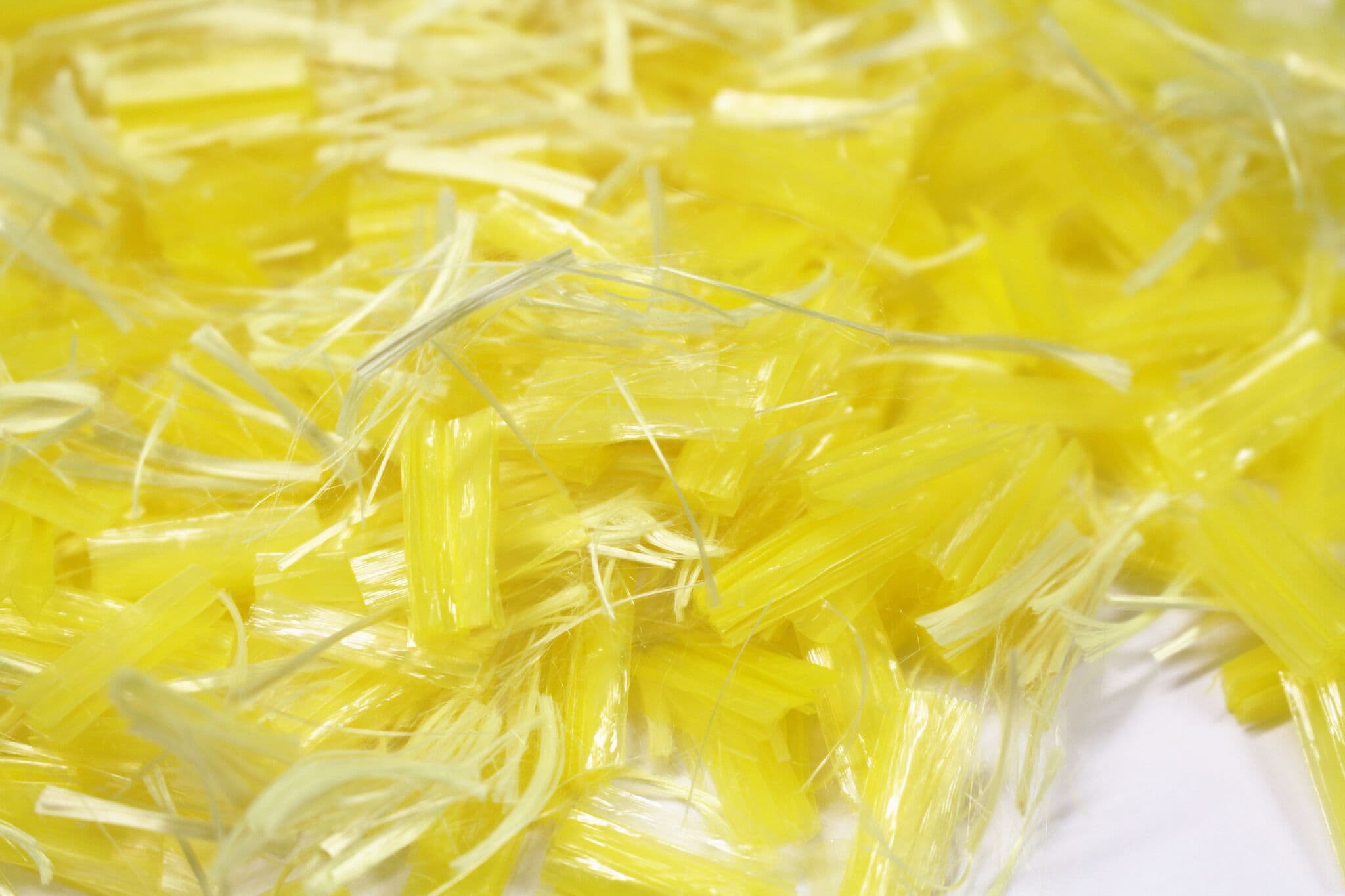
AsphaltX®
2000 filaments per aramid strand — 19 million fibres per tonne of asphalt. Lowest CO₂ footprint, European manufacturing, proven on the N337.
- TypeAramid (Twaron®) + polyolefin fibre blend
- Length± 19 mm
- Tensile strengthTwaron 3000 MPa · polyolefin 483 MPa
- Specific gravityTwaron 1.45 · polyolefin 0.91 g/cm³