What does asphalt cost per m2? 2026 prices (and the extra cost of fibre reinforcement)

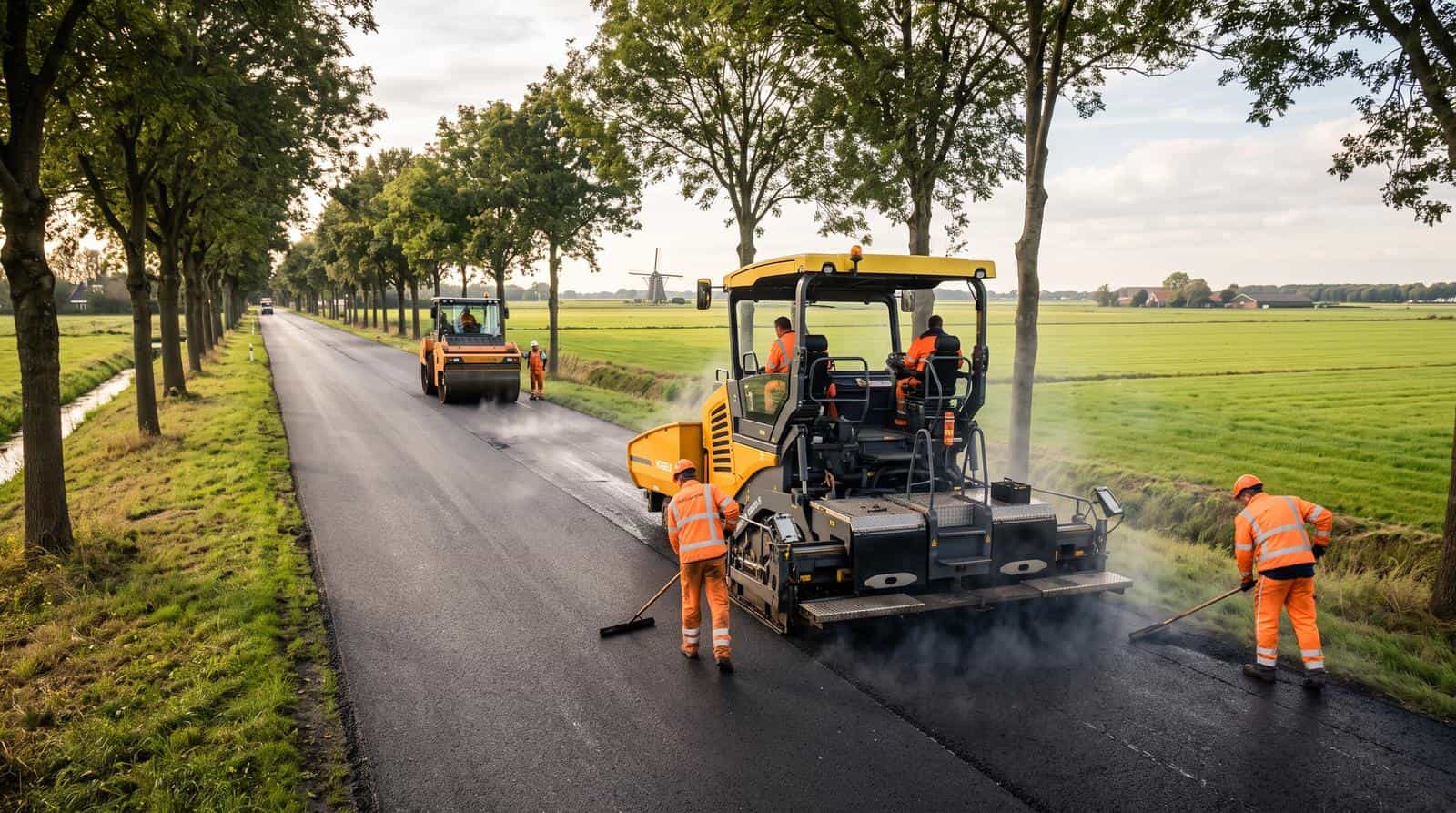
What does asphalt cost per m² in 2026? Guide prices per application and asphalt type (DAB, SMA, porous asphalt), the price per tonne — and why fibre reinforcement often works out cost neutral.
The asphalt price per m2 in 2026 sits indicatively between €25 and €130 per m², including laying. A private driveway costs on average €35 to €60 per m², an industrial yard €20 to €35 per m². Asphalt type (DAB, SMA, porous asphalt), layer thickness and surface area determine the price; fibre reinforcement adds only a limited — often cost-neutral — premium on top.
Asphalt price per m2: 2026 guide prices
The price of asphalting in the Netherlands varies widely, depending on the type of asphalt, the layer thickness, the surface area and the condition of the substrate. Indicative guide prices (2026 price level, including laying, excluding VAT and major groundworks):
• Private driveway (usually two layers of DAB) — €35 to €60 per m².
• Industrial yard or car park — €20 to €35 per m², depending on foundation, loading and asphalt mix.
• Asphalt cycle path — strongly dependent on width and foundation; allow indicatively €30 to €60 per m² for the asphalt work itself, excluding groundworks and edge restraints.
• Road section or provincial road — for large contiguous areas the price of the asphalt work drops towards the bottom of the range, from around €25 per m².
• General range (all applications) — €25 to €130 per m², depending on asphalt type, layer thickness and scale.
The larger the area, the lower the price per m² usually turns out: fixed costs such as transport, mobilising the paving crew and plant deployment are spread across more square metres. That is exactly why a small repair patch quickly costs two to three times as much per m² as a full road section.
What determines the cost of asphalting?
Five factors explain almost the entire price difference between projects:
• Type of asphalt — DAB, SMA and porous asphalt each have a different base price (see below).
• Layer thickness and number of layers — a surface course is usually more expensive per tonne than a base or binder course; a complete build-up comprises two to three layers.
• Surface area and accessibility — larger, easily accessible projects benefit from economies of scale.
• Preparatory works — milling existing asphalt, groundworks, foundation or drainage significantly affect the total cost, independent of the asphalt choice itself.
• Binder and reinforcement — a standard penetration bitumen is cheaper than polymer modified bitumen (PMB); fibre type and dosage determine the premium of fibre reinforcement.
For road authorities, the tendering approach comes on top: awarding on MKI or service life rather than lowest construction price means calculating with different figures. How to set that up is explained in tendering fibre-reinforced asphalt.
Price per asphalt type: DAB, SMA and porous asphalt
Within the range of €25 to €130 per m², the mix makes the difference:
• DAB (dense asphalt concrete) — the workhorse for driveways, industrial yards and municipal roads. The lowest asphalt concrete price within the range and widely available from every asphalt plant.
• SMA (stone mastic asphalt) — surface course for more heavily loaded roads. More expensive than DAB because of the higher aggregate and bitumen content, but more wear resistant and flat for longer.
• ZOAB (porous asphalt) — the standard surface course on national motorways: permeable and noise reducing. The cost of porous asphalt lies not only in the higher mix price, but above all in the shorter service life of the surface course and the more frequent maintenance cycle.
It is precisely with surface courses that reinforcement pays off: cracking and ravelling determine when a layer must be replaced. How to stretch that replacement cycle is explained in asphalt maintenance and extending service life.
Asphalt price per tonne — and how to convert it to m²
Asphalt plants charge per tonne, not per m². An indicative mix price in 2026 lies at €40 to €80 per tonne ex works (DAB at the bottom, SMA and porous asphalt at the top of that range), excluding transport and laying.
Conversion works via density: compacted asphalt weighs around 2,300 to 2,400 kg/m³. A layer 5 cm thick therefore comes to roughly 115 to 120 kg per m². At €40 to €80 per tonne, the material share is thus around €5 to €10 per m² per 5 cm layer. The rest of the square-metre price — often two thirds or more — consists of transport, the paving crew with rollers, labour, foundation and preparation. That explains why the total price per m² is so much higher than the bare material price, and why a more expensive mix or a fibre dosage moves the final price only marginally.
The extra cost of fibre reinforcement
Fibre reinforcement is added to the mix during production. The premium therefore consists almost entirely of the fibre itself — no extra work pass on the road, no different equipment and no adjusted recipe is needed. At a dosage of 500 grams of AsphaltX per tonne of asphalt (aramid fibre based on Twaron, around 0.05% of the mix weight, depending on mix and application), a 5 cm surface course requires some 60 grams of fibre per m².
That premium is comparable to — and often lower than — the price difference between regular penetration bitumen and PMB. Research within the European FIBRA project (practical trial section on the A73 near Roermond) shows that aramid fibres instead of PMB can be a cost-neutral alternative to PMB in the Dutch situation, provided a comparable service life is achieved. This is because:
• No extra work pass is needed, unlike reinforcement grids or meshes.
• A standard penetration bitumen suffices instead of the more expensive PMB.
• The production temperature is around 15 to 20 °C lower (165 °C versus around 181 °C for the PMB reference), which saves energy at the asphalt plant.
The full comparison of the two routes — production process, MKI and on-road performance — is set out in aramid fibres versus PMB.
Cost per m² per year: the fair comparison
A price per m² only says something about the one-off construction cost. For road authorities, what counts is the sum over the service life: construction plus maintenance, divided by the number of years the layer lasts. Fibre reinforcement can contribute to a longer service life of the road surface — potentially up to 50% longer for the road surface and up to 200% for the asphalt layer itself, depending on fibre type and application.
A worked example: a surface course at €30 per m² that lasts 12 years costs €2.50 per m² per year. If fibre reinforcement makes that same layer last a third longer (16 years — well within the researched range), that drops to around €1.90 per m² per year, while the fibre premium remains comfortably below the difference. Add to that the indirect savings: fewer maintenance interventions mean less traffic disruption, fewer closures and less milling waste.
If you want to run these figures for your own network, the service life approach is also the language of MEAT tenders and MKI-based awards. Background, mixes and practical cases are bundled in the pillar on fibre-reinforced asphalt.
From guide price to concrete quotation
The guide prices in this article are indicative (2026 price level): the actual price follows from mix choice, layer build-up, surface area and the condition of the substrate. For comparison: floors and paving in concrete follow a similar cost logic — see what fibre-reinforced concrete costs. If you are considering fibre reinforcement for a road section, industrial yard or cycle path, request a quotation for your road section with your tonnage and mix type — we will calculate the fibre dosage and premium for you in concrete terms.
Frequently asked questions
- What does 100 m² of asphalt cost?
- For a driveway of 100 m² you pay indicatively €3,500 to €6,000 (€35 to €60 per m², two layers of DAB, 2026 price level). An industrial yard of 100 m² costs around €2,000 to €3,500. Small areas are relatively expensive per m² because of fixed costs such as transport and mobilising the paving crew. For an exact figure, request a quotation.
- Which is cheaper: asphalt or concrete?
- Asphalt usually has a lower construction price per m² and can carry traffic sooner; concrete lasts longer without surface course replacement. For roads and yards with heavy or turning traffic, concrete can be cheaper over the service life. Therefore compare on cost per m² per year — see also what fibre-reinforced concrete costs.
- What does milling or removing asphalt cost?
- Milling an existing asphalt layer costs indicatively €5 to €15 per m², including removal, depending on layer thickness and surface area (2026 price level). Milled asphalt is readily recyclable and is reused as granulate in new mixes, which reduces disposal costs. For a full reconstruction, groundworks and foundation come on top.
- What does fibre-reinforced asphalt cost extra per m²?
- The premium sits almost entirely in the fibre itself: with AsphaltX the dosage is around 500 grams per tonne of asphalt (~0.05%, depending on mix and application), or some 60 grams per m² for a 5 cm surface course. Because a standard bitumen suffices instead of more expensive PMB and the production temperature is 15 to 20 °C lower, fibre reinforcement can work out cost neutral on balance.
- What does porous asphalt (ZOAB) cost per m²?
- Porous asphalt is more expensive per tonne than DAB because of the high aggregate content and therefore sits at the top of the mix price range (indicatively €40 to €80 per tonne ex works). The biggest cost difference, however, lies in the maintenance cycle: a porous asphalt surface course lasts less long than a dense one, so the cost per m² per year works out higher.
Share this article
Products mentioned
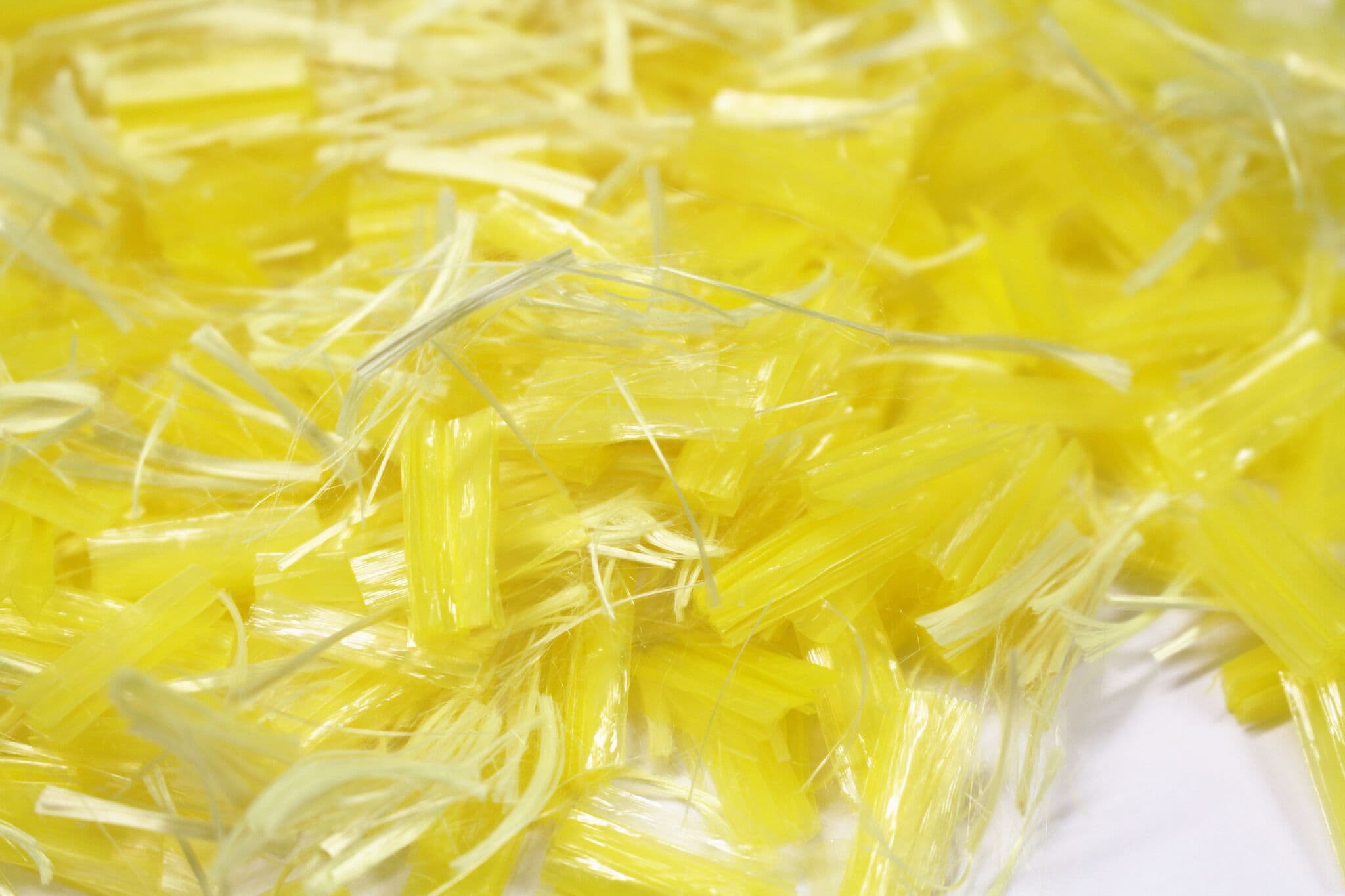
AsphaltX®
2000 filaments per aramid strand — 19 million fibres per tonne of asphalt. Lowest CO₂ footprint, European manufacturing, proven on the N337.
- TypeAramid (Twaron®) + polyolefin fibre blend
- Length± 19 mm
- Tensile strengthTwaron 3000 MPa · polyolefin 483 MPa
- Specific gravityTwaron 1.45 · polyolefin 0.91 g/cm³