Road management on a tight budget: fibre reinforcement for municipalities

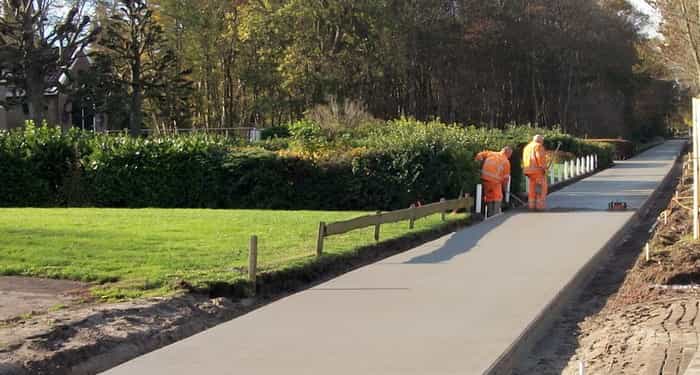
Municipalities manage the largest share of the road network on limited budgets. Fibre reinforcement extends the service life of roads, cycle paths and concrete works — within existing maintenance contracts.
Fibre reinforcement of asphalt and concrete makes municipal road management cheaper — roads and cycle paths last indicatively 20 years or more per maintenance cycle instead of around 15, with no new procurement process: a functional requirement in the existing maintenance specification is enough. Practice shows the return: a fibre concrete cycle path without steel mesh came in 46% cheaper, and a White Topping renovation saved around 25% in project costs.
Why municipal road management is under growing pressure
Municipalities manage the largest share of the Dutch road network — roughly 125,000 of the approximately 140,000 kilometres of paved road fall under municipalities and water boards. Unlike the national highways agency or the provinces, the average municipality has no asphalt laboratory or road engineering department of its own to assess the service-life and environmental performance of innovative mixes. At the same time, the maintenance backlog is growing: many roads and structures from the 1960s and 1970s are reaching the end of their technical life simultaneously, while maintenance budgets rarely grow to match. How large that challenge is nationally is covered in the largest maintenance challenge ever.
For the road manager, that means choosing: carry out minor maintenance more often, postpone reconstructions, or buy more service life per maintenance round. Fibre reinforcement falls into that third category. It is a measure that piggybacks on work already planned — milling and resurfacing, or pouring a concrete pavement — and pushes the next maintenance moment years further out. Within the pillar applications and target groups, this is therefore one of the most direct routes from knowledge to execution.
What does fibre reinforcement deliver per asset type?
A municipal portfolio is not a motorway: it consists of residential streets, cycle paths, bus lanes, depots and, increasingly, quay walls. The failure mechanism differs per asset type — and so does what fibres have to offer.
Residential streets and access roads
In residential streets, cracking from root heave, cable and utility trenches and turning traffic is the biggest wear item. Aramid fibres in the asphalt mix form a three-dimensional reinforcement that slows crack growth and rutting. The dosage of aramid fibres for municipal roads is indicatively around 0.05% — roughly 500 grams per tonne of asphalt, depending on mix and application — and requires no change to the mix design. On the Varsseveldseweg in Doetinchem, 6 kilometres of binder course were reinforced this way at 500 g/tonne, in a mix that was moreover 100% circular in accordance with BRL 9023.
How fibres compare with other measures in major maintenance — and when which measure pays off — is set out in asphalt maintenance: measures, costs and extending service life.
Cycle paths
Cycle paths are the most proven field of application for municipalities. For a new concrete cycle path, fibre concrete for cycle paths can fully replace the traditional steel mesh: in Wijckel (Friesland) that delivered 46% lower costs, zero kilograms of steel reinforcement and faster execution because laying and fixing reinforcement mesh was eliminated.
For an existing asphalt cycle path at the end of its life, White Topping is an alternative to full reconstruction: a thin concrete pavement with fibres over the existing asphalt structure. Along the N344 near Barneveld, 12 cm of fibre concrete was laid over the old asphalt this way: around 2,500 tonnes of asphalt did not have to be removed, project costs came out roughly 25% lower and the expected service life exceeds 20 years. The technique, thickness build-up and preconditions are covered in White Topping: fibre concrete over asphalt.
Bus lanes and bus stop bays
Bus lanes combine heavy axle loads with channelised traffic: every bus follows exactly the same track, and at stops braking and turning forces are added. Asphalt deforms fastest there — rutting and ravelling at bus stop bays are a classic maintenance item. A concrete pavement or concrete bus stop bay with fibre reinforcement is often the rational choice here: concrete does not creep under stationary or slow-moving heavy traffic, and fibres control the shrinkage cracking that leads to slab replacement in traditional unreinforced concrete. Where the bus lane remains in asphalt, aramid fibres raise the resistance to rutting precisely on the most heavily loaded strips.
Municipal depots and recycling centres
Depots, recycling centres and salt stores are trafficked by refuse compactors, loading shovels and lorries with turning loads — comparable to logistics yards. Steel fibre or macro fibre concrete is the standard solution here for liquid-tight and wear-resistant paving. The design choices match those for commercial yards; see fibre reinforcement for car parks for dosages and execution details that transfer one-to-one to a depot.
Street furniture and small-scale foundations
Tree planters, foundations for lighting columns, traffic signs and seating elements are too small to make reinforcement mesh economic, but too heavily loaded to build unreinforced. Fibre concrete from the truck mixer — with no steel fixing — is the quickest route here: the fibres are already in the mix and the crew pours straight away. For works departments doing this in-house, it is often the first low-threshold introduction to fibre reinforcement.
Quay walls, culverts and bridges
For many municipalities the structures challenge is bigger than the roads challenge: thousands of quay walls, culverts and bridges are approaching the end of their life. In concrete repair and new build in wet environments, one property weighs heavily: fibre reinforcement made of synthetic material or basalt does not corrode, whereas traditional reinforcing steel, once chlorides penetrate, bursts the concrete apart from the inside. Fibre concrete also plays a growing role in replacing timber bridge decks; the trade-off between composite, plastic and fibre concrete is covered in replacing a timber bridge deck. Note: for structural work such as quay walls, a calculation by the structural engineer remains required — fibres do not fully replace traditional reinforcement in every application.
Worked example: from 15 to 20+ years per kilometre of cycle path
A worked example makes the business case concrete. Take 1 kilometre of asphalt cycle path, 2.50 metres wide (2,500 m²), with a surface course cycle of around 15 years:
• Without fibres — over a 60-year period, 4 surface course replacements are needed (years 15, 30, 45 and 60), each with costs for milling, paving, closures and diversions.
• With fibre reinforcement — at a life extension to 20 years or more per cycle, that becomes 3: a quarter fewer maintenance rounds, less disruption and less material use over the same period.
• The extra cost — at around 500 g of fibres per tonne of asphalt, a 2,500 m² surface course involves a few tens of kilograms of fibres; the surcharge thus remains a fraction of the cost of one extra maintenance round (indicative, 2026 price level, depending on project and mix).
For new concrete cycle paths the sum is even more direct: the steel mesh is eliminated entirely, including laying, tying and crane movements. In Wijckel that saved 46% on construction costs. And where an existing asphalt path is overlaid with fibre concrete (White Topping), the avoided demolition and disposal comes on top — around 2,500 tonnes of asphalt in Barneveld.
Want to run the numbers for your own portfolio? The fibre calculator works out dosages and quantities per project.
How to include fibres in your specification or framework contract
Fibre reinforcement requires no new procurement process. The measure can be applied within existing maintenance contracts via a functional requirement or a variation order. A workable step-by-step plan:
• Step 1: select a pilot section — choose a cycle path, residential street or depot floor already on the maintenance schedule, so the fibres piggyback on planned work.
• Step 2: specify functionally, not by product — for example: 'the asphalt pavement contains a fibre reinforcement that demonstrably increases resistance to cracking and rutting; the contractor substantiates the expected life extension with independent research or references from practice.' That keeps the requirement clean under procurement law and leaves the market free in how to meet it.
• Step 3: ask for substantiation — have bidders demonstrate service-life and environmental performance with standard tests (for concrete fibres EN 14889 and beam tests to EN 14651) and reference projects.
• Step 4: record the baseline — photograph and monitor the pilot section, so that after two or three winters you have your own evidence for wider roll-out in the framework contract.
• Step 5: scale up via the framework contract — include the functional requirement as a standard clause at the next extension or revision of the maintenance specification.
Municipality or province: a different playing field
Provinces work with large integrated contracts, EMVI award criteria and their own innovation programmes; a provincial road such as the N337 then serves as a testing ground where a contractor can bid distinctively with fibre reinforcement. Municipalities usually lack that toolkit — but they do have an advantage: a smaller portfolio with many similar assets and short lines of communication. Where a province innovates project by project, a municipality can include one functional specification clause in its framework contract and let it work through for years on every cycle path and residential street. For smaller road managers without in-house road engineering expertise in particular, that is the most efficient route: formulate it well once, then request it as standard.
Getting started in practice
The threshold is lower than many road managers think: fibres require no different plant, no mix design change for asphalt and no new contract. Choose a pilot section from the existing maintenance schedule, formulate the requirement functionally and let the supplier determine the dosage per mix. If you are unsure which fibre type suits which asset — aramid for asphalt, synthetic macro fibre or steel fibre for concrete — the selection guide points you to the right product in a few steps, or you can request a project-specific quotation directly, taking your specification requirements as the starting point.
Frequently asked questions
- Can fibre reinforcement be applied within an existing maintenance contract?
- Yes. Fibre reinforcement is included as a functional requirement in the maintenance specification or as a variation order within a framework agreement; no new procurement process is needed. For asphalt the mix design does not change — on the Varsseveldseweg, 6 km of binder course was reinforced with 500 g of fibres per tonne without any mix modification.
- How much longer does a road last with fibre reinforcement?
- Indicatively, fibre reinforcement extends a maintenance cycle from around 15 to 20 years or more, depending on mix, loading and subgrade. For concrete cycle paths the expected service life exceeds 20 years; the White Topping renovation along the N344 near Barneveld was designed for that and saved around 25% in project costs at the same time.
- Do fibres fully replace the reinforcement mesh in a concrete cycle path?
- In lightly loaded paving such as cycle paths, macro fibre concrete can fully replace the steel mesh — in Wijckel that was done at 46% lower cost. In structural work such as quay walls or bridge decks it is not a given: there a calculation by the structural engineer determines whether and how much traditional reinforcement remains necessary alongside fibre concrete.
- What do fibres cost per kilometre of road?
- For asphalt it comes to around 500 grams of aramid fibre per tonne of mix (depending on mix and application); per kilometre of surface course that amounts to a few tens of kilograms of fibres. The surcharge is thus a fraction of one maintenance round — indicative, 2026 price level. A quotation based on your specification gives the exact amount per project.
- Can fibre-reinforced asphalt be reused in a circular way?
- Yes. Fibre-reinforced asphalt is milled and reused as normal; on the Varsseveldseweg the fibre reinforcement was even applied in a 100% circular mix in accordance with BRL 9023. With White Topping, the existing asphalt structure moreover stays in place entirely as a foundation, avoiding demolition and disposal — around 2,500 tonnes in Barneveld.
Share this article
Products mentioned
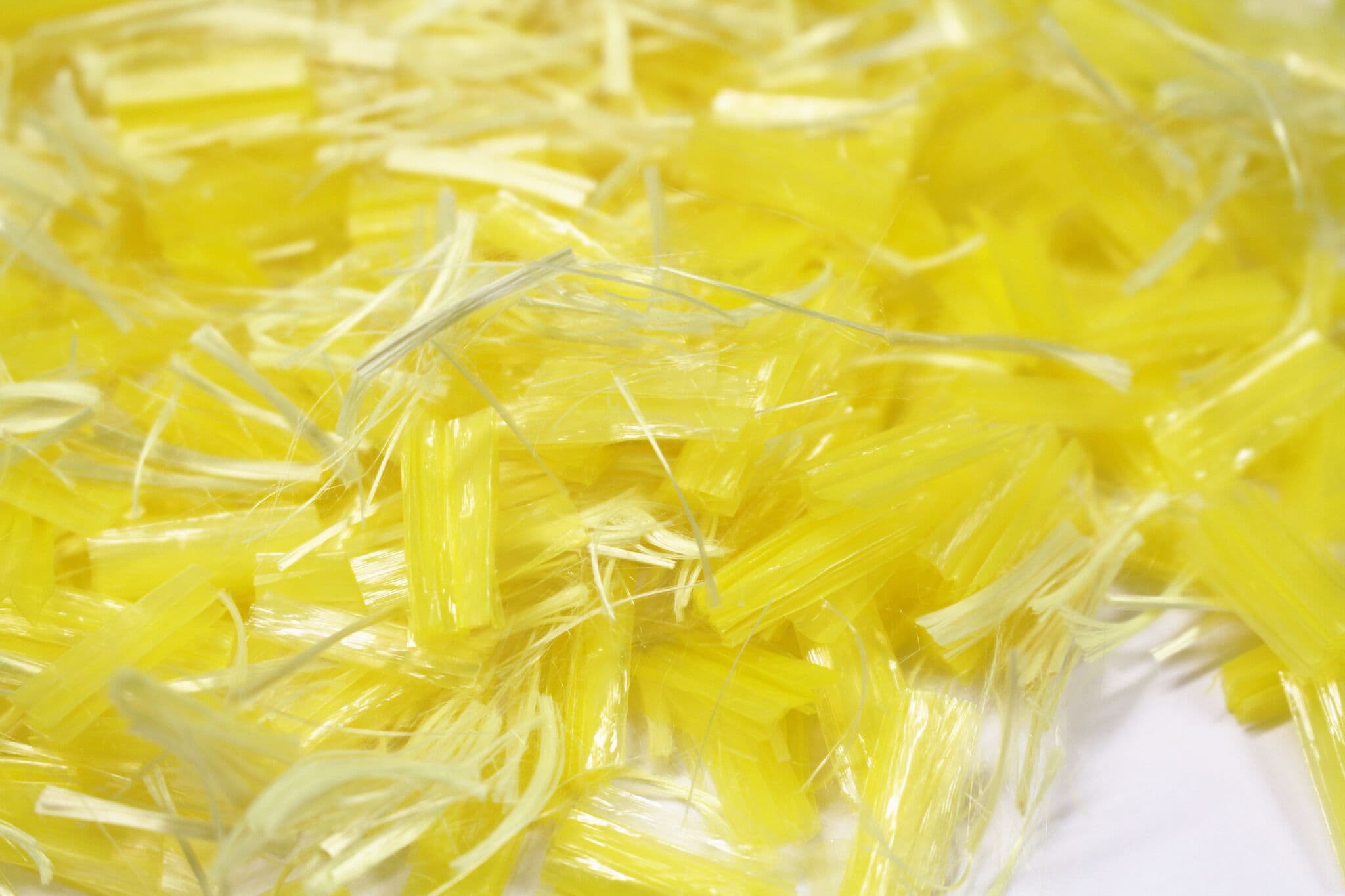
AsphaltX®
2000 filaments per aramid strand — 19 million fibres per tonne of asphalt. Lowest CO₂ footprint, European manufacturing, proven on the N337.
- TypeAramid (Twaron®) + polyolefin fibre blend
- Length± 19 mm
- Tensile strengthTwaron 3000 MPa · polyolefin 483 MPa
- Specific gravityTwaron 1.45 · polyolefin 0.91 g/cm³
 Most chosen
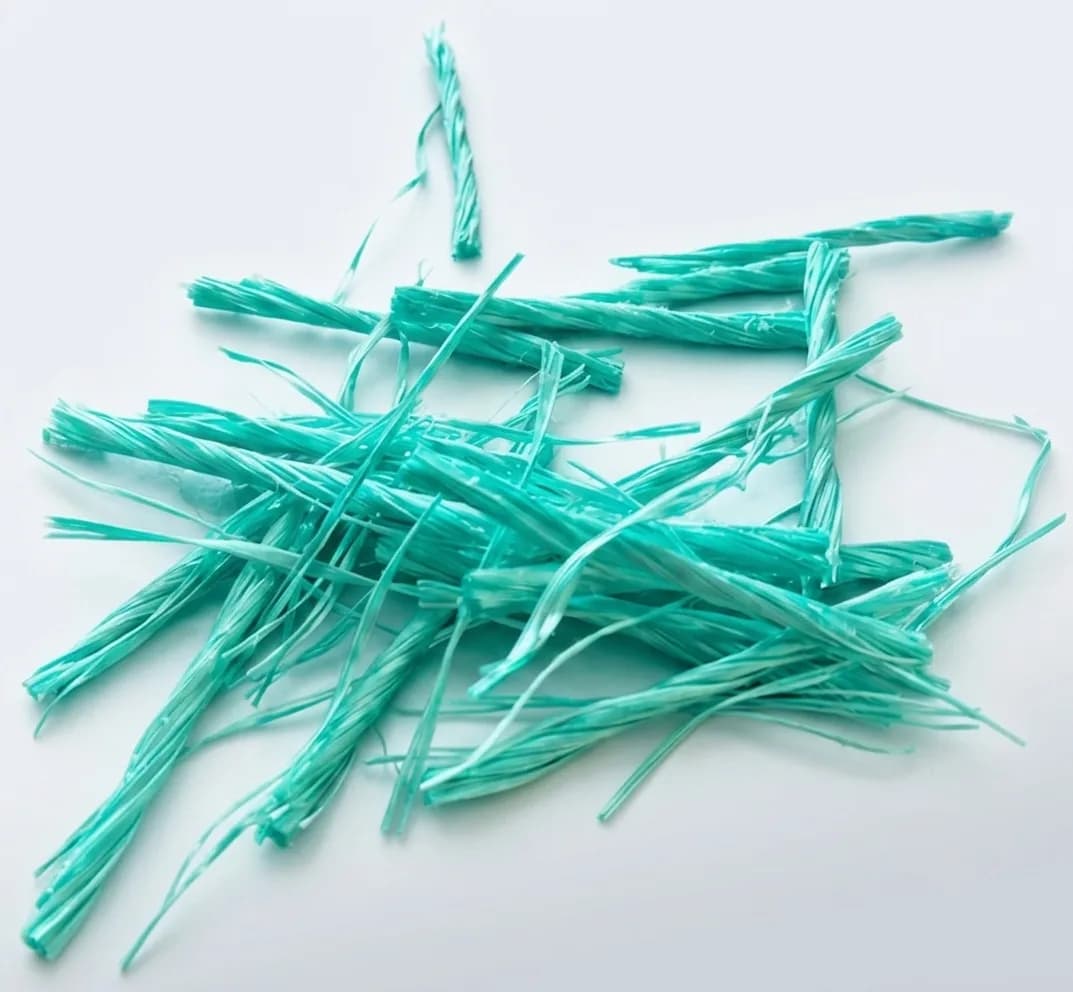
TwistR® GREEN HYBRID
High-performance synthetic macro fibres made from 100% polypropylene. Transforms concrete into a stronger composite material.
- TypeHybrid: twisted monofilament + fibrillating network fibre
- Material100% virgin polypropylene
- Length48 mm
- Dosage2.0 – 6.0 kg/m³
Pallet price on request