Car parks, parking decks and garage floors: fibre reinforcement by situation

A parking deck on a building makes different demands than a ground-level car park or a garage full of de-icing salt. The right fibre choice per situation, with dosages and indicative prices.
Fibre reinforcement absorbs the typical parking loads — stop-start traffic and concentrated point loads — in both asphalt and concrete. At ground level you choose between fibre reinforced asphalt (aramid, around 500 grams per tonne) and a concrete pavement with macro fibres; on a parking deck and in car parks and garages, corrosion-free fibre reinforced concrete wins, because de-icing salt attacks reinforcing steel there and every centimetre of structural depth saves around 24 kg/m² in self-weight.
The load profile of parking: stop-start and point loads
Unlike a through road, a parking facility sees a great deal of local, static loading: cars standing still for long periods, combined with concentrated turning movements when manoeuvring in and out of bays. That combination of static point loading and local shear stress is a fundamentally different load pattern from the even, rolling load of a carriageway — and it calls for a pavement that resists point loads and cracking at specific, repeatedly loaded spots such as entrances and exits, aisles between the bays, and loading and unloading zones.
Fibre reinforcement is well matched to this for four reasons:
• Spreading of point loads — fibres distribute the stress from concentrated loads (turning wheels at parking bays, stationary axles) more evenly through the mix.
• Fewer joints in concrete — with fibre reinforced concrete for car parks, larger bays are possible with fewer contraction joints; that simplifies the bay layout and reduces joint maintenance.
• Faster construction — eliminating the separate reinforcement stage (laying, aligning and fixing mesh) saves labour hours on large areas at shopping centres, distribution centres and park-and-ride sites.
• Sustainability requirements — more and more retail and property companies set their own sustainability targets; fibres deliver concrete arguments here through a lower production temperature (asphalt) and less steel consumption (concrete).
Ground-level car park: asphalt or concrete paving?
Both materials are used; the choice depends on service life, loading, aesthetics and budget. Fibre reinforced asphalt is usually the faster and cheaper choice for large areas with regular passenger traffic. A concrete pavement is chosen more often for heavier loading — lorry parking, loading and unloading zones — or where a longer service life with less maintenance outweighs the higher construction cost. If you are undecided, the comparison asphalt or concrete: decide with the selection tool will point you in the right direction in a few minutes.
Fibre reinforced asphalt: aramid against rutting
On asphalt car parks, rutting is the core risk: slow-moving and turning traffic kneads the asphalt, especially in summer. Aramid fibres against rutting in stop-start traffic strengthen the mix throughout; the dosage is indicatively around 0.05% — roughly 500 grams per tonne of asphalt, depending on mix and application. On the N337 provincial road between Zwolle and Deventer, with comparable braking and accelerating traffic, AsphaltX delivered 50% less rutting and 30% less cracking over an 8-kilometre stretch.
The fibres are blended in at the asphalt plant without any change to the mix recipe, including in mixes produced at lower temperatures — relevant for clients managing on CO₂.
Concrete paving with fibre reinforced concrete: fewer joints, no mesh
For a concrete car park, macro fibres replace the traditional reinforcement mesh: the fibres are distributed homogeneously through the entire volume and control shrinkage cracks exactly where they occur. For car-only areas a synthetic macro fibre such as TwistR (2–6 kg/m³) is usually sufficient; with regular lorry traffic or high point loads, a hooked-end steel fibre such as the MPZG HT+ 35/0.55 comes into play, with dosages determined by calculation. The required thickness for car parks generally lies between 12 and 18 cm, depending on subgrade and traffic; the reasoning behind it is set out in how thick a concrete floor needs to be.
What does a car park cost per m²? (indication)
Indicative, 2026 price level and strongly dependent on area, foundation and accessibility:
• Fibre reinforced asphalt, ground level — roughly €20 to €35 per m², laid; the fibre share is a limited part of that.
• Concrete paving with fibre reinforced concrete — indicatively €40 to €70 per m², laid; the concrete mix itself costs roughly €110–165 per m³, plus a premium of €15–45 per m³ for synthetic macro fibre or €12–65 per m³ for steel fibre.
• Renovation with white topping — project-dependent; where the existing asphalt is reused as the foundation, a saving of around 25% on project costs has proved realistic.
The higher construction price of concrete is partly recovered over the service life: a fibre reinforced concrete pavement lasts well over 20 years with minimal maintenance, whereas asphalt typically needs at least one surface course replacement in that period.
Parking deck on a building: every kilo of self-weight counts
A parking deck — on top of a shopping centre, office or purpose-built car park — adds a structural dimension to the classic load profile: the deck does not bear on sand, but on the structure beneath it. Every kilo of pavement weight has to be carried down through columns, beams and foundations. Concrete weighs around 2,400 kg/m³, so every centimetre of slab depth means some 24 kg/m² of permanent self-weight.
That is where fibre reinforced concrete pays off: because macro fibres deliver crack resistance throughout the entire volume, the structure can be designed more slender than with traditional mesh, which after all requires sufficient concrete cover above and below the steel. A deck that can be 2 cm thinner quickly saves 50 kg/m² — on a 5,000 m² deck that is 250 tonnes less structural weight. In new build this translates into lighter supporting structures; in renovation it can make the difference between staying within the existing load capacity or not.
Important: a parking deck is by definition structural work. Fibres do not automatically replace traditional reinforcement in full here — type, dosage and the combination with conventional reinforcement always follow from a calculation by the structural engineer, with residual strength classes to EN 14651 as the design basis. For heavily loaded decks and industrial floors at upper-storey level, high-tensile steel fibres such as the MPZG HT+ 35/0.55 are the starting point; the parallels with fibre reinforced concrete for industrial floors are considerable.
Car park garage floors: de-icing salt, chlorides and corrosion
In enclosed car parks and on open parking decks an insidious problem is at work: in winter, cars carry de-icing salt inside, where it ends up on the floor as chloride-laden meltwater. Chlorides penetrate the concrete and attack traditional reinforcing steel — resulting in rust, spalling concrete and costly concrete repairs. Why that mechanism is so destructive and how fibres prevent it is explained in our article on carbonation and corrosion of reinforcing steel.
For garage floors this means, in practical terms: synthetic macro fibres are completely corrosion-free and therefore insensitive to chlorides — there is simply nothing to rust. Steel fibres, unlike a reinforcement mesh, are dispersed through the volume without a continuous electrical circuit; fibres near the surface can show local rust specks under chloride exposure, but the expansive, structurally undermining corrosion process of a continuous mesh does not occur. For exposed floors or floors heavily loaded with de-icing salt, a synthetic fibre or a combination with a dense, monolithically finished top layer is therefore the logical choice.
Monolithic floors, power floating and polished concrete
Garage floors are usually built as a monolithic floor: structure and wearing surface in a single pour, machine power-floated to a dense, flat finish. In a car park that dense surface is not cosmetic — it slows the ingress of chloride-laden water and is easy to clean. Fibre reinforced concrete lends itself well to this: the fibres distribute through the volume and the power float works surface fibres away almost completely.
If the floor is subsequently polished — for instance in a prestige parking facility or showroom environment — the machine grinds the top layer flat. Synthetic fibres then appear at most as matt dots, steel fibres as small metallic specks; in a garage environment that is usually acceptable, but where aesthetic demands are high you opt for synthetic macro or micro fibres. Bear in mind that polishing concrete is a separate operation with its own costs, and that the skid resistance of the finished surface must continue to meet the applicable requirements for ramps and drive aisles.
For the thickness of a garage floor on sand, the rule of thumb is 10–12 cm; floors in multi-storey car parks follow the structural calculation of the deck above or below.
Renovation: white topping over a worn asphalt car park
Many existing car parks are ageing asphalt: rutting at the entrance, ravelling in the bays, a new surface course every ten years. Fully milling and resurfacing is not the only option. As long as the damage is limited to the surface, asphalt maintenance such as crack sealing or a surface treatment can extend the service life of the existing pavement. With white topping — fibre reinforced concrete over existing asphalt, the old asphalt stays in place as the foundation and a thin concrete pavement of around 10–15 cm of fibre reinforced concrete goes on top. On the cycle paths along the N344, that approach with a 12 cm TwistR concrete layer delivered around 25% lower project costs, because 2,500 tonnes of asphalt did not have to be removed.
For car parks the technique is doubly interesting because the site can be tackled bay by bay in phases, keeping the shop or business accessible. The precondition is sufficient residual bearing capacity in the existing structure — a deflection survey establishes that beforehand.
Practical points of attention
• Markings and lining — in both asphalt and concrete, the surface texture determines how well parking markings adhere; coordinate the finishing stage (brush finish, power floating) with the lining plan.
• Drainage — on ground-level sites, falls towards gullies are the standard; open-graded mixes such as porous asphalt are less common on car parks than on motorways. On decks and in garages, drainage is part of the structural design, partly because of the chloride-laden meltwater.
• Joints and bay layout — fewer contraction joints thanks to fibre reinforced concrete means less joint maintenance, but the remaining joints deserve a position outside the most heavily trafficked wheel paths.
• Accessibility during maintenance — a longer service life means closing (parts of) the site less often; for retail and park-and-ride locations that is one cost item fewer.
From situation to fibre recommendation
The common thread: at ground level you choose between fibre reinforced asphalt and a concrete pavement based on loading and budget, on a parking deck self-weight drives the design, and in the car park garage chlorides set the standard. More applications from this segment can be found on the pillar page applications and target groups. If you want to know which fibre type and dosage suit a specific site, deck or garage floor, request a quotation with fibre recommendation — with traffic loading, area and subgrade, we will work out the alternative to traditional reinforcement for you.
Frequently asked questions
- Which fibres are suitable for a parking deck on a building?
- A parking deck is structural work, so the fibre choice follows from a calculation by the structural engineer. High-tensile steel fibres such as the MPZG HT+ 35/0.55 are the starting point for heavy loading; corrosion-free synthetic macro fibres score well under de-icing salt exposure. The gain lies in the more slender design: every centimetre less concrete saves around 24 kg/m² of self-weight.
- How thick does a concrete pavement for a car park need to be?
- For ground-level car parks the thickness generally lies between 12 and 18 cm: the lower end of that range for cars only on a good foundation, the upper end for lorry traffic or a mediocre subgrade. The final thickness follows from a calculation. The reasoning per application is set out in how thick a concrete floor needs to be.
- What does a fibre reinforced car park cost per m²?
- Indicative, 2026 price level: fibre reinforced asphalt roughly €20–35 per m² laid, a concrete pavement with fibre reinforced concrete roughly €40–70 per m². Area, foundation and accessibility strongly influence the final figure; for renovation with white topping, a project saving of around 25% has proved realistic. A project-based quotation will give a definitive answer for your site.
- Why is de-icing salt a problem for car park floors?
- In winter, cars carry chloride-laden meltwater into the garage. Chlorides penetrate the concrete and attack traditional reinforcing steel, causing expansive rust and spalling concrete. Synthetic fibres are completely corrosion-free and steel fibres do not form a continuous mesh, so this damage mechanism does not occur. See also corrosion of reinforcing steel.
- Can I renovate a worn asphalt car park without replacing everything?
- Yes, provided the existing structure has sufficient residual bearing capacity. With white topping, the old asphalt stays in place as the foundation and a thin layer of fibre reinforced concrete of around 10–15 cm goes on top. On the N344 that saved around 25% on project costs, and it can be carried out bay by bay in phases so the site remains accessible.
- Can a power-floated or polished floor be built with fibres?
- Yes. On a monolithically power-floated floor, the power float works surface fibres away almost completely. When concrete is polished, exposed fibres are ground flush: synthetic fibres as matt dots, steel fibres as small metallic specks. In garages that is usually acceptable; where aesthetic demands are high, you choose synthetic macro or micro fibres.
Share this article
Products mentioned
 Most chosen
TwistR® GREEN HYBRID
High-performance synthetic macro fibres made from 100% polypropylene. Transforms concrete into a stronger composite material.
- TypeHybrid: twisted monofilament + fibrillating network fibre
- Material100% virgin polypropylene
- Length48 mm
- Dosage2.0 – 6.0 kg/m³
Pallet price on request
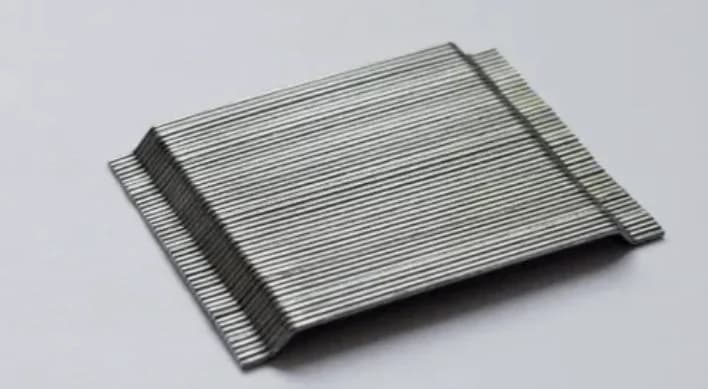
MPZG HT 35/0.55
High-tensile hooked steel fibres with aspect ratio 35/0.55. Maximum anchorage and ductility for heavily loaded structures.
- TypeCold-drawn hooked steel fibre (glued)
- Dimensions35 mm / Ø 0.55 mm
- Tensile strength1345 N/mm² ± 7.5%
- Modulus of elasticity200,000 N/mm²
Pallet price on request

AsphaltX®
2000 filaments per aramid strand — 19 million fibres per tonne of asphalt. Lowest CO₂ footprint, European manufacturing, proven on the N337.
- TypeAramid (Twaron®) + polyolefin fibre blend
- Length± 19 mm
- Tensile strengthTwaron 3000 MPa · polyolefin 483 MPa
- Specific gravityTwaron 1.45 · polyolefin 0.91 g/cm³