What is ZOAB? Dutch porous asphalt explained

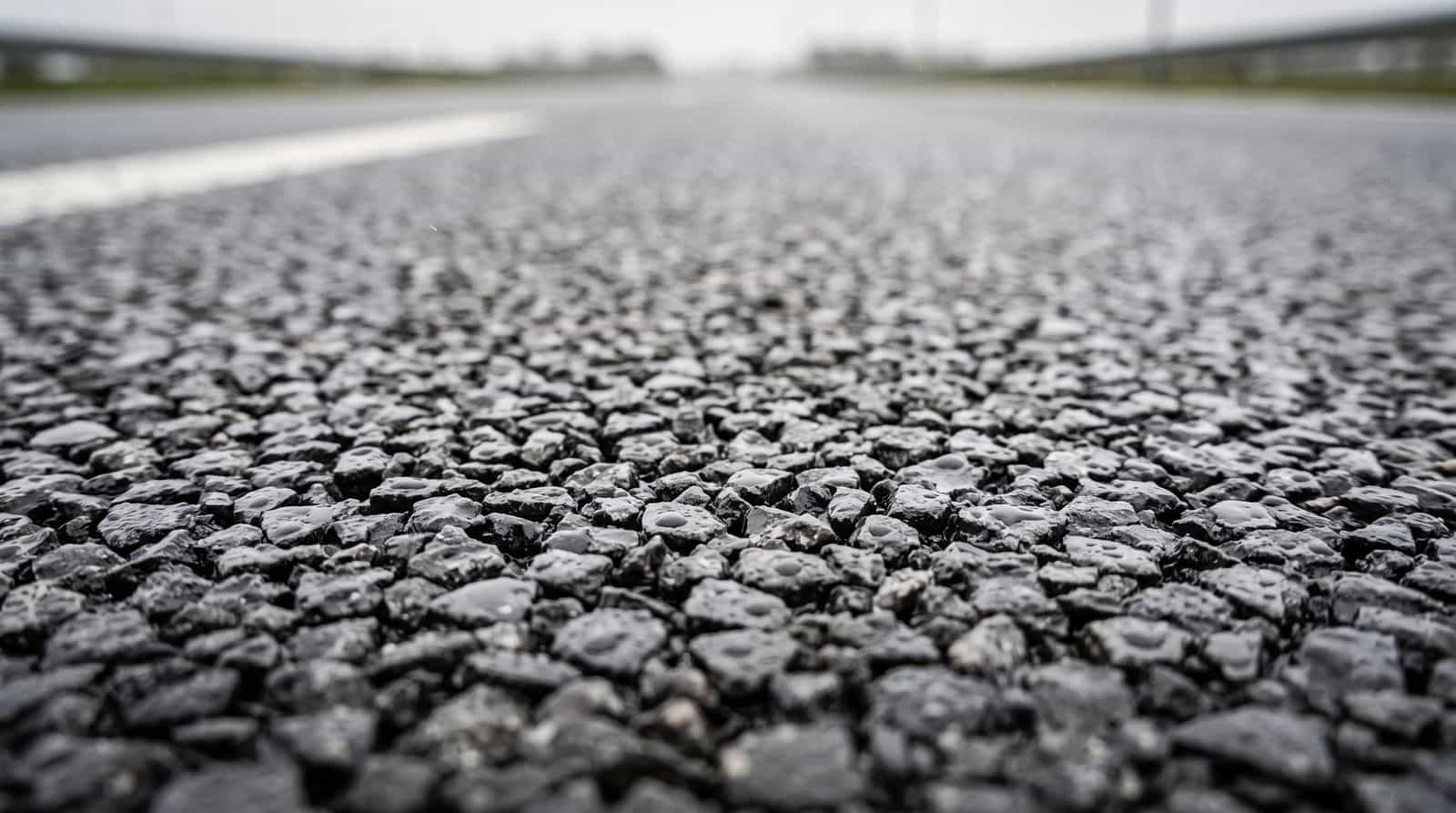
ZOAB is porous asphalt with over 20% air voids: it drains rainwater away and dampens tyre noise. How it works, where it is vulnerable and what fibres do about it.
ZOAB stands for zeer open asfaltbeton — Dutch for very open asphalt concrete: porous asphalt with at least 20% air voids. Rainwater drains down through the road surface and tyre noise is dampened. ZOAB has been the standard on Dutch trunk roads since the late 1980s — around 90% of the national motorway network is surfaced with it. The downside: susceptibility to ravelling and a shorter surface course lifespan.
What does the abbreviation ZOAB mean?
The abbreviation ZOAB literally means zeer open asfaltbeton (very open asphalt concrete) — pronounced as a single word. "Very open" refers to the air voids in the mix: where dense asphalt concrete contains at most a few per cent of voids, in ZOAB it is at least 20% of the volume. Internationally this mix type is known as porous asphalt (PA); in the FIBRA research documents on the A73 you will therefore encounter the designation 2L-PA for two-layer ZOAB.
The term "ZOAB asphalt" that you often read is strictly speaking tautological — the asphalt is already in the abbreviation — but it has become fully established in everyday usage. ZOAB is a surface course mix: it forms the top layer of the pavement, laid on a dense asphalt base course that provides the structural strength.
Who invented ZOAB?
There is no single named inventor: ZOAB was developed in the Netherlands in the 1970s by Rijkswaterstaat (the Dutch national road authority) together with the road construction sector, building on experience with porous surface courses previously used at airports to prevent water films on runways. The first Dutch trial sections appeared on the national road network in the early 1970s.
The results — less spray, less aquaplaning and a noticeably quieter road surface — were so convincing that from 1987 Rijkswaterstaat began prescribing ZOAB as the standard surface course for trunk roads. Today around 90% of Dutch trunk roads carry a ZOAB surface course, and the mix is internationally regarded as a Dutch export product in road construction.
How does ZOAB work?
The secret of ZOAB lies in the mix composition. A dense asphalt mix contains, besides crushed stone, a large amount of sand and filler, so that virtually all the space between the stones is filled. ZOAB, by contrast, contains very little sand and filler: the mix consists almost entirely of coarse, single-sized crushed stone coated in a thin layer of bitumen mortar. The stones bear on each other like a skeleton and leave voids open between them — the air void content of at least 20% from which the mix takes its name.
That open structure delivers the two properties for which ZOAB is used: water drainage and noise reduction.
Water drainage: no spray, less aquaplaning
In rain, the water drains down through the voids into the surface course and flows sideways over the dense base course towards the verge or the drainage system. The running surface itself therefore remains virtually free of water films. For the road user that means: hardly any spray behind lorries, better visibility of the road markings and a greatly reduced risk of aquaplaning. This road safety effect was the main reason for introducing ZOAB on a large scale at the time.
Noise reduction: voids dampen tyre noise
The same voids absorb part of the tyre noise and prevent the "air pumping effect" between tyre and road surface. Single-layer ZOAB is therefore indicatively some 2 to 3 dB quieter than dense asphalt concrete; two-layer ZOAB adds roughly another 2 dB on top. For reference: on the A73 trial section, CPX noise levels of 91 to 93 dB(A) were measured twelve weeks after laying — and those values proved independent of the reinforcement type used, as we set out in our article on fibre reinforced asphalt and noise reduction.
For road authorities that must comply with noise production ceilings, that damping is often the decisive reason to choose (two-layer) ZOAB.
Single-layer versus two-layer ZOAB
ZOAB comes in two main variants:
• Single-layer ZOAB — one open surface course of around 50 mm with relatively coarse crushed stone (for example 11/16 mm). The standard solution on most of the trunk road network.
• Two-layer ZOAB (also called double-layer ZOAB) — a coarse, very open lower layer topped with a thin surface layer of fine crushed stone ("two-layer ZOAB fine", for example 4/8 mm). The fine top layer acts as a filter: dirt is caught near the top and is flushed out again by rain and traffic, so that the coarse lower layer stays open.
Two-layer ZOAB is the quietest variant and is used above all where noise requirements are strict, such as alongside housing. The trade-off is that the fine top layer is the most vulnerable to ravelling and therefore needs maintenance soonest. It is exactly this mix type (2L-PA 8) on which fibre reinforcement was tested in the FIBRA field trial on the A73.
What are the disadvantages of ZOAB?
The open structure that gives ZOAB its qualities is at the same time its Achilles heel. Three disadvantages shape the maintenance picture.
Ravelling: the dominant damage mechanism
Ravelling is the loss of crushed stone from the road surface. Because the stones in ZOAB are connected only via thin mortar bridges, there is little reserve: if the bitumen mortar ages through sun, water and temperature cycles, those bridges become brittle and traffic works the stones loose. Once started, the process accelerates — every stone that disappears increases the load on its neighbours. For Rijkswaterstaat, ravelling is the governing damage mechanism that determines the end of a ZOAB surface course's life, and it is particularly severe at locations with turning and scrubbing traffic such as slip roads and tight curves.
Frost and ice: freezes sooner, needs more salt
ZOAB and frost are a difficult combination. The voids insulate the surface course from the warmer ground below, so the surface cools faster than dense asphalt and freezes over sooner. In addition, de-icing salt partly drains into the voids with the meltwater, so it remains effective on the running surface for less time: winter maintenance on ZOAB requires more frequent and heavier salting. Hence the well-known warning that bridges and ZOAB sections are the first to become icy in wintry conditions.
Shorter lifespan and higher costs
A ZOAB surface course does not last as long as a dense one. Indicatively: where stone mastic asphalt (SMA) often lasts 15 years or more, single-layer ZOAB is typically replaced after some 10 to 13 years, and the fine top layer of two-layer ZOAB often after just 7 to 9 years — strongly dependent on traffic loading and location. ZOAB is also more expensive to lay than dense asphalt (more bitumen of higher quality per tonne, higher demands on workmanship), and drainage alongside the road requires extra attention. Anyone calculating over the whole life cycle must therefore factor in both the construction costs and the shorter replacement cycle.
Lifespan and maintenance of ZOAB
Maintaining ZOAB comes down to two things: keeping the voids open and keeping the mortar healthy for as long as possible.
• Cleaning — a ZOAB cleaner (a spray-and-suction unit that forces water into the road surface at high pressure and immediately extracts it) reopens clogged voids, so that drainage and noise reduction stay up to standard.
• Preventive preservation — rejuvenators temporarily restore aged bitumen mortar and postpone ravelling; life-extending maintenance that road authorities are programming increasingly often.
• Monitoring and repair — annual inspections for ravelling and scuffing resistance determine when local repair or replacement of the surface course is needed.
How to translate those trade-offs into a maintenance programme is covered in our article on asphalt maintenance and life extension.
Fibre reinforcement: making ZOAB more resistant to ravelling
Because ravelling starts at the ageing mortar bridges, that is also where the most promising intervention lies: strengthening the mortar itself. That is exactly what fibre reinforced asphalt does. During production, strong fibres — for ZOAB usually aramid — are dry-mixed through the mixture. The fibres anchor themselves in the mortar, bridge incipient micro-cracks and keep the stone skeleton intact for longer: fibre reinforcement against ravelling of ZOAB in the most literal sense.
That this works on the most demanding road type imaginable has been demonstrated in the Netherlands on the A73 near Roermond. Within the European FIBRA project, BAM and Rijkswaterstaat laid a two-layer ZOAB trial section there in August 2020, carrying around 50,000 vehicles per working day. The section with aramid fibre (Twaron 1080, dosed at around 0.05% — roughly 500 grams per tonne of asphalt, depending on mix and application) performed on a par with the polymer modified bitumen reference for scuffing resistance, drainage and noise, but was produced at around 165°C instead of 181°C and scored over 10% lower on the Environmental Cost Indicator (cradle-to-gate).
In practical terms this means an aramid fibre suitable for ZOAB surface courses is available that runs through the asphalt plant without any change to the recipe: AsphaltX, based on the same Twaron aramid as in the A73 research, with a melting point above 450°C and included on the OPWA list (BRL 9320 / NL BSB). Important to know: the fibre takes over the role of polymer modification in the surface course mortar, but does not replace structural measures — mix selection remains project-specific.
A ZOAB project or maintenance task ahead?
Want to know more about the technology behind fibres in asphalt? Our knowledge centre gathers all articles on this subject in the pillar fibre reinforced asphalt. Is a ZOAB surface course on your programme, and do you want to know what fibre reinforcement means for lifespan and environmental cost score? Request a quotation or trial project advice — we will run the figures for your mix and traffic loading free of charge.
Frequently asked questions
- What does the abbreviation ZOAB stand for?
- ZOAB stands for zeer open asfaltbeton — Dutch for very open asphalt concrete: an asphalt mix with at least 20% air voids between the crushed stone. Through those voids, rainwater drains into the road surface and tyre noise is dampened. Internationally this mix type is known as porous asphalt (PA). ZOAB has been the standard surface course on Dutch trunk roads since the late 1980s.
- Who invented ZOAB?
- ZOAB has no individual inventor: the mix was developed in the Netherlands in the 1970s by Rijkswaterstaat and the road construction sector, inspired by porous surface courses used at airports. After the first trial sections in the early 1970s, ZOAB became the standard surface course on trunk roads from 1987; it now covers around 90% of the Dutch motorway network.
- What is the difference between single-layer and two-layer ZOAB?
- Single-layer ZOAB is one open surface course of around 50 mm with coarse crushed stone. Two-layer (double-layer) ZOAB combines a coarse, open lower layer with a thin, fine top layer that acts as a dirt filter and makes the road surface roughly another 2 dB quieter. The fine top layer is, however, more susceptible to ravelling and is therefore replaced sooner.
- Why does ZOAB get icy in frost?
- The voids in ZOAB insulate the surface course from the warmer ground below, so the surface cools faster and freezes over sooner than dense asphalt. De-icing salt also drains into the voids with the meltwater and therefore works on the running surface for a shorter time. Winter maintenance on ZOAB thus requires more frequent and more intensive salting than on dense surface courses.
- How long does ZOAB last?
- Indicatively, single-layer ZOAB lasts some 10 to 13 years and the fine top layer of two-layer ZOAB around 7 to 9 years, against 15 years or more for dense surface courses — depending on traffic loading and location. Ravelling is usually the governing factor. Strengthening the mortar with aramid fibres such as AsphaltX slows that mechanism and extends the service life of the surface course.
- What is ravelling of ZOAB?
- Ravelling is the loss of crushed stone from the road surface. In ZOAB the stones are connected only via thin bridges of bitumen mortar; once that mortar ages, traffic works the stones loose and the damage accelerates itself. On the A73, the FIBRA research demonstrated that fibre reinforcement of the mortar slows this mechanism down.
Products mentioned
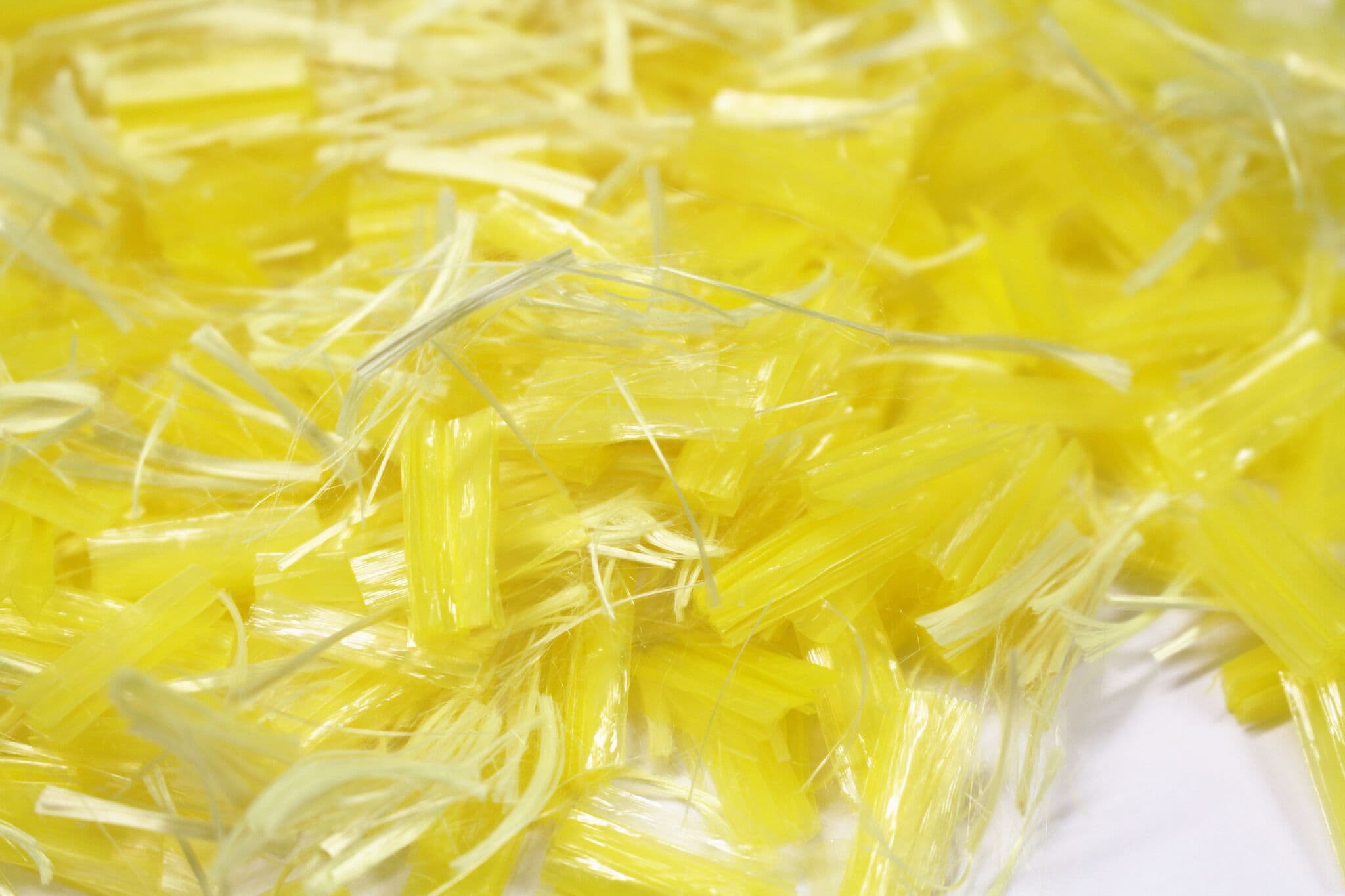
AsphaltX®
2000 filaments per aramid strand — 45% more than competitors. Lowest CO₂ footprint, European manufacturing, proven on the N337.
- TypeAramid (Twaron®) + polyolefin fibre blend
- Length± 19 mm
- Tensile strengthTwaron 3000 MPa · polyolefin 483 MPa
- Specific gravityTwaron 1.45 · polyolefin 0.91 g/cm³