At what temperature does asphalt melt? Road heat, soft asphalt and heat-resistant fibres

Asphalt has no fixed melting point: bitumen softens from around 45–55 °C and only turns fluid at 150–200 °C. A temperature table from summer road to asphalt plant, softening points per bitumen grade, how hot asphalt gets in the sun and how heat-resistant aramid fibres counter rutting.
There is no single temperature at which asphalt melts. Its binder, bitumen, softens gradually: common road grades reach their softening point at around 45 to 55 °C, which a black road surface easily hits in summer sun, and only become truly fluid at roughly 150 to 200 °C, the range in which asphalt is mixed at the plant.
On a hot day that softening shows up as soft patches, rutting in the wheel tracks and bleeding bitumen, not as a road that turns liquid. Below is a temperature table running from summer road to asphalt plant, followed by the softening points of common bitumen grades, how hot asphalt gets in the sun and how heat-resistant aramid fibres keep the mix in shape.
What is the melting point of asphalt?
Asphalt has no true melting point: bitumen is a thermoplastic, visco-elastic material that goes from stiff to soft to fluid over a wide temperature range, so the melting temperature of asphalt is really a range. The reference value is the softening point, measured with the ring-and-ball test (EN 1427): the temperature at which a disc of bitumen, heated steadily, sags under a small steel ball. For common road-paving bitumens it lies around 45 to 55 °C, depending on the penetration grade. Polymer modified bitumens are deliberately set higher.
In practice, asphalt never melts on the road. It only becomes thin and fluid at around 150 to 200 °C, the temperature range of the asphalt plant: hot mix is produced at around 160–185 °C, warm mix at 100–140 °C. What does happen on a hot road is subtler. Once the binder passes its softening point, the asphalt keeps its shape but loses part of its load-bearing capacity and resilience, so under repeated tyre loading the mix deforms more easily and permanently. The full chain from plant to roller is covered in asphalt temperature during production and laying.
The table below shows what happens to asphalt at each temperature, from a sun-baked road to the mixer (indicative values).
| Temperature | What happens to the asphalt | Where you meet it |
|---|---|---|
| 40–60 °C | Surface passes the softening point of common bitumen grades; the mix loses stiffness | Road surface on a sunny day at 20–30 °C air temperature |
| 60–67 °C | Binder clearly soft; highest risk of rutting and bleeding under heavy, slow traffic | Heatwaves; the US EPA reports up to 67 °C (152 °F) at midday in hot climates |
| 90–100 °C | Lower limit for compacting dense asphalt; below it voids stay open | During laying, behind the paver and roller |
| 100–140 °C | Bitumen workable thanks to foamed bitumen or additives | Warm mix asphalt production |
| 150–200 °C | Bitumen thin and fluid: the closest thing to melted asphalt | Hot mix production, typically 160–185 °C |
| Above 220 °C | Flash point of paving bitumen; never reached in normal processing | Safety limit at the asphalt plant |
| Above 450 °C | Aramid (Twaron) still dimensionally stable; melting/decomposition point above 450 °C, far beyond any asphalt process | Reinforcing aramid fibre in AsphaltX |
Softening point by bitumen grade
Paving bitumen is graded by penetration: the depth, in tenths of a millimetre, to which a standard needle sinks into the bitumen at 25 °C (EN 1426). The harder the grade, the lower the penetration and the higher the softening point. Common Dutch surface courses use a standard penetration grade such as 70/100. Polymer modified bitumen (PMB) is set higher by design: in the EN 14023 designation the last number is the minimum softening point, so PMB 45/80-55 has a softening point of at least 55 °C. How that route compares with fibre reinforcement is set out in polymer modified bitumen versus aramid fibres.
That is why a road surface temperature of 50–60 °C is critical: it coincides with the zone in which standard bitumen loses its stiffness. A 70/100 binder is already past its softening point on an ordinary sunny day, while harder grades and PMB keep their stiffness up to a higher temperature.
| Bitumen grade | Penetration at 25 °C (0.1 mm) | Softening point |
|---|---|---|
| 160/220 | 160–220 | 35–43 °C |
| 70/100 | 70–100 | 43–51 °C |
| 50/70 | 50–70 | 46–54 °C |
| 30/45 | 30–45 | 52–60 °C |
| 20/30 | 20–30 | 55–63 °C |
| PMB, e.g. 45/80-55 or 45/80-65 | 45–80 | at least 55 °C or 65 °C |
Does asphalt melt in hot weather? Why the road surface becomes soft
No, asphalt does not melt in the sun, but it can soften. Once the road surface climbs above the softening point of its binder, typically on days with an air temperature of 25–30 °C or more, the mix loses stiffness. You notice a road surface that becomes soft in hot weather through shoe and tyre marks, sticky patches and deeper ruts where heavy vehicles pass.
What people call "melting roads" is usually bleeding: binder rising to the surface where there is extra bitumen, for instance on a fresh surface dressing, around patch repairs or on spots with slow, heavy traffic. The road itself does not turn liquid; that takes 150 °C or more. How bleeding, rutting and heave develop is explained further down under "What goes wrong on a hot road surface?"
At what temperature does tarmac melt?
Tarmac starts to soften once the surface reaches around 45 to 55 °C and only becomes fluid at 150 to 200 °C: modern tarmac is simply asphalt, so it behaves the same way. In the UK, "tarmac" is the everyday word for an asphalt road surface. The name comes from tarmacadam, patented in 1902 by Edgar Purnell Hooley, which was bound with coal tar. During the 20th century petroleum bitumen replaced coal tar, so today's roads have a bitumen binder and the melting temperature of tarmac falls in the same range as in the table above.
The same goes for "tar": in everyday speech it often just means the road surface, and for a road the answer to "at what temperature does tar melt" is the same.
How hot does asphalt get in the sun?
Black asphalt absorbs the vast majority of sunlight and releases its heat only slowly. As a result, the road surface temperature in unshaded spots quickly sits 20 to 30 degrees above the air temperature. An ordinary summer day of 25 °C thus produces a road surface of 45 to 55 °C; during heatwaves of 35 °C or more, surface temperatures above 60 °C have been measured in the Netherlands. As a rule of thumb for asphalt temperature in the sun (indicative, full sun, little wind, dark dense asphalt):
• 20 °C air: road surface around 40–50 °C
• 25 °C air: around 45–55 °C
• 30 °C air: around 50–60 °C
• 35 °C air and above: 60 °C or more
In hot climates the US EPA reports asphalt surface temperatures of up to 67 °C (152 °F) at midday.
The build-up of the road plays a part. A dense surface course retains heat longer than porous asphalt (ZOAB), which cools slightly faster thanks to its void content, but in full sun both heat up considerably. The surroundings count too: between the façades of a paved shopping street, a road surface stays warmer at night than a rural road between meadows. That is precisely why road surface temperature has become a fixed component of heat stress maps in municipal climate adaptation policy.
Does asphalt absorb heat?
Yes, and more than most other paving materials. Fresh black asphalt has an albedo of about 0.04: it reflects roughly 4% of sunlight and absorbs the rest. Worn, greyed asphalt reaches about 0.12; new concrete, for comparison, about 0.55. A thick asphalt layer also stores that heat and releases it slowly after sunset, which is why asphalt streets stay warm at night and feed the urban heat island.
Raising the reflectance, with light-coloured aggregate or reflective coatings, is one of the routes discussed below under "Heat-resistant asphalt: lower the temperature or strengthen the mix".
How is road surface temperature measured?
To measure road surface temperature, road authorities do not rely on air temperature but on sensors embedded in the road. Ice warning systems along provincial roads and motorways measure the temperature of the road surface itself, together with moisture and residual salt. That distinction is essential: on clear, windless nights a road surface radiates its heat quickly and can freeze while the air temperature is still above zero. That is the classic cause of an unexpectedly slippery road in autumn, and the signal to grit preventively.
In summer the same principle works the other way round: the road surface runs far ahead of the air. Municipalities increasingly map those peaks with heat maps and infrared surveys, because hot paving contributes to urban heat stress. Road surface temperature has thus become a steering instrument in both seasons: in winter for winter maintenance, in summer for climate adaptation and material choice.
What goes wrong on a hot road surface?
A softened road surface shows itself in three recognisable damage patterns, each with its own mechanism.
Rutting in the wheel tracks
The best-known heat problem: in the spots where most tyres pass, traffic gradually presses the softened mix down and sideways. This creates longitudinal grooves in the road surface that hold water and encourage aquaplaning. Heat is not the only cause: mix composition and traffic loading weigh at least as heavily. You can read a full overview of causes, measurement methods and remedies in our article on what rutting is and how to fix it; here we keep the focus on the role of temperature.
A slippery road surface from bleeding bitumen
During sustained heat, bitumen can "sweat" to the surface: it flows upwards and forms a smooth, greasy film over the aggregate. Such a slippery road surface is treacherous, especially for motorcyclists and cyclists, and all the more when the first shower turns the loose binder into a slick layer. On very hot days, Dutch road authorities therefore sometimes spread salt: it attracts moisture, cools the surface and binds the rising bitumen, so the road stays skid resistant. In the UK, highway authorities usually spread fine crushed-rock dust or grit on bleeding sections to soak up the binder and restore grip.
Asphalt heaving upwards
Material expands in heat, and a road surface is no exception. If the paving has nowhere to go, for instance at a transition to a structure or between concrete slabs, the built-up stress can push the road surface up locally or cause it to crack. In extreme heat that occasionally leads to a so-called blow-up, mainly where concrete slabs or rigid structures meet, because rigid material has no room to absorb the expansion. If asphalt lifts outside hot periods, tree roots or frost damage are the more likely culprits; our article on asphalt maintenance and service life explains how to spot and tackle that kind of damage early.
Heat-resistant asphalt: lower the temperature or strengthen the mix
There are three complementary ways to tackle heat damage:
• Lower the temperature at the source. Light-coloured, reflective asphalt mixes, now applied by several Dutch municipalities, reflect more sunlight, so the road surface heats up less. Measurements show surfaces several degrees cooler; the US EPA cites 10 to 16 °F (about 6 to 9 °C) for cool pavements. Less heat automatically means less softening of the binder, and thus less rutting.
• Use a stiffer binder. Harder grades and PMB have a higher softening point (see the table above). For PMB, the price is a higher production temperature and harder recycling, as the comparison of polymer modified bitumen versus aramid fibres shows.
• Make the mix itself more heat resistant. Fibre reinforcement works on a different lever: it leaves the temperature alone and improves the mix's resistance to deformation. Fibres distribute the loading of passing traffic across a larger volume, reducing the chance of local, permanent deformation, even when heat has softened the binder.
The routes are not mutually exclusive; they reinforce each other. A light-coloured mix that is also fibre reinforced benefits from a lower surface temperature and from better resistance to the remaining heat effects. How fibre-reinforced asphalt works across the board is covered on our pillar page on fibre-reinforced asphalt.
Heat-resistant fibres in asphalt: how aramid holds the mix in place
Fibres distributed through the mix not only bridge crack faces, but also contribute to the stiffness and cohesion of the whole under load. Where the bitumen softens in the heat, aramid fibres retain their mechanical strength: aramid has a melting point above 450 °C, far above both road surface and production temperatures. That partly compensates for the stiffness loss of the softened binder.
In practice this happens with a remarkably small amount of material. An aramid asphalt fibre such as AsphaltX, with Twaron fibres that counter rutting in the heat, is a blend of Twaron aramid (tensile strength 3000 MPa) and a polyolefin fibre. The polyolefin melts at around 110 °C during hot mixing and acts as a carrier that spreads the aramid through the mix, so the heat resistance in the finished road comes from the aramid. The dosage is 500 grams per tonne of asphalt (around 0.05%), without any change to the mix design. AsphaltX is suitable for porous asphalt (ZOAB), SMA and dense asphalt, and is included in the OPWA list (BRL 9320 / NL BSB). Because the aramid does not melt at hot mix temperatures of 160–185 °C, the reinforcement remains intact at every common hot mix production temperature.
Dutch trial sections show this is more than theory: on the A73 near Roermond, BAM and Rijkswaterstaat tested four mixes with and without fibres within the European FIBRA project. The set-up and outcomes are described in our practical case on the FIBRA research on the A73.
Which fibres can take the heat?
Not every fibre in asphalt does the same job, and not every fibre survives the heat:
• Aramid (para-aramid, e.g. Twaron): melting point above 450 °C, so it comes through the mixer intact and keeps its strength where bitumen softens. This is the reinforcing fibre.
• Polyolefin: melting point around 110 °C, so it melts in hot mix. In fibre blends it acts purely as a carrier for the aramid.
• Cellulose: used in SMA and porous asphalt mainly as a stabiliser that stops the binder draining off the stone, not as reinforcement. On the A73, for example, one of the two reference mixes (penetration bitumen) used cellulose fibre.
For heat-related rutting, what counts is a fibre that keeps its strength at 50–60 °C on the road and survives 160–185 °C in the mixer.
Where is heat-resistant asphalt most relevant?
• Residential streets and inner-urban roads, where heat stress is an ever bigger theme within climate adaptation policy and municipalities are considering reflective as well as reinforced mixes. More on this in fibre reinforcement for municipal road management.
• Heavily loaded lanes and roundabouts, where the combination of heat, turning traffic and intensive loading makes rutting appear fastest.
• Industrial estates with lots of stationary or slow-moving traffic, for instance at loading and unloading bays: concentrated, prolonged loading on a hot road surface creates an elevated deformation risk there.
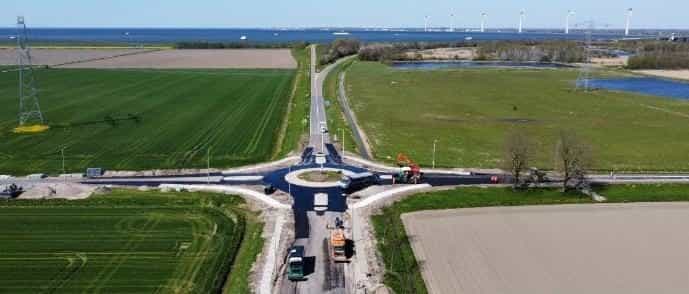
A concrete example of the second category is the renovation of the N711 roundabout in Flevoland: 1,585 tonnes of asphalt were processed and 400 kg of AsphaltX fibres with Twaron aramid applied, chosen because of the heavy, turning traffic loading. As an added sustainability result, the project achieved an MKI score of €8.50 and roughly 70% lower environmental impact.
From heat problem to approach
Heat-resistant asphalt is not a single technology but a combination of measures. Asphalt never melts on the road, but it does soften once its binder passes its softening point, and that is exactly where reflective mixes and fibre reinforcement act: reflective mixes tackle the road surface temperature at the source, while fibre reinforcement makes the mix itself resistant to the heat that remains. For road authorities that take climate adaptation seriously, the combination is the logical next step, certainly at locations where rutting is already visible.
Is heat damage or rutting an issue in your maintenance area? Request a quotation or share your situation via our contact form; we will help you think through mix, dosage and how to make the case to your client.
Frequently asked questions
- At what temperature does asphalt melt?
- Asphalt has no fixed melting point: bitumen is thermoplastic and softens gradually. The softening point of common road grades lies around 45–55 °C (70/100: 43–51 °C, 50/70: 46–54 °C), a level a road surface reaches on hot days. Bitumen only becomes thin and fluid at roughly 150–200 °C; hot mix asphalt is produced at 160–185 °C. The flash point of paving bitumen is above 220 °C.
- Can asphalt melt in the sun?
- No. At an air temperature of 30 °C the surface reaches around 50–60 °C, which is above the softening point of common bitumen. The road then softens: you get sticky patches, bleeding bitumen and deeper ruts under heavy traffic. But it never turns fluid; that takes 150 °C or more.
- At what temperature does tarmac melt?
- Tarmac is the everyday UK word for asphalt with a bitumen binder, so it behaves the same: it starts to soften at a surface temperature of around 45–55 °C and only becomes fluid at 150–200 °C. Coal tar, which gave tarmac its name, has long been replaced by bitumen.
- How hot does asphalt get in the sun?
- Typically 20 to 30 degrees above the air temperature: at 30 °C in the air, black asphalt heats up to around 50–60 °C at the surface, and during heatwaves values above 60 °C have been measured. In hot climates the US EPA reports up to 67 °C (152 °F) at midday. The reason is the dark colour, which absorbs almost all sunlight, and the slow release of that heat.
- Does asphalt absorb heat?
- Yes. Fresh black asphalt reflects only about 4% of sunlight (albedo around 0.04, worn asphalt around 0.12) and stores the heat in the layer, releasing it slowly at night. That is why asphalt streets contribute to urban heat islands and why reflective mixes and coatings are used.
- Why does a road surface become slippery in the heat?
- During sustained heat, bitumen can flow to the surface and form a greasy film over the aggregate. That makes the road surface slippery, especially for motorcyclists and during the first rain after a hot spell. On very hot days, Dutch road authorities sometimes spread salt to cool the surface and bind the rising bitumen; in the UK, crushed-rock dust or grit is usually spread to soak up the binder and restore grip.
- Why does asphalt buckle or lift in hot weather?
- A road surface expands in the heat. If the material has nowhere to go, for instance at a transition to a structure, the stress pushes the road surface up locally (in extreme cases a blow-up). If asphalt lifts outside hot periods, tree roots or frost damage are usually the cause rather than temperature.
- Do fibres help against rutting in the heat?
- Yes. Aramid (Twaron, melting point above 450 °C) keeps its strength where bitumen softens at 50–60 °C, and the fibres distribute the traffic loading across a larger volume of the mix. That reduces the chance of permanent deformation. In aramid fibres such as those in AsphaltX, the polyolefin carrier melts during mixing (110 °C) while the aramid remains; the dosage is 500 grams per tonne, without changing the mix design.
Share this article
Products mentioned
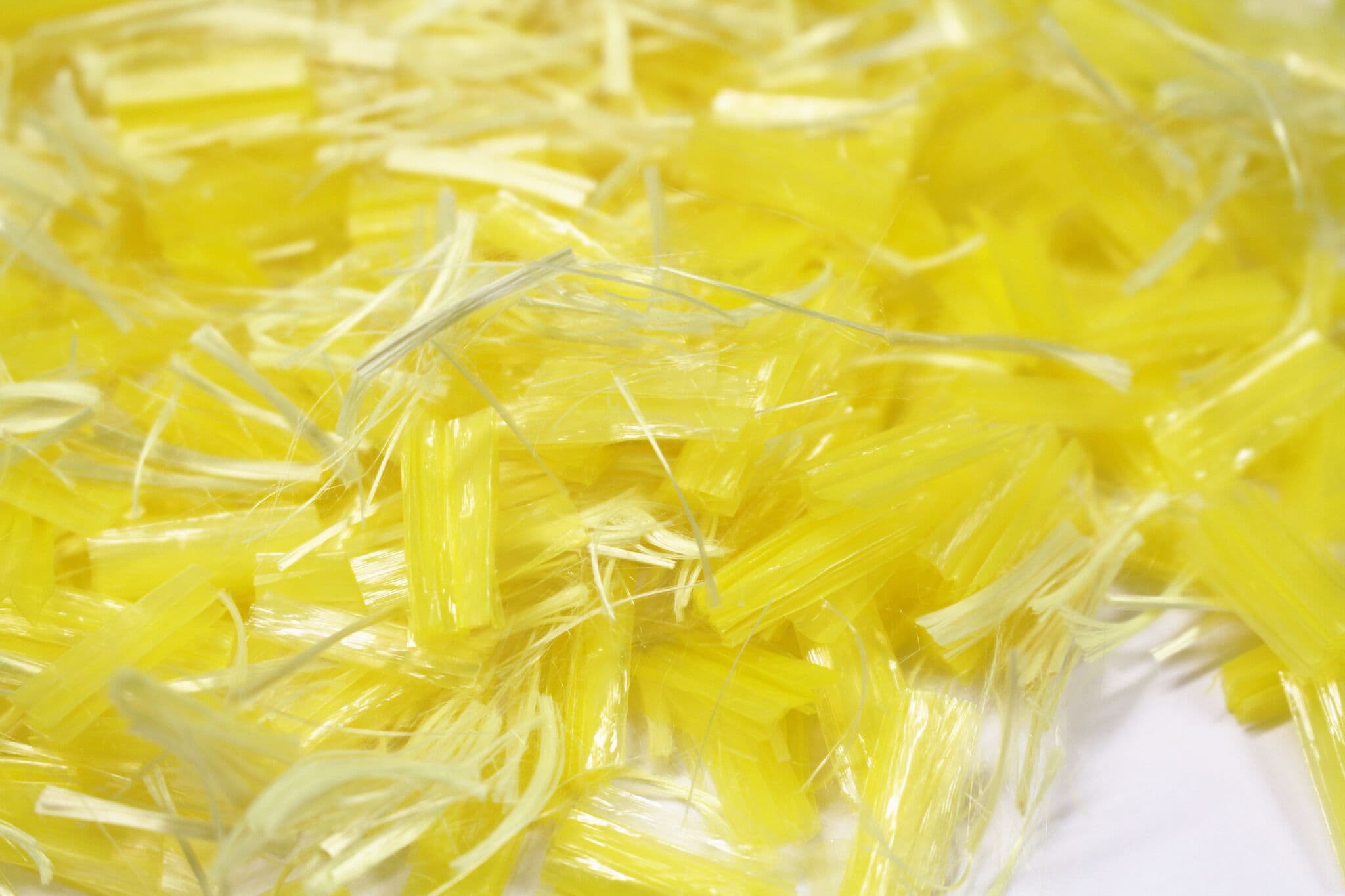
AsphaltX®
2000 filaments per aramid strand — 19 million fibres per tonne of asphalt. Lowest CO₂ footprint, European manufacturing, proven on the N337.
- TypeAramid (Twaron®) + polyolefin fibre blend
- Length± 19 mm
- Tensile strengthTwaron 3000 MPa · polyolefin 483 MPa
- Specific gravityTwaron 1.45 · polyolefin 0.91 g/cm³