The biggest maintenance challenge ever: the role of fibre reinforcement

Rijkswaterstaat calls it the biggest maintenance challenge ever. Fibre reinforcement extends road service life by 50% or more — and with that, changes every long-term maintenance plan.
The Netherlands faces the biggest maintenance challenge in its history: thousands of bridges, viaducts and road sections from the 1950s and 1960s are due for replacement or major maintenance almost simultaneously. Fibre reinforcement of asphalt and concrete extends the service life of surface courses and structures by at least 50% and saves labour hours on site — exactly what is scarcest in major road maintenance: budget and skilled workers.
How big is Rijkswaterstaat's maintenance challenge?
Rijkswaterstaat's Multi-Year Overview of the renewal challenge for bridges, tunnels and locks 2026–2030 shows that pressure on the infrastructure is increasing through more intensive and heavier traffic, while a changing climate demands roads that better withstand extreme heat, drought and downpours. On top of that, geopolitical tensions call for more resilient roads and bridges. Much maintenance has been deferred in recent years through a lack of funding and a shortage of qualified skilled workers.
Research by the Economic Institute for Construction (EIB), commissioned by the Logistieke Alliantie, confirms that picture: Dutch infrastructure struggles with a structural shortage of resources, mounting backlogs and increasing pressure on key freight corridors. Renovation and expansion lag behind growing demand, while available public funds are not always deployed in time due to delays and implementation problems.
What that looks like in practice became visible in early 2026 at the Lankhorst interchange near Meppel: Rijkswaterstaat had to carry out emergency works there after concrete had crumbled off the viaducts and landed on the A28. The underlying cause — corrosion of the reinforcing steel — affects a large part of the post-war stock. The cabinet has since announced a prioritisation framework in which preservation of existing infrastructure takes precedence over new construction.
The challenge, incidentally, lies only in small part with central government. Municipalities and provinces together manage almost 90% of the Dutch road network and face exactly the same question: how do I keep more assets in condition with the same budget and fewer people? Their many small cycle and pedestrian bridges are a case in point: when a timber bridge deck needs replacing, a composite or fibre reinforced concrete deck can take that bridge out of the 15 to 25-year timber replacement cycle. Within the pillar sustainability, standards and innovation we examine that question from the angle of materials and service life.
Maintenance cycles: what does major road maintenance cost?
Anyone drawing up a long-term road maintenance plan works with fixed cycles. An asphalt surface course on an averagely loaded road lasts around 12 to 15 years before major maintenance — milling and laying a new surface course — is needed. On heavily loaded routes, with turning traffic (roundabouts, junctions) or on soft subsoil, that cycle can be shorter; on quiet residential streets, longer.
The costs of major maintenance vary widely per situation, but as a rule of thumb (indicative, 2026 price level, depending on project and asset base):
• Milling + new surface course — around €15 to €30 per m²
• Replacing surface course and binder course — around €30 to €50 per m²
• Full reconstruction including foundation — a multiple of that, often €75 to €150+ per m²
On top come the indirect costs that rarely appear in the budget but are certainly felt: traffic measures, diversions, disruption for residents and businesses, and the administrative burden of every closure. For municipalities, where road maintenance is one of the biggest items in the management budget, every maintenance cycle that can be avoided or deferred therefore counts double.
Worked example: what +50% service life does to a long-term plan
Suppose: a road section of 10,000 m², a surface course cycle of 12 years and major maintenance at €20 per m² (indicative). Over a planning horizon of 30 years, the comparison looks like this:
• Without fibre reinforcement — major maintenance in year 12 and year 24: two interventions, together around €400,000
• With fibre reinforcement (+50% service life, 18-year cycle) — one intervention in year 18: around €200,000, plus a fibre premium of a few per cent on the surface course costs per intervention
• Remaining service life in year 30 — in both scenarios a surface course with around 6 years still ahead of it; the comparison is therefore fair
• Difference over 30 years — one full maintenance cycle fewer: almost €200,000 saved on this one road section, plus one closure with traffic disruption fewer
Translated to a municipal asset base of hundreds of thousands of square metres, such a difference shifts the entire long-term plan: fewer interventions per year, fewer simultaneous projects in the capacity planning and more room to catch up on backlogs. That is why service life extension is the most cost-effective lever to pull in virtually every management plan.
Why service life extension is now a top priority
In a challenge where preservation is prioritised over new construction and where money and skilled workers are scarce, every measure is relevant that (a) extends the service life of existing assets or (b) lets repair work proceed faster and with fewer labour hours. Fibre reinforcement of asphalt and concrete scores on both.
Longer road surface life. Research into fibre reinforced asphalt within the European FIBRA project shows that commercial fibre producers claim a road surface life extension of at least 50%, with an extension of the life of the asphalt layer itself of up to 200%, depending on fibre type and application. At a time when maintenance is structurally deferred through lack of money, every year a road surface lasts longer is a direct gain.
Fewer labour hours per project. The shortage of qualified skilled workers is one of the explicitly cited causes of the backlog. Fibre reinforcement is added during the mixing process — unlike traditional reinforcement (mesh, bars), where installation is a separate, labour-intensive work stage. That saves hours on site, exactly where the scarcity is greatest.
Less susceptible to the failure mechanism now causing problems. In recent incidents such as at the Lankhorst interchange, corrosion of steel reinforcement plays a leading role in the crumbling of concrete. Synthetic fibres such as aramid and polypropylene do not corrode, removing this risk in applications where fibre reinforcement can (partially) take over the role of traditional reinforcement. Note: in structural work, fibre reinforcement does not automatically replace traditional reinforcement in full — that always requires a calculation by the structural engineer.
Fibre reinforcement in road management and maintenance
For road authorities there are two main routes to deploy fibre reinforcement within regular management and maintenance: through the asphalt chain and through the concrete chain.
Asphalt: extending service life at every major maintenance
The natural entry point is major maintenance itself: at the moment milling and resurfacing are happening anyway, the new surface course can be executed as life-extending fibre reinforced asphalt — without modifying existing production and paving equipment at the asphalt plant or in the crew. How to weigh that up in regular asphalt maintenance, from ravelling to rutting, is covered in that article.
With an aramid fibre such as AsphaltX, the dosage is indicatively ~0.05% — around 500 grams per tonne of asphalt, depending on mix and application. On the provincial road N337 along the IJssel, this approach has been applied in practice; experience with fibre reinforced surface courses has also been gained on the A73 as part of the FIBRA research.
Concrete: repair, white topping and non-corroding reinforcement
On the concrete side, the opportunities lie in repair and renovation of non-primary-structural elements — wearing courses, foundations, industrial floors and top layers — where fibre concrete replaces the labour-intensive placement of reinforcement mesh. A macro fibre such as TwistR delivers steel fibre performance there without corrosion risk.
A specific technique for worn asphalt pavements is white topping with fibre concrete over existing asphalt: a thin fibre reinforced concrete layer directly on the old asphalt structure, interesting at heavily loaded locations such as bus lanes, junctions and container terminals where asphalt keeps rutting.
Long-term plans and performance contracts: how to secure service life
A longer service life only pays off if it also lands in the planning and contract system. Three concrete handles:
• Long-term road maintenance plan — calculate scenarios with extended cycles (as in the worked example above) and make the 30-year saving visible alongside the premium per intervention; service life extension then becomes an administratively defensible choice rather than a technical detail.
• Performance contracts for maintenance — specify functionally on service life and residual value rather than on recipe. Within a performance contract, the contractor has its own interest in deploying life-extending techniques such as fibre reinforcement; the client merely has to avoid excluding them.
• Framework agreements and specifications — fibre reinforcement can be included as an option or functional requirement in existing maintenance contracts, without a new tendering process. How that works for municipal road management and how provinces tender this through EMVI criteria is described in separate articles.
Getting started in practice
The biggest maintenance challenge ever does not call for one miracle cure, but for a sum of measures that together extend service life, save labour hours and ease the pressure on scarce budgets. Fibre reinforcement is one of the few measures that does so today, within existing contracts and with existing plant.
Is a major maintenance project or a revision round of your long-term plan on the agenda? Then request a project-specific quotation or put your road section to us — we are happy to work through the service life scenarios with you, from dosage to expected cycle extension.
Frequently asked questions
- How long does an asphalt surface course last?
- An asphalt surface course on an averagely loaded road lasts around 12 to 15 years before major maintenance is needed. Heavy or turning traffic (roundabouts, junctions) and soft subsoil shorten that cycle; quiet residential streets often manage longer. Fibre reinforcement extends the surface course cycle by at least 50%, to around 18 years or more, depending on fibre type and application.
- What does major road maintenance cost per square metre?
- Indicatively (2026 price level, depending on project): milling plus a new surface course costs around €15 to €30 per m², replacing the surface course and binder course around €30 to €50 per m², and a full reconstruction including foundation easily €75 to €150+ per m². Traffic measures and diversions come on top of that.
- What does fibre reinforcement deliver in a long-term road maintenance plan?
- With a service life extension of 50%, the maintenance cycle shifts from around 12 to 18 years. Over a 30-year planning horizon, that means one full intervention fewer per road section — at 10,000 m² and €20 per m², almost €200,000 saved, plus one closure with traffic disruption fewer. The fibre premium amounts to a few per cent on the surface course costs.
- Does fibre reinforcement fit within a performance contract for road maintenance?
- Yes. Because fibre reinforced mixes require no modification of production or paving equipment, a contractor can deploy them within a running performance contract. Clients who specify functionally on service life and residual value thereby automatically give the market an incentive to apply life-extending techniques such as fibre reinforced asphalt.
- Does fibre reinforcement fully replace traditional reinforcement?
- Not always. In non-primary-structural applications such as wearing courses, industrial floors and foundations, fibre reinforcement can fully replace reinforcement mesh. In structural work — bridges, load-bearing elements — a calculation by the structural engineer is always required, in which fibres can fully or partially supplement traditional reinforcement. The advantage of synthetic fibres: they do not corrode, the failure mechanism behind much of today's concrete damage.
Share this article
Products mentioned
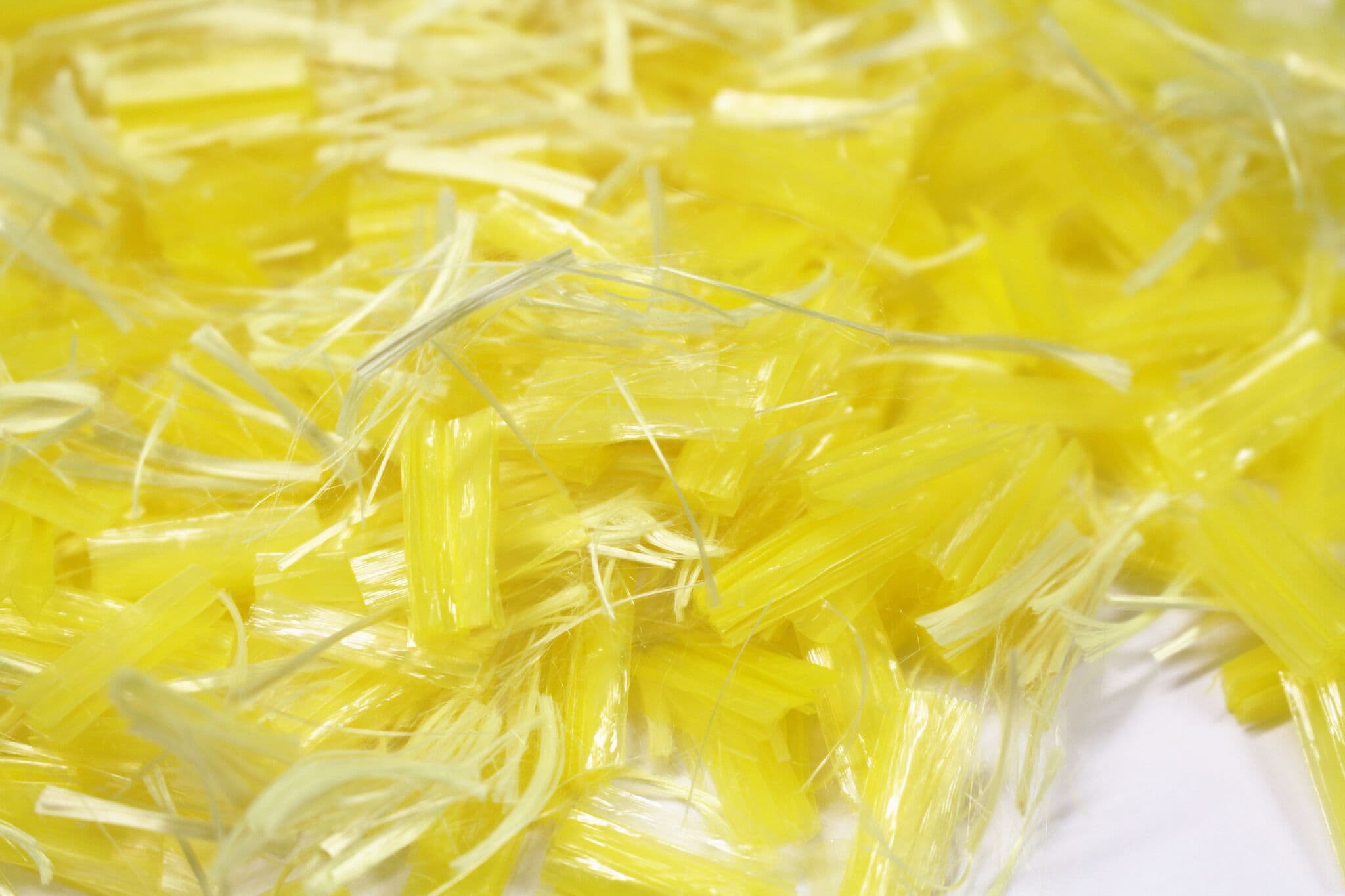
AsphaltX®
2000 filaments per aramid strand — 19 million fibres per tonne of asphalt. Lowest CO₂ footprint, European manufacturing, proven on the N337.
- TypeAramid (Twaron®) + polyolefin fibre blend
- Length± 19 mm
- Tensile strengthTwaron 3000 MPa · polyolefin 483 MPa
- Specific gravityTwaron 1.45 · polyolefin 0.91 g/cm³
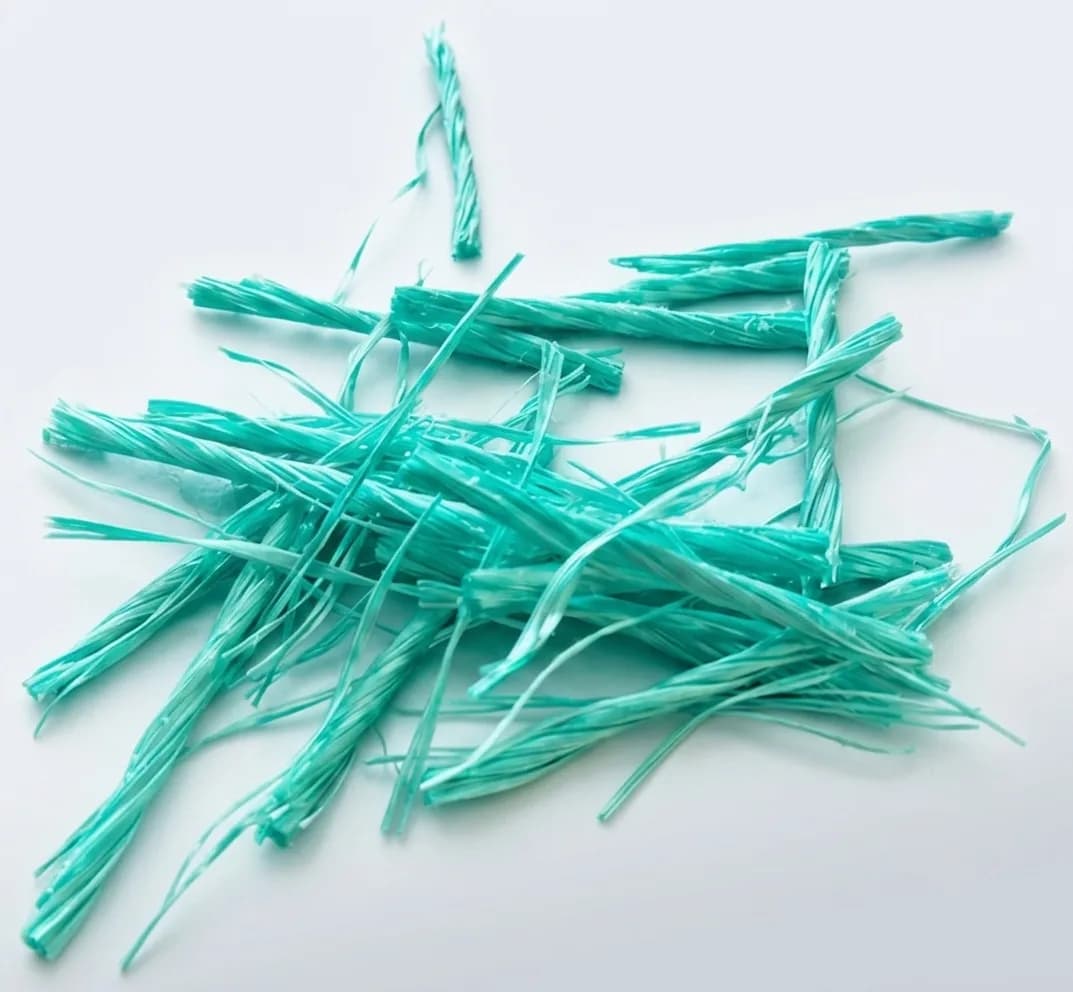 Most chosen
TwistR® GREEN HYBRID
High-performance synthetic macro fibres made from 100% polypropylene. Transforms concrete into a stronger composite material.
- TypeHybrid: twisted monofilament + fibrillating network fibre
- Material100% virgin polypropylene
- Length48 mm
- Dosage2.0 – 6.0 kg/m³
Pallet price on request