The FIBRA project: European research into fibre-reinforced asphalt

Behind the Dutch trial sections with fibre-reinforced asphalt lies a European CEDR research project with seven partners from six countries. What the FIBRA project involved, who took part and which guidelines it delivered.
The FIBRA project (2018-2020) was a European research project into fibre-reinforced asphalt within the CEDR programme of the European road authorities. Five research institutions and two road builders from six countries developed design guidelines, scaled up production and built trial sections — including on the Dutch A73 — and demonstrated that fibres can replace polymer modified bitumen cost-neutrally.
What is the FIBRA project?
FIBRA is the acronym of "Fostering the implementation of fibre-reinforced asphalt mixtures by ensuring its safe, optimized and cost-efficient use". The project ran from 2018 to 2020 and was carried out within CEDR's transnational research programme.
The trigger was a classic knowledge gap. Laboratory research had long shown that fibres improve the cracking and fatigue behaviour of asphalt — how that mechanism works is explained in what is fibre-reinforced asphalt. But European road authorities remained hesitant: there were no shared characterisation methods, no design guidelines and hardly any documented practical experience on heavily loaded roads. Precisely those barriers were what FIBRA had to remove.
CEDR: research commissioned by European road authorities
CEDR stands for Conférence Européenne des Directeurs des Routes, the association of European national road authorities. Rijkswaterstaat represents the Netherlands within CEDR. Through a joint research programme, the road authorities fund research into the questions they themselves face — from new materials to asset management.
That commissioning role matters for the value of the outcomes. CEDR research into asphalt is not steered by a supplier wanting to sell its product, but by the parties who manage, tender and must maintain the roads for decades. The framing of FIBRA was therefore practice-oriented from day one: under what conditions can we safely specify fibre-reinforced asphalt on our trunk road network?
The consortium: seven partners from six countries
The project was led by the University of Cantabria in Spain and brought together five research institutions and two industrial partners from six countries:
• University of Cantabria (Spain) — project lead and mixture research.
• Empa (Switzerland) — federal research institute for materials science and technology.
• Technische Universität Braunschweig (Germany) — research into road construction materials.
• SINTEF (Norway) — one of Europe's largest independent research organisations.
• BAM Infra (Netherlands) — road builder, responsible for the Dutch trial section on the A73.
• Veidekke Industri (Norway) — road builder, responsible for the Norwegian field trials.
The combination was deliberate: universities and institutes for laboratory characterisation and modelling, road builders for scaling up to real production plants and real road sections. As a CEDR member, Rijkswaterstaat was closely involved in the Dutch part of the research.
Objectives: from knowledge gap to guideline
The goal of FIBRA was to foster the implementation of fibre-reinforced asphalt mixtures by ensuring their safety, optimisation and cost-effectiveness. That translated into four concrete research strands:
• Characterisation — shared laboratory methods to assess fibre-reinforced mixtures on, among other things, cracking and fatigue behaviour.
• Design guidelines — practical guidelines for composing fibre-reinforced asphalt mixtures and for the structural design of pavements containing these mixtures.
• Scaling up — taking the production process from laboratory scale to regular asphalt plants, without modifications to existing production and paving equipment.
• Validation and environment — the construction of trial sections under real traffic, plus an assessment of the environmental impact of the FIBRA pavements through life cycle analysis.
That last strand has only become more important with the arrival of environmental performance requirements in tenders; how the MKI of asphalt is calculated nowadays is covered in our article on the PCR Asphalt 2026.
What the laboratory research covered
Before a single tonne of fibre-reinforced asphalt went onto the road, the consortium characterised various fibre types — including aramid, polyacrylonitrile (PAN) and cellulose fibres — in a range of mixtures. Central were the properties that determine the service life of asphalt: resistance to fatigue, cracking and, in open surface courses, ravelling.
An important detail for practice: the fibre mixtures were designed with standard penetration bitumen instead of the more expensive polymer modified bitumen (PMB). The central research question was whether fibres can take over the role of polymer modification — with the added advantage that standard bitumen can be processed at a lower temperature and the reclaimed asphalt is later easier to recycle.
From laboratory to trial section
The project did not stop at reports. Part of FIBRA was scaling up the production process and building test sections under real traffic, including the best-known example: the trial section on the Dutch A73 motorway near Roermond, built in August 2020 with four variants of two-layer porous asphalt.
The Dutch measurements — equivalent road performance at a 15-20 °C lower production temperature and an MKI more than 10% lower (cradle-to-gate) — are covered in a separate article: the results of the A73 trial section describe the full set-up, all measured values and the long-term monitoring by BAM and Rijkswaterstaat.
Why BAM believed in fibres
For a road builder, joining such a research project is a strategic choice. BAM saw clear advantages of fibre reinforcement over polymer modified bitumen, particularly in terms of service life, production temperature and, with that, sustainability.
Decisive was the business case: replacing polymer modified bitumen with fibre-reinforced bitumen proved cost-neutral in the Dutch situation at a comparable service life. Anyone who gets a lower production temperature, a lower environmental impact and better recyclable reclaimed asphalt for the same money has an edge in tenders with EMVI and MKI criteria. For that reason BAM saw it as a strategic advantage to explore the possibilities of fibres further.
What the FIBRA project delivered
The results of FIBRA are recorded in public deliverables, including reports on the scaling up of the production process and the construction of the test sections (2021). In summary, the project delivered three things:
• Guidelines — practical tools for designing and characterising fibre-reinforced asphalt mixtures and for the structural design of pavements, so that road authorities can specify fibres with substantiation.
• Practical proof — trial sections demonstrating that fibre-reinforced asphalt performs equivalently to PMB mixtures on heavily loaded roads, produced on existing plants without modifications.
• Environmental substantiation — life cycle analyses quantifying the lower environmental impact of the fibre route, usable in tenders where the environmental cost indicator counts.
For the theme of extending asphalt service life, it is above all the combination of the three that is valuable: not just the claim that fibres slow fatigue and cracking, but also the measurement methods and field data to substantiate that claim per project. More research and case studies can be found in our knowledge dossier on fibre-reinforced asphalt.
From European research to your project
The technology validated in FIBRA is now simply available. With AsphaltX, aramid fibres for asphalt, based on the same Twaron aramid technology as on the A73, fibre reinforcement is applied today on provincial roads, business parks and construction roads. The dosage is indicatively around 0.05% — roughly 500 grams per tonne of asphalt, depending on mixture and application.
A Dutch example at provincial scale is the N337 between Zwolle and Deventer: over 8 kilometres, aramid fibre reinforcement there delivered 50% less rutting and 30% less cracking compared with the reference section. If you are considering fibre-reinforced asphalt for a surface course or maintenance project, we are happy to think along — without obligation — on mix design, dosage and the expected MKI gain via a tailored quotation.
Sources
• CEDR FIBRA project (2018-2020), public deliverables, including Deliverable 5.1 "Scaling up of the production process and implementation of test sections" and Deliverable 6.2 "Exploitation Strategy Plan", 2021.
• Rijkswaterstaat/BAM Infra Nederland, trial section and demonstration garden for sustainable asphalt A73.
Frequently asked questions
- What does FIBRA stand for?
- FIBRA is the acronym of "Fostering the implementation of fibre-reinforced asphalt mixtures by ensuring its safe, optimized and cost-efficient use". The project ran from 2018 to 2020 within the transnational research programme of CEDR, the association of European road authorities.
- What is CEDR and what does it do for asphalt research?
- CEDR (Conférence Européenne des Directeurs des Routes) is the association of European national road authorities; Rijkswaterstaat represents the Netherlands. Through a joint research programme, the road authorities fund research into questions from their own management practice. FIBRA was such a project: research into fibre-reinforced asphalt, steered by the parties who tender for and maintain roads — not by a supplier.
- Which parties took part in the FIBRA project?
- Five research institutions and two road builders from six countries, led by the University of Cantabria (Spain). Others included Empa (Switzerland), Technische Universität Braunschweig (Germany), SINTEF and Veidekke Industri (Norway) and BAM Infra (Netherlands), which built the trial section on the A73. As a CEDR member, Rijkswaterstaat was involved in the Dutch part.
- What was the most important result of the FIBRA project?
- That fibres can take over the role of polymer modified bitumen (PMB). On the A73 trial section, mixtures with aramid and PAN fibres on standard bitumen performed equivalently to the PMB reference, at a 15-20 °C lower production temperature and an MKI more than 10% lower (cradle-to-gate) — and cost-neutrally. The project also delivered design and characterisation guidelines for road authorities.
- Does fibre-reinforced asphalt extend the service life of a road?
- Fibres improve resistance to fatigue, cracking and ravelling — the damage mechanisms that determine the service life of asphalt. On the N337, aramid fibre reinforcement delivered 50% less rutting and 30% less cracking than the reference section. Definitive service-life figures require long-term monitoring; that is under way on the A73 trial section, monitored by BAM and Rijkswaterstaat since 2020.
Share this article
Products mentioned
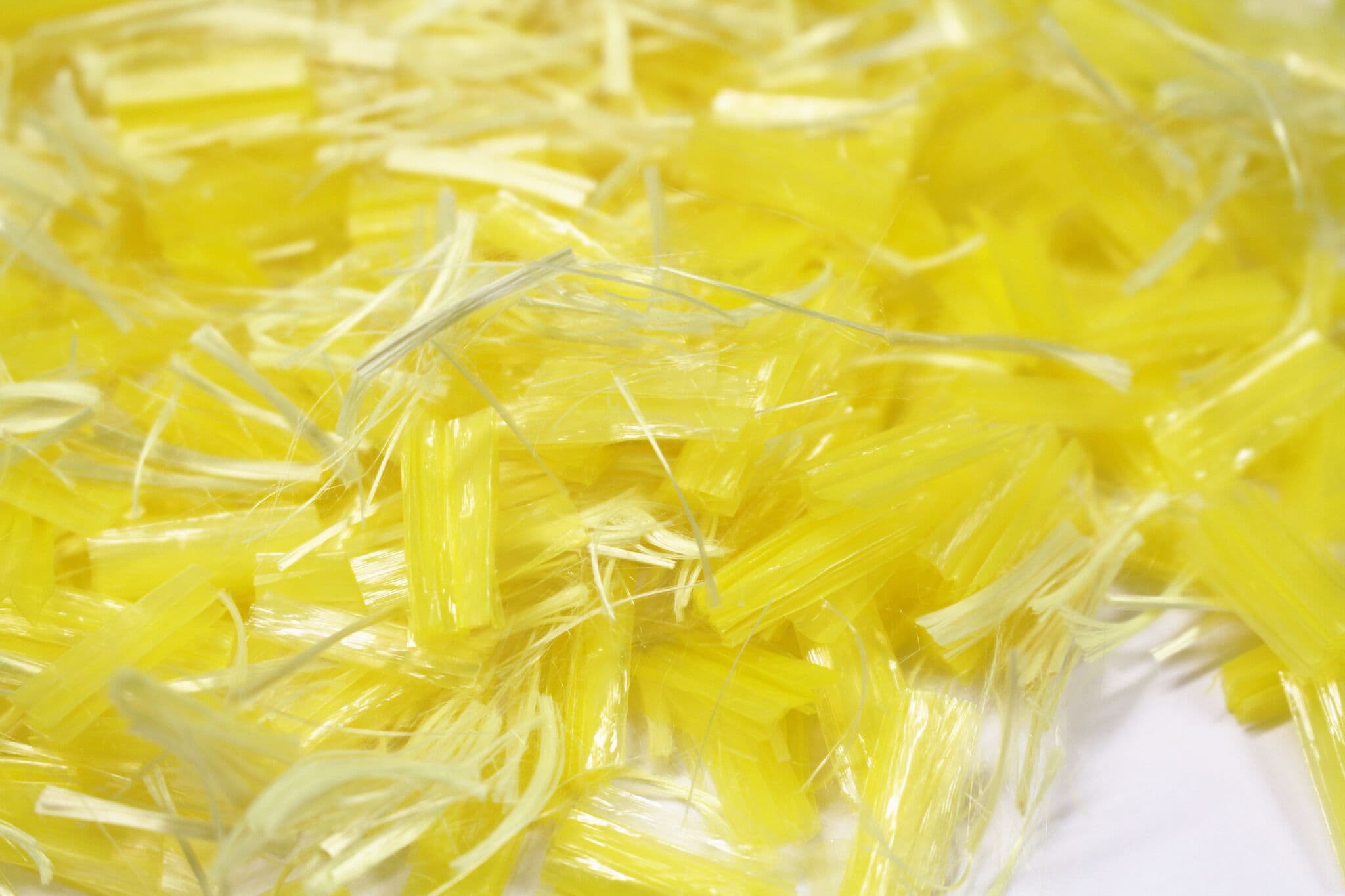
AsphaltX®
2000 filaments per aramid strand — 19 million fibres per tonne of asphalt. Lowest CO₂ footprint, European manufacturing, proven on the N337.
- TypeAramid (Twaron®) + polyolefin fibre blend
- Length± 19 mm
- Tensile strengthTwaron 3000 MPa · polyolefin 483 MPa
- Specific gravityTwaron 1.45 · polyolefin 0.91 g/cm³