Tendering fibre-reinforced asphalt: what to watch for?

Practical checklist for municipalities, provinces and water boards wanting to specify fibre-reinforced asphalt: sample specification text, MEAT criterion, market consultation and OPWA approval.
Fibre-reinforced asphalt is best included functionally in a road maintenance tender: set performance requirements for service life, MKI value and maximum production temperature rather than prescribing a single product. Check that the fibre is on the OPWA list, request substantiation according to the PCR Asphalt 2026 and include guarantee and monitoring provisions. That keeps the tender open to the market and objectively comparable.
Why include fibre reinforcement explicitly in the tender?
Without an explicit mention, contractors usually opt for the common, best-known solution: polymer modified bitumen (PMB) or reinforcement grids. If you want to exploit the advantages of fibre reinforcement — a 15 to 20 °C lower production temperature, better recyclability and a lower environmental impact — this must appear in the tender as a requirement or award criterion. Otherwise the standard solution almost always wins on familiarity, not on performance. That applies to a one-off reconstruction, but just as much to every regular road maintenance tender: if you want to procure sustainable asphalt, you anchor it in the specification.
Those figures are no supplier claim. In the FIBRA research on the A73 near Roermond, the fibre-reinforced mixes were produced at around 159–165 °C versus around 181 °C for the PMB reference, with comparable in-service performance on a route carrying some 50,000 vehicles per working day. The life cycle assessment moreover showed the highest environmental impact for the PMB mix: over 10% difference in Environmental Cost Indicator (MKI) at cradle-to-gate level. You will find more background on the technology in the pillar on fibre-reinforced asphalt.
Functional specification or prescribing a fibre type?
There are two approaches to getting fibre-reinforced asphalt into a road construction specification. The differences at a glance:
• Tender request — functional: you set performance requirements (minimum ITS value, maximum production temperature, service life, MKI score); prescriptive: you fix the fibre type and dosage.
• Room for innovation — functional: the market chooses the means itself; prescriptive: no room for alternatives.
• Competition — functional: multiple plants and suppliers can bid; prescriptive: risk that effectively only one party can comply.
• Certainty about the end result — functional: dependent on the burden of proof you request; prescriptive: greater, but the selection risk sits with you as client.
• Procurement law — functional: no debate; prescriptive: brand names require the addition 'or equivalent'.
For most tenders, functionally specifying fibre reinforcement is the accepted and flexible approach, supplemented with a reference to proven practical results such as the results of the FIBRA trial section on the A73. That keeps the tender open and prevents paper promises from tipping the balance.
Sample specification text and MEAT criterion
The texts below are indicative and intended as a starting point; adapt them to your own RAW system and project situation.
Sample: functional specification item for a surface course
The surface course shall be executed in an asphalt mix with a maximum production temperature of 165 °C. The bidder shall substantiate the expected service life of the mix with independent practical research or documented trial section results. Additives applied shall be approved for environmental soil quality in accordance with the Soil Quality Decree: included on the OPWA list, or demonstrably equivalent via leaching research on the mix. The MKI value of the offered mix shall be calculated according to the PCR Asphalt 2026 and included, verified, in the Dutch National Environmental Database (NMD).
Sample: MEAT award criterion for sustainability
Award criterion sustainability of the surface course: the bidder receives a notional discount in proportion to the MKI value per tonne of mix, calculated in DuboCalc according to the PCR Asphalt 2026, with the sector reference mix as the reference value. Service life claims count only if substantiated with independently validated practical data; the stated service life shall be included in the contract as a guarantee obligation.
How the notional discount feeds through into the ranking of bids — and how to demonstrate MKI gains in DuboCalc — is explained in the article on MKI and DuboCalc. The MKI value of asphalt thereby becomes an objectively comparable quantity rather than a marketing term.
Step-by-step plan: market consultation before the tender
A market consultation prevents the most common mistake when tendering innovative mixes: a request the market cannot bid on. A workable step-by-step plan:
• Step 1 — map the solution routes: fibre reinforcement, PMB and reinforcement grids, each with reference projects and available environmental data.
• Step 2 — publish a consultation document (for instance via TenderNed) with concrete questions: which performance can you substantiate, at which dosage, with what experience at the asphalt plant?
• Step 3 — test the draft requirements for market breadth: can at least three parties realistically comply? If not, widen the functional range.
• Step 4 — process the results into functional requirements plus a MEAT criterion, and be transparent in advance about how you will verify claims.
• Step 5 — announce the guarantee and monitoring regime in the consultation, so bidders can price it in rather than negotiating over it later.
For a single maintenance specification, this process can be compact: a written consultation round of four to six weeks is often enough to sharpen the tender.
Checklist: what to watch for in the specification
• Environmental soil quality approval — asphalt falls under the Soil Quality Decree; an additive must be on the OPWA list or have been assessed as equivalent. How BRL 9320 and NL BSB for asphalt additives work is explained in the OPWA article; AsphaltX®, for instance, is an asphalt fibre included on the OPWA list with a maximum of 0.1% (1 kg per tonne).
• Environmental performance substantiation — request an MKI calculation according to the PCR Asphalt 2026, included and verified in the NMD, so fibre-reinforced mixes are objectively comparable with PMB alternatives.
• Service life substantiation — do not accept bare supplier claims; request independent practical research or trial section data, such as the FIBRA research on the A73.
• Production and processing experience — have the bidding asphalt plant demonstrate that it can process the fibre homogeneously, for instance via project references. Fibre dosing requires no adapted equipment, but it does require demonstrable process experience.
• Guarantee and monitoring — include guarantee provisions on the service life to be achieved and consider a monitoring obligation (visual inspection and skid resistance measurement) during the guarantee period, aligned with your regular inspection cycle under the CROW road management system.
• CO₂ Performance Ladder — the lower production temperature and reduced dependence on PMB provide directly usable input for sustainability-based awards and bidders' own ladder ambitions.
Framework contracts for road maintenance: securing fibre reinforcement structurally
Much municipal and provincial road maintenance runs not through individual projects but through a framework contract for minor and major maintenance, often with a term of two to four years. It is precisely there that arranging fibre reinforcement at the outset pays off: include in the framework contract a sustainability variant or optional specification item for fibre-reinforced surface courses, with functional requirements and settlement prices fixed in advance. That way, not every sub-project needs to run its own tender, and the road authority can choose per maintenance measure. The asphalt maintenance measures to choose from, from crack sealing to full reconstruction, are compared with indicative costs per m² in a separate article.
For maintenance planning, align with the system you already use: the CROW guidelines for rational road management, with visual inspections as the basis. Fibre-reinforced sections can be tracked within that same inspection cycle — on the A73 this is done with additional video inspections in year 2 and year 5 on top of Rijkswaterstaat's regular monitoring programme. That instantly turns the framework contract into a learning environment: after one contract period you have your own data on service life and damage patterns.
Common pitfalls
• Prescribing too tightly without a market consultation, so that effectively only one supplier can bid — vulnerable under procurement law and bad for pricing.
• Setting no requirements for production experience, with the risk of poor execution by a plant that has never dosed fibres.
• Requesting insufficient substantiation of environmental and service life claims, so sustainability advantages cannot be compared objectively between bidders.
• Requesting MKI without a verification requirement: an unverified LCA is worthless in DuboCalc and opens the door to paper optimisation.
• Forgetting monitoring: without a baseline measurement and inspection agreements you cannot enforce a service life guarantee later.
From tender to execution
A good tender combines functional requirements, a verifiable MEAT criterion and a realistic burden of proof. Practice shows it works: on the provincial road N337 between Zwolle and Deventer, fibre-reinforced asphalt was laid over 8 kilometres without any change to the asphalt plant's recipe, with an aramid dosage in the order of 0.05% (around 500 grams per tonne, depending on mix and application).
Dutch Fiber Trading supports clients and specification writers with draft specification texts, dosage advice and the accompanying environmental documentation. Request a quotation or specification advice or put your tendering question to our advisers — including for a second opinion on a draft tender.
Frequently asked questions
- May I prescribe a specific fibre product in a tender?
- Only with the addition 'or equivalent': procurement law prohibits brand requirements that unnecessarily restrict competition. In practice, functional specification is more robust — set performance requirements for service life, production temperature and MKI, and request substantiation with independent practical data such as the FIBRA research on the A73. That gets you the desired result without legal risk.
- How do I compare the environmental performance of fibre-reinforced asphalt with PMB?
- Via the MKI value, calculated according to the PCR Asphalt 2026 and included, verified, in the Dutch National Environmental Database. Those uniform calculation rules make mixes objectively comparable. In the FIBRA research, the PMB reference mix had over 10% higher environmental costs at cradle-to-gate level than the fibre-reinforced variants, partly due to the roughly 15–20 °C higher production temperature.
- What does the OPWA list mean for my tender?
- Asphalt falls under the Dutch Soil Quality Decree: every additive must be approved for environmental soil quality. If a fibre is on the OPWA list, the mix simply falls within the stated range under the plant's NL BSB certificate, without additional leaching research. AsphaltX® is on the OPWA list with a maximum of 0.1% — the recommended dosage of around 0.05% sits comfortably within that.
- Does fibre-reinforced asphalt fit into a framework contract for road maintenance?
- Yes, and that is often the most efficient route. At the start of the framework contract, include a sustainability variant or optional specification item with functional requirements and settlement prices for fibre-reinforced surface courses. The road authority can then choose per maintenance measure without a separate tender, and you build up your own monitoring data within one contract period via the regular CROW inspection cycle.
- What guarantees and monitoring can I request for fibre-reinforced asphalt?
- Customary are a service life guarantee on the stated performance, combined with a monitoring obligation: visual inspection and skid resistance measurement during the guarantee period, aligned with your regular inspection programme. On the A73, additional video inspections in year 2 and year 5 were agreed. Record the baseline measurement immediately after opening — without a baseline, a guarantee cannot be enforced later.
Share this article
Products mentioned
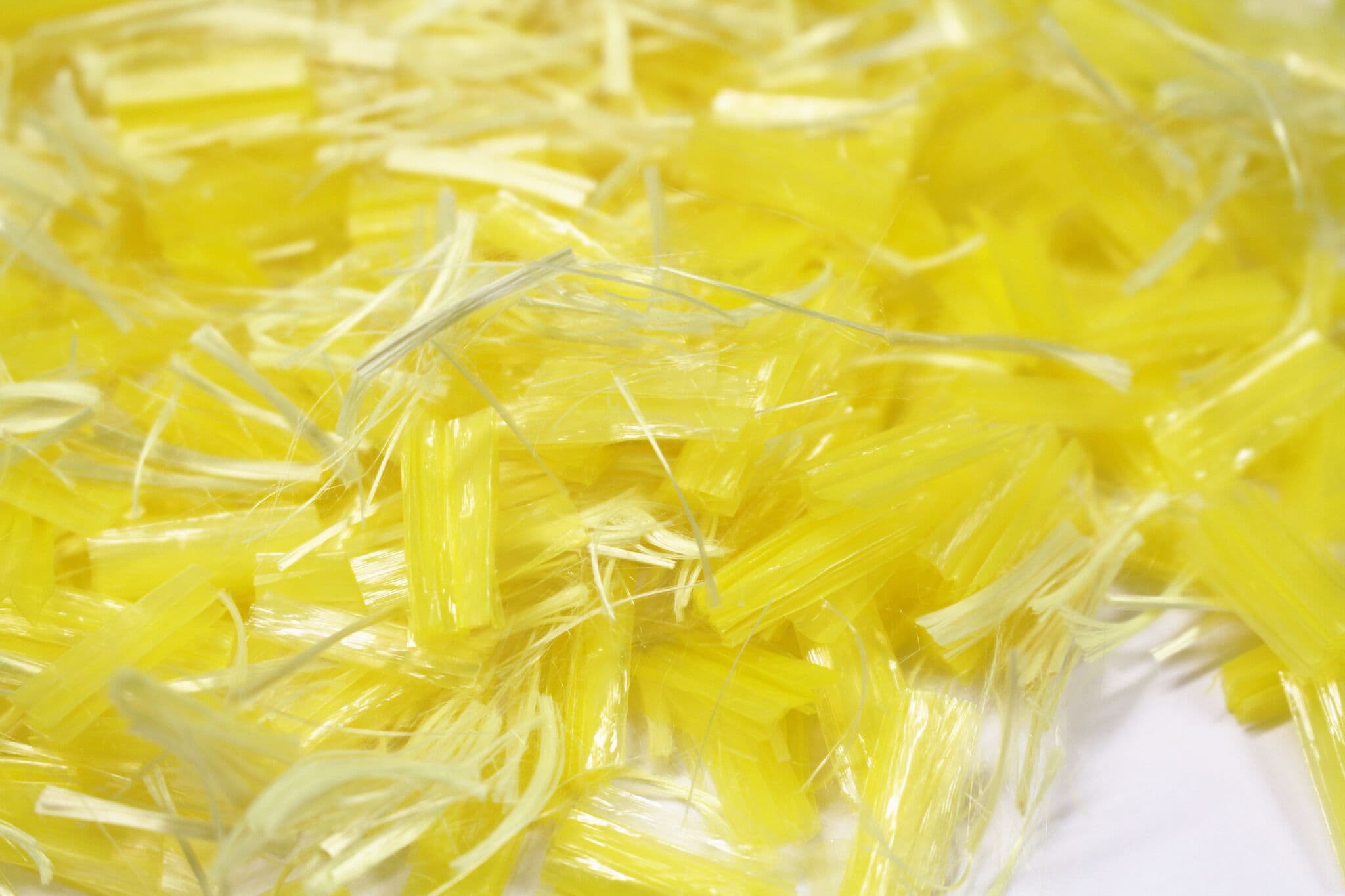
AsphaltX®
2000 filaments per aramid strand — 19 million fibres per tonne of asphalt. Lowest CO₂ footprint, European manufacturing, proven on the N337.
- TypeAramid (Twaron®) + polyolefin fibre blend
- Length± 19 mm
- Tensile strengthTwaron 3000 MPa · polyolefin 483 MPa
- Specific gravityTwaron 1.45 · polyolefin 0.91 g/cm³