500 grams per tonne: how AsphaltX® strengthens asphalt with Twaron®

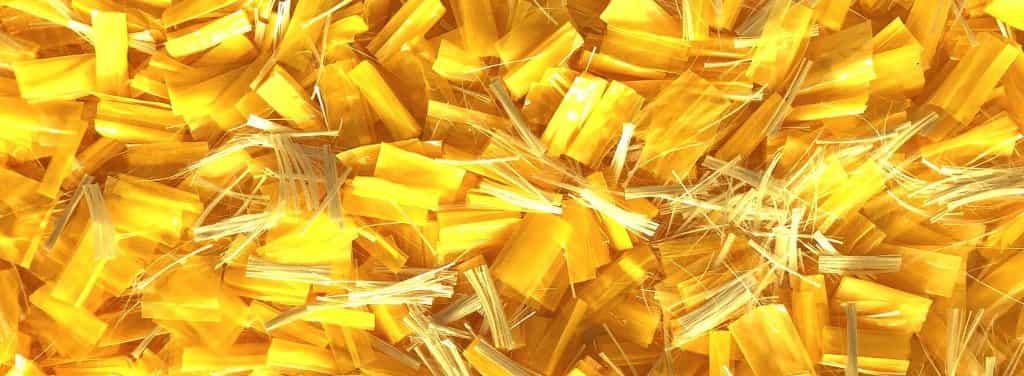
Heavier traffic and varying bitumen quality wear road surfaces out faster. With around 500 grams of Twaron® aramid fibres per tonne, AsphaltX® extends service life — without changing the recipe or equipment.
AsphaltX® is an asphalt reinforcement fibre based on Twaron® aramid, dosed at around 500 grams per tonne of asphalt (0.05%, depending on mix and application). The fibres increase the cohesion of the mix and slow cracking and rutting: on the N337, that delivered 50% less rutting and 30% less cracking.
What is AsphaltX?
AsphaltX is a fibre blend for asphalt, developed by Dutch Fiber Trading, that combines two components: Twaron® aramid fibres and polyolefin fibres. The aramid provides the strength — a tensile strength of around 3,000 MPa, considerably stronger than steel per kilo — while the polyolefin (tensile strength 483 MPa) acts as a carrier and supports even distribution through the hot mix. Both fibres are around 19 mm long, matched to the grading of common Dutch asphalt mixes.
Twaron® is an aramid fibre of Dutch origin, best known from bulletproof vests and aircraft components. What the fibre does there — absorbing large forces at minimal weight — it does in asphalt at micro level: bridging micro-cracks and distributing traffic loading across the mix instead of onto a single weak spot. Exactly how that mechanism works is explained in our article on what an aramid fibre is.
The result: an asphalt mix with standard penetration-grade bitumen that performs comparably to or better than mixes with polymer modified bitumen (PMB) in resistance to cracking, rutting and ravelling — while production, laying and recycling stay simpler. More background on fibre reinforcement in road construction can be found in our knowledge centre on fibre reinforced asphalt.
Why 500 grams per tonne is the optimum dosage
The recommended dosage of AsphaltX is around 500 grams per tonne of asphalt — equivalent to 0.05% by mass, depending on mix and application. That dosage is no accident, but the balance between three factors:
• Fibre distribution — at 0.05% there are enough fibres to weave three-dimensionally through the entire mix, without fibres clustering or the workability of the mix declining.
• Environmental headroom — the OPWA list permits a maximum of 0.1% (1 kg per tonne) for AsphaltX. The recommended dosage of 500 grams sits comfortably within that, with margin for project-specific deviations.
• Cost-effectiveness — at 500 g/tonne, the fibre cost per tonne of asphalt remains limited, while the effect on service life and maintenance carries through in full. The European FIBRA research shows that aramid fibres can be cost-neutral compared with PMB in the Dutch situation.
Practically, the dosage aligns seamlessly with the packaging: AsphaltX is supplied in boxes of 35 bags of 500 grams each (17.5 kg per box, 210 kg per pallet). One bag per tonne of asphalt — a dosing error is thereby virtually ruled out. What fibre reinforcement means per square metre for your project budget is worked out in what fibre reinforced asphalt costs per m².
2,000 filaments per strand: what does that mean?
An aramid strand is built up from a bundle of hair-thin filaments. AsphaltX uses strands with 2,000 filaments — around 45% more than comparable asphalt fibres on the market and thereby unique worldwide in this segment.
Why that matters: during mixing, each strand fans out into individual filaments. More filaments per strand therefore means, at the same dosage of 500 grams per tonne, more separate fibres in the mix, more finely distributed. Every extra fibre is an extra bridge across a potential crack face and an extra contact point holding the mortar in the stone skeleton. As a result, the reinforcement is not in a few isolated spots, but through and through in the asphalt — from surface course to base course.
How the fibres strengthen the asphalt
In the mix, the AsphaltX fibres act as three-dimensional micro-reinforcement. Unlike stabilising paving fibres such as cellulose, which mainly hold the binder in place, aramid strengthens the mix mechanically. Three mechanisms determine the effect:
• Crack bridging — if a micro-crack forms somewhere, the aramid fibres span the crack face and hold the crack closed before it can propagate to the surface.
• Load distribution — the loading from passing (heavy goods) traffic is distributed via the fibre network over a larger volume, which slows permanent deformation (rutting).
• Cohesion and ravelling resistance — in open-graded mixes such as porous asphalt, the fibres hold the mortar bridges between the stones in place, so ravelling develops more slowly.
The heat of the production process poses no risk to the fibres' effect: Twaron® aramid does not melt and is stable to well above 450°C, far above the mixing temperature of 160 to 180°C. The polyolefin component deliberately melts at around 110°C — it dissolves into the binder and contributes to adhesion, while the aramid retains its reinforcing function intact.
Processing at the asphalt plant: add dry, done
For asphalt plants, the threshold has deliberately been kept low. AsphaltX is added dry to the mixer — with the aggregate, before the bitumen is dosed — and requires no modification whatsoever to equipment or asphalt recipe. The bitumen remains a standard penetration-grade bitumen; no modified binder, extra dosing installation or altered mixing cycle is needed.
The field trials of the FIBRA project on the A73 confirmed that picture: the aramid fibre mix produced well and was actually easier to work by hand than the PMB reference mix, without fibre clusters or plant problems. The production rate, at around 130 tonnes per hour, was slightly lower than with PMB (145 to 150 tonnes per hour), because the pre-packed bags are added to the mixer by hand — a step that lends itself well to automation. All the measurement results from that research can be found in the A73 case study with the FIBRA results.
AsphaltX can be used in the three common mix types: porous asphalt (ZOAB), SMA and dense asphalt concrete (DAC). One additive thereby covers the complete spectrum, from porous surface courses on motorways to dense constructions on business parks and roundabouts.
Environmentally certified: the OPWA listing
Asphalt falls under the Dutch Soil Quality Decree; every additive must be environmentally approved before a plant may process it under an NL BSB certificate. AsphaltX is included on the OPWA list (Product Group Description Warm Asphalt, linked to BRL 9320) in the additives category, with a maximum applicable percentage of 0.1% — 1 kg per tonne — in both shaped and unshaped construction materials, and a reassessment running until mid-2031.
For the asphalt plant, this means that AsphaltX can be processed within that bandwidth in NL BSB-certified mixes without additional leaching testing; for the client, that the mix simply falls under the producer's existing certificate. How that system works in detail is covered in our article on the OPWA list, BRL 9320 and NL BSB.
Proven on the N337: 50% less rutting
The strongest evidence comes from practice. On the N337 provincial road between Zwolle and Deventer, AsphaltX was applied in the asphalt construction over an 8-kilometre stretch, without any change to the plant's recipe. The monitoring results compared with the reference section:
• Rutting — 50% less
• Cracking — 30% less
• Expected service life — around 30% longer
For the road authority, that translates into fewer maintenance interventions, less traffic disruption and a demonstrably lower MKI score over the life of the road section. Alongside the N337, AsphaltX has been applied on the Varsseveldseweg, a roundabout on the N711 in Flevoland and various municipal roads, among others.
MKI and CO₂ advantage: fibres instead of PMB
Because AsphaltX works with a standard penetration-grade bitumen, the production temperature can be 15 to 20°C lower than for a comparable PMB mix — on the A73, the aramid mix was produced at around 165°C versus around 181°C for the PMB reference. That directly saves energy at the plant and reduces fumes during laying.
The life cycle assessment within FIBRA also shows that the PMB mix scores more than 10% higher on the environmental cost indicator (MKI) at cradle-to-gate level than the aramid variant. In tenders awarded on MKI or CO₂, fibre reinforcement with AsphaltX is therefore a concretely scoring alternative — with the lowest CO₂ footprint in its category and production within Europe (ISO 9001, CE).
Using AsphaltX in your project
Considering fibre reinforcement for a provincial road, roundabout, haul road or business park? View the specifications of AsphaltX® with datasheet, or request a quotation for your asphalt project directly. Our advisers will gladly work out with you what 500 grams of Twaron® fibres per tonne of asphalt mean for the service life, maintenance costs and MKI score of your road section.
Frequently asked questions
- What is the difference between AsphaltX and loose aramid fibre?
- AsphaltX is a ready-to-use fibre blend of Twaron® aramid and polyolefin in pre-dosed bags of 500 grams — exactly one bag per tonne of asphalt. The polyolefin carrier ensures even distribution in the mixer and dissolves into the binder at around 110°C, while the aramid remains intact as reinforcement. Loose aramid fibre requires your own dosing and carries a higher risk of clustering.
- Does AsphaltX work in porous asphalt, SMA and dense asphalt?
- Yes. AsphaltX is suitable for porous asphalt (ZOAB), SMA and dense asphalt concrete (DAC). In open-graded mixes such as porous asphalt, the fibres mainly improve ravelling resistance by holding the mortar bridges in the stone skeleton in place; in dense mixes they slow cracking and rutting. The OPWA listing applies to both shaped and unshaped construction materials, so to all three mix types.
- Does the asphalt plant need to change the recipe or equipment?
- No. AsphaltX is added dry to the mixer with the aggregate, before the bitumen is dosed, and works with a standard penetration-grade bitumen. No modified binder, extra dosing installation or altered mixing cycle is needed. In the FIBRA field trials on the A73, no fibre clusters or production problems were observed.
- How much AsphaltX goes into a tonne of asphalt?
- The recommended dosage is around 500 grams per tonne of asphalt (0.05%), depending on mix and application. The OPWA list permits a maximum of 0.1% — 1 kg per tonne — leaving room for project-specific deviations. The packaging aligns with this: bags of 500 grams, so one bag per tonne.
- Don't the fibres melt in the hot asphalt mix?
- The Twaron® aramid fibre does not melt and remains stable to well above 450°C — far above the usual mixing temperature of 160 to 180°C. The polyolefin component deliberately melts at around 110°C: it dissolves into the bitumen and supports adhesion, while the aramid retains its reinforcing function in the mix.
Share this article
Products mentioned
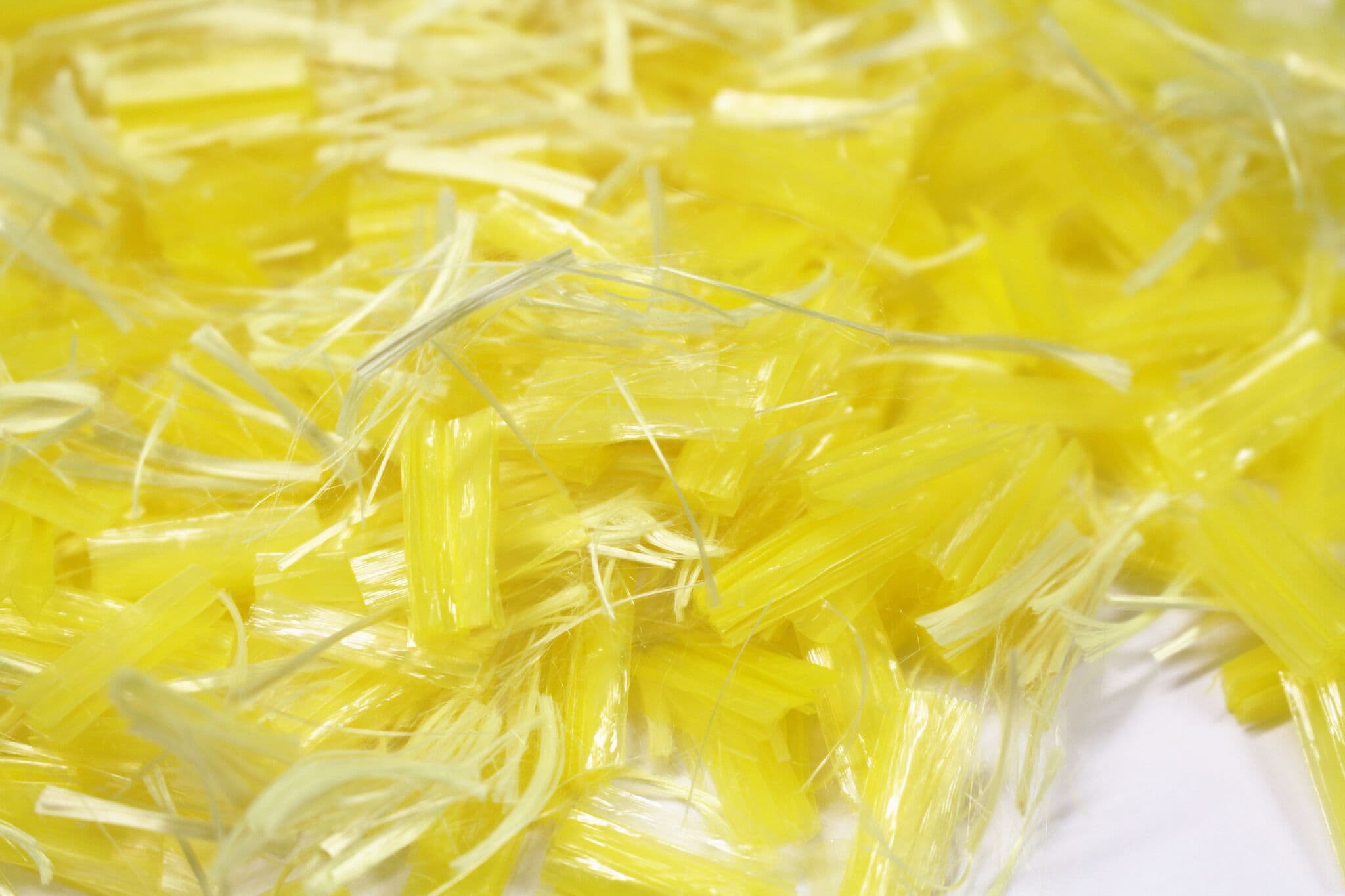
AsphaltX®
2000 filaments per aramid strand — 19 million fibres per tonne of asphalt. Lowest CO₂ footprint, European manufacturing, proven on the N337.
- TypeAramid (Twaron®) + polyolefin fibre blend
- Length± 19 mm
- Tensile strengthTwaron 3000 MPa · polyolefin 483 MPa
- Specific gravityTwaron 1.45 · polyolefin 0.91 g/cm³