White topping concrete: a fibre-reinforced overlay on existing asphalt

A thin, fibre-reinforced white topping concrete overlay on existing asphalt extends the service life by decades. When it pays off, which layer thicknesses and joint spacings apply and what it costs.
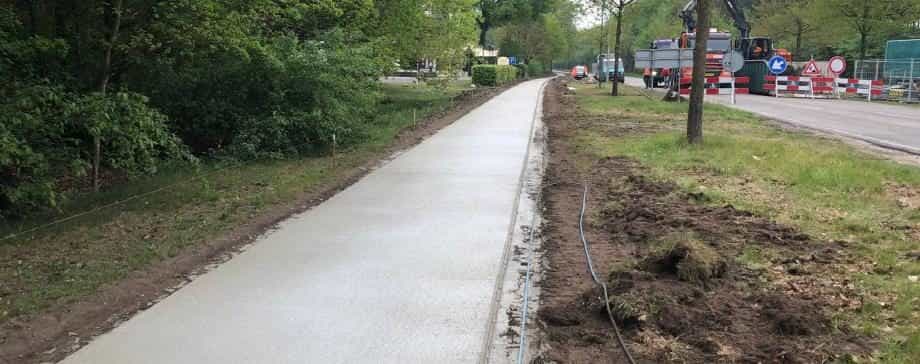
White topping concrete is a concrete overlay, often fibre-reinforced, poured directly over an existing asphalt pavement. The old asphalt stays in place and acts as the foundation. On the cycle paths along the N344, that delivered a 12 cm thick concrete layer, around 25% lower project costs and an expected service life of more than 20 years.
What is white topping?
In white topping, a layer of concrete — often relatively thin compared with a classic concrete road — is applied directly over an existing, aged asphalt pavement. Instead of milling off the asphalt completely, hauling it away and replacing it, the old construction is reused as a load-bearing base layer. That saves raw materials, transport movements and CO₂ emissions, and it delivers a low-maintenance pavement that behaves like a fully fledged concrete road.
In American guidance the technique is usually written as one word, whitetopping, and the bonded variants are also known as bonded concrete overlays of asphalt (BCOA). Internationally, white topping concrete is classified by layer thickness and by whether the concrete relies on its bond with the asphalt. The values below are indicative; the exact boundaries differ slightly between guidelines.
| Type | Concrete thickness | Bond to the asphalt | Typical use | Fibres |
|---|---|---|---|---|
| Conventional (unbonded) white topping | around 20 cm (8 in) or more | Not relied on: the slab carries the load by itself | Heavily trafficked roads | Optional |
| Thin white topping | around 10 to 15 cm (up to 20 cm in some guidelines) | Usually bonded: concrete and asphalt act together | Cycle paths, yards, bus lanes, lighter-trafficked roads | In some overlays |
| Ultra-thin white topping | around 5 to 10 cm | Fully dependent on a good bond | Car parks, low-traffic roads, other light-duty pavements | Nearly always |
White topping in Dutch practice
For Dutch applications — cycle paths, car parks, industrial yards and lighter-trafficked road sections — the layer thickness usually falls in the thin segment. That is exactly where fibre reinforcement comes in: a thin layer offers no room for traditional reinforcement mesh, while crack control is essential.
When white topping instead of milling and resurfacing?
The classic reflex with a worn asphalt surface course is asphalt renewal by milling and resurfacing. That is a fine solution if the problem sits in the surface course and the road authority wants to keep an asphalt pavement. White topping becomes interesting as soon as the surface keeps returning as a structural cost item, while the underlying construction is still sound.
Typical triggers to consider white topping:
• Rutting — asphalt deforms under heavy or slow-moving loads; concrete is virtually insensitive to it. Read also what causes rutting and how to solve it.
• Ravelling and repeated surface-course maintenance — if a new surface course is needed every 10 to 15 years, a concrete pavement with a 20+ year service life quickly wins the whole-life cost comparison.
• Heavy or turning loads — loading and unloading zones, bus lanes, roundabouts and access roads where asphalt keeps deforming.
• Sustainability requirements in the tender — reusing the existing construction scores directly in ECI calculations: less removal, less new material.
White topping is not a solution for every situation. With subsidence, a poor foundation or insufficient residual bearing capacity of the asphalt, the problem simply shifts through to the new concrete layer. An assessment of the residual bearing capacity — for example with falling weight deflection measurements — is therefore always the first step. Where the pavement level cannot rise (connections, thresholds, cables and pipes), the thin build-up also demands bespoke design work.
Why fibre reinforcement for a thin concrete layer?
Because white topping layers are thinner than a regular concrete pavement, the construction is more susceptible to cracking from shrinkage and temperature changes. At the same time, a layer of 10 to 12 cm offers hardly any room to position reinforcement mesh with sufficient concrete cover. Fibre reinforcement solves both problems in one go:
• Crack control throughout the volume — macro fibres are homogeneously distributed through the concrete and deliver residual strength after cracking (tested to EN 14651), exactly what a thin layer demands.
• No separate reinforcement stage — laying, aligning and fixing mesh is eliminated entirely. That saves labour hours and shortens the execution time of the renovation.
• Slimmer construction — fibres increase the crack resistance of the concrete, allowing the required concrete thickness to come down. Less concrete means less transport and lower CO₂ emissions.
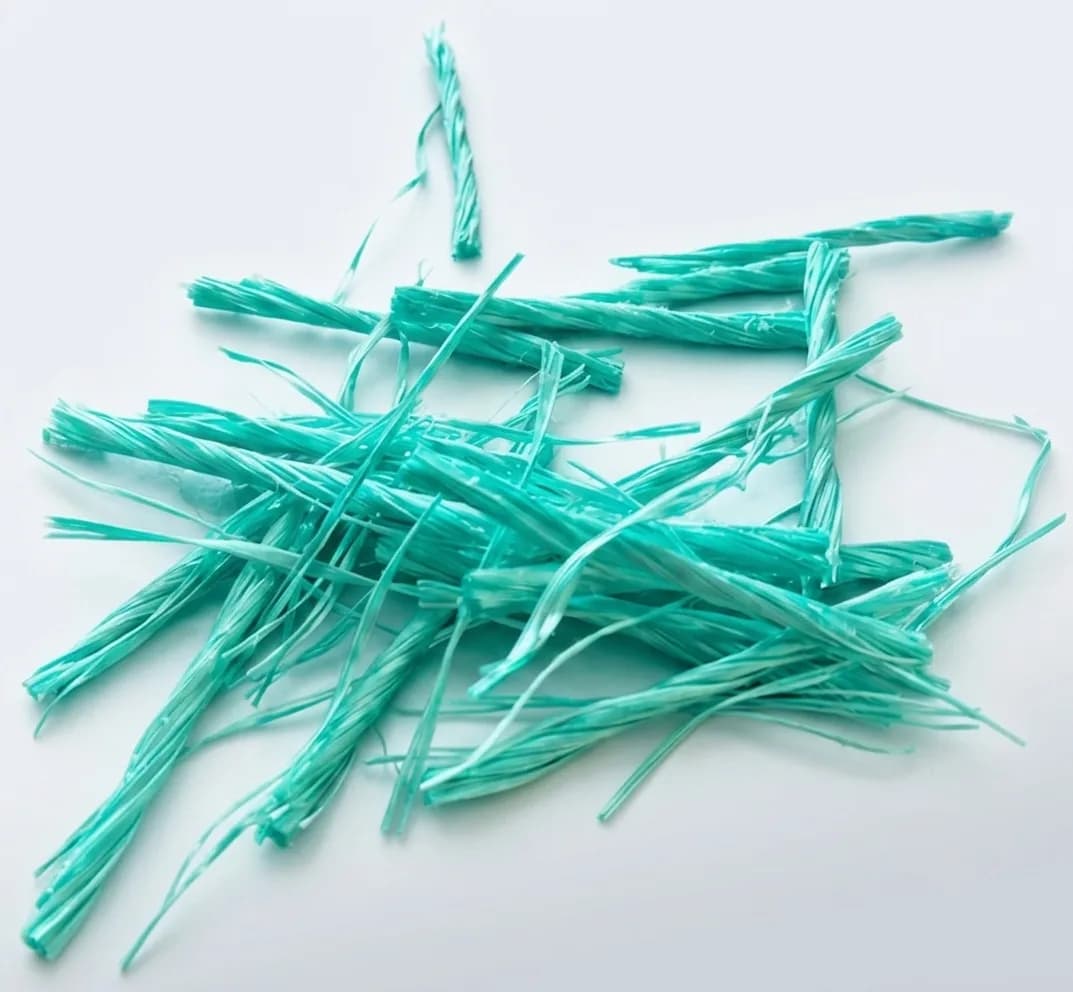
In practice, white topping with TwistR fibre concrete is the usual choice: a hybrid synthetic macro fibre that fully replaces the steel mesh in this kind of pavement. For projects where a mineral fibre is preferred, for aesthetic or environmental reasons for instance, the corrugated basalt fibre Basalt Wave is an alternative. Fibre type and dosage are matched to layer thickness and traffic loading; structural applications require a calculation by the structural engineer.
White topping concrete: mix, thickness and joint spacing
The concrete in a white topping is usually a regular pavement mix rather than a special product. Indicatively, strength classes C30/37 to C35/45 are used, in exposure class XF4 where de-icing salts are applied; the structural engineer sets the final specification. What sets white topping concrete apart is the combination of a thin layer, a sound bond and short joint spacing. Four design parameters determine the result:
• Layer thickness follows from the traffic loading, the residual bearing capacity of the asphalt and the intended design life. For cycle paths and yards, around 10 to 15 cm is usually sufficient; heavily trafficked roads need more.
• Remaining asphalt: for a bonded overlay, guidance generally asks for at least around 7.5 cm (3 in) of sound asphalt after milling, so that both layers can work together.
• Joint spacing: short bays keep curling and shrinkage stresses in a thin slab low. For bonded overlays, a common rule of thumb in overlay guidance is a maximum joint spacing of around 12 to 18 times the layer thickness (indicative), so roughly 1.2 to 1.8 m for a 10 cm layer.
• Fibre dosage: TwistR is dosed within a range of 2.0 to 6.0 kg/m³. Where a white topping lands in that range depends on layer thickness, joint spacing and the required residual strength, and is fixed in the design.
Step by step: how a white topping renovation proceeds
A white topping project broadly runs through seven steps:
• 1. Residual bearing capacity survey — deflection measurements and cores determine whether the asphalt can continue to function as the foundation.
• 2. Local repairs — potholes, subsidence and severely cracked sections are repaired first, so the substrate bears evenly.
• 3. Surface preparation — rutting is milled flat and the asphalt is cleaned. A rough, clean milled surface is decisive for the bond between concrete and asphalt — with thin layers, the critical point of the construction.
• 4. Pouring the fibre concrete — the fibres are dosed at the concrete plant or on site; the mix is placed in a single pass, with no waiting for steel fixers.
• 5. Finishing — levelling and applying the desired surface texture (a broom finish for skid resistance, for example).
• 6. Curing — a curing compound or covering prevents overly rapid drying, extra important for a thin layer with a relatively large surface area.
• 7. Sawing joints — contraction joints are sawn shortly after pouring. The thinner the layer, the smaller the bays: with ultra-thin layers these are small bays in the order of one to two metres; at 12 cm the bays are more generous.
After a few days of strength development, the pavement can be opened. Because removing the old asphalt and the reinforcement stage are eliminated, the total lead time is shorter than with full reconstruction.
Costs: white topping versus full reconstruction
The cost gain of white topping lies in what does not happen: no removal and disposal of the old asphalt, no new foundation, less new material and a shorter closure. On the cycle paths along the N344, around 2,500 tonnes of asphalt remained in the construction and 1,900 tonnes of new concrete sufficed — good for roughly a 25% saving on project costs compared with traditional replacement.
Then there is the service-life effect. A fibre-reinforced concrete pavement lasts well over 20 years with minimal maintenance, where asphalt in the same period usually needs at least one surface-course replacement. In a whole-life cost calculation (LCC) and in the ECI score for tenders, that counts double. Specific prices per square metre are highly project-dependent — layer thickness, accessibility, area and the condition of the asphalt determine the outcome. Therefore request a project-specific quotation; indicatively, at 2026 price levels, the saving grows the more of the existing construction can be reused.
Field examples: cycle paths along the N344 and N355
The method has been proven on the public road in the Netherlands, with cycle paths leading the way. In 2019, Schagen Infra renovated the cycle paths along the N344 between Voorthuizen and Garderen for the municipality of Barneveld. On the reused asphalt construction came a 12 cm thick concrete pavement with a total of 7,000 kg of TwistR HYBRID fibres. The result: 2,500 tonnes of asphalt that did not need to be hauled away, around 25% lower project costs, lower CO₂ emissions, improved cycling comfort and an expected service life of more than 20 years.
Along the N355 in Friesland it went a step further: there, white topping was applied to a cycle path as a European first — a thin concrete layer with TwistR macro fibres, directly over the existing asphalt, executed by Schagen Infra for the province of Friesland. The concrete is moreover 100% reusable at the end of its life.
For road authorities struggling with an ageing asphalt network, these projects are a usable reference for a cycle path of fibre concrete — the approach scales from a single cycle path to a complete renovation programme.
Concrete pavements in asset management: beyond the cycle path
White topping is one of the ways fibre concrete makes the assets of municipalities and provinces more sustainable. The same consideration — making use of the existing construction, crack control without mesh, less maintenance — applies to car parks, industrial yards and the replacement of timber bridge decks with fibre concrete. How fibre reinforcement fits into road management more broadly is covered in our article on fibre reinforcement for municipalities and on the pillar page applications and target groups.
If it concerns existing concrete with damage, overlaying is not always necessary: targeted repair often suffices. See repairing concrete and fixing cracks for that.
Applying white topping in your project
Considering a concrete overlay on existing asphalt? Three pieces of information determine feasibility: the residual bearing capacity of the asphalt construction, the traffic loading and the available pavement height. With that information, we draw up a fibre recommendation together with your structural engineer — type, dosage and layer thickness — and calculate the saving compared with full reconstruction. We will send the reference sheets of the N344 and N355 projects on request.
Frequently asked questions
- How thick does the concrete layer in white topping need to be?
- That depends on the traffic loading and the residual bearing capacity of the asphalt. For cycle paths and lightly trafficked pavements the layer thickness is usually between around 10 and 15 cm; on the N344 near Barneveld, 12 cm of fibre concrete sufficed. More heavily trafficked road sections require thicker layers. The final thickness follows from a calculation by the structural engineer.
- Can white topping be applied over any asphalt?
- No. The asphalt must be able to continue functioning as a foundation: sufficient residual bearing capacity, no continuous subsidence and a sound foundation beneath it. Deflection measurements and cores establish this before the design. If the construction is structurally worn out, full reconstruction is the better choice. A clean, rough (milled) surface is also a precondition for the bond between concrete and asphalt, and for a bonded overlay guidance generally asks for at least around 7.5 cm of sound asphalt after milling.
- What is the difference between bonded and unbonded white topping?
- In bonded white topping, the concrete is placed on a milled, clean asphalt surface so that both layers act together; that makes thin (around 10 to 15 cm) and ultra-thin (around 5 to 10 cm) layers possible. Unbonded or conventional white topping is thicker, around 20 cm or more, and carries the load by itself, with the asphalt acting as a stable base. For cycle paths and yards, the bonded thin variant with fibre concrete is the usual choice.
- Does white topping help against rutting?
- Yes. Rutting is a deformation of asphalt under heavy or slow-moving loads; a concrete pavement is virtually insensitive to it. If rutting returns after every surface-course replacement, that is a strong signal to consider white topping. More on the causes can be found in our article on rutting.
- What does white topping cost compared with traditional replacement?
- Indicatively, reusing the existing construction saves substantially: on the N344 it was around 25% of the project costs, because 2,500 tonnes of asphalt did not have to be hauled away and less new material was needed. The exact price per square metre depends on layer thickness, area and the condition of the asphalt; a project-based quotation provides certainty.
- Do fibres fully replace the reinforcement mesh in a white topping layer?
- In pavements such as cycle paths and yards, macro fibres can fully replace the steel mesh, as was done on the N344 and in Wijckel with TwistR fibres. The fibres deliver residual strength after cracking to EN 14651. For structural applications, a calculation by the structural engineer remains necessary to determine type and dosage.
Share this article
Products mentioned
 Most chosen
TwistR® GREEN HYBRID
High-performance synthetic macro fibres made from 100% polypropylene. Transforms concrete into a stronger composite material.
- TypeHybrid: twisted monofilament + fibrillating network fibre
- Material100% virgin polypropylene
- Length48 mm
- Dosage2.0 – 6.0 kg/m³
Pallet price on request
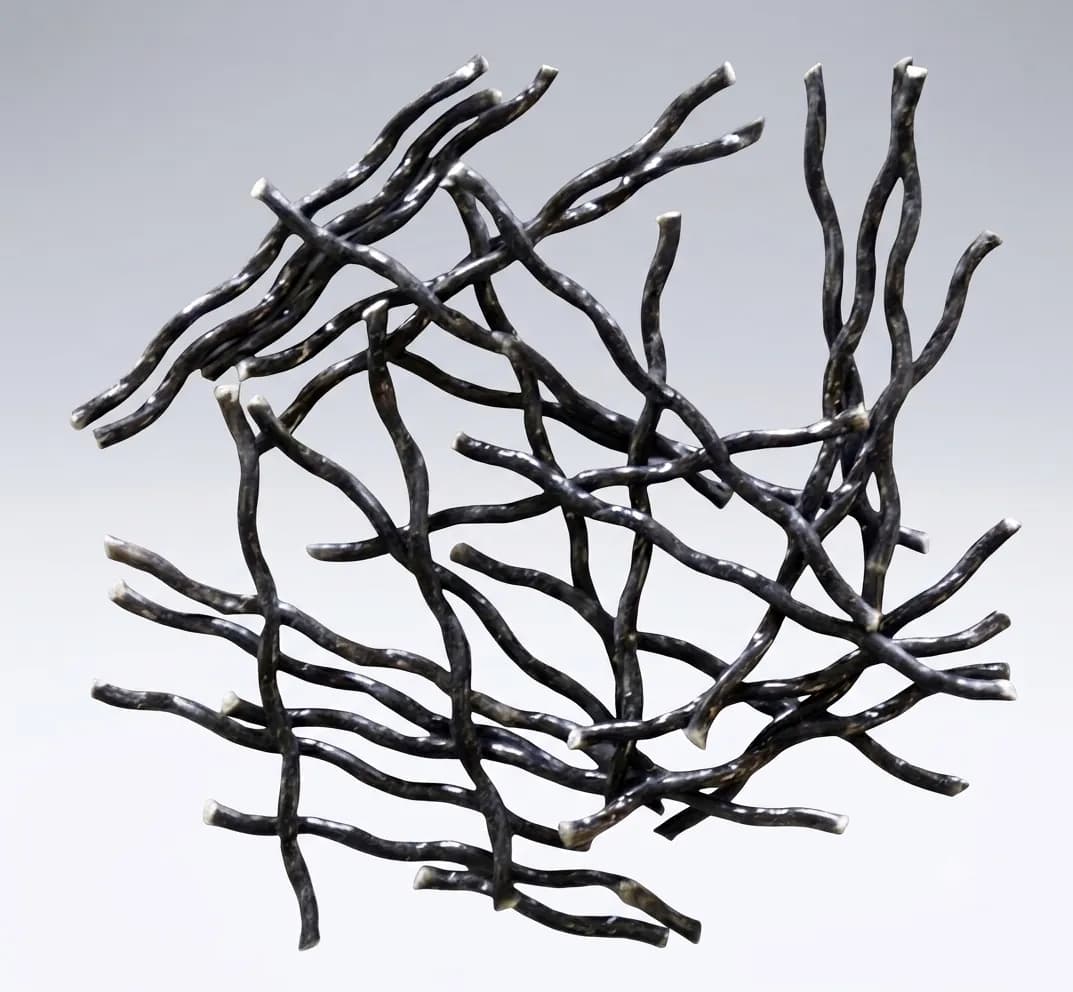
Basalt Wave
Wave-profile basalt fibre for excellent bonding in the concrete matrix. High temperature resistance for demanding constructive applications.
- TypeBasalt macro fibre (wave-profile 3D)
- Length50 mm
- DiameterØ 1.2 mm
- Strand tex2000 tex