What is rutting? Causes, dangers and solutions

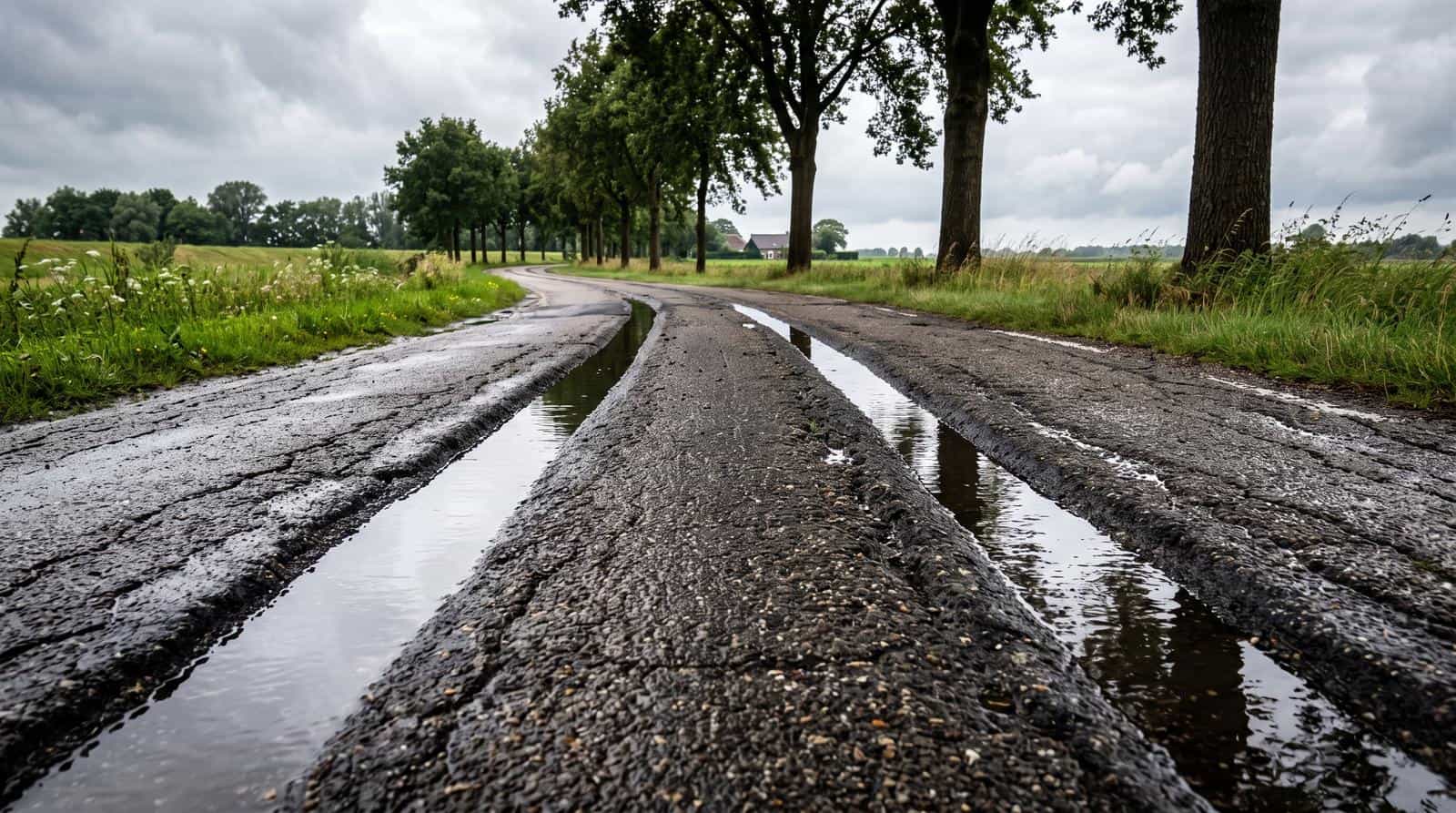
Rutting — permanent grooves in the wheel tracks — is the core problem of heavily loaded asphalt. The four causes, where it appears first, and what can be done about it.
Rutting is the permanent indentation of the road surface in the wheel tracks: elongated grooves in the places where most tyres run. It develops through repeated loading by (heavy) traffic and is accelerated by heat, a mixture that is too soft or a weak subgrade. Rainwater sits in the ruts — with aquaplaning as the greatest danger.
What exactly does rutting mean?
Asphalt is not a rigid material. The binder, bitumen, is thermoplastic and behaves viscously under sustained loading: every axle load that passes presses the mixture in and sideways by a minuscule fraction. One lorry makes no difference; tens of thousands of axle loads per year on exactly the same strip do. The sum of all those small, permanent deformations becomes visible as two parallel grooves in the road surface — the wheel tracks. That is rutting: permanent (plastic) deformation in the transverse profile of the road, as opposed to elastic deformation that springs back after the tyre has passed.
The location is characteristic: precisely in the left and right wheel track of the traffic lane. The grooves are often most clearly visible after a rain shower, when the water sits in them as two glistening ribbons. Alongside the deepened tracks, the mixture may bulge up slightly — the displaced material has to go somewhere, after all.
The term also appears in driver training: the Dutch driving theory exam asks what you should do when there is rutting in the road surface. The answer there: adjust your speed, keep extra distance and, in rain, drive just outside the ruts where possible, without steering or braking abruptly. This article covers the other side of the same question: why those ruts develop and how road authorities and contractors prevent them.
Why is rutting dangerous?
• Aquaplaning — the greatest risk. A film of water sits in the ruts and cannot drain to the road edge. At higher speeds, tyres lose contact with the road surface on it — precisely on the strip where everyone drives.
• Steering behaviour — deep ruts "pull" at the tyres. Especially when changing lanes or swerving, the car feels unsettled; motorcyclists and cyclists can be thrown off balance by the rut edge.
• Winter ice — water standing in the ruts freezes sooner than a well-draining surface, resulting in localised icing.
• Accelerated consequential damage — a deformed transverse profile loads the surface course unevenly, so cracking and ravelling at the rut edges occur faster and the maintenance cycle shortens.
For road authorities, rutting is therefore not just a comfort issue but above all a road safety issue, and a fixed part of the annual road inspection.
What causes rutting? The four causes
Rutting rarely has a single cause. In practice the damage arises from a combination of four factors, and the effective solution depends on which factor dominates.
1. Heavy and channelised traffic
The driver behind every form of rutting is repeated axle loading. Lorry traffic weighs in disproportionately: the deforming effect of an axle load increases more than proportionally with weight, so a single heavy lorry axle loads the road surface many times more than thousands of cars. If that heavy traffic also runs in exactly the same track every time — channelised traffic, as on a bus lane or an inside lane full of lorries — all the loading concentrates on two narrow strips and rutting accelerates considerably.
2. Heat: a soft road surface deforms faster
Bitumen loses stiffness as the temperature rises. The softening point of standard road bitumen lies around 45–55 °C — and that level is genuinely reached in the Netherlands: at 30 °C air temperature, black asphalt heats up to around 50–60 °C at the surface. Under those conditions the same traffic presses the softened mixture in noticeably faster. Hot summers are therefore the period in which rutting grows hardest. How temperature, soft asphalt and fibres interrelate exactly is covered in our article on heat, road surface temperature and rutting.
3. The mixture: binder, stone skeleton and compaction
Not every asphalt mixture is equally resistant to permanent deformation. Risk factors are a binder that is too soft or too generously dosed, round (natural) sand instead of crushed material, and a weak stone skeleton in which the stones do not interlock sufficiently. Execution counts too: a surface course insufficiently compacted at installation is "re-rolled" by traffic in the first years — with an early rut as the result. Mixtures with a strong stone skeleton, such as stone mastic asphalt (SMA), are designed precisely to transfer the loading through stone-on-stone contact rather than through the mortar.
4. The subgrade and foundation
Rutting does not have to originate in the asphalt layers themselves. If the foundation or the (in the Netherlands often soft) subgrade sinks away beneath the wheel track, the whole package sinks with it. This structural type of rut can be recognised by its shape: a wide, gently sloping trough across the full width of the wheel track, without bulging alongside. A narrow, sharply defined rut with raised edges points instead to deformation in the upper or surface course. That distinction is essential for the approach: a surface-course problem can be fixed by milling and a new, deformation-resistant surface course; a foundation problem cannot.
Where does rutting appear first?
• Roundabouts — the combination of slow-moving heavy traffic and twisting, shoving forces in the curve makes roundabouts the classic rutting location. Fatting-up and ravelling also occur faster here.
• Bus lanes — buses are heavy and run almost perfectly channelised in the same track; at stops, braking and pulling away are added on the same few square metres time and again.
• Junctions and traffic lights — stationary and slowly accelerating heavy traffic loads the mixture for long periods in one spot, exactly the loading pattern bitumen copes with worst.
• Motorways and trunk roads — mainly the inside lane with concentrated lorry traffic; on the outside lane rutting is rare.
• Business parks and loading bays — heavily laden axles standing still for long periods at high summer temperatures produce the same effect as a junction, but daily.
How do road authorities measure rutting?
The measure is rut depth: the depth of the groove relative to the original transverse profile. Classically it is measured with a straightedge laid across the traffic lane and a wedge or dial gauge at the deepest point. At network level it is nowadays done on the move: survey vehicles with laser profilometers record the transverse profile across entire road sections and deliver rut depths per hectometre.
In the methodology for rational road management (CROW), rutting is one of the fixed damage patterns assessed during periodic inspection. The measured rut depth, together with road type and speed regime, determines when a measure is needed: what is acceptable on a 60 km/h access road is a safety risk on a 100 km/h through road because of aquaplaning. The rut depth measurement thus feeds directly into the multi-year maintenance plan — more on that in our article on asphalt maintenance and extending service life.
Solutions against rutting
Which measure makes sense depends on the cause and the layer in which the rut sits. In practice there are three routes, from preventive to curative.
Mixture choice and binder
The first line of defence is a deformation-resistant mix design: a strong stone skeleton (SMA or stone-skeleton mixtures), crushed aggregate and a binder that suits the loading. On heavily loaded locations, polymer modified bitumen (PMB) has traditionally been specified, remaining stiff and elastic even at higher temperatures. PMB has drawbacks, however: a higher production temperature, more difficult recycling and a higher environmental impact — the trade-off is set out in our explanation of what fibre-reinforced asphalt is.
Fibre reinforcement: holding the mixture in place mechanically
Fibre reinforcement tackles rutting through a different mechanism from PMB: not a tougher binder, but a three-dimensional network of strong fibres that spreads the load of each passing axle over a larger volume and so counters local, permanent deformation. The fibres retain their strength even when the bitumen softens on a hot day — aramid fibres have a melting point above 450 °C and a tensile strength of 3,000 MPa.
The dosage is strikingly small: around 0.05%, or roughly 500 grams of aramid fibres against rutting per tonne of asphalt, depending on mixture and application — without any change to the asphalt mix design or the equipment at the plant. The proof comes from practice: in the European FIBRA research on the A73 near Roermond, the aramid mixture met all Dutch requirements at a 15–20 °C lower production temperature than the PMB reference; the full results are in our case study of the A73 trial section. And at the most rutting-prone location there is — a roundabout with heavy, twisting traffic — Schagen Infra chose fibre reinforcement: in the renovation of the N711 roundabout in Flevoland, 1,585 tonnes of asphalt were reinforced with 400 kg of AsphaltX, with an MKI score of €8.50 and around 70% lower environmental impact as an added result.
More background on the working principle, mixture types (porous asphalt, SMA, dense asphalt) and tendering can be found on our pillar page on fibre-reinforced asphalt.
Milling, a new surface course or reconstruction
Once the rut is there, superficially "filling it up" is rarely durable: the cause sits in the layer beneath. For rutting in the surface course, the standard measure is milling and applying a new, deformation-resistant surface course — also the natural moment to execute that new layer fibre-reinforced, at limited additional cost within the major maintenance already planned. If the deformation sits deeper (foundation or subgrade), only a partial or full reconstruction of the road structure helps, including tackling the foundation layer.
Preventing rutting on your next project
For road authorities and contractors the practical conclusion is: fight rutting at the moment a new layer is coming anyway. On risk locations — roundabouts, bus lanes, junctions, heavily loaded lanes — choose a deformation-resistant mixture and consider fibre reinforcement as a recyclable alternative to or complement of PMB. The dosage of 500 grams per tonne requires no change to mix design or execution, and the performance has been demonstrated in practice on the A73, N337 and N711.
Want to know what fibre reinforcement means for your road section, roundabout or business park? Request a quotation or put your situation to us via contact — we will think along on mixture type, dosage and the substantiation towards your client or specification.
Frequently asked questions
- What is rutting?
- Rutting is the permanent indentation of a road surface in the wheel tracks: two elongated grooves in the places where most tyres run. It develops because repeated traffic loading presses the asphalt mixture in and sideways a fraction at a time. After rain the ruts are clearly visible as glistening ribbons of water — and that standing water is also the greatest safety risk.
- What causes rutting?
- A combination of four factors: repeated loading by (heavy) traffic, heat that softens the bitumen — at 30 °C air temperature a road surface reaches 50–60 °C — a mixture with a binder that is too soft or a weak stone skeleton, and a sinking foundation or subgrade. On roundabouts, bus lanes and junctions several factors coincide, which is why rutting appears there first.
- What should you do when there is rutting on the road?
- As a road user: adjust your speed, keep extra distance and, in rain, drive just outside the ruts where possible, without abrupt steering or braking — standing water in the ruts increases the risk of aquaplaning. This question also comes up in the Dutch driving theory exam. As a road authority, persistent rutting is a signal to measure the rut depth and schedule maintenance.
- How is rutting measured?
- Via the rut depth: classically with a straightedge across the traffic lane and a wedge at the deepest point, at network level with survey vehicles that record the transverse profile with laser profilometers. In the CROW inspection methodology, rutting is a fixed damage pattern; the measured depth, together with road type and speed regime, determines when a maintenance measure is needed.
- Do fibres help against rutting?
- Yes. Fibres spread the load of passing traffic over a larger volume of the mixture and retain their strength when bitumen softens in heat. Aramid fibres such as AsphaltX are dosed at around 500 grams per tonne of asphalt, without any change to the mix design. The effect has been demonstrated in practice on the A73 trial section (FIBRA) and the N711 roundabout in Flevoland.
Products mentioned
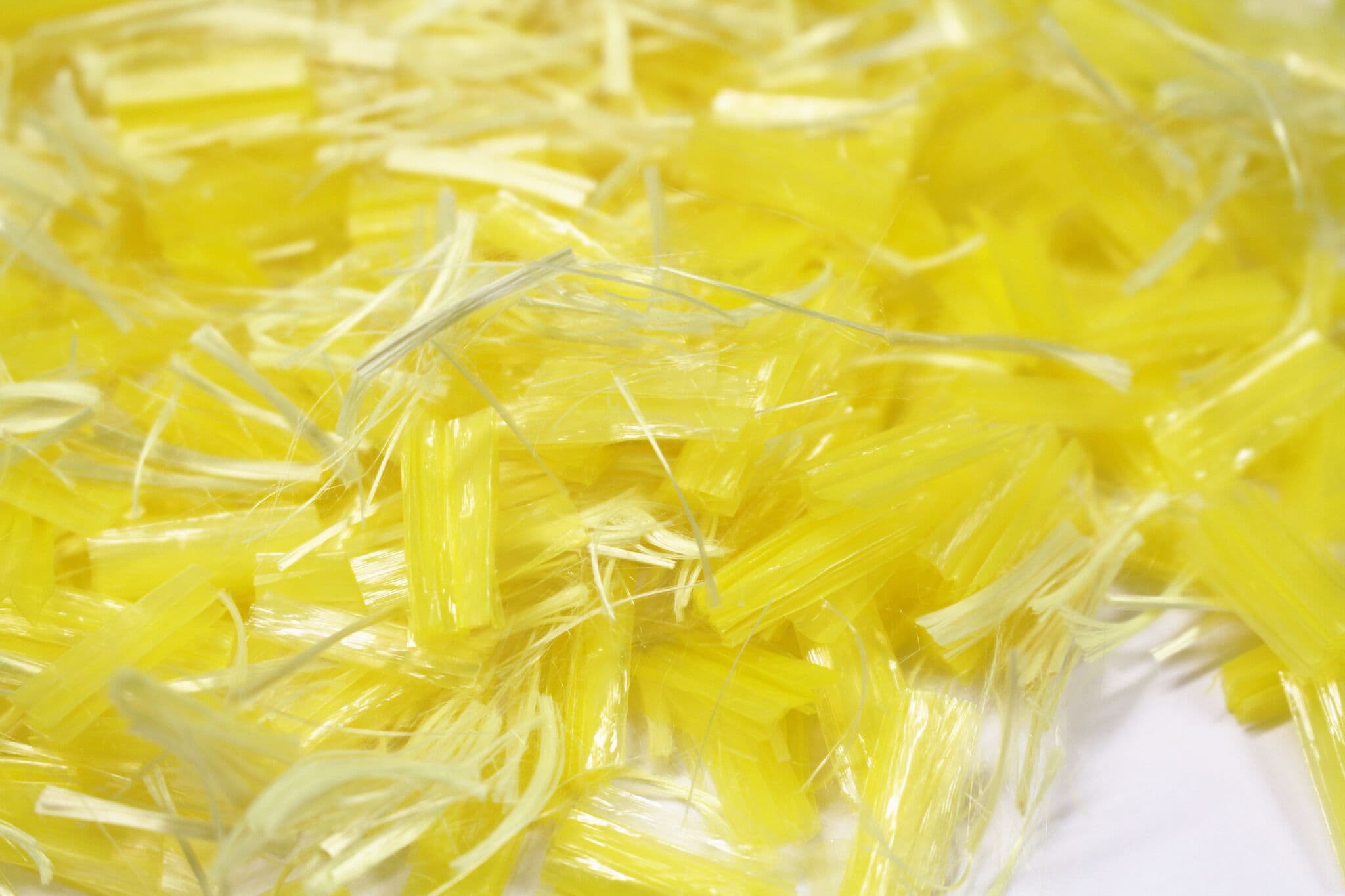
AsphaltX®
2000 filaments per aramid strand — 45% more than competitors. Lowest CO₂ footprint, European manufacturing, proven on the N337.
- TypeAramid (Twaron®) + polyolefin fibre blend
- Length± 19 mm
- Tensile strengthTwaron 3000 MPa · polyolefin 483 MPa
- Specific gravityTwaron 1.45 · polyolefin 0.91 g/cm³