What is fibre reinforced asphalt and how does it work?

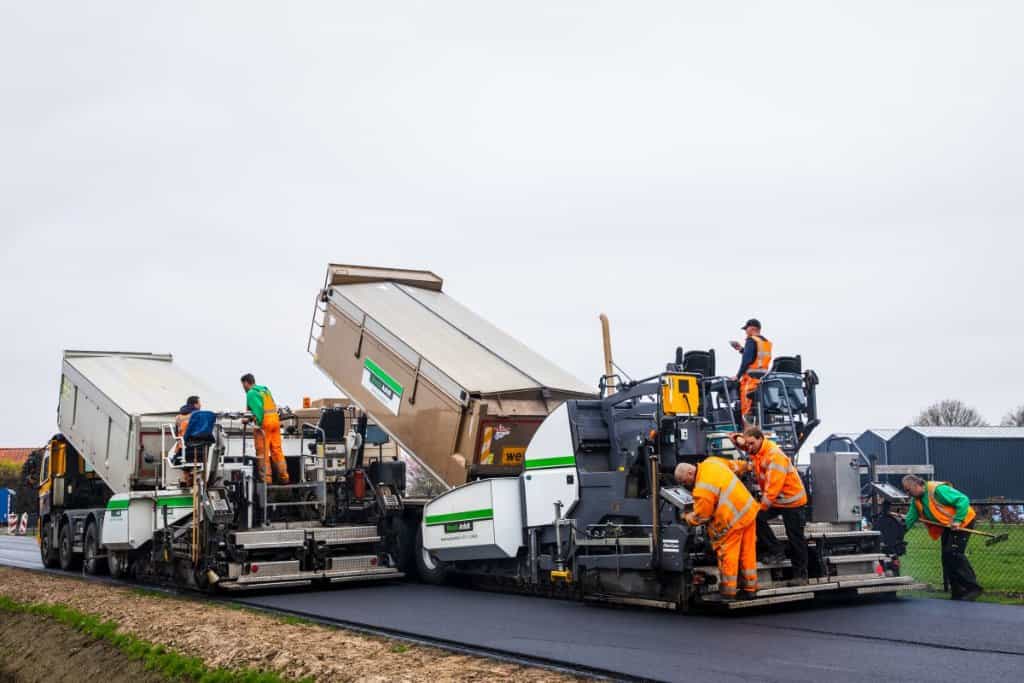
Fibre reinforced asphalt contains strong fibres that slow cracking, ravelling and rutting — a recyclable alternative to PMB and reinforcement grids, proven on the A73 and N337.
Fibre reinforced asphalt is asphalt to which strong fibres are added during mixing — usually aramid (around 0.05%, roughly 500 grams per tonne, depending on mix and application) or PAN (around 0.15%) — to counter cracking, ravelling and rutting. It replaces polymer modified bitumen (PMB) or reinforcement grids, performs comparably at a 15-20°C lower production temperature and can extend the service life of the road surface by up to 50%.
Why does asphalt need reinforcement?
Asphalt consists of a mixture of crushed stone, sand, filler and bitumen as the binder. The bitumen glues the stones together and makes the whole watertight and flexible — but it is also the most vulnerable component. Under the influence of traffic loading, temperature cycles and ageing of the binder, three characteristic damage patterns develop over time:
• Cracking — the bitumen hardens and embrittles through oxidation; tensile stresses from traffic and temperature then lead to cracks that let water through to the foundation.
• Ravelling — stones working loose from the surface as the mortar bridge between them fails. Open-graded mixes are particularly susceptible.
• Rutting — permanent deformation in the wheel track caused by repeated tyre loading, especially from heavy, slow-moving traffic. How exactly this develops is explained in our article on rutting.
Porous asphalt is especially vulnerable: ZOAB (very open asphalt concrete) has a high void content for noise reduction and water drainage, which means the stone skeleton has less mutual contact than in dense mixes. Every measure that slows these damage patterns means direct life extension of the road — and therefore fewer milling and replacement cycles, less traffic disruption and lower management costs. This article is the starting point of our knowledge series on fibre reinforced asphalt.
How does fibre reinforcement work in asphalt?
Fibres are added dry during the mixing process: the fibres are first mixed with the hot aggregate, and the bitumen follows. Once well distributed through the mix, the fibres act at micro level as three-dimensional reinforcement:
• Crack bridging — where a micro-crack forms, the fibre spans the crack face and slows its growth into a visible crack.
• Load distribution — the loading from passing traffic is spread more evenly across the mix instead of being concentrated on a single weak spot.
• Stabilisation of the mortar — in porous asphalt, the fibre holds the mortar bridge between the stones of the stone skeleton together more firmly, which counters ravelling.
The principle resembles fibre reinforcement in concrete, but the conditions are harsher: the fibre must withstand mixing temperatures of 160 to well over 180°C without losing its properties. That is why only heat-resistant fibre types are used in asphalt. Heat also matters once the road is in use: how fibres help asphalt resist rutting when the road surface temperature rises on hot summer days is explained separately.
Which paving fibres are used in asphalt?
In the trade, the fibres added to an asphalt mix are often simply called paving fibres or asphalt fibres. They fall into two groups: reinforcing fibres, which strengthen the mix mechanically, and stabilising fibres, which mainly hold the binder in place. The two main reinforcing fibre types are:
• Aramid fibre — an extremely strong, heat-resistant synthetic fibre, typically dosed at around 0.05% of the mix (roughly 500 grams per tonne, depending on mix and application). What aramid is exactly and why it is so strong is covered in our article on the aramid fibre. Dutch Fiber Trading supplies aramid asphalt fibres with Twaron technology: AsphaltX, with 2,000 filaments per strand.
• PAN fibre (polyacrylonitrile) — also widely used, typically dosed at around 0.15% of the mix, often combined with a small proportion of cellulose fibre against binder drainage.
Stabilising fibres play a different role. Cellulose fibres have been used for decades in stone mastic asphalt (SMA), typically at around 0.3% of the mix (indicative, depending on the mix design); mineral fibres are sometimes used instead. They stop the binder-rich mortar from draining off the aggregate during transport and laying (binder drain-down), but add little or no mechanical reinforcement. Aramid and PAN fibres do reinforce the mix mechanically, which is why they are the paving fibres chosen against cracking, ravelling and rutting.
In concrete paving (external slabs, cycle paths, yards and hardstandings) different fibres are used: synthetic macro and micro fibres or steel fibres, covered on our concrete fibres page. For asphalt, the reinforcing fibres we supply for porous asphalt, SMA and dense mixes are listed under asphalt fibres.
Fibres or asphalt reinforcement with grids and meshes?
Anyone searching for asphalt reinforcement will come across not only fibres but also reinforcement grids and meshes: grids of glass fibre, steel or plastic installed between two asphalt layers. This form of grid reinforcement also slows (reflective) cracking, but there are fundamental differences:
• Working direction — a grid only works in the plane in which it lies; fibres are distributed three-dimensionally throughout the whole layer and therefore also act against ravelling and rutting.
• Installation — a grid requires a separate, time-consuming operation (placing, bonding, overlaying); fibres go into the mixer and require no extra step on site.
• Reuse — a road surface with grids is harder to process when milled; fibre reinforced asphalt with standard bitumen fits into the regular recycling chain.
For localised, highly crack-prone transitions (for example above a widening or a pipe trench), a grid can still be a logical choice. For reinforcing the complete mix — across the full width and depth of the layer — fibres are the more flexible and faster route.
Why fibres instead of PMB?
Traditionally, asphalt is strengthened by adding a polymer (usually SBS) to the bitumen: polymer modified bitumen (PMB). That makes the binder tougher, but PMB is harder to recycle, requires a higher production temperature and needs a separate production stream at the asphalt plant. Fibre reinforcement combines the best of both worlds: a standard penetration-grade bitumen (for example 70/100) is sufficient — with a correspondingly 15-20°C lower production temperature — and no separate reinforcement layer is needed.
Within the European FIBRA project (CEDR), both routes were tested side by side in a controlled trial section on the A73 near Roermond. The PMB reference was produced at around 181°C, the aramid fibre mix at around 165°C. On the road — abrasion resistance, water drainage, noise (CPX), visual condition after traffic loading — the two variants performed virtually identically, while the life cycle assessment showed a more than 10% higher environmental cost indicator (MKI) for the PMB mix at cradle-to-gate level. The full comparison of the figures can be found in aramid fibres versus PMB.
Is fibre reinforced asphalt more expensive?
The direct additional cost sits almost entirely in the fibre itself; nothing needs to be adapted at the asphalt plant or in the paving equipment. Against that stand real savings: a standard penetration-grade bitumen is cheaper than PMB, the lower production temperature saves energy, and the longer service life reduces the cost per year of use. The FIBRA business case shows that aramid fibres can be cost-neutral compared with PMB in the Dutch situation, provided a comparable service life is achieved.
Compared with unmodified standard asphalt, the construction price is indicatively a few per cent higher (price level 2026, depending on mix, tonnage and project) — an additional cost that on heavily trafficked roads typically pays for itself many times over through deferred maintenance. A full calculation per square metre can be found in what fibre reinforced asphalt costs per m².
Sustainable asphalt: lower temperature, longer life, recyclable
For road authorities with circularity targets, fibre reinforced asphalt scores on three fronts:
• Lower production temperature — 15-20°C less than PMB mixes means lower energy consumption at the plant and fewer fumes during laying, which also benefits road workers.
• Life extension — every asphalt layer that lasts longer needs milling and replacing less often. Viewed over the life of the road, that directly requires fewer primary raw materials. Which other measures extend the life of a road surface is covered in our article on asphalt maintenance.
• Recyclability — fibre reinforced asphalt with standard penetration-grade bitumen is easier to recycle than PMB mixes and can also be combined with a high proportion of reclaimed asphalt (RAP), without this limiting the effect of the fibres.
Since the PCR Asphalt 2026, that sustainability gain has also become uniformly measurable in the MKI score of the mix — relevant for tenders in which environmental performance is weighted. How fibres contribute to emission-free paving is explained in our article on sustainable asphalt.
Results in practice: A73 and N337
The FIBRA field research on the A73 showed that fibre reinforced porous asphalt performs comparably to PMB mixes in terms of abrasion resistance, water drainage, noise reduction and visual condition after traffic loading — at a lower production temperature and with a lower environmental impact. All mixes tested, including the aramid variant, comfortably met the Dutch requirements. All the measurement results are in the A73/FIBRA case study.
Closer to home, AsphaltX has been proven on the N337 provincial road between Zwolle and Deventer: over an 8-kilometre stretch, the asphalt was reinforced with aramid fibres without any change to the asphalt plant's recipe. Monitoring showed 50% less rutting and 30% less cracking compared with the reference section, resulting in an approximately 30% higher expected service life of the road surface.
Where is fibre reinforced asphalt used?
Fibre reinforcement is not a niche for motorways alone. Typical applications:
• Motorways and provincial roads — heavy, intensive traffic and high service life requirements (A73, N337).
• Roundabouts and junctions — turning and braking traffic, the toughest conditions for rutting.
• Haul roads and business parks — intensive lorry traffic in distribution and transport, where every day of maintenance costs revenue.
• Cycle paths and municipal roads — thinner constructions where cracking from the foundation propagates through more quickly.
The fibres are not tied to a single mix type: there are fibres for porous asphalt, SMA and dense asphalt, each with a dosage tuned to the mix design.
Fibre reinforced asphalt in your project
Would you like to know what fibre reinforcement means for your road section, roundabout or business park? The practical route: determine the mix type and the governing damage pattern (rutting, ravelling or cracking), and have the dosage tuned to the mix design. Dutch Fiber Trading is happy to run the numbers with you free of charge — request a quotation or dosage advice and receive a concrete proposal within two working days, including the MKI substantiation for your tender.
Frequently asked questions
- What is fibre reinforced asphalt?
- Asphalt to which small, strong fibres are added during the mixing process — usually aramid (around 0.05%) or PAN (around 0.15%) — to slow cracking, ravelling and rutting. It is an alternative to polymer modified bitumen (PMB) or reinforcement grids, with comparable performance in practice at a 15-20°C lower production temperature. More background can be found in our pillar on fibre reinforced asphalt.
- What are paving fibres and what do they do?
- Paving fibres are fibres mixed into an asphalt or concrete paving mix during production. In asphalt, reinforcing fibres such as aramid (around 0.05% of the mix) or PAN (around 0.15%) slow cracking, ravelling and rutting, while cellulose fibres in SMA mainly stop the bitumen draining off the aggregate. Asphalt fibres go into the mixer together with the hot aggregate, so no extra step is needed on site. In concrete paving, synthetic macro or micro fibres or steel fibres are used instead. The fibres we supply for asphalt are listed under asphalt fibres.
- Does fibre reinforcement fully replace PMB?
- In many applications, particularly porous asphalt (ZOAB), a standard penetration-grade bitumen with fibre reinforcement can take over the role of PMB with comparable performance in practice. This has been extensively tested and demonstrated within the European FIBRA project on the A73. The choice remains mix-dependent; the full comparison is in aramid fibres versus PMB.
- Is fibre reinforced asphalt more expensive than regular asphalt?
- The direct additional cost of the fibre itself is limited. Because a standard penetration-grade bitumen suffices instead of the more expensive PMB, and the production temperature is lower, fibre reinforced asphalt can even work out cost-neutral compared with PMB mixes. Compared with standard asphalt, the additional cost pays for itself through a longer service life — see the cost analysis per m².
- Does fibre reinforcement affect noise performance?
- No. Field measurements using the CPX method within the FIBRA project show negligible differences in noise performance: 92.5 dB(A) for the aramid section versus 92.8 dB(A) for the PMB reference (light vehicles, right-hand lane, A73). The noise-reducing effect of open-graded mixes such as porous asphalt is therefore fully retained.
- Is fibre reinforced asphalt suitable for heavy loading, such as haul roads or business parks?
- Yes. Fibre reinforcement is successfully used on heavily trafficked motorways (such as the A73), provincial roads (such as the N337), temporary haul roads and business parks with intensive lorry traffic. It is precisely under heavy, turning loads — roundabouts, junctions, loading and unloading areas — that the improved rutting resistance pays off most.
- Can fibre reinforced asphalt be produced at lower temperatures?
- Yes. Because a standard penetration-grade bitumen is used instead of PMB, the production temperature is typically 15-20°C lower (on the A73: around 165°C versus 181°C for the PMB reference). That saves energy at the asphalt plant and reduces fume emissions during laying.
- Can fibre reinforced asphalt be recycled well?
- Yes. Fibre reinforced asphalt with standard penetration-grade bitumen is generally easier to recycle than mixes with PMB and fits into the existing recycling chain for reclaimed asphalt. It can also be combined with a high RAP content in the mix. It thereby contributes to the circularity goals of clients such as Rijkswaterstaat.
- Does the asphalt plant need modified equipment?
- No. Fibre reinforced asphalt can be produced with existing production and paving equipment. Fibres are typically added to the mixer by hand via pre-packed bags; on the A73 this made the production rate slightly lower (around 130 tonnes/hour versus 145-150 tonnes/hour), a step that lends itself well to automation.
- Can I include fibre reinforced asphalt in a tender?
- Yes. This can be done functionally — based on performance requirements such as environmental performance (MKI) and service life — or by specifying a particular fibre type. Functional specification generally gives the market more room and more competition between bidders. Since the PCR Asphalt 2026, the environmental performance of mixes is also uniformly comparable.
- Is there independent research into the performance of fibre reinforced asphalt?
- Yes. The European FIBRA project (CEDR) carried out extensive field research on a trial section on the A73 near Roermond, with publicly available results on mechanical performance, environmental impact and costs. A summary of all the measured values can be read in our case study on the A73.
Share this article
Products mentioned
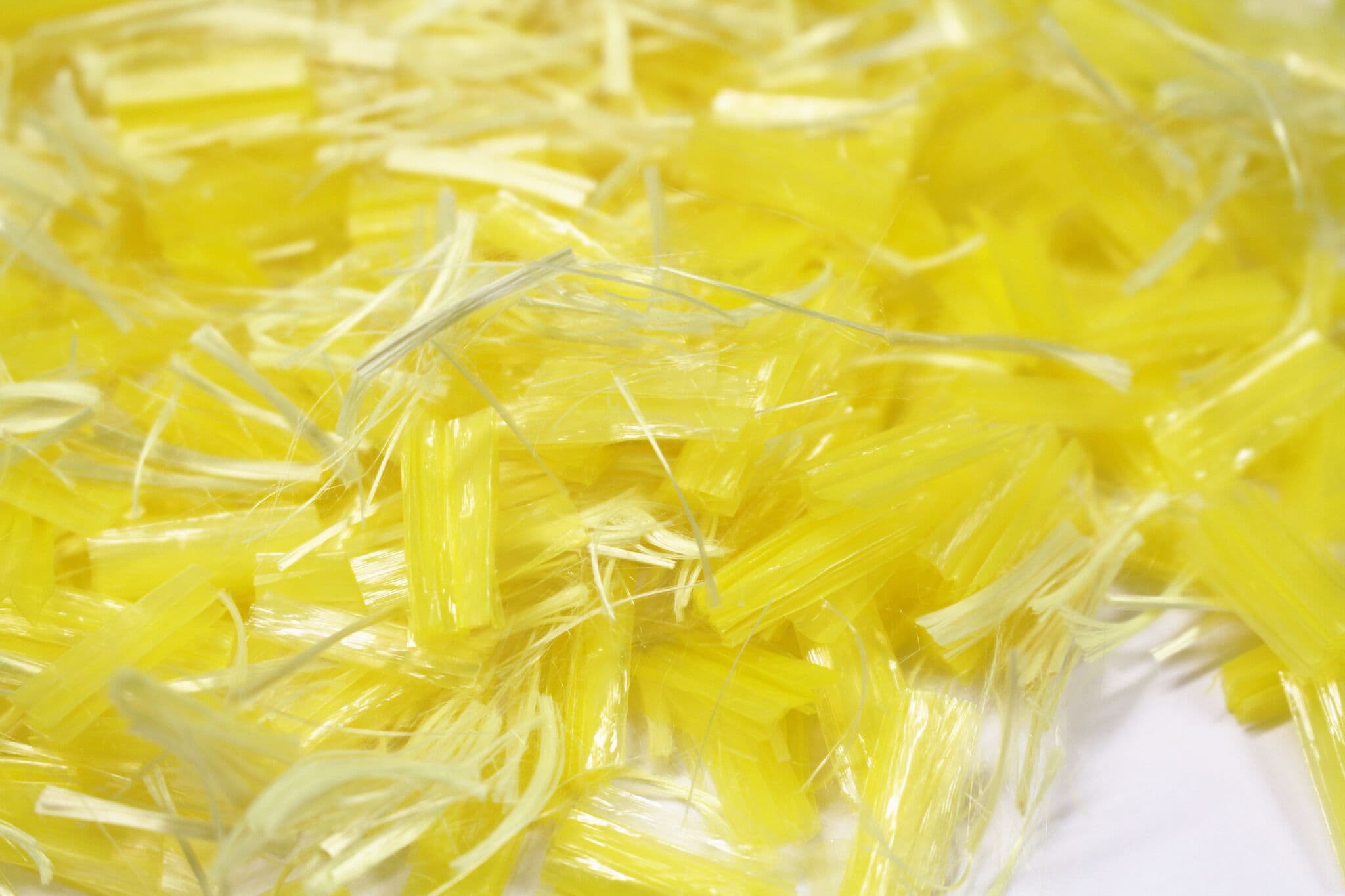
AsphaltX®
2000 filaments per aramid strand — 19 million fibres per tonne of asphalt. Lowest CO₂ footprint, European manufacturing, proven on the N337.
- TypeAramid (Twaron®) + polyolefin fibre blend
- Length± 19 mm
- Tensile strengthTwaron 3000 MPa · polyolefin 483 MPa
- Specific gravityTwaron 1.45 · polyolefin 0.91 g/cm³