Steel fibre concrete: applications, dosage and price per m³


Steel fibre concrete replaces meshes and cages with steel fibres in the mix. What it costs per m³, which dosage you need and where it does and does not fit.
Steel fibre concrete is concrete to which steel fibres are added during mixing — typically 25 to 50 kg per m³ — which take over the role of reinforcement meshes or cages wholly or in part. The fibres give the concrete flexural tensile strength and ductility in all directions. Indicatively, steel fibre concrete costs €140 to €230 per m³, depending on dosage and fibre type.
What is steel fibre concrete and how does it work?
Concrete is strong in compression but weak in tension: its tensile strength is roughly a tenth of its compressive strength. Traditionally, a structural engineer solves this with reinforcing steel at the locations where tensile stress occurs. Steel fibre concrete takes a different approach: hundreds of thousands of short steel fibres — a 35 mm fibre counts around 14,500 pieces per kg, so at 25 kg/m³ that is already some 360,000 fibres per cubic metre — distribute themselves throughout the entire volume and bridge cracks as soon as they form. The result is a three-dimensionally reinforced material without a separate reinforcement operation.
The performance of a steel fibre is mainly determined by three parameters: the aspect ratio (length-to-diameter ratio), the tensile strength of the steel wire and the anchorage. Modern structural fibres are cold-drawn from high-tensile steel wire and provided with hooked ends that anchor themselves in the cement matrix. When cracking occurs, the hooks deform in a controlled manner, so the concrete retains load-bearing capacity after cracking instead of failing brittly — that post-cracking behaviour (ductility) is exactly what a structural engineer needs in order to be allowed to count fibres as reinforcement.
Structural steel fibres fall under standard EN 14889-1; the post-cracking behaviour of the fibre concrete itself is determined with the bending test to EN 14651. How fibres absorb forces is explained in our article on the mechanism of fibre reinforcement; a broader overview of all fibre types is in the pillar on fibre reinforced concrete.
Tensile strength and performance classes
The tensile strength of steel fibre concrete as a composite depends on concrete quality, dosage and fibre type — so there is no single stand-alone figure for "tensile strength of steel fibre concrete". What is hard fact: the tensile strength of the fibre itself and the performance class of the fibre concrete. As an indication from our own range:
• Standard high-tensile fibre (35/0.55) — tensile strength 1,345 N/mm² ± 7.5%
• Heavy high-tensile fibres (50/0.90 and 60/0.75) — tensile strength 2,100 N/mm² ± 7.5%, performance class 56 and 64 respectively
For comparison: ordinary reinforcing steel B500 has a yield strength of 500 N/mm². High-tensile fibre wire is thus over two to four times as strong, which is necessary because a short fibre has to transfer its force through a limited anchorage surface.
Applications of steel fibre concrete
Steel fibre concrete is the standard choice where high loads and large surfaces come together. The most common applications:
• Industrial floors — point loads from racking and continuous forklift traffic; fibres reinforce corners and edges in particular. See our article on fibre reinforced concrete for industrial floors.
• Foundations and pad footings — floor slabs, yard foundations and foundation beams with limited span.
• Tunnels and sprayed concrete — tunnel segments and tunnel linings are internationally among the largest consumers of steel fibre.
• Precast elements — basement walls, manhole rings and pipes, where eliminating fixing work shortens the production cycle.
• Pavings and yard slabs — loading bays, container terminals and hardstandings with heavy axle loads.
Steel fibre concrete for foundations
For light to medium-weight foundations — yard foundations, foundations for lighting columns and street furniture, pad footings and beams with limited span — steel fibre concrete is often directly applicable as an alternative to meshes or cages. For primarily structural foundations under buildings, traditional reinforcement usually remains (partly) necessary; fibres are there combined with bars for additional crack control. Which foundation types lend themselves to fibre reinforcement is covered in fibre reinforced concrete for foundations. Rule of thumb: the more concentrated the point loads and the larger the tensile zones, the sooner the structural engineer will specify a combination.
Dosage: how much steel fibre per m³?
For steel fibre concrete, a typical dosage of around 0.3 to 1 per cent by volume applies, i.e. roughly 25 to 50 kg/m³. With modern high-tensile fibres with hooked ends, the dosage can sit at the lower end of that range or even below it: our structural steel fibres are dosed at 10 to 35 kg/m³, depending on the calculation. The stronger the wire and the better the anchorage, the fewer kilos are needed for the same performance class.
Three factors determine the final dosage: the intended effect (structural strength requires more than shrinkage crack control), the fibre parameters (a higher aspect ratio performs better per kilo, but mixes less easily) and the mix composition. Overdosing is not a safety margin but a risk: it increases the chance of fibre balling and workability problems. The full guidelines per fibre type are in dosing concrete fibres: practical guidelines.
For structural applications, the structural engineer determines the dosage, in cooperation with the fibre supplier and their design software. So do not simply reckon on "something between 25 and 50" yourself — the performance class from the calculation is decisive.
What does steel fibre concrete cost? Price per m³
The price of steel fibre concrete consists of the base price of ready-mixed concrete plus the fibres and any mix surcharges. Indicative, 2026 price level and depending on project and region:
• Base price ready-mixed concrete — €110 to €165 per m³, depending on strength class and region
• Steel fibres — around €1.10 to €1.85 per kg; at 25–35 kg/m³ that comes to roughly €30 to €65 per m³
• Mix surcharge — sometimes an adjusted consistency is needed to work the fibres in properly; a small premium
• Total — indicatively €140 to €230 per m³ for ready-to-pour steel fibre concrete
The direct premium per m³ tells only half the story, however. The biggest saving lies in scrapping the reinforcement operation: no meshes to deliver, cut, position and fix, a shorter lead time and fewer failure costs from wrongly positioned reinforcement. In practice, the total costs of steel fibre concrete and traditionally reinforced concrete therefore often differ little, while fibre concrete wins on speed. The full cost breakdown — including synthetic fibre — is in what fibre reinforced concrete costs. For a tailored project price, request a quotation.
Steel fibre concrete vs reinforced concrete
The fundamental difference: traditional reinforcement sits exactly where the structural engineer expects tensile stress, steel fibres sit everywhere. That makes fibre concrete strong in applications with distributed, variable or hard-to-predict loading (floors, pavings, precast), and traditional reinforcement indispensable where large tensile forces occur in concentrated form — beams with large spans, columns, moment connections.
• Execution — fibre concrete saves the complete fixing operation; reinforcement requires delivery, positioning and inspection
• Cracking behaviour — fibres control many fine cracks distributed across the surface; reinforcement concentrates crack width limitation around the bars
• Edges and corners — fibres reinforce right up to the edge; with meshes, the cover zone remains unreinforced
• Heavy structures — with high concentrated loads, (additional) traditional reinforcement remains the norm
Steel fibre concrete is therefore not a one-to-one replacement for every reinforced structure; structural work always requires a calculation by the structural engineer. In doubt between steel and synthetic fibres? Read the comparison steel fibres or synthetic macro fibres — synthetic is gaining ground in lighter applications and corrosion-prone environments.
Which steel fibre to choose? Dramix® 3D, 4D and 5D compared
Many specifications prescribe Bekaert Dramix® as a reference. Our steel fibre range can be mirrored one-to-one per performance level to the 3D, 4D and 5D generations, with the same standards basis (EN 14889-1):
• Standard structural — the MPZG HT+ 35/0.55, a Dramix 3D alternative with hooked ends: 35 mm long, tensile strength 1,345 N/mm², around 14,500 fibres per kg. For floors, foundations and general structural work.
• Mid-range — the MPWG HT+ 50/0.90 as an equivalent alternative to Dramix 4D: double hooked ends, tensile strength 2,100 N/mm², performance class 56. For heavily loaded floors, tunnels and precast.
• Top segment — the MPWG HT+ 60/0.75, our heaviest steel fibre as a 5D replacement: aspect ratio 60/0.75, tensile strength 2,100 N/mm², performance class 64. For the highest demands on post-cracking behaviour.
Equivalence is demonstrated through the performance class from the EN 14651 bending test, not through the brand: the structural engineer works with the post-cracking behaviour per dosage. Our advisers supply the corresponding datasheets and design values for your specification.
Pouring, power floating and polishing
Steel fibre concrete is poured and worked like regular concrete: pumping is fine, vibrating too. The fibres are dosed at the ready-mix plant — glued fibre bundles fall apart in the mixer and distribute themselves homogeneously, without balling. That homogeneous distribution is crucial to the structural performance; a good fibre does not sink or float out of the mix.
Power floating and polishing also work extremely well with steel fibre concrete — monolithically finished steel fibre floors are the rule rather than the exception in logistics. Bear two points in mind: close the surface in good time so fibres do not remain standing at the surface, and accept that a polished floor may occasionally show a fibre in the top layer. For aesthetic premium floors where that is unacceptable, a synthetic macro fibre or a thin unreinforced top layer is sometimes chosen. The complete step-by-step plan from preparation to curing is in our guide having fibre reinforced concrete poured.
Drawbacks of steel fibre concrete
An honest picture belongs here — steel fibre concrete also has limitations:
• Rust at the surface — fibres lying at or just below the surface can produce rust spots. Structurally this is almost always harmless (a loose fibre has no continuous corrosion path like a reinforcement bar), but aesthetically it can be a nuisance in exposed concrete.
• Aggressive environments — in chloride- or acid-laden environments (agricultural floors, silage slabs), steel is corrosion-prone; there, synthetic or basalt fibres are usually the better choice.
• No complete replacement in heavy structures — concentrated tensile forces and large spans continue to demand traditional reinforcement; the structural engineer determines the mix.
• Processing requires discipline — wrong dosing or poor mixing leads to balling and thus to weak spots; always work through the ready-mix plant, never by hand into the skip.
• Heavier lifting on site — at 25–50 kg/m³, a truck mixer easily carries 200 to 400 kg of steel; the logistics run through the plant, but small-scale mixing yourself is impractical.
Buying steel fibres for your project
Want to buy steel fibres or fill a specification with a Dramix® reference on an equivalent basis? Our steel fibre range is available per 20 kg bag and covered by EN 14889-1 datasheets and design values per performance class. Send your floor design or specification requirement with your quotation request, and we will calculate the dosage and fibre type — including a comparison with a synthetic alternative if that works out better for your application.
Frequently asked questions
- What does steel fibre concrete cost per m³?
- Indicatively €140 to €230 per m³ (2026 price level, project-dependent): €110–165 for the base ready-mixed concrete plus roughly €30–65 of steel fibres at a dosage of 25–35 kg/m³. In return, the complete reinforcement operation disappears, so total costs are often comparable to traditionally reinforced concrete.
- How many kg of steel fibre go into a m³ of concrete?
- Typical is 25 to 50 kg/m³ (0.3–1 per cent by volume). With high-tensile fibres with hooked ends, the dosage can be lower — our structural fibres are dosed at 10 to 35 kg/m³, depending on the calculation. For structural applications, the structural engineer determines the exact dosage based on the required performance class.
- What are the drawbacks of steel fibre concrete?
- Possible rust spots at the surface (aesthetic, rarely structural), corrosion sensitivity in acid- or chloride-laden environments, and the fact that fibres do not fully replace traditional reinforcement under heavy concentrated loads. Processing also requires discipline: wrong dosing or mixing can cause balling. For corrosion-prone environments, synthetic or basalt fibres are often more suitable.
- Is steel fibre concrete stronger than reinforced concrete?
- Not by definition — it is strong in a different way. Fibres reinforce the entire volume including edges and corners and control cracking distributed across the surface; bars deliver concentrated tensile capacity exactly where the design requires it. For floors and pavings, steel fibre concrete performs excellently; for large spans and heavy point loads, (additional) traditional reinforcement remains necessary, to be determined by the structural engineer.
- Can steel fibre concrete be power-floated or polished?
- Yes. Monolithically finished, power-floated steel fibre floors are standard practice in logistics and industry. Close the surface in good time so fibres do not remain standing upright in the top layer; occasionally a fibre may be visible when polishing. For aesthetic premium floors where that is undesirable, a synthetic macro fibre or a thin top layer can be an alternative.
- Is there an equivalent alternative to Dramix® steel fibres?
- Yes. Equivalence runs through the performance class (EN 14651 bending test) and EN 14889-1, not through the brand. Our MPZG HT+ 35/0.55 mirrors Dramix 3D, the MPWG HT+ 50/0.90 mirrors Dramix 4D (performance class 56) and the MPWG HT+ 60/0.75 mirrors Dramix 5D (performance class 64) — with datasheets and design values for your specification.
Products mentioned
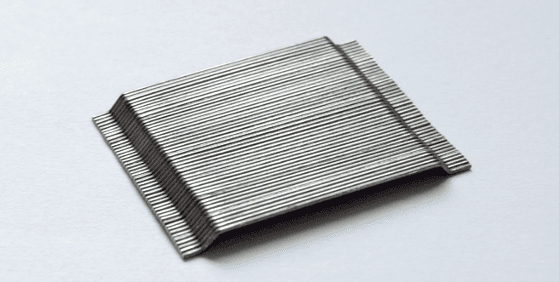
MPZG HT+ 35/0.55
High-tensile hooked steel fibres with aspect ratio 35/0.55. Maximum anchorage and ductility for heavily loaded structures.
- TypeCold-drawn hooked steel fibre (glued)
- Dimensions35 mm / Ø 0.55 mm
- Tensile strength1345 N/mm² ± 7.5%
- Modulus of elasticity200,000 N/mm²
Pallet price on request
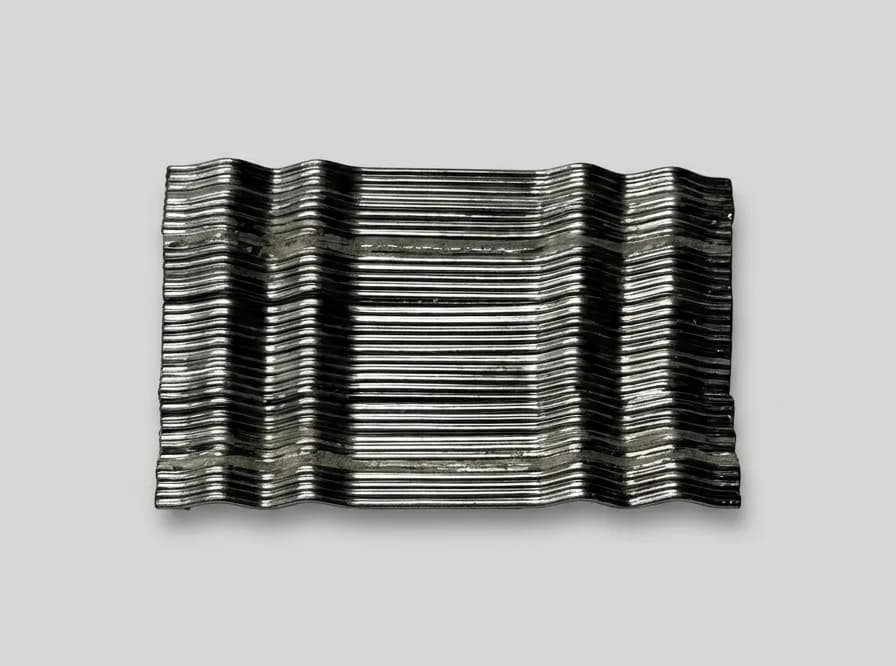
MPWG HT+ 50/0.90
High-tensile hooked steel fibres with aspect ratio 50/0.90. Maximum anchorage and ductility for heavily loaded structures.
- TypeCold-drawn hooked steel fibre (glued)
- Dimensions50 mm / Ø 0.90 mm
- Tensile strength2100 N/mm² ± 7.5%
- Performance class56
Pallet price on request
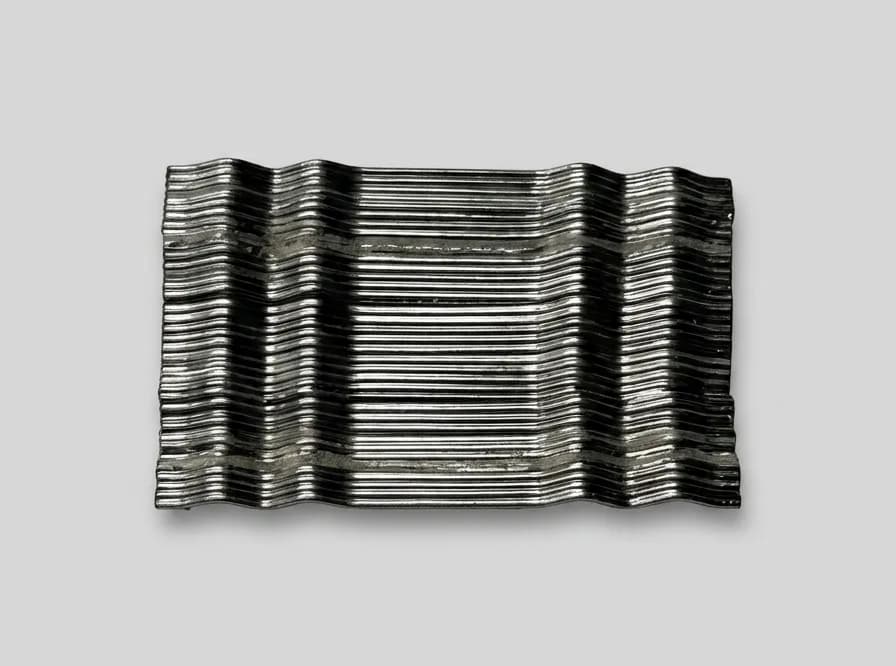
MPWG HT+ 60/0.75
High-tensile hooked steel fibres with aspect ratio 60/0.75. Maximum anchorage and ductility for heavily loaded structures.
- TypeCold-drawn hooked steel fibre (glued)
- Dimensions60 mm / Ø 0.75 mm
- Tensile strength2100 N/mm² ± 7.5%
- Modulus of elasticity210,000 N/mm²
Pallet price on request