Buying concrete fibres: choosing the right fibre reinforcement supplier

Buying concrete fibres is not a matter of price alone: fibre type, dosage advice, certificates and field data differ per supplier. This checklist with seven criteria helps you choose.
Buying concrete fibres is not about the lowest price per kilo: fibre type, dosage and substantiation must match your application. Judge a supplier on technical dosage advice, CE marking to EN 14889, verified environmental data (EPD/NMD) and independent field data. Indicatively, fibre reinforcement adds €12 to €65 per m³ of concrete — including labour, often comparable with or cheaper than reinforcement mesh.
Why the choice of supplier matters
Fibre reinforcement is not a standard product that performs identically everywhere. Performance in the concrete is determined by the combination of fibre type, tensile strength, anchorage and dosage — and it is precisely the advice on these that differs per supplier. The wrong choice leads to insufficient residual strength, processing problems at the ready-mix or asphalt plant, or a dossier that does not stand up to scrutiny by the client and the regulator.
Anyone looking to buy fibres for concrete is, moreover, buying more than a bag of fibres: the dosage per m³, the mixing procedure, the residual strength class for the structural engineer and the environmental substantiation for the tender all come with it. Within the pillar applications and target groups, this is the procurement article: below you will first find an overview of the product types, then the checklist for comparing suppliers.
Which concrete fibres can you buy? The product types at a glance
Any serious supplier can map its range onto this classification (dosages indicative, depending on application and residual strength requirement):
• Hybrid macro fibre (synthetic) — structural residual strength at 2-6 kg/m³, completely corrosion-free; a hybrid macro fibre with a twisted structure such as TwistR anchors itself mechanically in the concrete matrix and often replaces the reinforcement mesh in floors and foundations.
• High-tensile steel fibre — 25-50 kg/m³, tensile strengths from 1,345 to 2,100 N/mm²; with hooked ends (such as the MPZG HT+ 35/0.55) for heavily and dynamically loaded floors and foundations.
• Corrugated basalt fibre — mineral, light (~2.7 g/cm³) and heat-resistant up to ~700°C; the 3D wave profile of the Basalt Wave delivers the anchorage that straight mineral fibres lack. Note: basalt is not fully alkali-resistant — the coating determines its durability in the concrete matrix.
• Fibrillated micro fibre — mesh-shaped PP fibre (ProFib) for sand-cement screeds and chape; monofilament micro fibres (Promicro) are dosed at 0.5-1.8 kg/m³ against plastic shrinkage cracking.
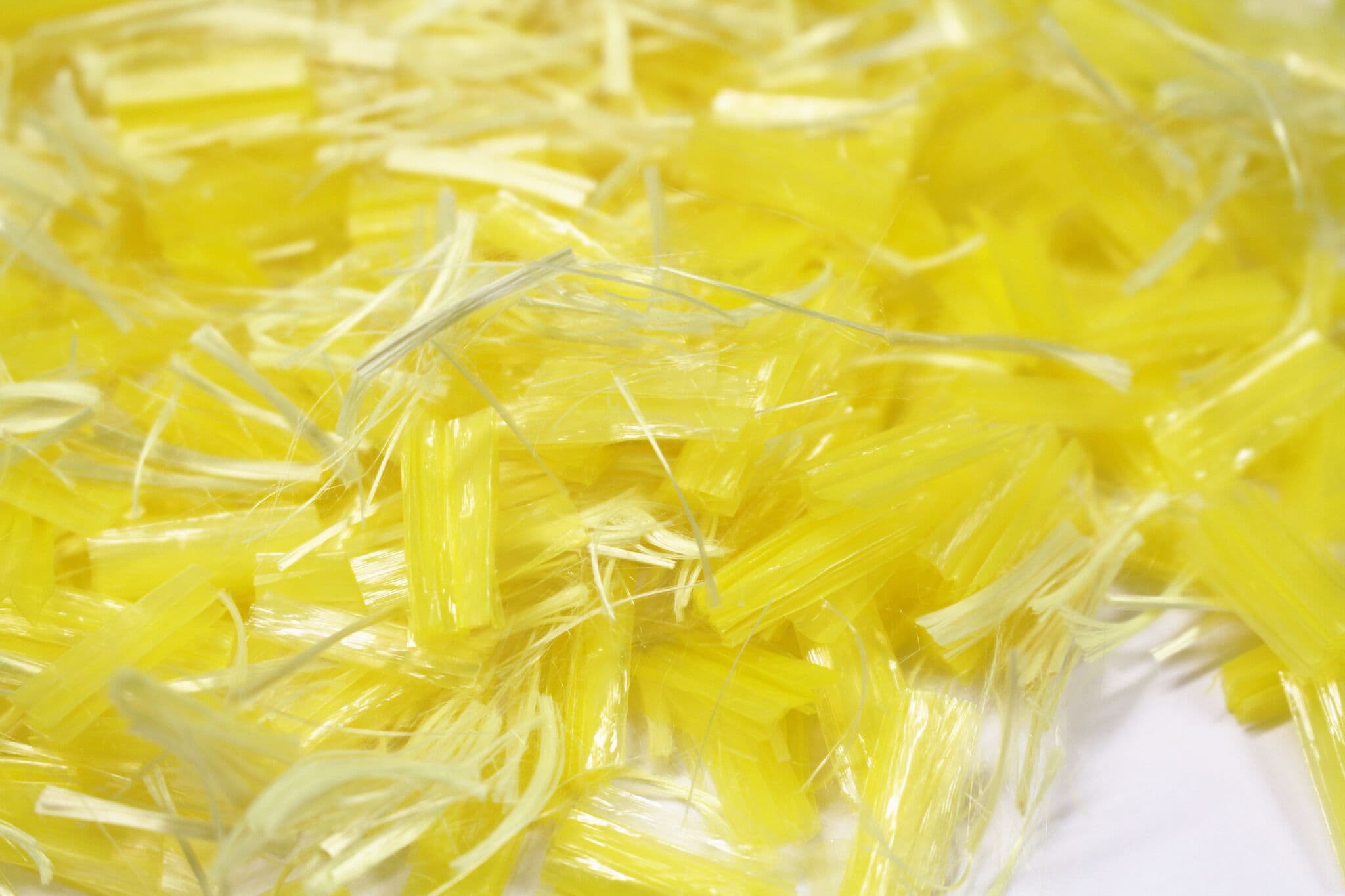
• Aramid asphalt fibre — for the asphalt line: AsphaltX with Twaron aramid, dosed at around 500 grams per tonne of asphalt (~0.05%, depending on mix and application).
Which type suits which loading is covered in the overview article types of concrete fibres compared; below, the question is whom you buy from.
Checklist: what to look for in a fibre reinforcement supplier
Seven criteria for comparing suppliers side by side — with, for each point, the evidence you can request:
• Technical dosage advice. A good supplier substantiates dosage and fibre type on the basis of loading, environment and required residual strength — not a sales pitch, but a calculation. Test the advice against the ranges in the practical dosage guidelines per fibre type; a supplier who quotes the same dosage for every application gives themselves away.
• Experience with your specific application. Ask for reference projects that resemble your situation. Experience with porous asphalt on trunk roads says little about agricultural floors; specific cases such as the N337 (50% less rutting with aramid fibres) or the NDSM wharf (98% CO₂ reduction on the reinforcement through macro fibres) are verifiable.
• Independent research and field data. Check whether the fibre has been examined in published, independent research rather than supplier claims alone — for asphalt fibres, for instance, the European CEDR FIBRA project, which documented both production and performance with field trials on the A73.
• Certification and environmental declarations. CE marking to EN 14889-1 (steel) or EN 14889-2 (polymer) is the precondition for including fibre performance in a structural calculation. Additionally, choose a supplier with its own EPDs and datasheets, stating the NMD category; exactly which documents to request is covered in our certificates article, and the documents themselves are on the certificates page.
• Environmental approval (asphalt). An asphalt plant may only process an additive without additional leaching tests if it is on the OPWA list (BRL 9320/NL BSB). Request the listing and the maximum applicable percentage — for AsphaltX that is 0.1%, well above the recommended dosage.
• Availability and lead time. For larger projects, it matters whether the supplier has sufficient stock and delivery capacity to supply without delay, and whether delivery can be integrated directly with the ready-mix plant — including pre-weighed packaging per m³ or per tonne.
• Support with structural substantiation. Fibres do not always fully replace traditional reinforcement; structural work requires a calculation by the structural engineer based on the EN 14651 residual strength classes. A supplier who works with structural engineers or refers you to them does not spare you that step — but does make it demonstrably watertight.
What do concrete fibres cost?
What do concrete fibres cost in practice? Do not calculate per bag, but per m³ of concrete or per tonne of asphalt — that is the figure you compare with reinforcement mesh or PMB (all figures indicative, 2026 price level, depending on dosage, fibre type and project):
• Steel fibre (10-35 kg/m³) — indicative premium of €12-€65 per m³ of concrete; the steel fibre price per kg and per m³ is broken down by dosage in a separate article.
• Synthetic macro fibre (2-6 kg/m³) — indicative premium of €15-€45 per m³.
• PP micro fibre (0.6-1.0 kg/m³) — a few euros per m³.
• Aramid asphalt fibre (~500 g/tonne) — a limited extra cost per tonne of asphalt; the FIBRA research shows that in the Dutch situation aramid fibres can be cost-neutral compared with PMB.
So never compare quotations on price per kilo alone: a fibre with a higher kilo price but better anchorage can achieve the same residual strength at a lower dosage — and then the more expensive fibre wins at m³ level. When replacing mesh, also count the saved labour and steel fixing. The complete concrete price per m³ with and without fibres, including the base concrete per strength class, is in our price overview.
Questions to ask a prospective supplier
• Which fibre types and brands do you supply, and which applications are they best suited to?
• Can you name reference projects comparable to my situation?
• Which quality certification (CE to EN 14889) and environmental declarations (EPD, NMD category) are available?
• Do you offer free advice on dosage and processing, substantiated with tested residual strength values?
• Can you help with the substantiation for a tender or sustainability report (MKI, CO₂)?
• Do you work with structural engineers for structural applications?
The answers should be in writing and verifiable: datasheets, certificates and project references. A supplier who talks their way around them is thereby giving you the answer.
Buying fibres in Belgium: chape and ATG
Two points of emphasis apply to the Belgian market. Anyone in Flanders ordering fibres for chape is technically asking for exactly the same thing as the Dutch screed fibre: a fibrillated or monofilament micro fibre against shrinkage cracks in the sand-cement screed — the same dosages and drying times, just a different name. In addition, alongside CE marking, an ATG approval is often requested in Belgium; check with your supplier whether it is available for the chosen fibre type. Dutch Fiber Trading supplies the same fibres to Dutch and Belgian contractors and chape installers alike.
Why a specialised Dutch supplier?
Alongside international manufacturers, there are specialised suppliers in the Netherlands who carry both synthetic concrete fibres and aramid fibres for asphalt, with knowledge of the Dutch standards and calculation practice, local ready-mix and asphalt plants, and documented field projects such as the A73 and the N711. You notice that difference above all when things get tense: in the dosage discussion with the plant, the residual strength substantiation for the structural engineer or the MKI calculation in a tender. Dosage advice from a Dutch fibre specialist is then not an extra, but the core of what you are buying.
Ordering concrete fibres: how to go about it
First determine your application and loading, and have the supplier substantiate a fibre type and dosage for it — or explore the direction yourself with the product-type overview above. If you work through a ready-mix plant, include the fibre specification in your order; the plant doses the fibres into the mixer. Contractors and traders will find the current sales points on the dealer page.
Want to compare suppliers in concrete terms? Request a comparative quotation with your application, area or tonnage and required performance, or get in touch for free dosage advice — including the datasheets, EPDs and reference projects from the checklist above.
Sources
• Van den Braembussche, "Vezelversterkt beton" (ATG approval)
• CEDR FIBRA project, Deliverables 5.1 and 6.2, 2021
• Dutch Fiber Trading (dutchfibertrading.com)
Frequently asked questions
- Where can you buy concrete fibres?
- You buy concrete fibres from specialised fibre suppliers, through the ready-mix plant (which doses the fibres into the mixer to specification) or through builders' merchants and dealers. For structural applications, choose a supplier who delivers CE-marked fibres (EN 14889) with datasheets, tested residual strength values and dosage advice. The current sales points of Dutch Fiber Trading are on the dealer page.
- What do concrete fibres cost per m³ of concrete?
- Indicatively (2026 price level, depending on dosage and project): steel fibre €12-€65 premium per m³ of concrete, synthetic macro fibre €15-€45 per m³ and PP micro fibre a few euros per m³. Including the saved labour and steel fixing, fibre reinforced concrete is often comparable with or cheaper than concrete with reinforcement mesh. Always compare on price per m³ at equal residual strength, not on price per kilo.
- Which documents should you request when buying concrete fibres?
- Four kinds: CE marking to EN 14889-1 (steel fibres) or EN 14889-2 (polymer fibres), a datasheet with tested residual strength values (EN 14651), an environmental declaration (EPD) with NMD category for MKI and CO₂ substantiation, and for asphalt additives the OPWA listing (BRL 9320/NL BSB). See the certificates checklist for fibre materials for the full explanation per document type.
- Can you also order fibres directly through the ready-mix plant?
- Yes. In practice you usually order fibre reinforced concrete as a single product from the ready-mix plant: you specify fibre type and dosage (or the required residual strength class) and the plant doses the fibres during mixing. The fibre supplier then delivers directly to the plant, in packaging matched to the m³ dosage. How that works is explained in fibres at the ready-mix plant.
- Are fibres for chape also available in Belgium?
- Yes. Chape is the Flemish name for the sand-cement screed; the fibres for it are identical to Dutch screed fibres: fibrillated or monofilament PP micro fibres against shrinkage cracks, dosed at around 0.5-1.8 kg/m³. In Belgium, check whether an ATG approval is available alongside the CE marking. Dutch Fiber Trading supplies the same fibres to Belgian chape installers and screed layers.
Share this article
Products mentioned
 Most chosen
TwistR® GREEN HYBRID
High-performance synthetic macro fibres made from 100% polypropylene. Transforms concrete into a stronger composite material.
- TypeHybrid: twisted monofilament + fibrillating network fibre
- Material100% virgin polypropylene
- Length48 mm
- Dosage2.0 – 6.0 kg/m³
Pallet price on request
AsphaltX®
2000 filaments per aramid strand — 19 million fibres per tonne of asphalt. Lowest CO₂ footprint, European manufacturing, proven on the N337.
- TypeAramid (Twaron®) + polyolefin fibre blend
- Length± 19 mm
- Tensile strengthTwaron 3000 MPa · polyolefin 483 MPa
- Specific gravityTwaron 1.45 · polyolefin 0.91 g/cm³