Reinforcement mesh: sizes, weights, prices and the fibre alternative

Which reinforcement mesh suits your floor or foundation? The standard sheet sizes, wire gauges, mesh openings and weights at a glance — and when fibre reinforcement makes the mesh redundant.
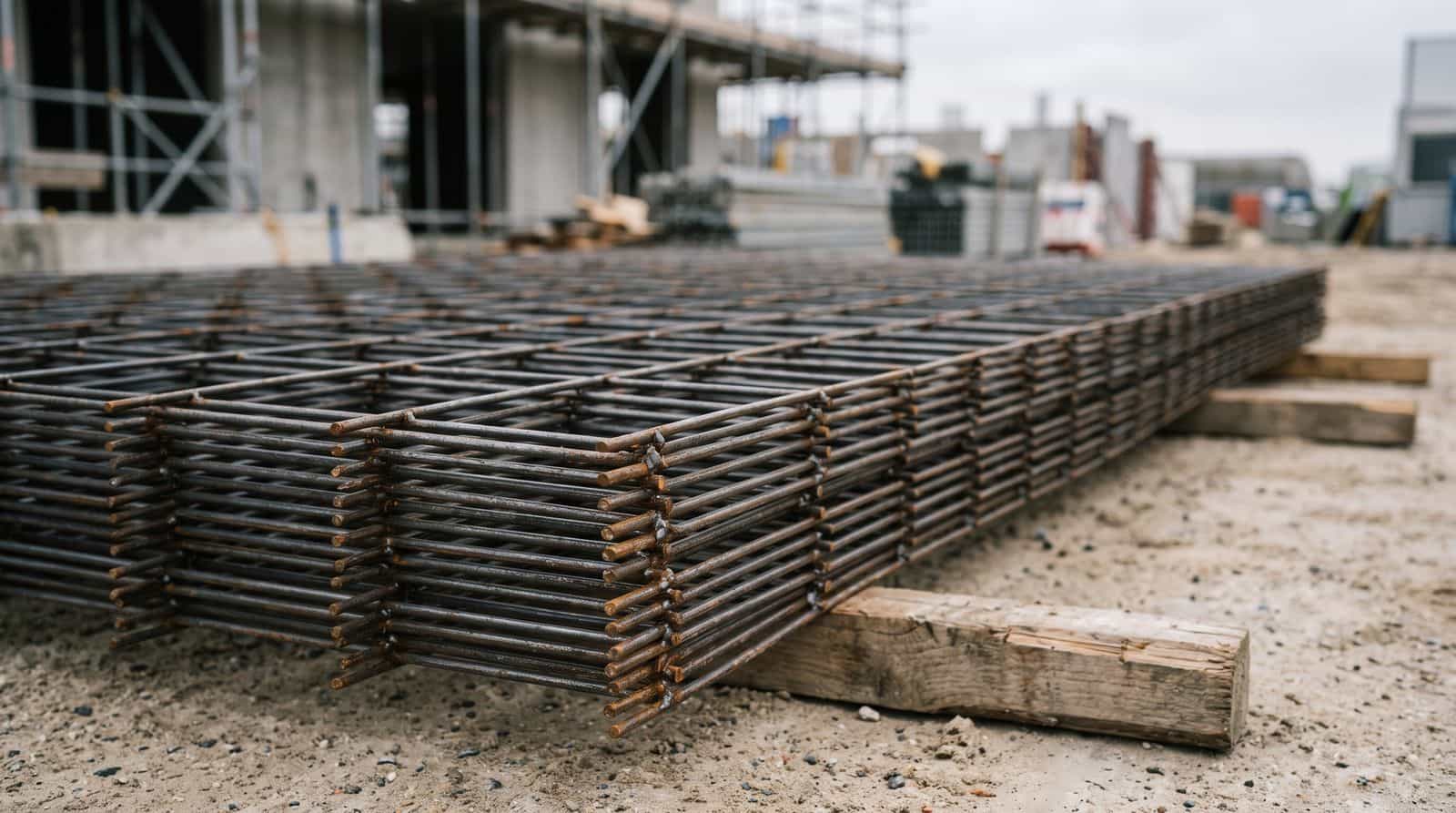
Reinforcement mesh (in the Netherlands known as bouwstaalmatten, wapeningsnetten or betongaas) consists of spot-welded sheets of reinforcing steel for reinforcing floors and foundations. The standard sheet size is 300 × 200 cm (6 m²), with wire gauges of 4 to 12 mm and mesh openings of 100 to 200 mm. The weight runs from around 12 to 71 kg per sheet.
What exactly is reinforcement mesh?
A reinforcement mesh sheet consists of longitudinal and transverse wires of reinforcing steel that are machine-welded together at the intersections. The result is a dimensionally stable mesh that absorbs tensile stress in concrete as soon as the concrete cracks — exactly where concrete itself is weak. In the Netherlands, the wires are usually supplied in steel grade B500A to NEN-EN 10080; in Belgium the terms B-mesh or BE 500 S are common.
The terms are used interchangeably in practice: bouwstaalmat, wapeningsnet, betongaas and (for the standard series) PS mesh all refer to the same product. In the PS designation, the number stands for the steel cross-section in mm² per linear metre: a PS 188, for example, is a mesh with 6 mm wires at a 150 × 150 mm opening, a PS 335 has 8 mm wires at the same opening.
Reinforcement mesh is one of the two main routes for reinforcing a concrete floor. The other route is fibre reinforcement that is distributed through the concrete during mixing — more on that below, because for many floors it is now the faster alternative.
Standard sizes of reinforcement mesh
The usual trade size is 300 × 200 cm: a 6 m² sheet that can still be lifted by two people and transported in a van or on a trailer. In addition, there are non-standard sheet sizes and made-to-measure meshes for project supply.
• Standard size — 300 × 200 cm (6 m²), the size that builders' merchants and DIY stores keep in stock as standard.
• Smaller trade sizes — including 200 × 100 cm and 250 × 200 cm, handy for renovation or restricted access.
• Project sizes — up to around 600 × 240 cm, to order via the reinforcement supplier, including meshes with starter bars for connecting reinforcement.
• Mesh openings — 50 × 50, 100 × 100, 150 × 150 and 200 × 200 mm are the common grids; 150 × 150 mm is the standard for floors.
• Wire gauges — 4, 5, 6, 8, 10 and 12 mm; galvanised versions are mainly available in the thinner diameters for garden and interior applications.
When ordering, pay attention to the combination of wire gauge and mesh opening: a 6 mm mesh with a 100 × 100 mm opening contains considerably more steel per metre than the same wire at 150 × 150 mm, and thus delivers a higher reinforcement cross-section.
Weight of reinforcement mesh per m² and per sheet
The weight of a reinforcement mesh follows directly from the wire gauge and the mesh opening. As a rule of thumb: the weight per m² is twice the metre weight of the wire multiplied by the number of wires per metre. Reinforcing steel weighs around 0.222 kg/m at 6 mm, 0.395 kg/m at 8 mm and 0.617 kg/m at 10 mm.
Indicative weights at a 150 × 150 mm mesh opening (per m² and per standard 300 × 200 cm sheet):
• 5 mm (PS 131) — approx. 2.1 kg/m² · approx. 12.5 kg per sheet
• 6 mm (PS 188) — approx. 3.0 kg/m² · approx. 18 kg per sheet
• 8 mm (PS 335) — approx. 5.3 kg/m² · approx. 32 kg per sheet
• 10 mm (PS 524) — approx. 8.2 kg/m² · approx. 49 kg per sheet
• 12 mm (PS 754) — approx. 11.8 kg/m² · approx. 71 kg per sheet
At a 100 × 100 mm opening, the weight is around half as much again; a 4 mm mesh at 100 × 100 mm weighs about 2.0 kg/m², i.e. around 12 kg per standard sheet. These weights matter for transport and lifting, but also for crane planning: a bundle of fifty 8 mm sheets already weighs well over 1,500 kg.
Which reinforcement mesh for which application?
• Screeds and thin renovation floors — 4 or 5 mm at a 100 × 100 mm opening, mainly as anti-crack mesh; with underfloor heating in a screed, the mesh often doubles as a fixing grid for the pipes.
• Patios, paths and light floors — 6 mm reinforcement mesh at 150 × 150 mm: the best-selling type for housebuilding and self-build.
• Garage floors, shed floors and strip foundations — 8 mm mesh at 150 × 150 mm, the standard choice as soon as car traffic or point loads reach the floor.
• Industrial floors and more heavily loaded slabs — 10 or 12 mm, often in two layers (double reinforcement meshes) and always based on a calculation by the structural engineer.
For most of these floor applications there is, incidentally, a mesh-free variant: for floors without heavy concentrated structural requirements, a structural macro fibre such as TwistR as a reinforcement mesh alternative without fixing work can replace the mesh, at dosages of 2 to 6 kg per m³ of concrete. When in doubt: have the comparison calculated, fibres do not fully replace traditional reinforcement in every situation.
Laying, connecting and fixing reinforcement mesh
A reinforcement mesh only works if it sits at the correct height in the concrete cross-section. For this, the mesh is placed on spacers (supports), so there is sufficient concrete cover below and above the steel — for exterior applications usually at least 30 mm of cover. A mesh lying flat on the subgrade that is not lifted during pouring does virtually nothing structurally: wrongly positioned reinforcement is a classic source of failure costs.
When connecting multiple sheets, the rule of thumb is an overlap of at least one to two mesh openings — at a 150 × 150 mm opening, about 30 cm. The overlapping sheets are tied together with tying wire or special connecting clips, so the whole assembly does not shift during pouring. This manual connecting is still colloquially called fixing (in Dutch: vlechten), even though with mesh sheets it is a matter of connecting rather than the traditional bar-fixing with loose bars.
Allow a serious labour item for laying, connecting and checking: delivery, cutting to size around penetrations and recesses, positioning, tying and the reinforcement inspection before pouring together make up a complete extra operation that disappears with fibre concrete.
What does reinforcement mesh cost?
Prices of reinforcement mesh follow the steel price and differ per purchase volume and supplier. Indicative, 2026 price level, depending on project and market price of steel:
• Reinforcement mesh 6 mm, 300 × 200 cm — around €25 to €45 per sheet (€4 to €8 per m²).
• Reinforcement mesh 8 mm, 300 × 200 cm — around €45 to €75 per sheet (€8 to €13 per m²).
• Galvanised or made-to-measure meshes — a surcharge of tens of per cent over untreated standard format.
Cheap reinforcement mesh from the DIY store looks attractive per sheet, but the sheet price is only part of the story. For a fair comparison, also count spacers, tying wire, cutting waste, transport and above all the labour hours for laying. Practice shows that the total costs of mesh reinforcement and fibre reinforcement often differ little, while the fibre route scraps the separate reinforcement operation and the associated planning.
When can you replace the reinforcement mesh with fibre reinforcement?
For many floors, the reinforcement mesh is no longer a given. Structural fibres are mixed through the concrete at the ready-mix plant and come out of the mixer ready to use: no delivery of sheets, no spacers, no connecting work and no risk of a mesh lying on the bottom of the pour. More background on this trade-off can be found in our overview of fibre reinforced concrete.
Fibre reinforcement is usually a good alternative for:
• Floors on a stable, load-bearing subgrade — garage, shed, barn and industrial floors, yard paving and cycle paths.
• Screeds and underfloor heating floors — where crack control is the goal and a fine mesh is mainly shrinkage reinforcement.
• Projects under time pressure or with limited labour capacity — the reinforcement operation disappears completely.
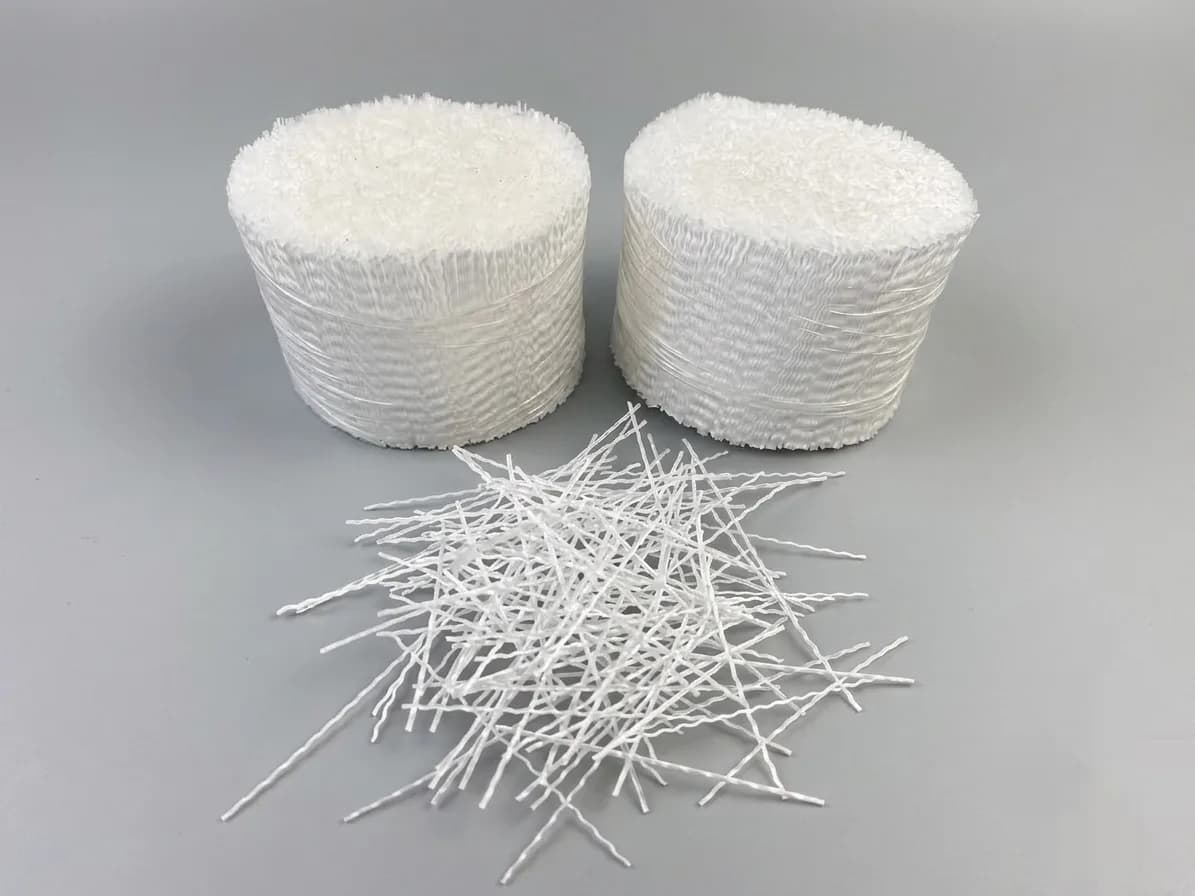
The reinforcement mesh remains the designated route for primarily structural elements with a dedicated reinforcement calculation (beams, columns, heavily loaded foundations), on soft or expansive ground where the mesh keeps both sides of a crack on the same plane, and wherever the specification explicitly prescribes mesh reinforcement. In those cases, a hybrid solution — less or lighter mesh plus fibres for crack control — can still deliver gains; for rough agricultural floors, for example, the polyolefin macro fibre Wiking 4050 TR (EN 14889-2, class II) is a proven choice.
Want to know what this means for your project? Calculate the difference per m³ with the calculator or request a quotation with dosage advice — you will then receive the comparison between mesh reinforcement and fibre reinforcement for your specific floor.
Frequently asked questions
- What is the standard size of a reinforcement mesh sheet?
- The standard size of a reinforcement mesh sheet is 300 × 200 cm, i.e. 6 m² per sheet. In addition, there are smaller trade sizes such as 200 × 100 cm and project sizes up to around 600 × 240 cm. The common mesh openings are 100 × 100 and 150 × 150 mm, with wire gauges from 4 to 12 mm.
- How much does an 8 mm reinforcement mesh sheet weigh?
- An 8 mm reinforcement mesh with a 150 × 150 mm opening weighs around 5.3 kg/m². A standard 300 × 200 cm sheet (6 m²) therefore comes to about 32 kg. For comparison: a 6 mm sheet weighs around 18 kg, a 10 mm sheet around 49 kg per sheet.
- How much overlap should reinforcement mesh sheets have when connecting?
- When connecting reinforcement mesh sheets, allow an overlap of at least one to two mesh openings — with a 150 × 150 mm opening, that is about 30 cm. Tie the overlapping sheets together with tying wire or connecting clips and place the whole assembly on spacers, so the reinforcement stays at height during pouring.
- Do I need reinforcement mesh with underfloor heating?
- Not by definition. In screeds with underfloor heating, a fine mesh mainly serves as shrinkage reinforcement and a fixing grid; crack control can also be handled with fibre reinforcement. For floating screeds thinner than 65 mm, a combination of mesh and fibres is recommended; on a firm insulation layer, fibres alone often suffice.
- Can fibre concrete fully replace reinforcement mesh?
- In many floor applications, yes: structural macro fibres at dosages of 2 to 6 kg/m³ replace the mesh in floors on a load-bearing subgrade, from garage floor to industrial floor. For primarily structural elements with a dedicated reinforcement calculation, (additional) traditional reinforcement remains necessary — always have this calculated by a structural engineer.
Products mentioned
 Most chosen
TwistR® GREEN HYBRID
High-performance synthetic macro fibres made from 100% polypropylene. Transforms concrete into a stronger composite material.
- TypeHybrid: twisted monofilament + fibrillating network fibre
- Material100% virgin polypropylene
- Length48 mm
- Dosage2.0 – 6.0 kg/m³
Pallet price on request
Wiking 4050 TR
High-performance polyolefin macro fibre, ideally suited to rough floors — a strong and cost-effective alternative to steel reinforcement.
- TypePolyolefin macro fibre (monofilament)
- Length48 mm
- Diameter700 µm
- Tensile strength557 MPa
Pallet price on request