Environmental certification of fibre materials: what to request

Anyone citing fibre reinforcement in a tender or sustainability report will encounter certification. A request checklist per document type: what it is, who issues it and when it is mandatory.
When procuring fibre reinforcement (steel, synthetic or asphalt fibres), you request four types of documents: product certification (CE marking to EN 14889, supplemented for the Belgian market by an ATG approval), an environmental declaration (EPD) stating the NMD category, environmental clearance for asphalt additives (the OPWA list, BRL 9320/NL BSB) and the normative design basis such as fib Bulletin 105. Of these, the verified EPD is the only one that quantifies the environmental impact of the fibre itself, and a category 1 environmental declaration is directly usable in MKI and MPG calculations without any surcharge.
Why you request certificates at the quotation stage
Certificates are not paperwork for the file afterwards; they determine in advance whether a fibre can be used in your project at all. Three examples from practice: a structural engineer may only include fibre performance in the calculation if the fibre is CE marked under the correct conformity system; an asphalt plant may only dose an additive without additional leaching tests if it is on the OPWA list; and in an MKI-driven tender, an environmental claim only counts if a verified environmental declaration sits behind it.
Anyone who requests the documents only after award discovers the gaps at the moment when switching products is expensive. This article therefore walks through four questions per document type: what is it, who issues it, when is it mandatory and what exactly do you ask your supplier? The underlying standards are covered in detail in the articles of our pillar sustainability, standards and innovation.
The document types at a glance
• CE marking (EN 14889) — legally mandatory product conformity for concrete fibres; issued on the basis of testing by a notified body.
• ATG approval — voluntary Belgian technical approval attesting fitness for the application; relevant for projects in Belgium.
• EPD / environmental declaration — verified environmental data per product life cycle; needed for MKI, MPG and CO₂ substantiation.
• NMD inclusion (category 1, 2 or 3) — determines how the environmental data count in Dutch calculation instruments.
• OPWA list (BRL 9320 / NL BSB) — environmental clearance for asphalt additives.
• Design standards (fib Bulletin 105, CUR Recommendation 111, EN 14651) — not a certificate, but the calculation basis the supervisory authority will ask for.
CE marking to EN 14889: the legal basis
What is it? EN 14889 is the European product standard for fibres in concrete: part 1 for steel fibres, part 2 for polymer fibres. The resulting CE marking declares that the stated properties — tensile strength, length, slenderness and the effect on residual flexural tensile strength according to the EN 14651 beam test — have been determined and checked according to the standard.
Who issues it and when is it mandatory? The manufacturer applies the marking on the basis of testing and oversight by a notified body. For structural applications, the more demanding conformity system 1 with continuous external production control applies; for non-structural use, system 3 suffices. CE marking is mandatory for every fibre placed on the EU market as concrete reinforcement. How the class system and the conformity systems work in detail is explained in our article on EN 14889 and CE marking for fibre concrete.
Example question for your supplier: supply the Declaration of Performance (DoP) stating the conformity system and the declared residual flexural tensile strength at the intended dosage.
ATG approval: technical approval for the Belgian market
What is it? An ATG approval (Technische Goedkeuring / Agrément Technique) is a voluntary attestation-with-certificate from the Belgian approval system. Where CE marking only declares that properties have been measured according to the standard, an ATG also pronounces on the fitness of the product for a defined application — for reinforcement fibres, that means tensile strength, dimensions and bond behaviour in the intended concrete application, including continuous factory control.
Who issues it and when is it relevant? ATGs are issued within the Belgian Union for technical approval in construction (UBAtc/BUtgb) and are typically valid for five years, with interim checks. An ATG is never mandatory, but Belgian clients and engineering consultancies regularly request one in specifications — so for contractors who also work across the border, this is no edge case. In the Netherlands, the combination of CE marking (system 1) with an assessment to CUR Recommendation 111 fulfils a comparable role.
Example question for your supplier: is there a valid ATG or equivalent technical approval for this fibre, and if not, what substantiation will the engineering consultancy accept as an alternative?
EPD and environmental declaration: the environmental data behind your claim
For every sustainability claim in a tender — MKI, MPG or CO₂ reduction — the environmental declaration is the source document. For EPDs for construction materials, a fixed chain applies: a life cycle assessment supplies the data, the EPD records them in verified form and the National Environmental Database makes them usable in calculation instruments.
What is an EPD (Environmental Product Declaration)?
An Environmental Product Declaration is a standardised environmental profile of a product across its life cycle, drawn up to EN 15804+A2 and ISO 14025. The declaration reports, per life stage (modules A1-A3 production, A4-A5 construction, B use, C demolition and D reuse), scores on nineteen environmental impact categories, including climate change, acidification and resource depletion. An independent, recognised verifier checks the underlying calculation; the EPD is then typically valid for five years, or less if the recipe or production process changes materially.
Always request the EPD of the fibre product itself, not just of the final mix. Only then can your concrete technologist or asphalt plant calculate the fibre's effect on the environmental profile of the complete mix. For our macro fibre TwistR, an EPD to EN 15804+A2 is available (ISO 14025 / ISO 21930), which makes the up to 98% CO₂ reduction compared with traditional steel reinforcement traceable rather than a brochure claim.
Category 1, 2 and 3 in the National Environmental Database
The National Environmental Database (NMD) is the Dutch source from which calculation tools such as DuboCalc and MPG software draw their product cards. The category determines the weight of the data:
• Category 1 — brand-specific environmental declaration, checked by a recognised verifier. Highest certainty, counts without any surcharge.
• Category 2 — brand-independent (industry-average) data, likewise verified. Usable, but not differentiating for your specific product.
• Category 3 — unverified, generic data. These receive a 30% surcharge on the environmental scores — a direct penalty on your MKI or MPG outcome.
For a bid in which environmental performance carries weight, a category 1 environmental declaration is therefore not a formality but a calculation advantage: the same product scores 30% worse with category 3 data than with verified own data. So ask not only whether a product is in the NMD, but in which category and under which card name.
Example question for your supplier: in which NMD category is the product included, what is the expiry date of the declaration and may we see the verification report?
NIBE environmental database and other classifications
Alongside the NMD, you will encounter the NIBE environmental database in specifications and sustainability reports: an independent classification that ranks construction products per application into environmental classes (from 1a, best choice, to 7c). NIBE is based on the same LCA methodology, but it is a comparison instrument, not an official calculation source: for an MPG or MKI calculation, only the NMD card counts. Useful as a quick comparison between product alternatives, not as a substitute for a category 1 declaration.
How does an LCA calculation work?
Every EPD and every MKI value starts with an LCA calculation (life cycle assessment). It proceeds in four steps according to ISO 14040/14044 and, for Dutch construction, the Assessment Method for the Environmental Performance of Construction Works:
• Step 1: goal and scope — which product, which functional unit (for example 1 kg of fibre or 1 m³ of fibre concrete) and which life stages (cradle-to-gate or cradle-to-grave).
• Step 2: inventory — mapping all raw materials, energy, transport and emissions per stage.
• Step 3: impact assessment — the inventory translated into the nineteen environmental impact categories of EN 15804+A2.
• Step 4: interpretation and reporting — the basis for the EPD and, after weighting in euros (each kg of CO₂ equivalent counts for € 0.05, for example), the MKI value.
When comparing LCA results, always check the functional unit and scope: a cradle-to-gate figure per kilogram of fibre says little as long as it has not been converted to the complete mix per m³ or per tonne over the service life. How that MKI value then yields a notional discount on your bid price in DuboCalc is explained in the article MKI and DuboCalc for fibre reinforcement.
Steel fibres: which environmental certification applies?
The same logic applies to steel fibres, but the documents are often confused. CE marking to EN 14889-1 is product conformity, not an environmental claim. Strictly speaking, what counts as environmental certification of steel fibres is not a certificate but a verified EPD to EN 15804+A2. Since the A2 amendment, such an EPD in principle covers not only production (modules A1-A3) but also end of life (modules C1-C4) and module D, the credit for recycling the steel; the standard permits a cradle-to-gate-only declaration under specific conditions only. What to check per document:
• EPD (EN 15804+A2, ISO 14025): the only document that quantifies the footprint of the fibre itself. Check the verifier, the expiry date, the modules declared and whether the declared product matches the fibre type, length and diameter you will actually be supplied.
• Steel production route: the footprint of the wire depends heavily on whether it is made from scrap-based electric arc furnace steel or via the blast furnace route. A good EPD states this; a recycled-content percentage without a verified EPD behind it is not a calculation input.
• ISO 14001: certifies the environmental management system of the production site, not the product. It is a useful supplier criterion, but it supplies no figures for an MKI, MPG or embodied carbon calculation.
• BREEAM and LEED: both rating schemes reward verified EPDs in their materials credits, with product-specific EPDs valued above industry-average ones, so request the EPD early if the project is being assessed.
Compare steel and synthetic fibres per m³ at equal performance, never per kilogram. Our hooked steel fibres such as MPWG HT+ 50/0.90 fall under EN 14889-1 and are dosed at 10 to 35 kg/m³, whereas a synthetic macro fibre such as TwistR is dosed at 2.0 to 6.0 kg/m³. A per-kilogram EPD figure only becomes meaningful once it has been multiplied by the dosage that achieves the residual flexural tensile strength class your structural engineer requires. Which of the two suits your application is covered in steel fibres or synthetic macro fibres.
Example question for your steel fibre supplier: is there a verified EPD to EN 15804+A2 for exactly this fibre type, which modules does it cover and which steel production route is behind the stated figures?
Asphalt: the OPWA list, BRL 9320 and the PCR Asfalt
For asphalt additives, an environmental-clearance layer comes on top. Additives must be on the OPWA list to be dosed without additional leaching tests under an NL BSB® certificate (BRL 9320) held by the asphalt plant. Our asphalt fibre AsphaltX is on the OPWA list with a maximum applicable percentage of 0.1% — well above the recommended dosage of around 500 grams per tonne (0.05%, depending on mix and application). The full system is described in our article on the OPWA list and BRL 9320.
For the environmental performance of asphalt mixes, the PCR Asfalt additionally applies as the product category rule: it lays down how environmental profiles of (fibre reinforced) mixes must be calculated, so that EPDs are mutually comparable. The 2026 update of the PCR Asfalt is the most recent version.
Example question for your supplier: show the OPWA listing with the maximum applicable percentage and confirm that the mix's EPD data have been drawn up to the current PCR Asfalt.
Design standards: fib Bulletin 105 and CUR Recommendation 111
Certificates say what a fibre is; design standards determine what you may do with it. For fibre reinforced concrete in (semi-)structural applications, fib Bulletin 105 forms the international calculation basis, supplemented in the Netherlands by CUR Recommendation 111 as the assessment framework and EN 14651 as the associated test method. Ask your supplier for performance data in the form your structural engineer needs (residual flexural tensile strength classes at specific dosages) — and hold on to the rule that fibres do not always fully replace traditional reinforcement: structural work requires a calculation by the structural engineer.
Quality assurance during processing
One thing appears in no certificate: how the fibre behaves in the mixer of your concrete or asphalt plant. Homogeneous distribution, correct dosing and the absence of balling are practical aspects you can only verify through reference projects of the processing party and a trial mix in advance. The supplier's experience with comparable projects therefore weighs at least as heavily as the certificate itself; what else to look for is covered in choosing the right fibre reinforcement supplier.
Request checklist for your quotation enquiry
Include these six points as standard in your quotation or specification enquiry:
• Declaration of Performance (DoP) with the CE marking to EN 14889, stating the conformity system and the residual flexural tensile strength at the intended dosage.
• ATG approval or equivalent technical approval for structural work in Belgium.
• EPD of the fibre itself (EN 15804+A2), including expiry date and verifier.
• NMD inclusion with category stated — category 1 avoids the 30% surcharge in MKI and MPG calculations.
• For asphalt: OPWA listing (BRL 9320 / NL BSB) with the maximum applicable percentage, plus EPD data to the current PCR Asfalt.
• Reference projects with comparable mixes and the option of a trial mix.
For our own products, the documents are ready on the certificates and datasheets pages; if you would like the complete set for a specific project, we will include it with your quotation.
Frequently asked questions
- What is an ATG approval?
- An ATG approval (Technische Goedkeuring — technical approval) is a voluntary Belgian attestation-with-certificate, issued within the UBAtc/BUtgb and typically valid for five years. Unlike CE marking, which only guarantees measurement methods, an ATG pronounces on the fitness of the product for a defined application, including continuous factory control. Belgian clients regularly request one in specifications; in the Netherlands, CE system 1 and CUR Recommendation 111 fulfil a comparable role.
- Which certificates do I request for fibre reinforcement?
- Four document types: the Declaration of Performance with the CE marking to EN 14889 (stating conformity system and residual flexural tensile strength), an EPD to EN 15804+A2 with the NMD category stated, for asphalt additives the OPWA listing under BRL 9320/NL BSB, and for Belgian structural work an ATG approval. Also request reference projects — workability in the mixer appears in no certificate. An overview per product is on our certificates page.
- What environmental certification applies to steel fibres?
- CE marking to EN 14889-1 only covers product conformity. The environmental certification that counts for steel fibres is a verified EPD to EN 15804+A2, which since the A2 amendment in principle covers production (A1-A3), end of life (C1-C4) and the recycling credit (module D), ideally included in the National Environmental Database as category 1. ISO 14001 certifies the factory's management system, not the product. Always compare the footprint per m³ at the dosage needed for the required residual strength class, not per kilogram of fibre.
- What is the difference between a category 1, 2 and 3 environmental declaration?
- Category 1 is a brand-specific environmental declaration checked by a recognised verifier; category 2 contains verified industry-average data; category 3 consists of unverified generic data and receives a 30% surcharge on the environmental scores in the National Environmental Database. For tenders in which MKI or MPG carries weight, a category 1 declaration therefore delivers a direct calculation advantage over generic data.
- How long is an EPD valid?
- An EPD to EN 15804+A2 and ISO 14025 is typically valid for five years from publication. The declaration must be revised earlier when the recipe, raw materials or production process change materially, because the underlying LCA calculation is then no longer representative. When requesting one, always check the publication and expiry dates and whether the declared product matches exactly the variant you will be supplied.
- What is the difference between the NMD and the NIBE environmental database?
- The National Environmental Database (NMD) is the official Dutch calculation source: DuboCalc and MPG software calculate exclusively with NMD product cards. The NIBE environmental database is an independent comparison instrument that ranks products per application into environmental classes from 1a to 7c, based on the same LCA methodology. NIBE helps to compare alternatives quickly; for formal MKI or MPG substantiation, only the NMD inclusion counts.
Share this article
Products mentioned
 Most chosen
TwistR® GREEN HYBRID
High-performance synthetic macro fibres made from 100% polypropylene. Transforms concrete into a stronger composite material.
- TypeHybrid: twisted monofilament + fibrillating network fibre
- Material100% virgin polypropylene
- Length48 mm
- Dosage2.0 – 6.0 kg/m³
Pallet price on request
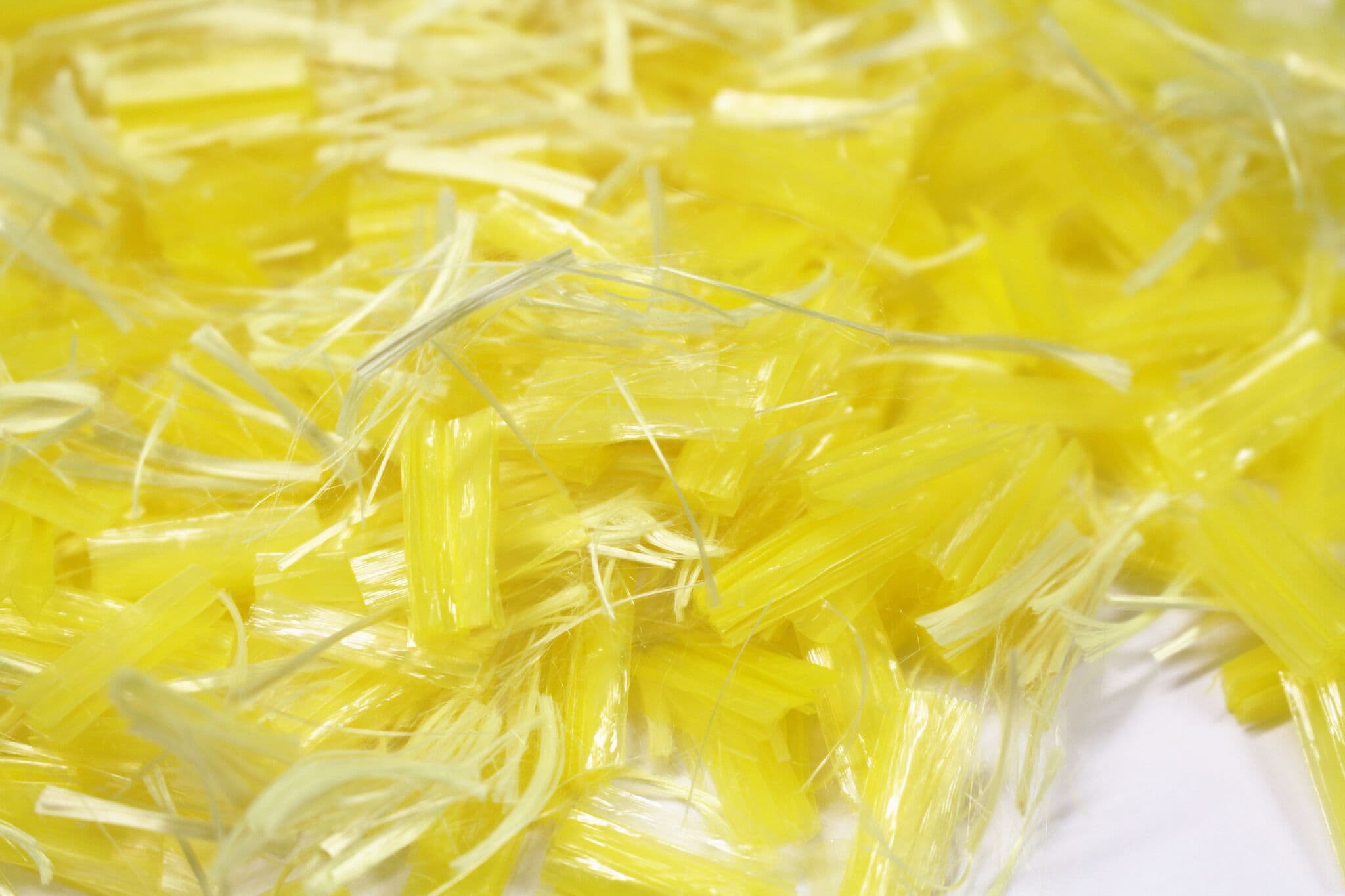
AsphaltX®
2000 filaments per aramid strand — 19 million fibres per tonne of asphalt. Lowest CO₂ footprint, European manufacturing, proven on the N337.
- TypeAramid (Twaron®) + polyolefin fibre blend
- Length± 19 mm
- Tensile strengthTwaron 3000 MPa · polyolefin 483 MPa
- Specific gravityTwaron 1.45 · polyolefin 0.91 g/cm³