Fibre concrete vs reinforcement mesh: the difference in time and cost

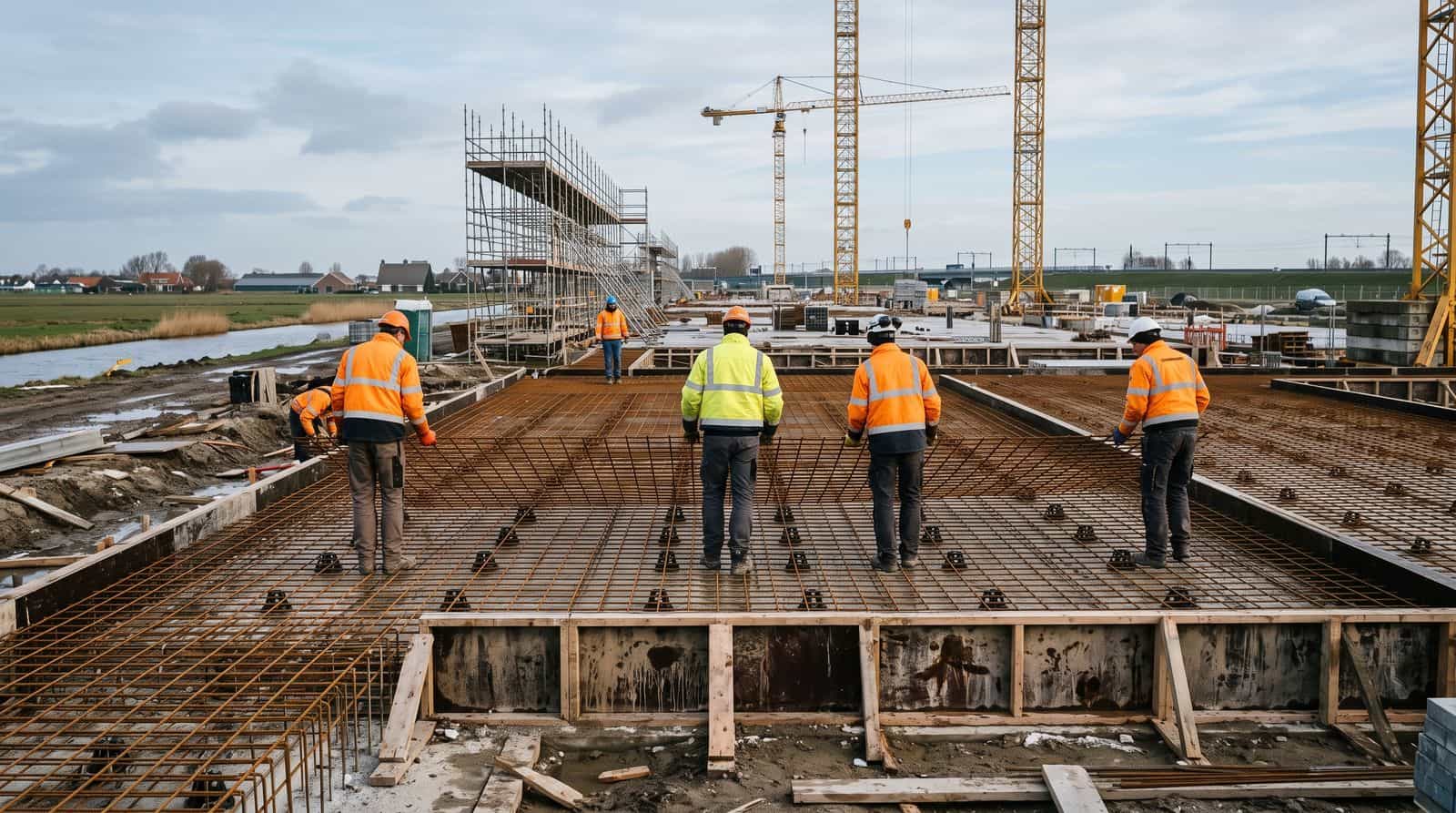
Fibre concrete or reinforcement mesh? We set material and labour costs per m² side by side, with a worked man-hours example for a 500 m² floor and a project case.
In many floors and pavings, fibre concrete replaces the entire work stage of reinforcement mesh: delivering, sawing, placing, lapping and setting spacers all disappear. Material costs often balance out, but on labour and lead time the difference quickly runs to 30 to 50 man-hours per 500 m² of floor. Only on settlement-prone ground or structurally designed work is a mesh sometimes still needed.
Reinforcement mesh or fibre concrete: where is the difference?
A reinforcement mesh — also called mesh fabric or welded wire mesh — is a prefabricated grid of welded reinforcing steel bars; in floors, meshes of 8 mm (Ø8, 100 or 150 mm grid) and 6 mm are the most common. In a ground-bearing floor, such a mesh in practice acts mainly as anti-crack reinforcement: it keeps shrinkage cracks fine and distributed, but rarely contributes structurally. Precisely that crack-controlling role is what fibres take over best.
With fibre concrete, the ready-mix plant doses steel or synthetic fibres during mixing. The reinforcement is thereby already in the mixer: distributed three-dimensionally through the entire concrete volume, including in edges and corners where a mesh often just falls short. How this behaviour compares with classic reinforcing steel is covered in the overview fibre reinforced concrete vs traditional reinforcement; this article focuses on the question on which the choice is usually decided: time and money. More background on fibre types and dosages can be found in the pillar on fibre reinforced concrete.
The reinforcement mesh work stage: placing, lapping, spacers
With traditional reinforcement using mesh or mats, the process consists of several steps that all cost time and labour hours:
• Delivery and storage of the reinforcement mesh on site.
• Sawing or bending mesh to size around penetrations, edges and connections.
• Positioning the mesh at the correct height in the formwork, on spacers.
• Lapping and connecting the sheets together (tying with wire or clips).
• Checking the reinforcement position before pouring.
Each of these steps requires staff and time — and on a construction site, time translates directly into cost.
Placing and tying reinforcement mesh
Placing reinforcement mesh is physical work: a common mesh sheet of 3 × 2 metres in Ø8 mm with a 150 mm grid weighs around 5.3 kg per m², so over 30 kg per sheet. Those sheets are lugged around by two workers or lifted in by crane, sawn to fit around openings and columns, and then tied: fixed together with tie wire at the intersections and laps so that the assembly does not shift during pouring. All the common sizes and weights — from 8 mm mesh to heavier sheets — are listed in the overview of reinforcement mesh sizes and weights.
Laps and spacers
Reinforcement mesh sheets must overlap by at least one full grid square — in practice 15 to 30 cm — so that tensile forces are transferred from sheet to sheet. Across a floor bay, this quickly adds 5 to 10% extra material in laps. In addition, spacers are needed: plastic or concrete supports (indicatively 3 to 4 per m²) that hold the mesh at height, so that the concrete cover of typically 25 to 35 mm is correct everywhere. A mesh lying too low on the bottom of the formwork does virtually nothing — a classic source of failure costs.
With fibre concrete, this entire work stage disappears. There is nothing to place, nothing to lap and nothing to hold at height: the fibres sit homogeneously in the mix and the cover can, by definition, not end up wrong.
Cost comparison per m²: material and labour
Indicative cost breakdown per m² of floor (2026 price levels, depending on project, steel price and region):
• Reinforcement mesh Ø8 mm, material — around €4 to €7 per m², plus 5 to 10% lap losses.
• Spacers — around €0.50 to €1 per m².
• Labour: placing, sawing, tying and inspection — around €3 to €5 per m².
• Delivery, storage and any crane hours — project-dependent.
• Fibre concrete: additional cost on the price per m³ at the plant — for a 15 cm thick floor, on balance often comparable to the total material cost of a mesh. How that surcharge works out for steel fibres, dosage by dosage, is shown in the price of steel fibre concrete per m³.
• Reinforcement labour with fibre concrete — eliminated entirely.
The direct material costs of fibres versus reinforcement mesh can therefore be comparable per project, or with very large quantities of steel even favour mesh. The real saving lies in labour hours, lead time, less sawing waste and fewer failure costs from incorrectly positioned reinforcement. A full price overview per fibre type is given in what fibre reinforced concrete costs.
Which fibre replaces the mesh depends on the loading. For floors and pavings, TwistR is a synthetic macro fibre that replaces the steel mesh at a dosage of indicatively 2 to 6 kg/m³; for heavily loaded industrial floors, a hooked-end high-tensile steel fibre such as the MPZG HT+ 35/0.55 is common at dosages of indicatively 10 to 35 kg/m³. Both fibre classes fall under EN 14889 (part 1 steel, part 2 polymer) and their performance is tested according to EN 14651 — the dosage always follows from the calculation for your specific floor.
Worked example: 500 m² industrial floor
Take an industrial floor of 500 m², 15 cm thick (75 m³ of concrete). With reinforcement mesh, the reinforcement work stage looks indicatively like this:
• Material — around 84 sheets of 3 × 2 m in Ø8 mm, over 2,500 kg of steel including laps.
• Delivery and distribution — crane hours or a great deal of lifting and carrying.
• Placing, sawing, lapping and tying — 2 to 3 skilled workers, 1 to 1.5 working days: 30 to 50 man-hours.
• Checking the reinforcement position — an extra step before pouring.
At an hourly rate of €45 to €55, that labour alone represents around €1,500 to €2,750 — quite apart from one to two days of lead time in the programme, plant hire and the crane movement. With fibre concrete, dosing takes place at the ready-mix plant: on site the reinforcement work stage stands at zero man-hours and pouring can start directly after formwork and pipework. If you want to run this calculation for your own floor, use the fibre calculator with your area, thickness and loading.
Project case: 1,500 kg of reinforcing steel saved
In a recent project, traditional steel reinforcement was replaced with fibre reinforcement for the foundation of tree and planter boxes. A net 1,500 kg of reinforcing steel was saved. The entire design was converted to fibre reinforcement within two days, including approval from the municipality — a lead time that would have been considerably longer with traditional reinforcement (ordering, delivery, placement).
How fibre reinforcement plays out at larger project scale can be seen in the project at the NDSM wharf in Amsterdam, where the reinforcement work stage disappeared from the programme entirely.
When does a reinforcement mesh remain necessary?
Fibres are not an automatic answer to every floor. In three situations, the classic mesh (or a combination) remains the preferred option:
• Settlement-prone ground — a well-placed reinforcement mesh keeps both sides of a crack on the same plane and thereby limits differential settlement. On clay or expansive soil a mesh can therefore be essential, whereas fibre reinforcement generally suffices on stable, sandy ground and under lighter loading.
• Structurally designed work — fibres do not always fully replace traditional reinforcement. Structural floors, beams and walls require a calculation by the structural engineer, which sometimes results in a hybrid solution: fibres for crack control plus bars or mesh in the tension zones.
• Underfloor heating as a fixing question — pipes are traditionally stapled to the mesh. With fibre concrete, the fixing moves to castellated or tacker panels; why that works well in practice is covered in underfloor heating and fibre concrete.
Galvanised reinforcement mesh is sometimes chosen to avoid corrosion at the surface, at a considerable premium. If that is your reason for looking at galvanised, you are often better off with synthetic macro fibres: they are corrosion-free by nature, without a zinc coating.
How to make the choice for your project
The greatest cost benefit of fibre concrete lies not in the material itself, but in the time and labour hours freed up because an entire work stage disappears. Rule of thumb: the larger and flatter the surface, and the tighter the programme or the availability of steel fixers, the sooner fibre concrete wins. For heavy structural work or poor ground conditions, the structural engineer decides.
What changes in concrete terms for your crew on site — from pouring to finishing — is covered in fibre reinforcement on the construction site. If you already know your area and loading, request a quote with your project details; we will run the comparison with reinforcement mesh for you.
Frequently asked questions
- How much does a reinforcement mesh weigh per m²?
- A reinforcement mesh of Ø8 mm with a 150 mm grid weighs around 5.3 kg per m²; a common sheet of 3 × 2 metres therefore comes to over 30 kg. A Ø6 mm mesh weighs around 3 kg per m² (roughly 18 kg per sheet). All sizes are listed in our overview of reinforcement mesh sheets.
- How much should reinforcement mesh sheets overlap?
- Reinforcement mesh sheets must overlap by at least one full grid square — in practice 15 to 30 cm — so that tensile forces are transferred from sheet to sheet. Allow for 5 to 10% extra material per floor bay as a result. With fibre concrete this concern does not exist: the fibres are homogeneously distributed through the entire concrete volume.
- Can fibre concrete fully replace reinforcement mesh?
- In floors and pavings on a stable, load-bearing subbase, usually yes: there the mesh acts mainly as anti-crack reinforcement and fibres take over that role entirely. For structurally designed work or settlement-prone ground, the structural engineer decides; sometimes a hybrid solution with fibres alongside traditional reinforcement is the best choice.
- Which is cheaper: fibre concrete or reinforcement mesh?
- Material costs are often comparable; with very large quantities of steel, the mesh can even be cheaper. The saving of fibre concrete lies in labour and lead time: on a 500 m² floor, an indicative 30 to 50 man-hours of placing and tying disappear, around €1,500 to €2,750 (2026 price levels). Run your project through the fibre calculator.
- What are spacers for in reinforcement?
- Spacers hold the reinforcement mesh at the correct height in the formwork, so that the concrete cover of typically 25 to 35 mm is correct everywhere. Allow indicatively for 3 to 4 per m². If a mesh lies on the bottom without spacers, it does virtually nothing. With fibre concrete, spacers are eliminated entirely: the fibres are distributed through the whole concrete volume.
Share this article
Products mentioned
 Most chosen
TwistR® GREEN HYBRID
High-performance synthetic macro fibres made from 100% polypropylene. Transforms concrete into a stronger composite material.
- TypeHybrid: twisted monofilament + fibrillating network fibre
- Material100% virgin polypropylene
- Length48 mm
- Dosage2.0 – 6.0 kg/m³
Pallet price on request
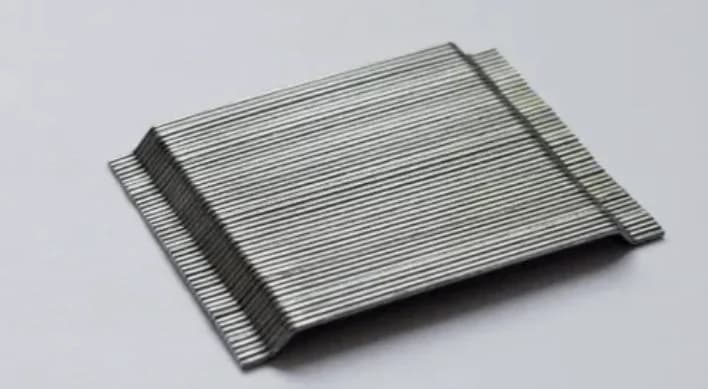
MPZG HT 35/0.55
High-tensile hooked steel fibres with aspect ratio 35/0.55. Maximum anchorage and ductility for heavily loaded structures.
- TypeCold-drawn hooked steel fibre (glued)
- Dimensions35 mm / Ø 0.55 mm
- Tensile strength1345 N/mm² ± 7.5%
- Modulus of elasticity200,000 N/mm²
Pallet price on request