Aramid fibres vs. PMB: costs, environmental impact and lifespan

PMB or aramid fibres in penetration-grade bitumen? Based on FIBRA data from the A73, we compare production process, environmental impact, recycling and costs.
Asphalt can be strengthened with polymer modified bitumen (PMB) or with aramid fibres in a standard penetration-grade bitumen. On the road, the two perform virtually identically, as the FIBRA research on the A73 shows. The difference lies in the process: the aramid mix is produced around 15-20°C cooler, scores over 10% lower on the MKI (cradle-to-gate) and is cost-neutral at equal service life.
What is PMB (polymer modified bitumen)?
Bitumen is the binder that holds the crushed stone, sand and filler in asphalt together — typically around 4 to 7% of the mix weight. Standard penetration-grade bitumen (the liquid bitumen asphalt plants buy in) is classified by hardness: a 70/100 bitumen, for example, is relatively soft and flexible, a 40/60 harder and stiffer. For most roads, such a pen-grade bitumen is perfectly adequate.
For heavily loaded or open-graded surface courses, however, the binder itself becomes the weak link. The bitumen is therefore modified with a polymer, almost always SBS (styrene-butadiene-styrene), in the order of a few per cent of the binder weight. The SBS forms an elastic network in the bitumen, which becomes tougher and more resilient as a result: better resistance to rutting, cracking and ravelling. The polymer also raises the softening point of the bitumen, so PMB keeps its stiffness at road surface temperatures at which a standard 70/100 grade is already softening.
That gain comes at a price. PMB is more viscous than pen-grade bitumen and therefore requires a higher production and laying temperature, plus a separate (heated) storage and production stream at the asphalt plant. And the modified binder is considerably more expensive per tonne than standard bitumen. Aramid fibres offer an alternative route: the fibres bridge crack faces mechanically, while the binder can remain a standard 70/100 penetration-grade bitumen.
Why strengthen: the problem of open-graded surface courses
Porous asphalt (ZOAB/PA) naturally has an open structure with a high void content — good for noise reduction and water drainage, but vulnerable to ravelling of the stone skeleton. Traditionally this is addressed with PMB: the tougher binder holds the stones in place for longer. Within fibre reinforced asphalt, the same challenge is solved mechanically: thin, strong fibres distribute themselves through the mix and take up tensile stresses as soon as a micro-crack forms anywhere.
For aramid fibres — such as AsphaltX, based on Twaron technology — the dosage is low: as an indication, around 0.05% of the mix weight, or some 500 grams per tonne of asphalt, depending on mix and application. How that mechanical action works in detail is covered in our article on what fibre reinforced asphalt is.
Production temperature: a step towards warm mix asphalt
In the trial section on the A73 near Roermond, the reference mix with PMB (Styrelf 65/105-80 A AP) was produced at approximately 181°C. The aramid fibre mix (with Twaron 1080 fibre) was produced at approximately 165°C — some 15-20°C lower. That difference translates directly into lower energy consumption at the asphalt plant and fewer fume emissions during laying, which benefits the health of road workers.
That lower temperature is no coincidence, but a consequence of the binder: pen-grade bitumen is less viscous than PMB and therefore mixes well at a lower temperature, while the fibres are added dry and need no heat. Why that works this way is explained in the production temperature of fibre asphalt.
Relevant for the years ahead: the sector is moving towards warm mix asphalt and low-temperature asphalt, and the new PCR calculation rules explicitly give warm mix a place in the environmental assessment. A fibre mix on pen-grade bitumen, at 165°C, already sits closer to that ambition than a PMB mix at 181°C, and the fibre route can also be combined with further temperature-reducing measures — the fibres themselves impose no lower limit.
Mechanical performance: the FIBRA figures from the A73
From the laboratory and field tests of the FIBRA results from the A73, the following figures emerge for the two variants (2L-PA 8, top layer), each compared as PMB reference versus aramid fibre (Twaron 1080):
• Production temperature — PMB reference: ~181°C; aramid fibre: ~165°C.
• ITS dry — PMB reference: 0.72 MPa; aramid fibre: 0.578 MPa.
• ITS wet — PMB reference: 0.63 MPa; aramid fibre: 0.446 MPa.
• ITSR (water sensitivity) — PMB reference: 88%; aramid fibre: 77%.
• Abrasion resistance (week 3) — PMB reference: 0.517; aramid fibre: 0.555.
• Noise level (CPX, light vehicles, right-hand lane) — PMB reference: 92.8 dB(A); aramid fibre: 92.5 dB(A).
• Visual inspection after 3 months — PMB reference: good; aramid fibre: good.
In short: the PMB variant performs slightly better on tensile strength and water sensitivity in the laboratory, but in the field measurements on the road — abrasion resistance, noise, water drainage, longitudinal evenness — the two variants are virtually on a par. All four FIBRA mixes, including the aramid variant, comfortably met the Dutch requirements and showed no damage after three months of traffic loading.
Reading guide to the noise figures
The CPX values quoted were measured on the right-hand lane, twelve weeks after construction. The left-hand lane was consistently around 1.2 dB(A) lower (around 91.3-91.6 dB(A)), because the right-hand lane wears faster under heavy traffic — an effect unrelated to the chosen reinforcement type. The difference between PMB and aramid is negligible on both lanes; more on this in our article on fibre reinforced asphalt and noise reduction.
Environmental impact: MKI and demonstrably sustainable asphalt
The life cycle assessment (LCA) within FIBRA shows that the PMB mix has the highest environmental impact at cradle-to-gate level, with a difference of more than 10% on the environmental cost indicator (MKI) compared with the aramid variant. When the full life cycle is included (cradle-to-grave, including maintenance and end of life), the differences narrow to less than 4% — mainly because fibre reinforced mixes are assumed to have a somewhat longer service life, which partly offsets the production impact.
For clients who want sustainable asphalt not merely promised but demonstrated, that difference carries ever more weight: MKI values feed directly into tenders via DuboCalc and EMVI criteria. Since the PCR Asphalt 2026, those environmental performances are also calculated uniformly, so the advantage of a fibre mix on pen-grade bitumen becomes comparable in black and white. Anyone who wants to score maximally on this criterion chooses an asphalt fibre with the lowest CO₂ footprint combined with a standard binder.
Recycling asphalt: why PMB planings are harder to reuse
The Netherlands reuses reclaimed asphalt (RAP) in new mixes on a large scale. Here the rule applies: PMB is harder to recycle than standard bitumen. The aged SBS network in PMB planings behaves differently from aged pen-grade bitumen, which makes the binder properties of a new mix containing PMB-bearing reclaim harder to predict and control. In practice, such planings are therefore often used at a lower grade, for example in base courses rather than back in a high-quality surface course.
An aramid mix uses a standard penetration-grade bitumen, so the planings behave like regular RAP when reused. The aramid fibres themselves are no obstacle: aramid is heat-resistant to far above common production temperatures and the dosage of around 500 grams per tonne is too small to disturb the recycling process. Whoever lays a surface course today therefore also determines how well that material can be reused in 15 years' time.
Costs: where does the premium sit?
The cost comparison is essentially a comparison between two premiums. With PMB, the premium sits in the binder: the modified bitumen is markedly more expensive per tonne than pen-grade bitumen, and that carries through into every tonne of asphalt because the binder makes up 4 to 7% of the mix. On top of that come the higher energy costs of the higher production temperature and the separate PMB storage stream at the plant.
With aramid fibres, the premium sits almost entirely in the fibre itself: around 500 grams per tonne of asphalt, without modifications to existing production or paving equipment and without a separate operation. The FIBRA business case shows that using aramid fibres instead of PMB can be cost-neutral in the Dutch situation, provided a service life comparable to the PMB mix is achieved — and the lower production temperature saves energy on top of that.
Exact amounts are project-dependent (indicative, price level 2026): mix type, tonnage and haul distance determine the outcome. So do not calculate with the construction price alone, but with the cost per m² per year of service life — how to build that up is covered in what fibre reinforced asphalt costs per m².
Workability and production at the plant
One practical advantage that recurred throughout the FIBRA trials: the aramid fibre mix was easier to work by hand than the hotter PMB mix, and no fibre clusters or other production or plant problems were observed. The production rate was slightly lower (around 130 tonnes/hour versus 145-150 tonnes/hour with PMB), because the fibres are added to the mixer by hand via pre-packed bags — a step that lends itself well to further automation with a dosing installation.
Which choice suits your project?
The main differences between PMB and aramid fibres at a glance:
• Mechanical strength (lab) — PMB: marginally higher; aramid fibres: comparable in practice.
• Production temperature — PMB: ~181°C; aramid fibres: ~165°C (15-20°C lower).
• Environmental impact (MKI, cradle-to-gate) — PMB: highest; aramid fibres: over 10% lower.
• Recyclability of planings — PMB: harder, often lower-grade reuse; aramid fibres: as regular RAP.
• Premium — PMB: in the binder (4-7% of the mix); aramid fibres: in ~500 g of fibre per tonne.
• Total cost — PMB: reference; aramid fibres: cost-neutral at equal service life.
For projects where sustainability, energy consumption and recyclability weigh heavily — certainly now that the PCR Asphalt 2026 makes environmental performance uniformly comparable — an aramid fibre instead of polymer modified bitumen is a realistic and well-substantiated alternative, with comparable performance on the road. If the mix is one where laboratory tensile strength and water sensitivity are decisive, PMB remains a logical candidate; in that case, have the trade-off calculated per mix design.
Would you like to know what aramid fibres mean for your specific asphalt mix and project location? Dutch Fiber Trading advises and runs the numbers with you free of charge.
Sources
• CEDR FIBRA project, Deliverable 5.1 "Scaling up of the production process and implementation of test sections" and Deliverable 6.2 "Exploitation Strategy Plan", 2021.
• Dutch Fiber Trading (dutchfibertrading.com).
Frequently asked questions
- What is PMB bitumen?
- PMB (polymer modified bitumen) is standard bitumen to which a few per cent of polymer has been added, almost always SBS. The polymer forms an elastic network that makes the binder tougher and more resistant to rutting and ravelling. The downside: PMB is more viscous, requires a higher production temperature (towards 181°C), a separate storage stream at the asphalt plant and is more expensive per tonne than penetration-grade bitumen such as 70/100 bitumen.
- Is asphalt with aramid fibres as strong as asphalt with PMB?
- In the laboratory, PMB scores slightly higher on tensile strength (ITS 0.72 versus 0.578 MPa dry) and water sensitivity. In the field measurements on the A73 — abrasion resistance, noise, water drainage, evenness — the two variants perform virtually on a par and comfortably met the Dutch requirements. See the FIBRA results from the A73 for all the measured values.
- Why is asphalt with PMB harder to recycle?
- The aged SBS network in PMB planings behaves differently from aged standard bitumen, making the properties of a new mix containing this reclaim harder to control. PMB-bearing planings are therefore often reused at a lower grade, for example in base courses. An aramid mix on penetration-grade bitumen behaves like regular reclaimed asphalt when reused; the fibre dosage of around 500 grams per tonne does not disturb the recycling process.
- Is fibre reinforced asphalt more expensive than asphalt with PMB?
- The FIBRA business case shows that aramid fibres instead of PMB can be cost-neutral in the Dutch situation, provided a comparable service life is achieved. The premium of the fibre (around 500 grams per tonne of asphalt) is offset by the more expensive PMB binder, the higher production temperature and the separate storage stream. Exact amounts are project-dependent; request a quotation for your mix and tonnage.
- Can fibre reinforced asphalt be produced at a lower temperature?
- Yes. On the A73, the aramid mix was produced at around 165°C versus 181°C for the PMB reference — 15-20°C lower, because penetration-grade bitumen is less viscous than PMB. That saves energy and limits fumes during laying. The fibre route can also be combined with warm mix asphalt techniques for further temperature reduction; the fibres themselves impose no lower limit.
Share this article
Products mentioned
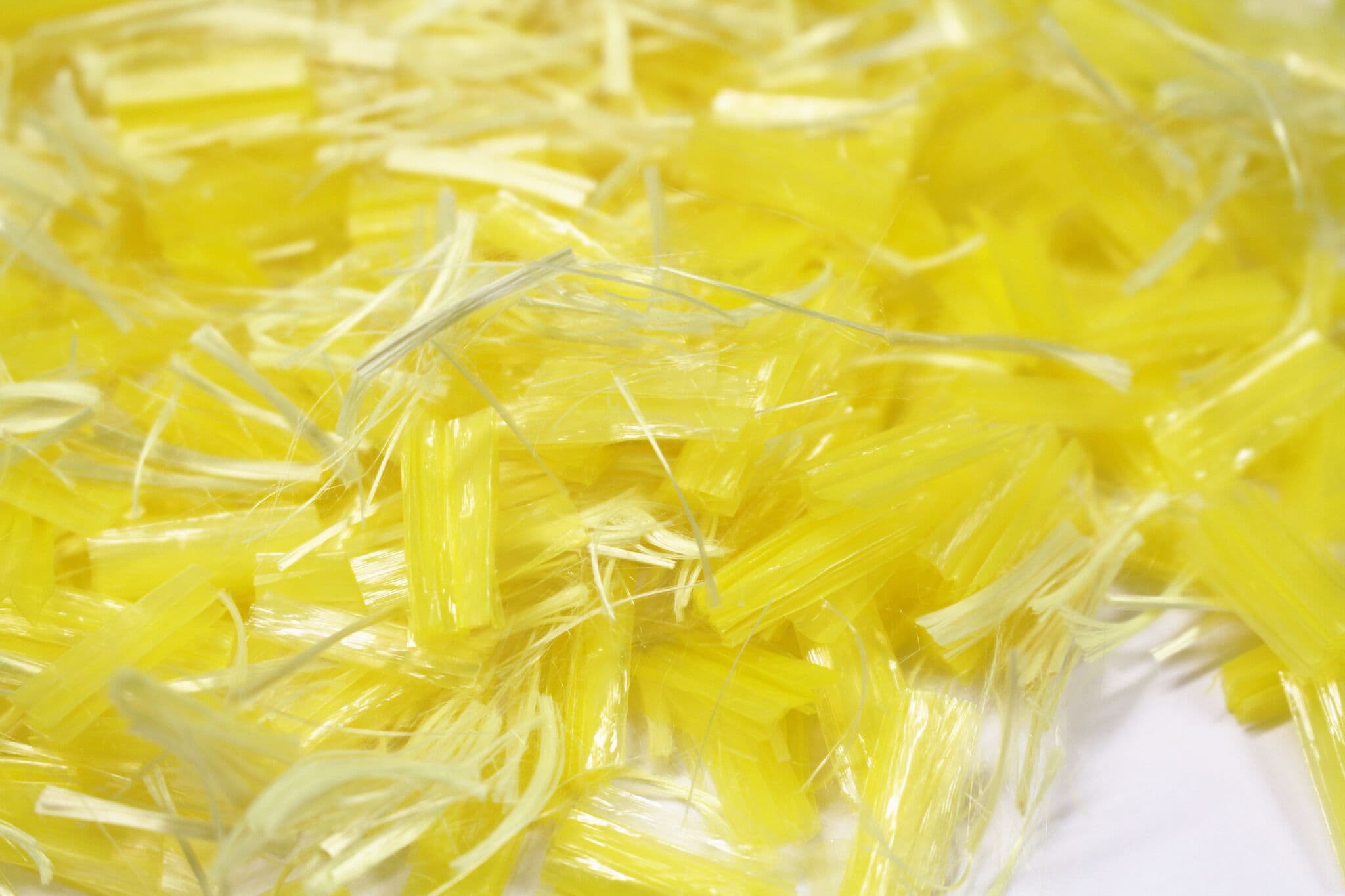
AsphaltX®
2000 filaments per aramid strand — 19 million fibres per tonne of asphalt. Lowest CO₂ footprint, European manufacturing, proven on the N337.
- TypeAramid (Twaron®) + polyolefin fibre blend
- Length± 19 mm
- Tensile strengthTwaron 3000 MPa · polyolefin 483 MPa
- Specific gravityTwaron 1.45 · polyolefin 0.91 g/cm³