What is an aramid fibre? Properties, types and use in asphalt

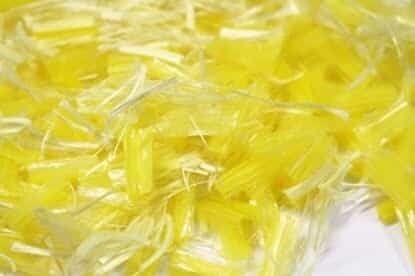
Aramid fibres are among the strongest synthetic fibres in existence. What an aramid fibre is, which types exist, what they cost and how they reinforce asphalt.
An aramid fibre is a synthetic fibre made of aromatic polyamide with a tensile strength of around 3,000 MPa — roughly five times stronger than steel per kilo. Aramid does not melt and remains dimensionally stable up to well over 450°C. In asphalt, aramid fibres act as three-dimensional reinforcement against cracking and rutting, at a dosage of around 500 grams per tonne.
What is an aramid fibre?
Aramid is the shortened name for aromatic polyamide: a polymer whose chains are built up from aromatic rings, linked together by amide bridges. During spinning, those stiff chains align almost perfectly along the length of the fibre, and hydrogen bonds between the chains lock that ordering in place. That explains the exceptional combination of tensile strength, low elongation and thermal stability — properties unattainable with ordinary synthetic fibres such as polypropylene.
The two best-known brand names are Twaron from Teijin Aramid — produced in the Netherlands, in Emmen and Delfzijl — and Kevlar from DuPont. Aramid has been used since the 1970s wherever extreme demands apply: bulletproof vests, aircraft components, brake linings, optical cables and fire-resistant clothing. In road construction, the fibre is the core of aramid asphalt fibres that slow cracking and rutting in the surface course.
Para-aramid and meta-aramid: two types
There are two families of aramid fibres, with clearly different applications:
• Para-aramid (Twaron, Kevlar) — the strong variant: very high tensile strength and stiffness, intended for reinforcement and strengthening. This is the type used in asphalt.
• Meta-aramid (Nomex, Teijinconex) — less strong, but with excellent resistance to heat and flames; mainly used in fire-resistant clothing and filtration.
So where aramid fibres are discussed in road construction, it is almost always para-aramid.
Properties of aramid fibres
The key aramid fibre properties at a glance, with the values of the Twaron fibre as used in asphalt:
• Tensile strength — around 3,000 MPa; per kilo of material roughly five times stronger than steel.
• Heat resistance — aramid does not melt, remains dimensionally stable up to well over 450°C and only decomposes above that. Well above the 140-180°C at which asphalt is produced.
• Density — 1.45 g/cm³, roughly five times lighter than steel (7.85 g/cm³).
• Low elongation — the fibre takes up load at even small deformations, rather than only after stretching.
• Chemical inertness — aramid does not react with bitumen or other constituents of the asphalt mix and is resistant to de-icing salts.
• Corrosion-free — unlike steel fibres or steel reinforcement grids, aramid does not rust.
This combination makes aramid ideally suited to slowing cracking in asphalt and holding together the stone skeleton of open-graded mixes — such as porous asphalt (ZOAB).
Aramid compared with other fibres
Several fibre types are used in asphalt and concrete, each with its own role. The differences at a glance:
• Aramid (Twaron/Kevlar) — tensile strength ±3,000 MPa, does not melt (dimensionally stable to >450°C); function: true reinforcement that bridges cracks and slows rutting.
• Cellulose — natural fibre with limited strength; function: binder carrier that prevents bitumen drain-down in SMA and porous asphalt, no reinforcing effect.
• Polyacrylic (PAN) and polyolefin — synthetic fibres with a much lower tensile strength and a melting point around 110°C (polyolefin); in fibre blends mainly carrier and dispersion fibres.
• Basalt — mineral fibre, spun from molten basalt rock, heat-resistant up to around 700°C; used mainly in concrete as a corrosion-free alternative to steel.
In practice, types are combined: an aramid asphalt fibre often contains, alongside the reinforcing para-aramid, a polyolefin carrier fibre that melts during hot mixing and thereby distributes the aramid filaments evenly through the mix. Which fibre suits which mix type is covered in what fibre reinforced asphalt is exactly.
How does an aramid fibre work in asphalt?
During asphalt production, the aramid fibre — often together with a small proportion of cellulose fibre against binder drainage — is added dry: the fibres go in with the aggregate, before the bitumen is added. Once the fibres are well distributed, the millions of filaments act at micro level as three-dimensional reinforcement:
• Crack bridging — where a micro-crack forms, the fibre spans the crack face and prevents the crack from propagating further.
• Load distribution — the loading from passing traffic is distributed through the fibres across the mix, instead of being concentrated on a single weak spot.
• Stabilisation of the mortar — in porous asphalt, the fibre holds the mortar bridge between the stones of the stone skeleton together more firmly, which counters ravelling (stones working loose).
The result is an asphalt mix that, with a standard penetration-grade bitumen — instead of the more expensive and harder-to-recycle polymer modified bitumen (PMB) — achieves comparable or better resistance to cracking and ravelling. How this principle relates to other reinforcement techniques is covered in our overview of fibre reinforced asphalt.
Why aramid fibres instead of PMB or reinforcement grids?
Traditionally, asphalt is strengthened with polymer modified bitumen or with reinforcement grids. Both have a downside: PMB requires a higher production temperature and is harder to recycle, while reinforcement grids require a separate, time-consuming operation and cause problems when milling.
The European FIBRA research on the A73 near Roermond compared both routes directly. The aramid fibre mix (with Twaron) was produced at around 165°C, the PMB reference mix at around 181°C — a difference of 15 to 20°C that translates directly into lower energy consumption and fewer fumes during laying. At cradle-to-gate level, the environmental cost indicator (MKI) of the aramid variant was more than 10% lower, and in the field measurements on the road both variants performed on a par. The full figures are in our comparison of aramid fibres and PMB.
An important caveat: for structural reinforcement questions — for example reflective cracking above a cracked foundation — an assessment by the road designer or structural engineer remains necessary; fibres are not an automatic one-to-one replacement for every reinforcement solution.
Dosage: how much aramid fibre per tonne of asphalt?
The usual dosage of aramid asphalt fibre is around 500 grams per tonne of asphalt — equivalent to roughly 0.05% of the mix weight, depending on mix and application. That low dosage is possible because a single strand consists of thousands of individual filaments that spread throughout the entire volume during mixing: AsphaltX with 2,000 filaments per strand contains 45% more than comparable products.
The fibres (length ±19 mm) are supplied in pre-packed bags of 500 grams: one bag per tonne of asphalt, added to the mixer by hand or automatically, without any change to the asphalt recipe. Why exactly those 500 grams are so effective is explained in 500 grams of Twaron per tonne of asphalt.
What do aramid fibres cost? Price per kg and purchasing
Aramid is a high-grade technical fibre and therefore more expensive per kilo than, say, polypropylene or cellulose: as an indication, allow several tens of euros per kilogram (price level 2026, depending on type, volume and packaging). Thanks to the low dosage of around 500 grams per tonne, however, the fibre cost per tonne of asphalt remains a modest premium — and the FIBRA business case shows that aramid fibres can work out cost-neutral compared with PMB, provided a comparable service life is achieved.
Anyone wanting to buy aramid fibres for asphalt applications in practice buys not loose fibre but a ready-dosed fibre blend from a specialised supplier. Dutch Fiber Trading supplies AsphaltX (Twaron-based, European production, included on the OPWA list under BRL 9320) from stock in boxes of 35 × 500 grams. Request a project price and current lead time via the quotation page, or get in touch for dosage advice per mix type.
Where is aramid fibre reinforced asphalt used?
Aramid fibres are used where asphalt is heavily loaded and the cost of premature maintenance is high:
• Motorways and provincial roads with high traffic intensity, such as the FIBRA trial section on the A73 and 8 kilometres of the N337 between Zwolle and Deventer.
• Regional roads and roundabouts, where turning traffic puts extra shear forces on the surface course — such as the N711 roundabout in Flevoland.
• Heavily loaded haul roads and temporary access routes.
• Business parks in the distribution and transport sector.
• Race tracks.
Because aramid does not melt in hot mixes, the fibre is also suitable for mixes selected specifically for temperature resistance; read how that works in heat-resistant asphalt against rutting.
Using aramid fibres in your project
Considering aramid fibres for a road section, roundabout or business park? Start with the mix type (porous asphalt, SMA or dense asphalt) and the expected loading; the dosage of around 500 grams per tonne serves as the starting point and is tuned per mix. AsphaltX requires no change to the recipe, so any asphalt plant can produce the mix. For a project-specific quotation and application advice, our team is ready to help via the quotation request.
Frequently asked questions
- What is aramid fibre?
- Aramid fibre is a synthetic fibre made of aromatic polyamide, known under brand names such as Twaron and Kevlar. The fibre combines a tensile strength of around 3,000 MPa — roughly five times stronger than steel per kilo — with heat resistance up to well over 450°C, low elongation and chemical inertness. In road construction, aramid serves as reinforcement in fibre reinforced asphalt against cracking and rutting.
- Why don't aramid fibres melt in hot asphalt?
- Aramid has no melting point like ordinary plastics: the fibre remains dimensionally stable up to well over 450°C and only decomposes above that. Asphalt is produced at 140 to 180°C, so the fibre retains its full strength during mixing, transport and compaction. Synthetic fibres such as polyolefin (melting point ±110°C) do melt at that stage, which is why they serve only as carrier fibres.
- What is the difference between Twaron and Kevlar?
- Twaron and Kevlar are both para-aramid fibres with virtually identical properties; the difference lies in the manufacturer. Twaron is produced by Teijin Aramid in the Netherlands (Emmen and Delfzijl), Kevlar by DuPont in the United States. AsphaltX is based on Twaron technology, with European production and therefore a short, traceable supply chain.
- What do aramid fibres cost per kg?
- Loose aramid fibre costs, as an indication, several tens of euros per kilogram (price level 2026, depending on type and volume). For asphalt, the dosage is only around 500 grams per tonne, so the fibre cost per tonne of asphalt remains limited; the FIBRA research shows that its use can be cost-neutral compared with PMB. Request a current project price via the quotation page.
- Do aramid fibres fully replace reinforcement grids?
- In many surface courses, yes: the fibres reinforce the mix three-dimensionally, save the separate operation of laying grids and cause no problems when the surface is later milled. For structural questions, however, such as reflective cracking above a cracked foundation, an assessment by the road designer or structural engineer is always required — fibres are not an automatic replacement for every reinforcement solution.
- Can aramid fibres also be used in concrete?
- Technically it is possible, but concrete almost always uses steel, synthetic or basalt fibres: they are cheaper per kilo and standardised for concrete performance (EN 14889). Aramid comes into its own in asphalt, where heat resistance during hot mixing is decisive. For concrete applications, see the range of concrete fibres.
Share this article
Products mentioned
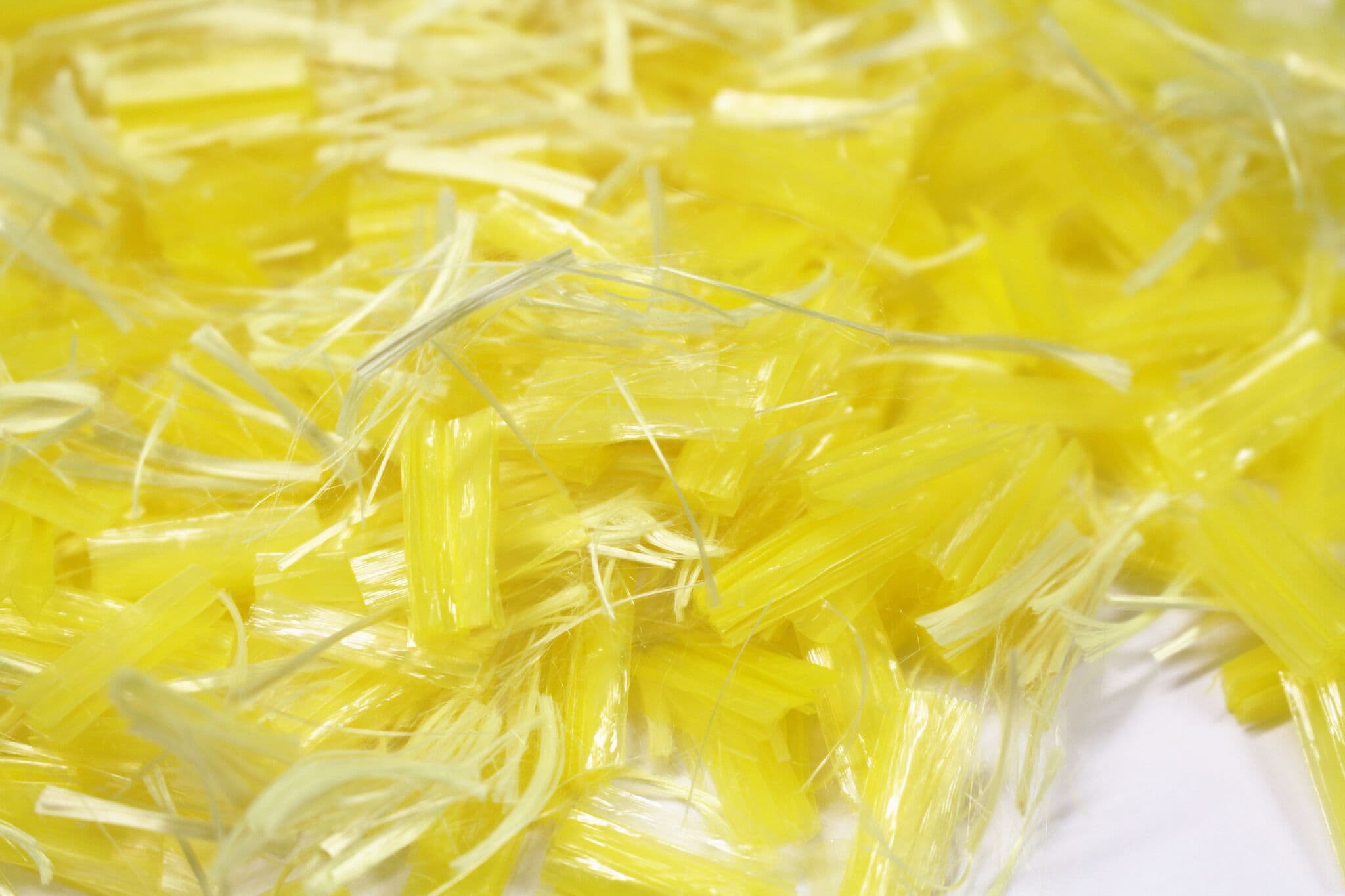
AsphaltX®
2000 filaments per aramid strand — 19 million fibres per tonne of asphalt. Lowest CO₂ footprint, European manufacturing, proven on the N337.
- TypeAramid (Twaron®) + polyolefin fibre blend
- Length± 19 mm
- Tensile strengthTwaron 3000 MPa · polyolefin 483 MPa
- Specific gravityTwaron 1.45 · polyolefin 0.91 g/cm³