Fibre reinforcement in greenhouse construction: pouring floors on sand

Greenhouse floors and main paths are monolithically poured concrete floors on sand, under permanent moisture and chemical loading. Corrosion-free fibre reinforcement replaces the mesh — without a laying stage.
A greenhouse floor is almost always a monolithic concrete floor on sand: 10–15 cm of concrete on a compacted sand bed with PE film, poured in a single operation and power-floated by machine. Fibre reinforcement (2–6 kg/m³ of macro fibre) replaces the reinforcement mesh — corrosion-free under fertilisers and permanent moisture, and with no separate laying stage before the pour.
Concrete in the greenhouse: a load combination few sectors know
Dutch greenhouse horticulture has some of the largest continuous concrete floors and paths in the country: main paths hundreds of metres long, processing areas, ebb-and-flood floors and loading pits. That concrete has to endure a combination of loads rarely seen outside the sector:
• Chemical exposure — fertilisers, nutrient solutions (pH typically 5.5–6.2) and crop protection products land on the floor daily.
• Permanent moisture loading — irrigation water, condensation against the greenhouse roof and humidity that stays high all year round.
• Intensive, repetitive transport — pipe rail trolleys, pallet trucks, forklifts and, increasingly, harvesting and UV robots driving exactly the same routes day in, day out.
• Ground risks — settlement from subsidence and a falling water table, resulting in cracking and unevenness in floors and foundations.
For traditional steel reinforcement, that first combination in particular is a problem: as soon as the concrete cover cracks or is too thin, moisture and chemicals attack the reinforcing steel. How that mechanism works — and why fibres are immune to it — is explained in our article on corrosion of reinforcing steel. What the agricultural business faces outside the greenhouse (barn floors, silage clamps, slurry acids) is covered separately in fibre-reinforced concrete in the agricultural sector; this article is about the cultivation side: the greenhouse floor itself.
Pouring a greenhouse floor on sand: the build-up
Greenhouses generally stand on a levelled sand layer, and the floors and paths are poured directly onto it — a concrete floor on sand, without a separate foundation. The quality of that sand bed determines the end result just as strongly as the concrete itself. The build-up from bottom to top:
• Sand bed — 20–30 cm of clean sand, mechanically compacted in layers with a plate compactor or roller.
• Separating layer — 0.2 mm PE construction film with generous overlaps; without film the mixing water drains away into the sand and the concrete cracks prematurely on the underside.
• Concrete slab — 10–15 cm of fibre-reinforced concrete, depending on the loading, power-floated by machine straight away.
The full pouring sequence — from ordering the concrete with the fibres already in the mix through to curing — is set out in the complete guide to pouring fibre-reinforced concrete.
Concrete floor thickness on sand: guide values for the greenhouse
The thickness follows from the heaviest load that will ever come onto the floor, not the average. Practical values on a well-compacted sand bed:
• Concrete paths between the crop rows — 8–10 cm; pipe rail trolleys and pedestrians.
• Main path — 10–12 cm; harvest trolleys, pallet trucks and robot traffic.
• Main path with forklift traffic — 12–15 cm; including the route to and from the packing shed.
• Processing area and loading pit — 15–18 cm; forklifts, lorry docks and point loads from racking.
The minimum thickness of a concrete floor on sand is around 10 cm. A reinforcement mesh makes pouring thinner than that difficult: the mesh needs 20–30 mm of concrete cover on both sides and must be set at height — at 10 cm there is hardly any setting room left. Fibres have no cover requirement and sit homogeneously through the whole slab, which makes 10 cm reliably buildable. The full thickness table per application can be found in how thick should a concrete floor be.
Monolithic concrete floor: pouring and finishing in one day
Greenhouse floors and main paths are executed as a monolithic concrete floor: pouring, levelling and machine power floating in one continuous operation, producing a dense, wear-resistant top layer without a separate screed. For cultivation, that is more than a cost issue. A power-floated, flat surface is easy to keep clean and disinfected (hygiene is a cultivation precondition in horticulture) and automated transport systems and robots impose strict flatness requirements: every bump on the main path is a breakdown in the making.
Fibre reinforcement fits seamlessly into that way of working. The fibres are blended through the mix at the batching plant and arrive with the truck mixer; the pouring crew can start straight away, and with a correctly dosed macro fibre the power floating proceeds by machine as normal. Large areas can moreover be executed with fewer contraction joints — every joint is an obstacle for trolleys and robots and a dirt trap.
Ebb-and-flood floors: watertight under nutrient solution
The ebb-and-flood floor is the most demanding concrete application in the greenhouse. This cultivation floor is flooded a few centimetres deep with nutrient solution per cycle and drained again after 10–30 minutes; the water is collected and reused. That imposes three hard requirements:
• Watertightness — the nutrient water must not leak away into the subgrade; in practice, concrete with crack widths up to around 0.2 mm counts as watertight.
• Chemical resistance — the floor stands full of slightly acidic, salt-rich nutrient solution many times a week.
• Dimensional stability under falls — the floor must lie exactly to falls in both directions to drain without ponding, and keep doing so for decades.
Crack control here is therefore not aesthetics but functionality. Fibre reinforcement limits crack widths because millions of fibres per cubic metre bridge every incipient crack immediately — including in the top zone, where a reinforcement mesh never reaches because of the cover requirement. And because synthetic fibres are chemically inert, the risk of a hairline crack leading to rusting reinforcement and spalling concrete simply does not exist.
Pipe rail, harvesting robots and point loads
Internal transport in a modern greenhouse is almost entirely standardised around the pipe rail system: steel pipes between the crop rows carrying pipe rail trolleys and spray robots. The rails themselves rest on supports, but all the traffic converges on the concrete main path — and that is exactly where the governing loads arise.
A fully laden harvest trolley, a pallet truck with crates or a harvesting robot with its battery pack loads the floor not evenly but via small wheel contact areas: point loads returning to the same lanes day after day. Fibre-reinforced concrete distributes those repetitive loads through the full slab cross-section and thus slows fatigue cracking on heavily used routes. For heavy, concentrated loads — racking legs in the processing area, dock edges at the loading pit — a locally thicker slab or supplementary reinforcement remains a matter for the structural engineer.
Settlement and subsidence: the slab moves with the ground
Many greenhouse areas lie on settlement-prone clay and peat soils, and subsidence and a falling water table are increasing the likelihood of differential settlement. A concrete floor on sand behaves as a slab on an elastic bedding: if the subgrade drops locally, the slab has to bridge that gap. That is precisely the moment when reinforcement present everywhere in the cross-section counts. Fibres provide residual strength after cracking (demonstrable via the flexural strength test of EN 14651) and hold crack faces together, so a settlement crack stays controlled instead of growing into a stepped fracture — for robot traffic, the difference between carrying on and standing still.
No reinforcement can prevent settlement entirely; a carefully compacted sand bed and a realistic assessment of the subgrade remain the foundation under every greenhouse floor.
Worked example: m² of greenhouse floor per day, with and without mesh
Suppose: a new-build greenhouse with 3,000 m² of poured concrete — main path, processing area and loading pit. With traditional reinforcement mesh, a separate work stage precedes the pour: delivering the mesh, laying it out, connecting it with laps and setting it on spacers. With a crew of two, 400–600 m² per day is a realistic output; for 3,000 m² that means 5 to 7 extra working days before the first truck mixer can arrive — in a greenhouse that at that point is often already glazed, with all the internal transport of mesh through narrow paths that entails.
With fibre reinforcement that stage disappears entirely: the fibres are already in the concrete when it arrives. The crew lays the film, sets up the laser-guided screeding equipment and pours and floats 800–1,200 m² per day. The difference is therefore not just around a working week of lead time, but also: no steel to carry into the greenhouse, no cover errors that come back years later as rust damage, and no mesh sinking away during the pour. What that saves in euros is worked out sector-wide in the knowledge centre under applications and target groups.
Which fibre for which greenhouse floor?
For greenhouse floors, main paths and processing areas, the Wiking 4050 TR is the logical first choice: an acid- and alkali-resistant macro fibre made of polyolefin (dosage 2–6 kg/m³) that is insensitive to fertilisers, nutrient water and cleaning agents — and therefore the designated fibre for greenhouse floors under chemical loading. For structurally heavier applications, such as loading pits or floors with high point loads, the TwistR offers structural residual strength as corrosion-free floor reinforcement for horticulture: a 100% polypropylene macro fibre with a twisted structure that can replace traditional reinforcing steel in floors on sand.
Steel fibres are technically usable, but in the permanently damp, chemically loaded greenhouse climate, fibres at the floor surface can leave rust marks — for ebb-and-flood floors and visible floors, a synthetic fibre is therefore the safer choice. For the foundations of the greenhouse structure itself (wind loading, anchoring of columns), calculated traditional reinforcement generally remains the starting point; fibres play at most a supplementary role in crack control there. Always put structural choices to your structural engineer.
From greenhouse floor to haul road: fibres around the development
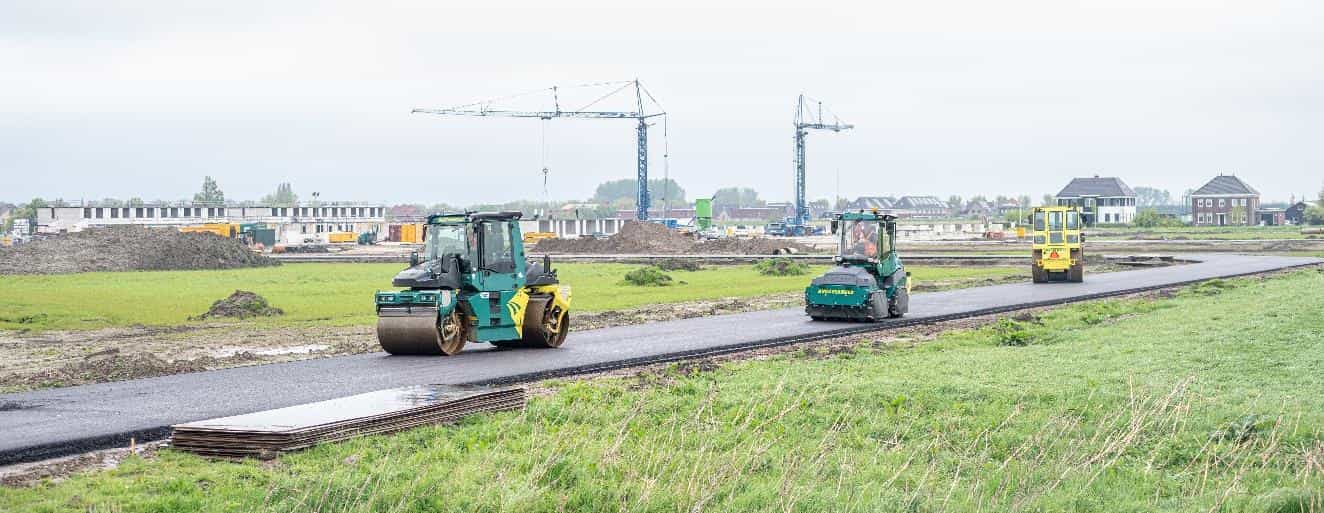
Fibre reinforcement does not stop at the greenhouse floor. Around a new-build greenhouse there is also yard paving, a loading area and, during construction, a haul road that has to carry heavy construction logistics for months. For the Tuindersweijde development in Obdam, Dura Vermeer built such a temporary haul road zero-emission with fibre-reinforced asphalt: 1,890 tonnes, designed for the heavy construction traffic of the entire project.
Planning a greenhouse floor, processing area or ebb-and-flood floor? Request a quotation with your floor area and loading and we will advise on fibre type and dosage — or use the selection guide to determine yourself which fibre suits your project.
Frequently asked questions
- Can a concrete floor be poured directly onto sand?
- Yes, provided the sand bed has been mechanically compacted in layers and 0.2 mm PE construction film with generous overlaps is laid on top. Without film, the mixing water drains away into the sand, the concrete dries out too fast at the bottom and cracks prematurely. On settlement-prone clay or peat soils, a thicker slab or ground improvement is needed; see the complete pouring guide.
- How thick should a greenhouse floor on sand be?
- Concrete paths between the crop rows: 8–10 cm. The main path: 10–12 cm, or 12–15 cm with forklift traffic. Processing areas and loading pits: 15–18 cm. The minimum thickness of a concrete floor on sand is around 10 cm — reliably achievable with fibre reinforcement, because fibres need no concrete cover or setting room the way a reinforcement mesh does. For high point loads, the structural engineer decides.
- What is a monolithic concrete floor?
- A monolithic concrete floor is poured, levelled and machine power-floated in one continuous operation, so the wear-resistant top layer and the structural slab form a single whole — without a separate screed. In greenhouse construction this is the standard for main paths and processing areas: the surface is flat enough for robot traffic and easy to keep clean. Fibre reinforcement is blended into the mix at the batching plant and does not interfere with power floating.
- What is an ebb-and-flood floor?
- An ebb-and-flood floor is a watertight concrete cultivation floor that is flooded a few centimetres deep with nutrient solution per cycle and drained again after 10–30 minutes, after which the water is reused. The floor lies exactly to falls and must keep crack widths below around 0.2 mm to remain watertight. Chemically inert synthetic fibres limit that crack width without any risk of rusting reinforcement.
- Why fibres instead of reinforcement mesh in the greenhouse?
- Three reasons. Corrosion: mesh rusts as soon as moisture and fertilisers reach the steel through a crack or thin cover — synthetic fibres are chemically inert. Lead time: laying mesh on 3,000 m² easily takes 5–7 extra working days, whereas fibres are already in the concrete. Quality: fibres sit homogeneously through the whole slab, including the top zone and at edges, where a reinforcement mesh never reaches.
Share this article
Products mentioned

Wiking 4050 TR
High-performance polyolefin macro fibre, ideally suited to rough floors — a strong and cost-effective alternative to steel reinforcement.
- TypePolyolefin macro fibre (monofilament)
- Length48 mm
- Diameter700 µm
- Tensile strength557 MPa
Pallet price on request
 Most chosen
TwistR® GREEN HYBRID
High-performance synthetic macro fibres made from 100% polypropylene. Transforms concrete into a stronger composite material.
- TypeHybrid: twisted monofilament + fibrillating network fibre
- Material100% virgin polypropylene
- Length48 mm
- Dosage2.0 – 6.0 kg/m³
Pallet price on request
Also read
- Fibre-reinforced agricultural concrete: barn floors, silage clamps and yard paving
- How thick should a concrete floor be? Slab thickness for garages, houses, sheds and industrial floors
- Carbonation and corrosion of reinforcing steel: how fibres prevent it