Concrete safety barriers: Jersey and step profiles, precast or slipformed, plus kerbs and traffic islands

What is a concrete safety barrier? Jersey and step profiles, precast or slipformed, EN 1317 classes, central reserve barriers, traffic islands, safety kerbs and barrier blocks, and where fibres help.
A concrete safety barrier is a vehicle restraint system alongside or between carriageways that catches an errant vehicle and redirects it back towards the road. It is a continuous wall with a Jersey or step profile, built from precast concrete units or cast in situ with a slipform paver. The broader term concrete road barrier also covers lower elements that separate or guide traffic without being crash-tested as a restraint system, such as central islands, traffic islands, safety kerbs and concrete barrier blocks.
This article sets all these types side by side: profiles, precast or cast in situ, the standards framework and what fibres contribute to these elements. Dutch Fiber Trading supplies fibres for the concrete, not barriers.
What is a concrete safety barrier?
A safety barrier, or vehicle restraint system (VRS), stops a vehicle leaving the road sideways or crossing into oncoming traffic. Highway authorities install one where leaving the road would be more dangerous than hitting the barrier: at hazards close to the carriageway such as bridge piers and gantries, at steep drops and in the central reserve where opposing traffic has to be protected. A wide grassed central reserve does not always need one.
There are two main families. The steel safety fence or guardrail is the familiar image on many roads; the standard Dutch steel barrier is 75 cm high. The other family is the concrete barrier: a continuous wall that works through its shape and mass. Policy has moved towards concrete in several countries. In England, Highways Agency (now National Highways) policy since January 2005 has been that all new motorway schemes use high containment concrete barriers in the central reserve. In the Netherlands, a Rijkswaterstaat memo on central reserve protection from 1992 concluded that concrete deserved more attention than before, and today many Dutch motorways have step profile concrete barriers in the central reserve.
Steel barrier or concrete barrier: the difference
The difference lies in how the barrier absorbs an impact. A steel barrier deforms: the rail and posts bend and need space behind the barrier to do so, the working width. A concrete barrier barely deforms. A 1986 publication by Rijkswaterstaat, the Dutch national roads authority, summed up the principle: whether a barrier is breached, moved or tipped over in an impact depends on its mass, its shape and its connection to the road.
Linked precast units can tilt locally in a heavy impact and settle back; a wall that is not anchored to the ground shifts slightly. According to a German study by the Federal Highway Research Institute (BASt), steel and concrete barriers proved equally safe in crash tests. The biggest practical difference is maintenance: a steel barrier has to be repaired after a strike, while a damaged concrete unit is swapped out or repaired locally.
| Feature | Steel safety barrier | Concrete safety barrier |
|---|---|---|
| Behaviour on impact | Rail and posts deform and absorb energy | Mass and shape redirect the vehicle; linked units tilt or shift slightly |
| Space behind the barrier | Working width needed for deflection | Small for a continuous or anchored wall; larger for free-standing units |
| After a strike | Repair or replace rail and posts | Replace the damaged unit or repair locally |
| Typical location | Verges, local roads, transitions | Central reserve, tunnels, hazards close to the carriageway, roadworks |
Types of concrete safety barriers and road barriers
Concrete road barriers fall into two groups that are worth keeping apart. The first group are the tall, continuous vehicle restraint systems: safety barriers tested as a complete system to EN 1317. The second group are lower elements that separate or guide traffic but have no tested containment level: central islands on local roads, traffic islands, safety kerbs, bollards and concrete barrier blocks.
That distinction decides which requirements apply, who has a say in the concrete mix and how free the designer is to choose reinforcement and fibres. With a tested system the design is fixed; with a cast traffic island or a barrier block, the designer and the precaster decide for themselves.
| Type | Shape and function | Construction | Where | Role of fibres |
|---|---|---|---|---|
| Safety barrier, Jersey profile | Wall with a sloping toe and steeper upper face, redirects an errant vehicle | Mostly precast units, linked | Roadworks, hazard protection, older central reserves | Limiting edge damage and shrinkage cracks |
| Safety barrier, step profile | Wall with a slightly inclined face and a small step at the base | Precast or slipformed in situ | Motorway central reserve, permanent schemes | Supplementary: shrinkage cracks in slipformed walls, de-icing salt zone |
| Temporary concrete barrier | Linked units with quick couplings | Precast, reusable | Roadworks and contraflows | Edge damage from repeated lifting and moving |
| Central island or central reserve barrier | Narrow raised island between directions of travel, or barrier in the central reserve | Precast units or cast in situ | Local roads, junctions, roundabouts | Macro or micro fibre in cast concrete |
| Traffic island | Raised island for crossing or channelling traffic | Cast in situ or precast | Junctions, crossings, roundabouts | Limiting shrinkage cracks and edge damage |
| Safety kerb | Raised edge that keeps wheels away from a parapet, wall or edge | Usually cast, part of the structure | Bridges, tunnels, viaducts, quay walls | De-icing salt and edge damage; non-corroding fibres |
| Bollard or corner guard post | Post that protects a corner, gate or facade against vehicle strikes | Precast concrete, steel or natural stone | Gates, passageways, building corners | Edge stability in concrete posts |
| Concrete barrier block | Heavy block that closes off a site or lane | Precast, often from returned concrete | Construction sites, site boundaries, temporary closures | Edge stability when lifting and moving |
Jersey barrier and concrete step barrier
The Jersey barrier comes from the United States and takes its name from the state of New Jersey, where its current shape emerged in the late 1950s. It developed from the earlier GM profile: a sloping toe that turns into a steeper upper face, so the wheel rides up and the vehicle is steered back. In the Netherlands, Rijkswaterstaat decided in 1986 that concrete barriers should use the Jersey profile. The standard unit in that publication was 6 m long, weighed 6 tonnes and stood about 0.80 m high; with steel posts and a tubular rail on top it was raised to about 1.30 m so that a lorry or coach was less likely to roll over it.
That decision is now history. It became clear that at high speed the Jersey profile could cause a vehicle to roll over, and in the 1990s the step profile became the Dutch standard for permanent concrete barriers: a single, slightly inclined face (similar to the single-slope barrier) with a small step at the base that limits damage in light impacts. The UK uses its own concrete step barrier, which the Concrete Centre describes as an H2 containment system with impact severity class B. For temporary schemes, both profiles are still in use.
Temporary concrete barriers at roadworks
At roadworks, temporary concrete barriers (part of what UK practice calls a temporary vehicle restraint system, or TVRS) separate the works area from live traffic. They are precast units, often up to about 12 m long, with quick couplings, loaded up after the job and reused elsewhere. EN 1317 has lower containment classes intended for temporary barriers (T1 to T3), although temporary barriers alongside fast roads are often tested to an N or H class as well. The highway authority decides which containment level a site needs.
For the concrete this is a hard life even if no vehicle ever hits it: the units are lifted, transported, stacked and reconnected again and again, and edges and coupling zones get chipped. That is where fibres come in; see the fibre section below.
Precast or cast in situ
A concrete safety barrier reaches the road in one of two ways. Precast units are made in a factory. According to the 1986 Rijkswaterstaat publication, they were cast upside down in a steel mould, giving exact dimensions, high concrete quality and a dense, smooth surface, and the mix could be adapted to resist de-icing salt attack. The units stand loose on the road surface, follow its settlement and are easy to replace after damage. How fibres are used in factory concrete is covered in the article on precast concrete elements.
Cast in situ barriers are slipformed: a slipform paver extrudes the wall as one continuous run on a prepared base, with no couplings. Such a wall hardly moves on impact. The concrete is placed on site, though, with the usual concerns: shrinkage and temperature changes call for joints or saw cuts, and the fresh wall must be cured properly to stop it drying out. Fibres for this kind of work are usually added at the plant or in the truck mixer; see fibres at the ready-mix plant.
| Aspect | Precast units | Cast in situ (slipform) |
|---|---|---|
| Production | In the factory, in a steel mould | On the road, as one continuous run |
| Installation | Units placed loose on the road surface and linked | Continuous wall on a prepared base |
| Behaviour on impact | Units can tilt or shift within the couplings | Continuous wall, little displacement |
| Temporary use | Yes, reusable and movable | No, permanent |
| Concrete concern | Edge damage during demoulding, lifting and transport | Shrinkage cracks, joints and curing |
| After damage | Swap the unit | Repair locally |
Standards: EN 1317 and exposure classes for de-icing salt
EN 1317 (BS EN 1317 in the UK, NEN-EN 1317 in the Netherlands) is the European series of standards for road restraint systems. Part 1 covers terminology and general criteria for test methods, part 2 the performance classes and impact test acceptance criteria for safety barriers (including vehicle parapets), part 3 crash cushions and part 5 product requirements, durability and CE or UKCA marking.
A safety barrier is assessed in full-scale crash tests, which give three characteristics: the containment level (which vehicle is contained at which speed and angle), the working width (how much space the barrier and vehicle take up during an impact) and the impact severity for the occupants, expressed as an ASI class. The highway authority specifies the combination needed at each location.
The performance belongs to the tested system as a whole: shape, mass, reinforcement, couplings and anchorage together. What that means for fibres is explained in the fibre section below.
The concrete itself is covered by the exposure classes of EN 206, applied in the UK through BS 8500 and in the Netherlands through NEN 8005. Concrete alongside salted roads falls into the classes for freeze-thaw with de-icing agents (XF2 for vertical surfaces in the spray zone, XF4 for horizontal surfaces and areas exposed to direct spray) and into the classes for chlorides from de-icing salt (XD1 to XD3). The exact class is set in the specification.
| Term | What it means | Classes |
|---|---|---|
| Containment level | Which vehicle is contained at which speed and angle | T1-T3 (incl. temporary), N1-N2, H1-H3, L1-L4b, H4a/H4b |
| Working width | How much space the barrier takes up in an impact | W1 (smallest) to W8 |
| ASI (impact severity) | How severe the impact is for the occupants | A, B, C |
| Freeze-thaw with de-icing salt | Surface scaling from frost and road salt | XF2, XF4 |
| Chlorides from de-icing salt | Risk of reinforcement corrosion | XD1, XD2, XD3 |
Concrete barrier blocks for site closures
Concrete barrier blocks are loose, heavy blocks or units that close off a site, entrance or lane: around a construction site, along a site boundary or at a temporary diversion. With barrier blocks, weight is the function. A block stays put because it is too heavy to push aside; as with a safety barrier, it comes down to mass, shape and contact with the ground.
A loose barrier block is not a safety barrier, though. It has no containment level under EN 1317 and is not meant as a restraint system alongside a carriageway with fast traffic. Blocks designed to stop a vehicle being driven deliberately into a site (hostile vehicle mitigation) are tested separately and fall outside this article.
Many barrier and interlocking blocks are made from returned concrete. Ready-mix plants pour what is left into steel moulds to make interlocking blocks, the familiar 'Lego blocks', for free-standing walls, retaining elements and bulk storage bays. This avoids costly disposal of returned concrete and saves raw material. Types, uses and the role of fibres in these blocks are covered under interlocking and precast concrete blocks and in concrete retaining walls.
Concrete central islands and traffic islands
The Dutch word middengeleider covers two things that English keeps apart. On motorways it is the central reserve barrier (median barrier in US usage) that protects opposing traffic: a safety barrier as described above, in steel or concrete. On local and regional roads it is a narrow raised central island between the directions of travel, for example at a junction or as a splitter island on the approach to a roundabout.
A traffic island is a raised island at a junction or crossing that channels traffic and gives pedestrians or cyclists a refuge halfway across. Concrete central islands and traffic islands are either placed as precast units or cast in situ on asphalt or a sub-base, often with a coloured or textured surface. They take a beating: lorry and bus wheels overrun the edges, snowploughs clip the corners, de-icing salt gets onto them, and a relatively thin cast layer is prone to shrinkage. How these elements fit into the wider management of public space is covered in the article on local authority highway maintenance.
Concrete traffic island: precast or cast in situ
Precast units have fixed shapes, go in quickly and cause little traffic disruption; some systems can be dismantled. A cast traffic island has no shape limits: teardrop islands, roundabout centres and long, curved central islands are made in one seamless piece. The downside is that cast concrete is prone to shrinkage cracks and edge damage if curing or reinforcement falls short.
This is where fibres play their most direct role. A polymer macro fibre such as TwistR can replace a light mesh in cast pavements and elements such as islands and strips where the structural engineer allows it, and holds edges and corners together better. A micro fibre such as Promicro limits plastic shrinkage cracking in the first hours after placing, when the surface dries faster than the young concrete can cope with. Neither fibre corrodes, which is an advantage in the de-icing salt zone.
Safety kerbs and bollards
A safety kerb is a raised upstand along the carriageway on a bridge, in a tunnel or alongside a structure. It keeps wheels away from the parapet, the wall or the deck edge, and a parapet or safety barrier often stands on or behind it. Most road bridges have one as part of the deck, and timber footbridges and cycle bridges often have a timber version; more on the safety kerb on a bridge in the article on replacing a timber bridge deck.
Terminology varies between countries: in Flanders, the Dutch word schampwand means a full concrete safety barrier such as the wall in the central reserve, not a raised edge. A bollard or corner guard post is something else again: a short post in concrete, steel or natural stone that protects a corner, gate or passageway from vehicle strikes.
For the concrete, the safety kerb is a tough location. It sits in the de-icing salt splash zone and takes wheel impacts on its edge. Reinforcement corrosion and spalling edges are well-known defects at the edges of structures; at an advanced stage this is known as concrete cancer. A non-corroding polymer or basalt fibre does not rust in that zone. It does not solve corrosion of the reinforcement in a safety kerb: cover and mix design (XD/XF) remain decisive there. Fibres help by keeping cracks narrow and edges intact. Basalt Wave is used, among other things, in precast concrete elements and in hybrid edge beams, combined with steel reinforcement.
Fibres in concrete safety barriers and road barriers: what they do and do not do
Fibres limit the damage that concrete road barriers suffer outside an impact, and that is where the gain lies for highway authorities and precasters. Three things matter:
• Edge damage during demoulding, lifting, transport and relocation: fibres throughout the volume hold edges and corners together, including where there is no reinforcement.
• Shrinkage cracks in cast islands, strips and walls: micro fibres limit plastic shrinkage cracking in the first hours, macro fibres hold later cracks together.
• Cracks in the de-icing salt zone: polymer and basalt fibres do not rust themselves, even when chlorides from de-icing salt penetrate the concrete, and they keep cracks narrow.
Fibres in these elements are also a research topic in their own right. One example is the master's thesis 'Vezelversterkt beton in schampwanden' (fibre-reinforced concrete in concrete safety barriers; Hasselt University and KU Leuven, academic year 2016-2017), which investigated whether fibres limit concrete fragments breaking off in an impact and whether they increase energy absorption. How fibres work in general is explained in fibre reinforcement versus traditional reinforcement.
What fibres do not do in a tested barrier
Fibres do not improve containment level, working width or ASI class. In a certified system they do not replace the longitudinal reinforcement, couplings or lifting provisions, and any change to the concrete of such a system goes through the manufacturer or system owner. In precast units that are not tested as barriers, the lifting reinforcement stays in place as well.
Steel fibres in the de-icing salt zone come with one caveat: loose steel fibres at the surface can rust and leave small rust spots, for example after the top layer wears. Where appearance matters, as with visible edges and islands, a polymer or basalt fibre is the more obvious choice.
Which fibre for which concrete element?
The choice between steel fibres or polymer macro fibres depends on the element and its location. For heavier precast units, a steel fibre such as MPZG HT 35/0.55 is common, at 10 to 35 kg/m³ depending on the structural design; for large, heavily loaded units the longer MPWG HT+ 50/0.90 is an alternative. TwistR is dosed at 2.0 to 6.0 kg/m³, Promicro at 0.6 to 1.0 kg/m³.
Steel and polymer fibres fall under EN 14889 (part 1 steel, part 2 polymer). That standard does not cover basalt fibres; there, the datasheet and declaration of performance are the starting point. If the structural engineer relies on the residual strength of the fibre concrete, it is determined to EN 14651. A highway authority that wants to specify fibres can include fibres in the tender specification.
Technical data and declarations of performance for each fibre are in the datasheets, and you can work out fibre costs per m³ with the calculator. For a specific element or specification, you can request a quote or advice. More applications for public authorities and highway agencies are listed under applications and target groups.
| Element | Concern | Fibre type | Example from the range |
|---|---|---|---|
| Precast barrier units and barrier blocks | Edge damage during demoulding, lifting and relocation | Steel fibre or basalt macro fibre | MPZG HT 35/0.55, Basalt Wave |
| Slipformed wall (cast in situ) | Plastic shrinkage cracks | Micro fibre | Promicro |
| Cast central island or traffic island | Shrinkage cracks, edge damage, replacing mesh where permitted | Polymer macro fibre, optionally with micro fibre | TwistR, Promicro |
| Safety kerbs and edges in the de-icing salt zone | Spalling edges, crack width in the chloride zone | Non-corroding fibre | TwistR, Basalt Wave |
| Interlocking blocks from returned concrete | Edge stability without reinforcement | Polymer macro fibre | TwistR |
Frequently asked questions
- What is a concrete safety barrier?
- A concrete safety barrier is a vehicle restraint system alongside or between carriageways that catches an errant vehicle and redirects it back towards the road. It is a continuous concrete wall with a Jersey or step profile, made from precast units or slipformed in situ. Highway authorities use it at hazards close to the road, at steep drops and in the central reserve where opposing traffic must be protected.
- What is the difference between a Jersey barrier and a step barrier?
- A Jersey barrier has a sloping toe that turns into a steeper upper face, a shape that originated in the United States in the late 1950s. A step barrier has a single, slightly inclined face with a small step at the base. At high speed the Jersey profile can roll a vehicle over, one reason the step profile became the Dutch standard for permanent barriers. In England, the concrete step barrier has been required in the central reserve of new motorway schemes since 2005.
- What standard applies to safety barriers?
- Safety barriers are covered by the EN 1317 series (BS EN 1317 in the UK). It sets out the crash tests and the classes for containment level, working width and impact severity (ASI); part 5 covers product requirements and CE or UKCA marking. The concrete itself has to meet the EN 206 exposure classes, such as XF for freeze-thaw with de-icing salt and XD for chlorides.
- Are concrete barriers precast or cast in situ?
- Both. Precast units are made in a steel mould in a factory, stand loose on the road and are linked with couplings; they are easy to replace and reusable at roadworks. Cast in situ barriers are slipformed as one continuous wall without couplings, which moves very little on impact but needs joints and careful curing on site.
- What is the difference between a central reserve barrier and a central island?
- A central reserve barrier is a safety barrier in the central reserve of a motorway or dual carriageway, in steel or concrete, that stops vehicles crossing into opposing traffic. A central island is a narrow raised island between the directions of travel on local roads, for example at a junction or on the approach to a roundabout. It is placed as precast units or cast in situ in concrete and has no tested containment level.
- What is a safety kerb?
- A safety kerb is a raised upstand along the carriageway on a bridge, in a tunnel or alongside a structure that keeps wheels away from the parapet, wall or deck edge. It sits in the de-icing salt splash zone and takes wheel impacts on its edge, so spalling edges and reinforcement corrosion are typical defects.
- Why are concrete barrier blocks so heavy?
- With a concrete barrier block, weight is the function: mass and shape keep the block in place, so a site, entrance or lane stays closed. A loose barrier block has no containment level under EN 1317 and is not a vehicle restraint system for use alongside a carriageway with fast traffic.
- Can fibres be added to concrete barriers?
- Yes. Fibres limit edge damage during lifting and relocation, shrinkage cracks in cast concrete and, as polymer or basalt fibres, crack width in the de-icing salt zone without rusting themselves. In untested elements such as cast traffic islands, central islands and barrier blocks, the designer and precaster decide. In a certified barrier, fibres do not improve crash performance and any change to the concrete goes through the system owner.
Share this article
Products mentioned
 Most chosen
TwistR® GREEN HYBRID
High-performance synthetic macro fibres made from 100% polypropylene. Transforms concrete into a stronger composite material.
- TypeHybrid: twisted monofilament + fibrillating network fibre
- Material100% virgin polypropylene
- Length48 mm
- Dosage2.0 – 6.0 kg/m³
Pallet price on request

Promicro
Synthetic PP monofilament micro fibre against plastic shrinkage cracks. Homogeneous dispersion and better surface quality at a low dosage.
- TypePolypropylene monofilament (round cross-section)
- Length12 mm
- Equivalent diameter32 µm
- Linear density6.5 dpf
Pallet price on request

Basalt Wave
Wave-profile basalt fibre for excellent bonding in the concrete matrix. High temperature resistance for demanding constructive applications.
- TypeBasalt macro fibre (wave-profile 3D)
- Length50 mm
- DiameterØ 1.2 mm
- Strand tex2000 tex
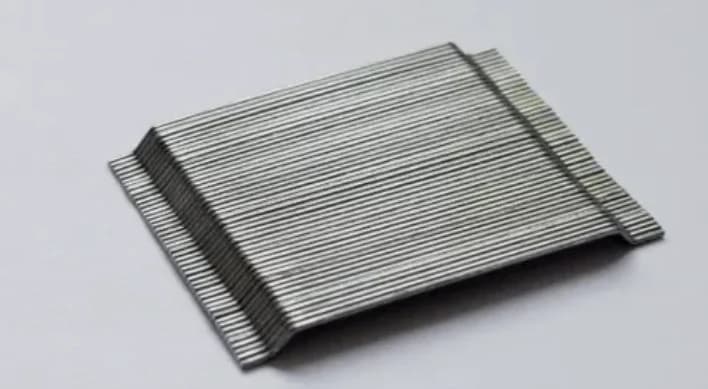
MPZG HT 35/0.55
High-tensile hooked steel fibres with aspect ratio 35/0.55. Maximum anchorage and ductility for heavily loaded structures.
- TypeCold-drawn hooked steel fibre (glued)
- Dimensions35 mm / Ø 0.55 mm
- Tensile strength1345 N/mm² ± 7.5%
- Modulus of elasticity200,000 N/mm²
Pallet price on request
Also read
- Fibres for precast concrete elements: types, dosage and production gains
- Road management on a tight budget: fibre reinforcement for municipalities
- Concrete retaining walls: types, dimensions, concrete grade, prices and fibre reinforced precast