Concrete spalling: causes, signs and repair — the lesson of the A28

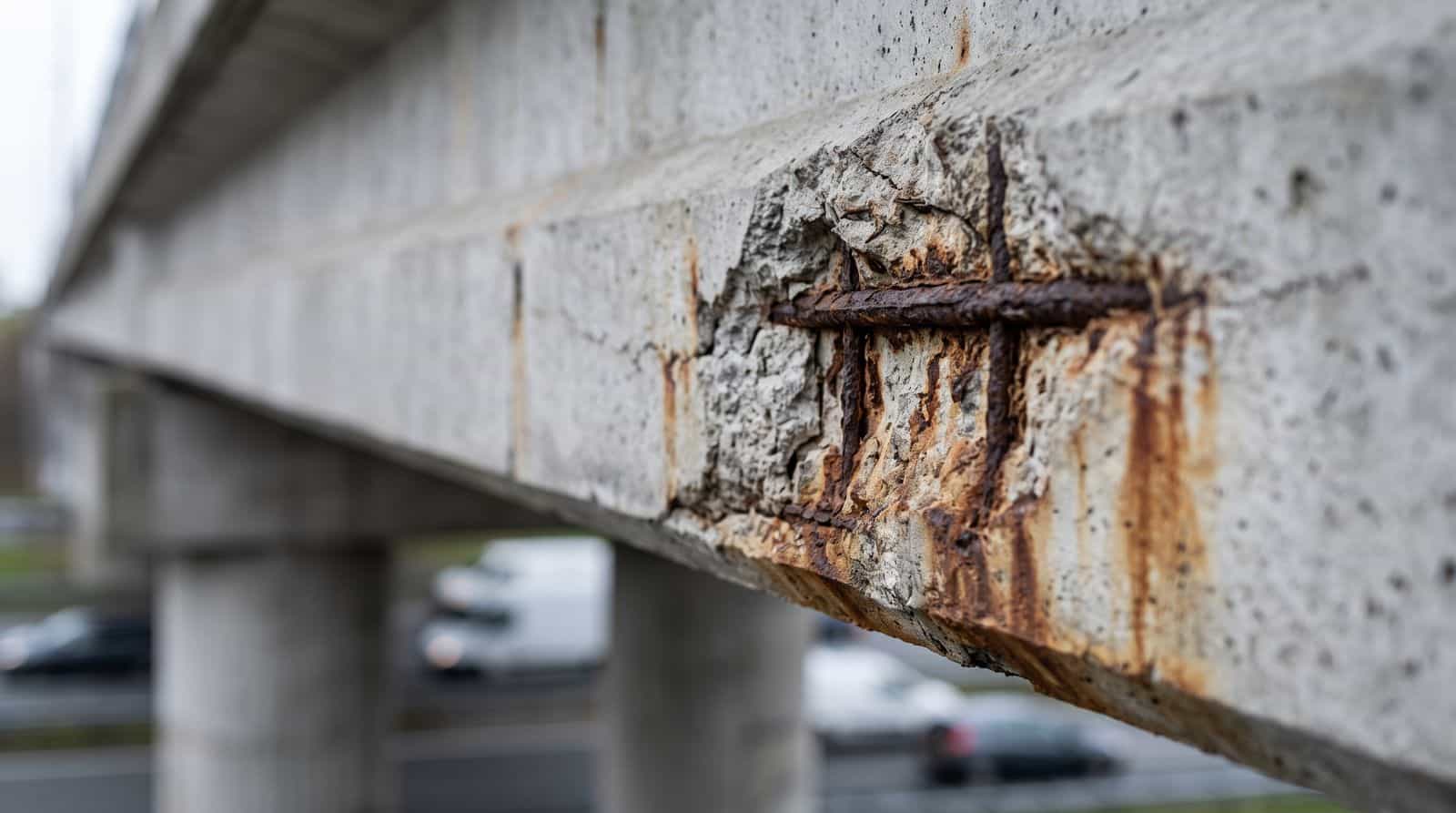
Concrete spalling is caused by corrosion of reinforcing steel and mainly affects structures built between 1960 and 1985. How to recognise it, what repair costs and how non-corrosive fibre reinforcement rules the problem out at source.
Concrete spalling is damage to reinforced concrete caused by corrosion of the reinforcing steel: rust occupies up to six times the volume of the original steel, bursts the concrete cover apart and eventually causes chunks of concrete to break away. It mainly affects structures built between 1960 and 1985. Repair costs an indicative €150 to €500 per m²; prevention is possible with non-corrosive fibre reinforcement.
What is concrete spalling and what causes it?
Concrete normally protects the steel reinforcement embedded in it very well: the highly alkaline environment (pH ≈ 13) forms a passivating layer around the steel that inhibits corrosion. Concrete spalling begins the moment that protection disappears. That happens via two routes: carbonation — CO₂ from the air penetrates the pores and lowers the pH — and chloride ingress, for example from de-icing salts or from calcium chloride that was once added to concrete mortar as a hardening accelerator.
Once started, the process reinforces itself. Rusting steel expands, causing cracks and delaminating concrete cover; through those cracks, moisture, oxygen and chlorides reach the steel even more easily. A thin concrete cover accelerates the process, because moisture and chlorides have less distance to travel to reach the reinforcement. You can read about the full mechanism — and why fibres do not have this failure path — in why reinforcing steel corrodes and how fibres prevent it.
Recognising concrete spalling: the warning signs
The signs of concrete spalling are easy to recognise in the field, usually in this order of severity:
• Rust-brown stains or streaks — corrosion products emerging through the concrete surface.
• Cracks running parallel to the reinforcement — the expanding steel pushes the cover open from within.
• Concrete that sounds hollow when tapped with a hammer — the cover has delaminated but is still in place.
• Detached slabs and visibly rusting reinforcing steel — the stage at which chunks of concrete come loose and can fall.
Note: white lime efflorescence is not concrete spalling, but it can indicate moisture transport through the concrete — a precondition for corrosion. When in doubt, a small diagnostic survey (cover measurement, carbonation depth, chloride content) provides certainty; it usually costs a few hundred euros and prevents you from repairing too much or too little.
After how many years does concrete spalling occur?
That depends on the route. Carbonation penetrates ordinary concrete at roughly 1 mm per year, at a decreasing rate. With a concrete cover of 25–35 mm, it therefore usually takes 30 to 50 years before the carbonation front reaches the reinforcement and corrosion can start. With chloride exposure — de-icing salts on structures, or chloride-containing mortar in the structure itself — it goes faster: damage after 15 to 30 years is then no exception. The A28 viaduct at the Lankhorst interchange dates from 1976 and shed chunks of concrete in 2026, after fifty years.
Which construction years are most at risk?
The risk period lies broadly between 1960 and 1985. Until the early 1980s, calcium chloride was used as a hardening accelerator in concrete mortar — chloride that was therefore inside the concrete from day one. Notorious are the precast Kwaaitaal and Manta floors (produced from around 1965 to 1983) above crawl spaces of houses: the combination of chloride-containing mortar and a damp crawl space is exactly the environment in which concrete spalling thrives. In infrastructure, a large proportion of bridges, locks and viaducts dates from the 1950s to 1970s — often with tighter covers than current standards prescribe and decades of de-icing salt exposure.
Is concrete spalling dangerous? The lesson of the A28
Yes — in two respects. Immediate danger arises from falling debris: on Thursday 29 January 2026, motorists and motorcyclists at the Lankhorst interchange (A28/A32, near Meppel) drove under a viaduct from which chunks of concrete had broken off and landed on the carriageway. Rijkswaterstaat had to carry out emergency works and temporarily close the road. Investigation showed that the steel reinforcement was corroding and that the concrete cover was thin in places, leaving the steel close to the surface — extra vulnerable to moisture and de-icing salts.
The second danger is more insidious: corrosion eats away the cross-section of the reinforcing steel and thereby erodes the load-bearing capacity over time. In houses with affected Kwaaitaal or Manta floors, sudden collapse is rare, but the load-bearing capacity does measurably decrease; in civil structures, advanced spalling can lead to axle-load restrictions or closure.
Lankhorst does not stand alone. Many Dutch civil structures are approaching the end of their technical service life — at the Zeeland Bridge, major maintenance is being carried out in 2026 in which the movable steel sections are being renovated to remedy cracking and extend the service life by at least 30 years. How large that challenge is, and the role fibre reinforcement plays in it, is covered in the largest maintenance challenge ever and what fibre reinforcement means for it.
What does repairing concrete spalling cost?
The cost of spalling repair varies widely with the extent, the accessibility and whether the repair needs to be structural. Indicative, 2026 price level, depending on the project:
• Small, non-structural repair (localised patches, easily accessible) — €50 to €150 per m².
• Structural repair with repair mortar to the EN 1504 series, including de-rusting and corrosion protection of the steel — €150 to €500 per m².
• Repair of a Kwaaitaal or Manta floor above a crawl space — €5,000 to €15,000 per house, depending on the deterioration and the chosen method (repair, support or replacement).
• Cathodic protection for chloride-contaminated concrete — a premium, but often the only durable option when chlorides sit deep in the structure.
Rule of thumb: the earlier you intervene, the smaller the volume of concrete to be removed and the lower the cost. One diagnostic survey is almost always cheaper than waiting a year.
Treating concrete spalling: how professional repair works
Professional treatment of concrete spalling follows a fixed sequence, laid down in the European standard EN 1504 for concrete repair:
• Diagnosis — cover measurement, carbonation depth and chloride content determine where and why the steel is corroding.
• Removal — all deteriorated concrete is chipped or milled away to behind the reinforcement, so the bar is exposed all round.
• De-rusting — the steel is blasted back to bright metal and given a corrosion-inhibiting bonding primer.
• Reinstatement — the cross-section is restored with a repair mortar (EN 1504-3, class R3 or R4 for structural work).
• Protection — a coating or hydrophobic treatment slows renewed ingress of CO₂ and chlorides.
If the damage is accompanied by cracking in floors or walls, also read our guide to structural concrete crack repair — crack repair and spalling repair each require their own approach.
Repairing concrete spalling yourself: when to and when not to
Small, superficial and non-structural patches — a broken-off corner of a garden wall or a non-load-bearing element — you can repair yourself with a ready-mixed repair mortar: remove deteriorated concrete, de-rust the steel with a wire brush, apply primer and fill. Leave anything load-bearing alone: balconies, walkways, lintels, crawl-space floors and civil structures. There, a structural engineer must first determine whether the remaining steel cross-section is sufficient, and repair to EN 1504 by a specialist company is the only responsible route. Simply plastering over a structural element masks the damage and makes later repair more expensive.
Preventing concrete spalling: reinforcement that cannot rust
All repair methods fight the consequences; removing the cause is only possible by using reinforcement that does not corrode. Within fibre reinforced concrete there are two proven routes for this. Non-corrosive basalt fibre reinforcement such as Basalt Wave is made from molten volcanic rock: it does not rust and is also heat-resistant up to around 700 °C. And synthetic fibres that rule out concrete spalling, such as the TwistR macro fibre made of 100% polypropylene, are chemically inert — in a damp, chloride-laden environment, simply nothing happens. Typical dosages are around 2 to 5 kg/m³, depending on the application and the design calculation.
Two caveats belong here. Fibres do not always fully replace traditional reinforcement: in primarily structural work such as bridges, steel reinforcement usually remains (partly) necessary and a calculation by the structural engineer is required. But even in combination with steel, fibres reduce the spalling risk: because they bridge and distribute micro-cracks rather than letting them merge into one large crack, moisture and chlorides penetrate to the steel less easily.
Fibre reinforcement is already directly applicable today in wearing courses and top layers on civil structures (where thin reinforcement meshes are the first to rust), industrial floors, foundations, repair mortars and non-primarily-structural elements. Which fibre suits which application is covered in types of concrete fibres compared.
From repairing to preventing
For managers of infrastructure from the 1950s to 1980s, the A28 case is a warning to look beyond the visible damage: wherever repairs are being carried out anyway, that is the moment to replace a corrosion-prone thin reinforcement layer with fibre reinforcement — the same repair budget then buys decades of extra certainty. Want to know what that means for your project, in dosage and cost? Request a quotation — we are happy to run the numbers with you.
Frequently asked questions
- Is concrete spalling dangerous?
- Yes. Immediate danger arises from falling debris, as at the A28 viaduct at the Lankhorst interchange in January 2026. In addition, corrosion eats away the cross-section of the reinforcing steel, reducing load-bearing capacity over time. For load-bearing elements such as balconies, walkways and crawl-space floors, prompt inspection by a specialist is therefore always sensible.
- After how many years does concrete spalling occur?
- Via carbonation, it usually takes 30 to 50 years before the front reaches the reinforcement (roughly 1 mm per year with 25–35 mm cover). With chloride exposure from de-icing salts or chloride-containing mortar, damage can occur after just 15 to 30 years. A thin concrete cover considerably accelerates both routes.
- Which construction years are at risk of concrete spalling?
- Mainly structures from 1960–1985. Until the early 1980s, chloride-containing hardening accelerators were used in concrete mortar; notorious are Kwaaitaal and Manta floors (around 1965–1983) above damp crawl spaces. Infrastructure from the 1950s to 1970s is also vulnerable due to tighter concrete covers and decades of de-icing salt exposure.
- Can I repair concrete spalling myself?
- Only small, superficial and non-structural patches: remove deteriorated concrete, de-rust the steel, apply primer and repair mortar. Load-bearing elements — balconies, lintels, crawl-space floors — first require assessment by a structural engineer and repair to EN 1504 by a specialist company. Plastering over the damage without tackling the corrosion merely masks it.
- How can I prevent concrete spalling?
- For existing concrete: sufficient cover, a protective coating or hydrophobic treatment, and timely inspection. For new work and repairs, reinforcement that cannot rust is the structural solution: basalt fibres or synthetic macro fibres do not corrode and rule out the failure mechanism behind concrete spalling at source.
Share this article
Products mentioned
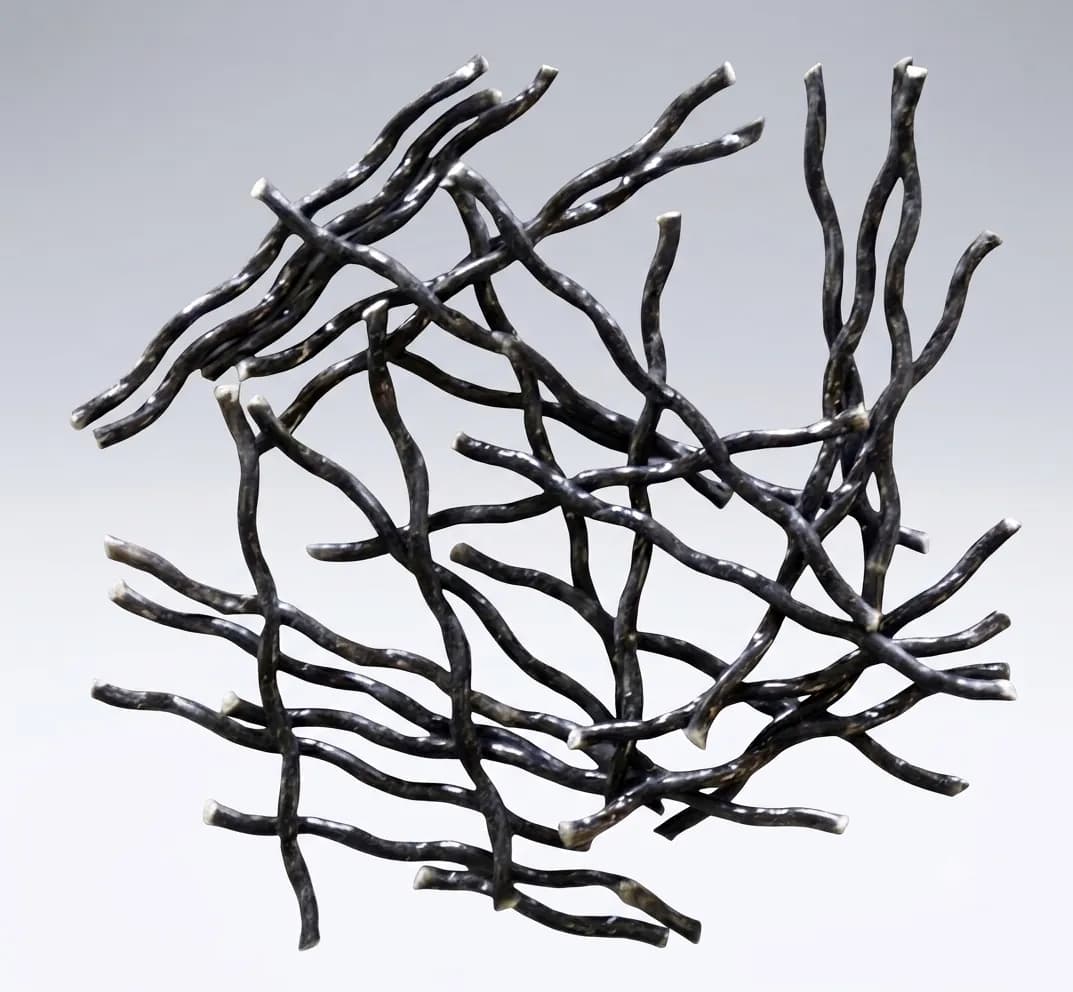
Basalt Wave
Wave-profile basalt fibre for excellent bonding in the concrete matrix. High temperature resistance for demanding constructive applications.
- TypeBasalt macro fibre (wave-profile 3D)
- Length50 mm
- DiameterØ 1.2 mm
- Strand tex2000 tex
 Most chosen
TwistR® GREEN HYBRID
High-performance synthetic macro fibres made from 100% polypropylene. Transforms concrete into a stronger composite material.
- TypeHybrid: twisted monofilament + fibrillating network fibre
- Material100% virgin polypropylene
- Length48 mm
- Dosage2.0 – 6.0 kg/m³
Pallet price on request