Carbonation and corrosion of reinforcing steel: how fibres prevent it

Carbonation and chloride ingress turn protective concrete into a corrosive environment for reinforcing steel. How the mechanism works — and how fibres rule it out.
Carbonation of concrete is the reaction of CO₂ from the air with the hardened cement paste, causing the pH to drop from around 12.5–13 to below 9. This removes the protective layer around reinforcing steel and corrosion begins: the main cause of concrete spalling. Carbonation and chloride ingress are the two principal causes of corrosion of steel reinforcement; too little cover, porous concrete and cracks let both reach the steel sooner. Synthetic and basalt fibres are chemically inert and do not have this failure mechanism.
What causes corrosion of steel reinforcement?
Steel in concrete only corrodes when two conditions are met: the passivating layer around the bar has been lost (depassivation), and moisture and oxygen can reach the steel. The causes of corrosion of steel reinforcement therefore fall into two groups: the mechanisms that break down that protection, and the conditions that let them reach the steel sooner or speed up the corrosion. The main causes at a glance:
• Carbonation: CO₂ from the air lowers the pH of the concrete until the steel is no longer passivated. A slow process, but it affects every exposed surface; explained in detail below.
• Chloride ingress: chlorides from de-icing salt or seawater break through the passivating layer locally, even while the pH is still high. The most aggressive route, typical of car parks and parking decks, bridges and marine structures.
• Chlorides cast into the mix: contaminated aggregate or mixing water, or the chloride-based accelerators (calcium chloride) found in some older concrete. The steel is then at risk from the day of casting.
• Too little concrete cover: sunken spacers and dimensional tolerances shorten the distance that CO₂ and chlorides have to travel to the reinforcement.
• Porous concrete: a high water-cement ratio, poor compaction or inadequate curing leaves an open pore structure through which CO₂, water and chlorides penetrate faster.
• Cracks: shrinkage cracks, settlement cracks and load cracks give CO₂, water and chlorides a shortcut to the steel.
• Moisture and oxygen: once the steel is depassivated, both determine the rate of corrosion. Concrete that alternates between wet and dry corrodes fastest; in permanently dry or permanently water-saturated concrete corrosion is much slower, because either the moisture or the oxygen is lacking.
• Less common causes: stray currents (for example near DC railway lines) and galvanic contact between reinforcing steel and other metals.
Carbonation and chlorides start the corrosion; the other factors decide how soon it starts and how fast it progresses. The sections below explain both mechanisms and show why corrosion-free fibre reinforcement, wherever it can replace the steel, removes the problem instead of merely delaying it.
What is carbonation of concrete?
Fresh concrete is strongly alkaline: the pore water has a pH of around 12.5 to 13 due to the lime (calcium hydroxide) released during cement hydration. In that environment, a thin, dense oxide film forms on embedded reinforcing steel — the so-called passivating layer — which brings further rust formation virtually to a standstill. As long as that layer is intact, the corrosion protection of reinforcing steel in concrete is excellent.
Carbonation undermines that protection from the outside. CO₂ from the air penetrates the concrete through the pores and reacts with calcium hydroxide to form calcium carbonate. That reaction consumes the alkalinity: in the carbonated zone, the pH drops from around 13 to below 9. The concrete itself does not become weaker there — it actually becomes slightly denser and harder. The problem is solely what happens to the steel once the carbonation front reaches the reinforcement: the passivating layer dissolves and the steel is chemically "exposed".
How fast does the carbonation front penetrate?
Carbonation proceeds slowly and slows itself down: the already carbonated outer layer acts as a barrier, so the penetration depth increases roughly with the square root of time. Indicatively, in dense, well-compacted concrete (higher strength class, low water-cement ratio) the front penetrates some 5 to 10 mm after 25 years; in porous or poorly cured concrete this can be 15 to 25 mm. Exterior surfaces that alternate between wet and dry carbonate fastest; permanently wet concrete hardly at all, because the pores are full of water.
The depth is easy to measure with a phenolphthalein indicator on a fresh fracture surface or drilled core: the non-carbonated part turns pink, the carbonated zone remains colourless. If the colourless front reaches or passes the reinforcement, corrosion initiation is only a matter of time.
Chloride ingress: the second route to corrosion
Alongside carbonation, there is a second, more aggressive initiation mechanism: chlorides. De-icing salt on roads, bridges and car park ramps, and seawater in coastal and marine structures, supply chloride ions that migrate towards the reinforcement through pores and micro-cracks. Chlorides can break through the passivating layer locally while the pH is still high — so the concrete does not need to carbonate first. As a rule of thumb, a critical chloride limit of around 0.4% of the cement mass at the level of the reinforcement applies.
Chloride-initiated corrosion is more treacherous than carbonation corrosion: it is often locally concentrated (pitting corrosion) and can rapidly erode the steel cross-section locally before much is visible at the surface. Car parks are the classic damage pattern: cars drag de-icing salt inside, the brine soaks into the floor and years later the reinforcement in the top zone turns out to be affected.
Why rusting reinforcing steel bursts the concrete apart
Once the passivating layer is gone and moisture and oxygen are available, the steel starts to rust. Rust occupies a volume two to six times greater than the original steel. That volume increase builds up a stress in the surrounding concrete that far exceeds the tensile strength of concrete — only around 10% of its compressive strength. The result: cracks along the reinforcement, delamination of the cover (spalling) and the familiar rust-brown traces. This expansion mechanism is the direct cause of concrete spalling.
The process reinforces itself. Every corrosion crack admits more moisture, CO₂ and chlorides, accelerating the corrosion and also reducing the effective steel cross-section — and with it the design capacity of the reinforcing steel (B500B, yield strength 500 N/mm²). In advanced damage, the load-bearing capacity of the element is at stake and repair by a specialist is required.
This article covers the mechanism and its prevention. If you already have visible damage — rust traces, delaminated cover, exposed reinforcement — then read the article on recognising and tackling concrete spalling and the practical guide to repairing cracks and concrete floors.
Concrete cover: the classic defence and its limits
The traditional protection against both mechanisms is distance: sufficient dense concrete between environment and steel. The required nominal concrete cover increases with the aggressiveness of the environment (exposure classes to EN 206 / Eurocode 2), indicatively:
• XC1 (dry, indoors) — around 20–25 mm nominal cover
• XC3/XC4 (outdoors, alternately wet and dry) — around 30–35 mm
• XD3 (de-icing salt, e.g. car park decks) — around 40–50 mm
• XS classes (seawater/coastal zone) — around 40–55 mm
For concrete cover in foundations cast against unprepared ground, a practical minimum of 50 to 75 mm additionally applies, because dimensional accuracy on a blinding layer or subgrade is poor.
Cover works — but only if it is actually there. On site, sunken spacers, too tightly bent meshes and dimensional tolerances are notorious causes of locally 10–20 mm too little cover. It is precisely at those spots that damage starts decades later. In thin elements (screeds, precast shells, architectural concrete), the required cover is moreover physically almost impossible to accommodate. The classic defence is therefore good, but vulnerable to workmanship errors and unsuitable for thin cross-sections.
Why fibre reinforcement does not have this failure mechanism
Synthetic fibres (polypropylene, aramid) and basalt fibres are chemically inert to the corrosion process: they do not react with oxygen, water or chlorides the way steel does. There is no passivating layer that can break down, no rust that can expand, and therefore no corrosion-driven cracking. Whether the concrete carbonates or becomes chloride-laden makes no difference to the fibre. Moreover, fibre reinforcement is distributed three-dimensionally throughout the entire cross-section — the concept of "too little cover" does not exist, because there is no critical position that needs protecting.
On tensile strength, modern fibres need not yield to steel: the tensile strength of reinforcing steel B500B is at least around 540 N/mm² (yield strength 500 N/mm²), and high-grade synthetic macro fibres achieve tensile strengths of the same order, while basalt fibres per filament sit well above that. The real difference lies in the way they work: fibres bridge micro-cracks distributed throughout the matrix and give the concrete post-cracking toughness (tested to EN 14651), whereas bars absorb concentrated tensile forces. For floors on sand, pavings, screeds and many precast applications, fibre reinforcement is therefore a fully-fledged alternative; for heavy structural work (beams, columns, retaining structures), conventional reinforcement or a hybrid solution remains necessary — always based on a calculation by the structural engineer.
Basalt fibre deserves one honest caveat: the material has excellent heat resistance (up to around 700 °C) and does not corrode, but it is not indefinitely alkali-resistant — in the alkaline concrete environment, some long-term degradation of the fibre surface occurs. Quality fibres such as Basalt Wave are therefore provided with a protective coating (sizing) that strongly slows this down.
Steel fibre is not reinforcing steel
Steel fibre concrete occupies a middle position in this story. Loose steel fibres of 35–60 mm can indeed rust at the surface and produce rust spots, for example after wear of the top layer. Structurally this is rarely a problem: an individual corroding fibre — unlike a continuous bar — causes no expansion damage deep in the cross-section, because the rust volume per fibre is minimal and no continuous corrosion path exists. Aesthetically, and in chemically aggressive or permanently wet environments (slurry pits, wash bays, exposed floors), it is a reason to choose synthetic or basalt fibre reinforcement instead of steel fibre.
Prevention matrix: which fibre for which environment?
How do you prevent concrete spalling in new construction or replacement? Choose the reinforcement strategy based on the corrosion risk of the environment. As a guide:
• Dry indoor climate (XC1), heavily loaded industrial floor — steel fibre or synthetic macro fibre; the corrosion risk here is small, so the choice comes down to performance and price.
• Exterior paving and yard floors with de-icing salt (XC4/XD3) — corrosion-free synthetic fibres such as TwistR, a macro fibre made of 100% polypropylene that replaces traditional reinforcing steel in floors and pavings without a single gram of corrodible material.
• Agricultural floors with manure acids and cleaning agents — synthetic macro fibre; see the article on fibre reinforced concrete in the agricultural sector for dosages and practical experience.
• Permanently damp or chemically loaded environments (marine works, basements, wash bays) — chemically inert fibre reinforcement: synthetic macro fibre or coated basalt fibre as a structural fibre that cannot rust.
• Thin cross-sections and exposed work (screeds, precast, architectural concrete, greenhouse paths) — micro and macro fibres; the cover requirement lapses and rust bleed-through is ruled out. In greenhouse horticulture this is already standard practice, see fibre reinforcement in greenhouse construction.
• Heavily structural elements in an aggressive environment — hybrid: conventional reinforcement with increased cover, supplemented with fibres against shrinkage cracks that would admit chlorides. Have the combination calculated by the structural engineer.
Rule of thumb for dosage: synthetic macro fibres for floor applications are dosed at an indicative 2 to 5 kg/m³, depending on loading and slab geometry — a fraction of the 30 to 60 kg of steel per m³ that a traditional reinforcement mesh in a floor represents, and without bending, fixing and lifting work on site.
From risk analysis to fibre choice
Corrosion of reinforcing steel is the most predictable and most avoidable cause of damage in concrete: the mechanism — carbonation or chloride ingress, depassivation, expansion — is fully understood. Anyone who honestly assesses the environment at the design stage can structurally rule out the risk by applying corrosion-free fibre reinforcement in the right places. Want to know more about the material side? The pillar page on fibre reinforced concrete brings together all articles on fibre types, dosages and standards (EN 14889).
Unsure which fibre suits your exposure class and application? The selection guide takes you in a few questions from environment and loading to a concrete fibre recommendation, including an indicative dosage.
Frequently asked questions
- What is carbonation of concrete?
- Carbonation is the reaction of CO₂ from the air with calcium hydroxide in the hardened cement paste, forming calcium carbonate. The pH of the concrete thereby drops from around 12.5–13 to below 9. The concrete itself remains strong, but the protective passivating layer on the reinforcing steel disappears, so the steel starts to rust in the presence of moisture and oxygen.
- How fast does concrete carbonate?
- The penetration depth grows roughly with the square root of time. Indicatively, the carbonation front reaches some 5–10 mm after 25 years in dense, well-cured concrete; in porous concrete this can be 15–25 mm. Alternately wet and dry exterior surfaces carbonate fastest. The depth can be measured with a phenolphthalein test on a drilled core or fresh fracture surface.
- What causes concrete spalling?
- Concrete spalling is caused by corrosion of the embedded reinforcing steel, initiated by carbonation or by chlorides from de-icing salt or seawater. Rust occupies a volume two to six times greater than steel and bursts the surrounding concrete apart: first cracks along the reinforcement, then delaminated cover and rust traces. See also the article on recognising and repairing concrete spalling.
- How can you prevent concrete spalling?
- In conventional design: sufficient concrete cover per exposure class (indicatively 20–25 mm indoors up to 40–55 mm with de-icing salt or seawater), dense concrete and good curing. More structural is ruling out the corrosion mechanism with corrosion-free reinforcement: synthetic macro fibres such as TwistR or coated basalt fibres can fully replace the rust-prone steel in floors and pavings.
- Can fibres fully replace reinforcing steel?
- In floors on sand, yard pavings, screeds and many precast elements, yes: there, macro fibres deliver the required post-cracking toughness (demonstrable via EN 14651 tests). For heavily structural elements such as beams, columns and retaining walls, conventional reinforcement or a hybrid solution remains necessary. Always have the application assessed by the structural engineer, or start with the selection guide.
Share this article
Products mentioned
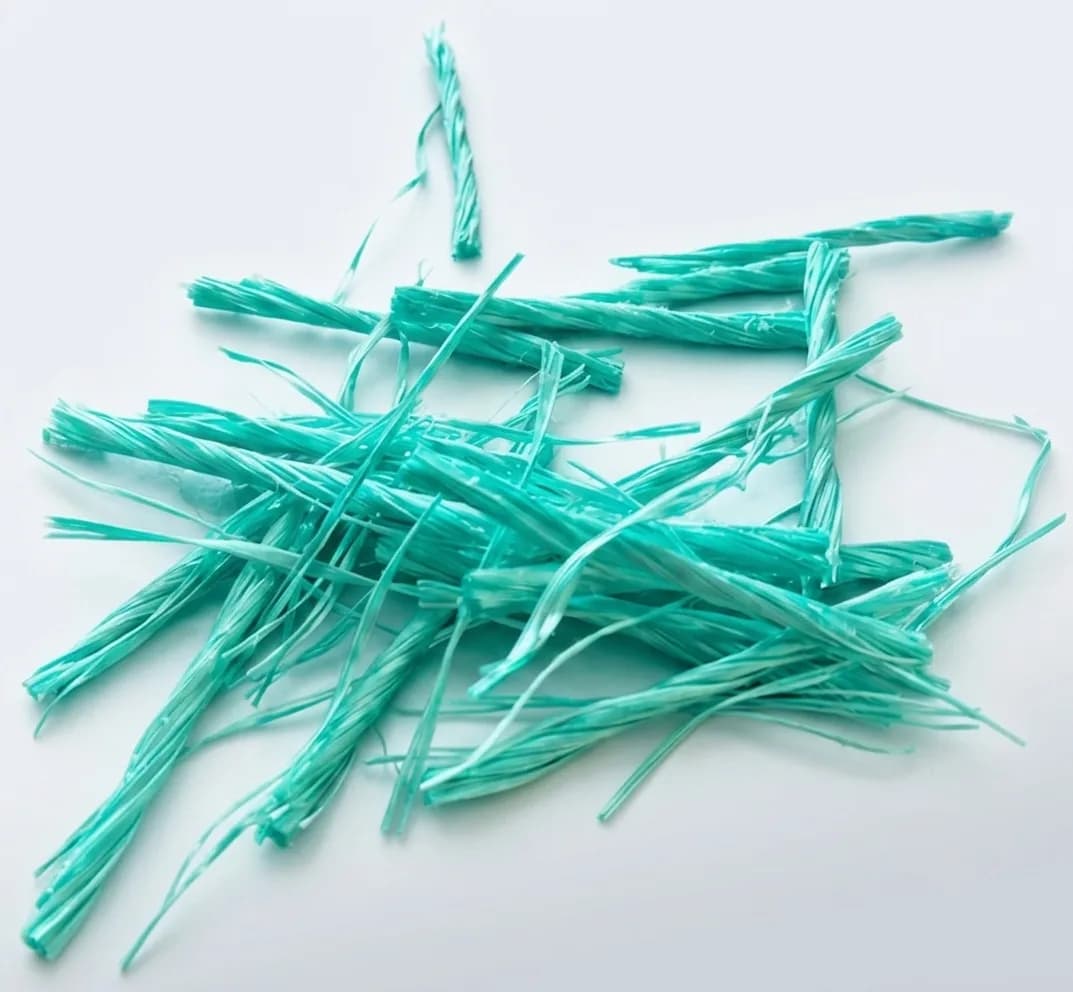 Most chosen
TwistR® GREEN HYBRID
High-performance synthetic macro fibres made from 100% polypropylene. Transforms concrete into a stronger composite material.
- TypeHybrid: twisted monofilament + fibrillating network fibre
- Material100% virgin polypropylene
- Length48 mm
- Dosage2.0 – 6.0 kg/m³
Pallet price on request
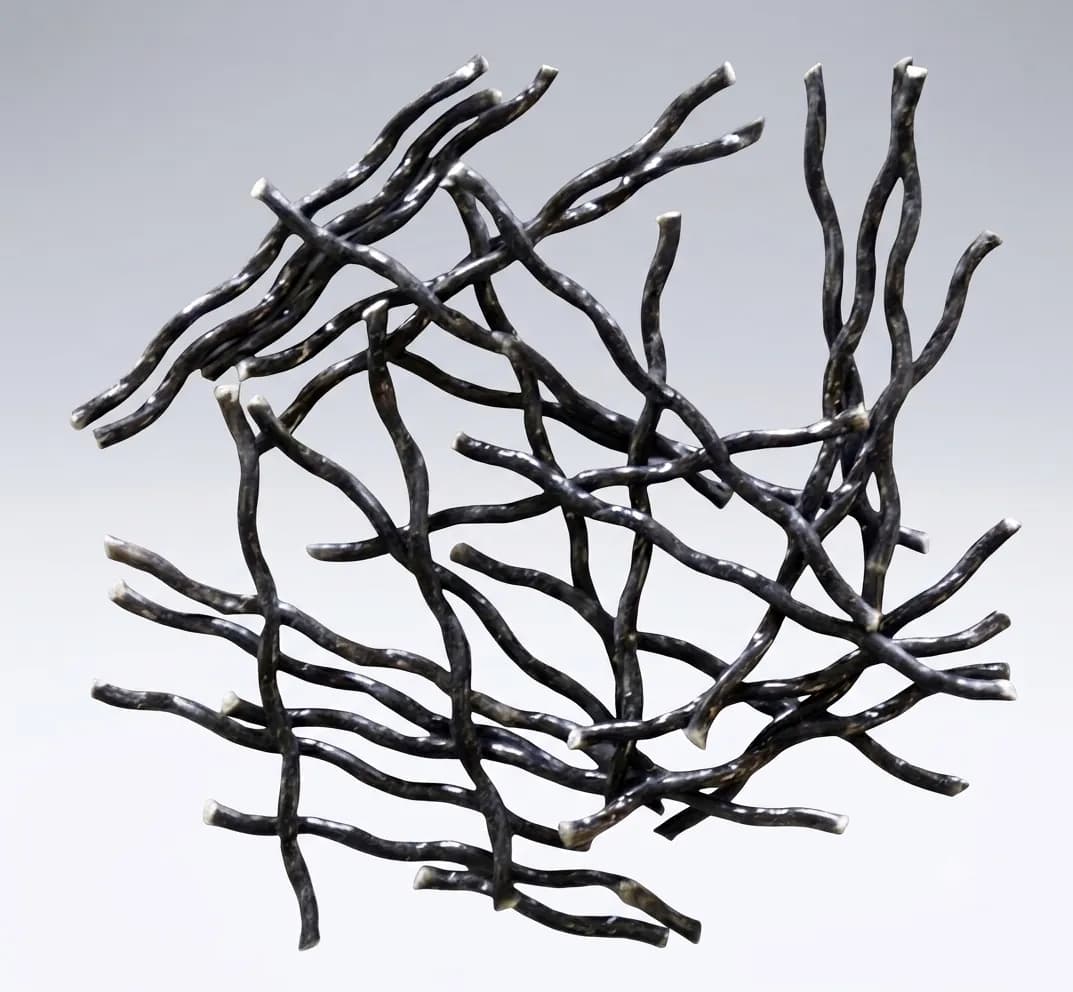
Basalt Wave
Wave-profile basalt fibre for excellent bonding in the concrete matrix. High temperature resistance for demanding constructive applications.
- TypeBasalt macro fibre (wave-profile 3D)
- Length50 mm
- DiameterØ 1.2 mm
- Strand tex2000 tex