Replacing a timber bridge deck: composite, plastic or fibre reinforced concrete?

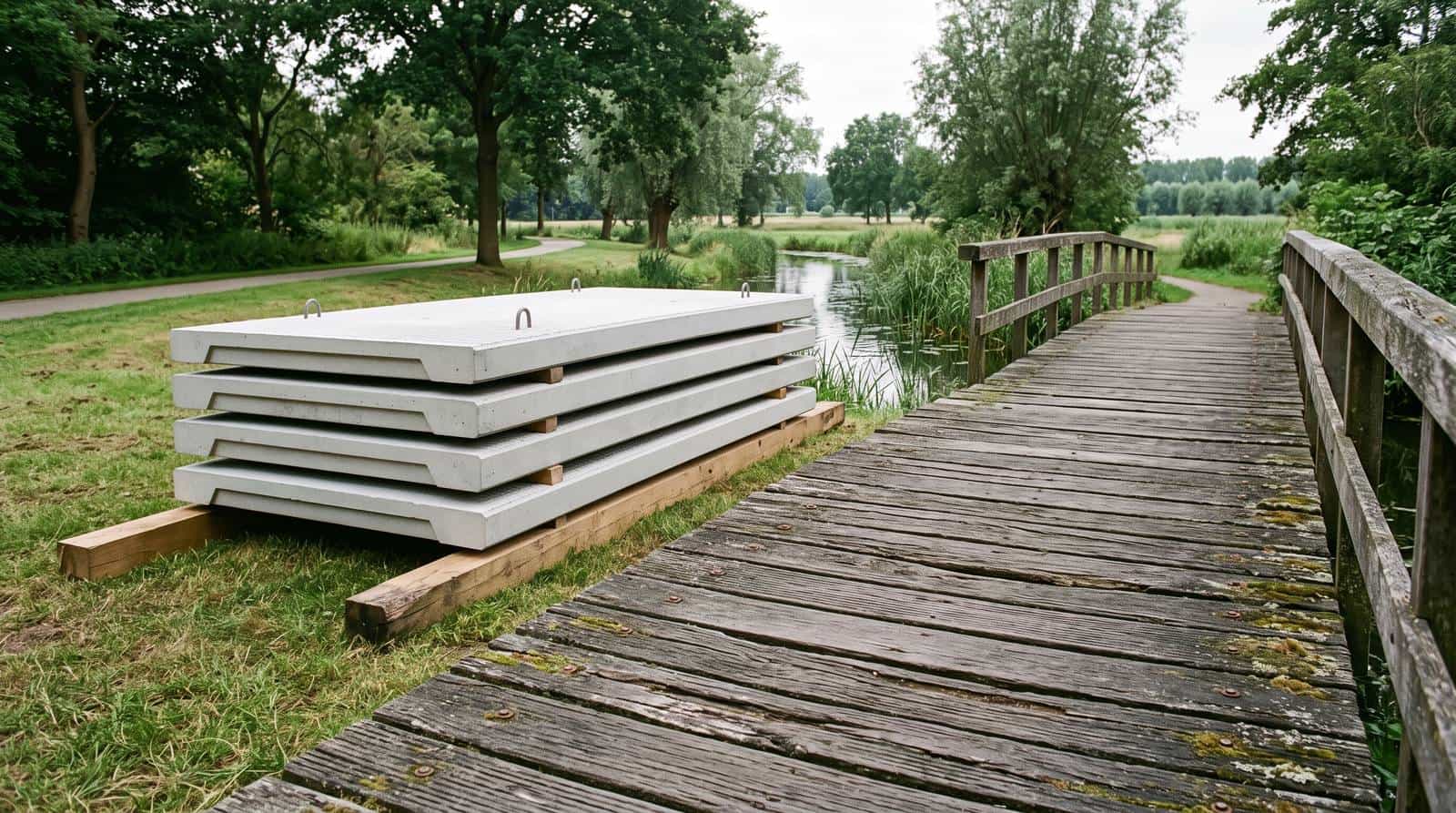
A timber bridge deck needs replacing every 15 to 25 years. Compare the three alternatives — composite, recycled plastic and precast fibre reinforced concrete — on service life, maintenance, weight, price and circularity.
A timber bridge deck lasts, depending on timber species and detailing, an indicative 15 to 25 years. When replacing it, asset managers choose between composite, recycled plastic and fibre reinforced concrete. Precast fibre reinforced concrete deck units combine the 100-year design life customary for concrete bridges (EN 1990) with corrosion-free fibre reinforcement and installation within a single short closure.
Why timber bridge decks are replaced
Timber is an appealing material for cycle and pedestrian bridges, but in the Dutch outdoor climate it works continuously against the asset manager. Three mechanisms determine the end of its service life:
• Rot and decay — moisture enters through fixing holes, end grain and the bearings; it is precisely where planks rest on the beams that hidden rot develops, coming to light only at inspection or when the deck deflects.
• Slipperiness — a wet or shaded deck becomes overgrown with algae and turns treacherously slick. An anti-slip wearing layer helps, but wears away under cycle traffic within a few years and has to be reapplied time and again.
• A short, labour-intensive maintenance cycle — annual inspections, interim plank replacement, retightening screws and, after 15 to 25 years, a full deck replacement. Sustainably certified hardwood such as azobé has, moreover, become scarcer and more expensive.
For municipalities this counts double: they manage thousands of small bridges and culverts, a large share of which date from the same construction period and therefore fall due for replacement almost simultaneously. That broader context — maintaining more assets on the same budget — is sketched in the greatest maintenance challenge ever. Anyone who does have to replace a deck is well advised not to put timber straight back, but to compare the alternatives on whole-life cost.
The three alternatives to a timber bridge deck
When replacing a timber deck on an existing substructure, there are three common routes. All three are lower-maintenance than timber; they differ chiefly in service life, weight, price and circularity.
Composite bridge deck (fibre reinforced plastic)
A composite bridge deck consists of glass fibre reinforced plastic (GRP): glass fibres in a thermosetting resin matrix, usually as hollow or filled sandwich panels. The result is a very light and stiff deck that neither rots nor corrodes. Suppliers quote design lives of 50 to 100 years, with little more maintenance than periodic cleaning and, in due course, a new wearing layer.
The downsides: the purchase price is clearly above that of timber, and the thermosetting resin still makes high-grade recycling difficult at end of life — in practice, decommissioned composite decks are mainly shredded and downcycled, or incinerated with energy recovery.
Plastic bridge deck (recycled plastic)
A plastic bridge deck of recycled plastic planks is the most direct timber substitute: the same plank format, the same fixing onto the existing beams. The material does not rot or splinter, needs no preservative treatment and can be recycled again at end of life.
Structurally, however, recycled plastic is the weakest of the three options: its stiffness is low and the material creeps under sustained loading. Plastic planks therefore work mainly over short spans between the beams of light pedestrian and cycle bridges; for heavier traffic or greater spans, a steel substructure or a different deck material is needed.
Concrete bridge deck of fibre reinforced concrete
The third route is a concrete bridge deck of precast fibre reinforced concrete: factory-cast deck units in which fibre reinforcement wholly or largely replaces the traditional reinforcement mesh. Concrete knows no rot, no slippery algae film as on timber (the surface is brush-finished or profiled) and for concrete bridges a design life of 100 years to EN 1990 is the customary starting point — four to six timber deck cycles in one go.
The classic objection to concrete in thin decks was the steel reinforcement: it requires concrete cover and rusts as soon as chlorides from road salt penetrate. Fibre reinforcement of plastic or basalt removes precisely that failure mechanism, making thin, relatively light deck units possible. How that corrosion problem works with traditional reinforcement is explained in our article on concrete decay through corrosion of reinforcing steel.
Timber, composite, plastic and fibre reinforced concrete compared
The trade-off per criterion, with timber as the reference (values indicative and depending on design, loading and detailing):
• Service life — timber: around 15–25 years per deck; composite: 50–100 years according to suppliers' design assumptions; recycled plastic: a few decades under light loading; fibre reinforced concrete: 100-year design life (EN 1990).
• Maintenance — timber: annual inspection, replacing planks and wearing layer; composite: cleaning and periodically a new wearing layer; plastic: virtually maintenance-free, though creep and fixings need checking; fibre reinforced concrete: virtually maintenance-free, no preservative systems and no corrosion inspections on the deck.
• Weight — composite: the lightest; plastic: comparable with or slightly heavier than hardwood; timber: relatively light; fibre reinforced concrete: the heaviest — a deck of 120 to 150 mm weighs around 290 to 360 kg/m² at 2,400 kg/m³, which makes a check of abutments and beams essential.
• Price — timber: lowest purchase price, highest maintenance and replacement costs; composite: highest purchase price, low operating costs; plastic: mid-range for light bridges; fibre reinforced concrete: mid-range in purchase and the lowest cost per year of service life once the substructure can take the weight (indicative, 2026 price level, depending on project).
• Circularity — timber: renewable, but short cycles and treated sections as a waste stream; composite: recycling of thermosets still limited; plastic: made from and suitable again for recyclate; fibre reinforced concrete: fully crushable into mixed aggregate, and with plastic fibres up to 98% CO₂ reduction on the reinforcement compared with steel.
The outcome depends heavily on the situation: for a light park bridge on a slender steel substructure, composite or plastic can be the logical choice; as soon as the substructure can take the mass and the asset manager wants out of the maintenance cycle, fibre reinforced concrete usually wins the whole-life cost comparison.
When does fibre reinforced concrete win?
Fibre reinforced concrete is the strongest candidate for deck replacement in three situations:
• A light precast deck on an existing substructure — because fibres need no concrete cover like steel mesh does, the deck thickness can come down. With a light precast fibre reinforced concrete deck based on a synthetic macro fibre such as TwistR (dosage 2–6 kg/m³, 100% polypropylene), the weight stays manageable and steel fixing in the factory is eliminated entirely.
• Thin decks in a chloride environment — road salt is the death knell for thin reinforced concrete. So choose corrosion-free reinforcement for thin bridge decks: the corrugated basalt fibre Basalt Wave is mineral, corrosion-free and heat-resistant up to around 700°C, and anchors optimally in the concrete matrix through its 3D wave profile.
• More heavily loaded decks and a precast concrete bridge in one piece — where maintenance or agricultural traffic must cross the deck alongside cyclists, high-tensile steel fibres such as the MPWG HT+ 50/0.90 (tensile strength 2,100 N/mm², double hooked ends, dosage 10–35 kg/m³ to EN 14889-1) deliver the required residual strength.
For all these variants: a bridge deck is structural work. The extent to which fibres replace traditional reinforcement follows from a calculation by the structural engineer based on residual strength tests to EN 14651 — not from the brochure. And the weight of the new deck must always be checked against the load capacity of the existing abutments and intermediate supports.
Execution: precast deck units and a short closure
The great execution advantage of precast fibre reinforced concrete is the short closure. The replacement process runs in four steps:
• Step 1: inspection and survey — assessment of abutments, beams and bearings for load capacity and remaining life; the new deck is engineered to size, including parapet anchor and drainage details.
• Step 2: factory production — the deck units are cast in steel moulds while the bridge simply stays in use. The fibres go into the mixer per batch; only lifting anchors and any edge reinforcement remain steel.
• Step 3: the swap — the timber deck is removed and the precast units are lifted in and finished. For an average cycle or pedestrian bridge that means a closure of days rather than weeks.
• Step 4: handover — no preservative system, no wearing layer cycle; the deck enters the management cycle with periodic inspection only.
How fibres speed up the production process in the precast factory — and why bridge elements in particular benefit — is covered in fibre reinforcement in precast concrete elements. If the bridge has a concrete deck with a worn asphalt wearing layer, full replacement is, incidentally, not always necessary: a thin fibre reinforced concrete layer over the existing surface, as with white topping, can also extend the service life.
From inspection to replacement plan
If a single timber bridge is on the schedule, a one-to-one comparison of the three alternatives on whole-life cost pays off. If you manage dozens, bundling pays off: a single functional call-off for a series of deck replacements brings down the precast price per deck and makes the planning of closures manageable. How to frame such a functional requirement within existing contracts is set out in fibre reinforcement for municipal road management; more applications for road authorities can be found in the pillar applications and target groups.
Want to know which fibre and dosage suit your bridge deck — synthetic macro fibre, basalt or steel? Send us the deck drawing and load class via a project-specific quotation; we calculate along with you from the first design study onwards.
Frequently asked questions
- How long does a timber bridge deck last?
- An indicative 15 to 25 years, depending on timber species, detailing and sun exposure. Hardwoods such as azobé reach the upper end of that range with good detailing; bearings and fixing points are usually the first to go, through hidden rot. By comparison: for concrete bridge decks a design life of 100 years to EN 1990 is the customary starting point.
- What is the difference between a composite and a plastic bridge deck?
- A composite bridge deck consists of glass fibre reinforced plastic: light, stiff and suitable for complete decks with design lives of 50 to 100 years, but difficult to recycle. A plastic bridge deck of recycled planks is a direct timber substitute on existing beams: readily recyclable, but less stiff and prone to creep, so mainly suited to light pedestrian and cycle bridges.
- Can a concrete deck go on the existing timber or steel substructure?
- Sometimes, but not as a matter of course. A fibre reinforced concrete deck of 120 to 150 mm weighs around 290 to 360 kg/m² — more than timber or composite. The structural engineer checks abutments, beams and bearings against that weight; thanks to the absence of cover over steel mesh, the fibre reinforced concrete deck can be thinner and lighter than traditionally reinforced concrete. If the load capacity falls short, composite is the lightweight alternative.
- How long is the bridge closed when the deck is replaced?
- With precast fibre reinforced concrete deck units, usually days rather than weeks: the units are cast in the factory while the bridge stays in use, after which the old deck is swapped out in one short closure. The exact duration depends on bridge width, accessibility and the number of deck units; with series replacement of several bridges, the closure per bridge can be shortened further.
- Why fibre reinforcement instead of reinforcement mesh in a bridge deck?
- Steel mesh requires concrete cover and corrodes as soon as road salt chlorides penetrate the concrete — the dominant failure mechanism in thin decks. Fibres of plastic or basalt do not rust and sit throughout the entire volume, allowing thinner and lighter deck units. Performance is standardised via EN 14889 and residual strength tests to EN 14651; for structural work, the structural engineer determines the dosage.
Products mentioned
 Most chosen
TwistR® GREEN HYBRID
High-performance synthetic macro fibres made from 100% polypropylene. Transforms concrete into a stronger composite material.
- TypeHybrid: twisted monofilament + fibrillating network fibre
- Material100% virgin polypropylene
- Length48 mm
- Dosage2.0 – 6.0 kg/m³
Pallet price on request
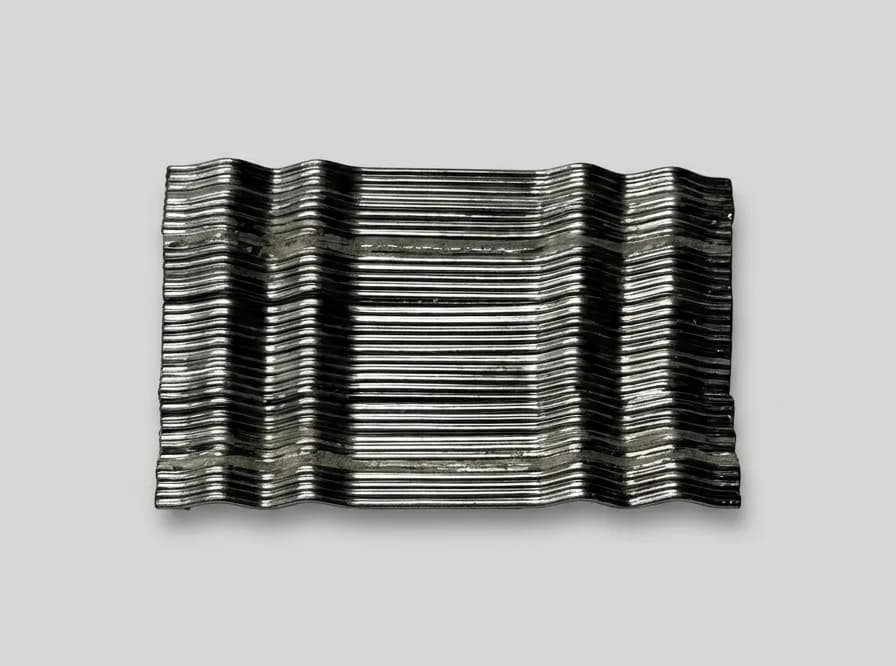
MPWG HT+ 50/0.90
High-tensile hooked steel fibres with aspect ratio 50/0.90. Maximum anchorage and ductility for heavily loaded structures.
- TypeCold-drawn hooked steel fibre (glued)
- Dimensions50 mm / Ø 0.90 mm
- Tensile strength2100 N/mm² ± 7.5%
- Performance class56
Pallet price on request

Basalt Wave
Wave-profile basalt fibre for excellent bonding in the concrete matrix. High temperature resistance for demanding constructive applications.
- TypeBasalt macro fibre (wave-profile 3D)
- Length50 mm
- DiameterØ 1.2 mm
- Strand tex2000 tex