Tendering sustainable roads: how provinces do it with fibres


Provinces steer sustainability through the tender: EMVI criteria such as an ECI ceiling and a service-life requirement make fibre reinforcement assessable — and performance measurement holds the promise after award.
Dutch provinces procure sustainable roads through an EMVI tender (since the 2016 Procurement Act formally BPKV, best price-quality ratio): alongside price, award criteria such as an ECI ceiling, service life and production temperature count. Fibre reinforcement scores on all those criteria — on the provincial N337 it delivered 50% less rutting and around 30% longer service life.
Why the tender is the province's key steering instrument
Provinces, more than many municipalities, have the scale and expertise to act as a testing ground for innovative road materials. The province of Utrecht, for example, has laid several trial sections with biobased asphalt under the CIRCUROAD programme, in cooperation with market parties. Provinces can play the same role for fibre-reinforced asphalt and concrete — and the instrument for it is not the maintenance budget, but the tender document. What the province rewards in award criteria, the market will offer.
The business case is also stronger on provincial roads than elsewhere. Provincial roads carry higher traffic volumes than municipal roads, so every measure for service-life extension pays back faster there: the more intensive the use, the greater the gain from a longer maintenance cycle. Add to that the asset renewal challenge: like the national highways agency, provinces face a substantial renewal wave of bridges, viaducts and roads from the 1950s and 1960s. Within the pillar applications and target groups, the provincial tender is thus one of the most direct routes to scaling up innovation.
What is an EMVI tender — and what does BPKV stand for?
EMVI stands for Economisch Meest Voordelige Inschrijving — the Economically Most Advantageous Tender: awarding on the best combination of price and quality, rather than on the lowest price alone. Since the Dutch Procurement Act 2016, EMVI has formally been the umbrella term with three variants — best price-quality ratio (BPKV), lowest cost based on cost-effectiveness (life cycle costs) and lowest price. In civil engineering practice, EMVI/BPKV are used interchangeably for the same principle: expressing quality as a notional discount on the tender sum.
For the full explanation of the methodology — how the notional discount is calculated, which assessment methods exist and how bidders build an EMVI plan — we refer you to EMVI tenders: meaning and criteria. This article focuses on the client side: drawing up criteria, assessing them and holding on to the performance after award.
Drawing up EMVI criteria: from ECI ceiling to service-life requirement
The art of good EMVI criteria is measurability: a criterion the assessment panel cannot test objectively produces disputes and litigation risk. For sustainable road maintenance, a set of criteria has proven itself in civil engineering that is both measurable and distinctive. An example set of EMVI award criteria for a provincial asphalt contract (indicative — the weighting is up to the contracting authority):
• ECI score (DuboCalc) — a ceiling value in the specification as a validity requirement, plus a notional discount per euro of ECI reduction below the ceiling
• Service life — extra years of warranty or demonstrated life extension relative to the reference construction
• Production temperature — a notional discount for lower-temperature asphalt (less gas consumption and fewer emissions at the plant)
• CO2 Performance Ladder — fixed discount percentages per rung, rising to rung 5
• Disruption reduction — shorter closures or smarter phasing, expressed in traffic disruption days
The ECI criterion is the linchpin. The Environmental Cost Indicator expresses all environmental effects of a mix in a single euro amount, calculated with DuboCalc on the basis of product records from the Dutch national environmental database (NMD). By combining a ceiling value with a discount per euro of reduction, you reward frontrunners without excluding the rest of the field. How that calculation works and what fibre reinforcement contributes to it is set out in ECI and DuboCalc for fibre reinforcement.
Functional specification keeps innovation in
Just as important as what the criteria contain is what is left out of the specification. Prescribing a mix design or reinforcement method unintentionally excludes solutions that score better on the performance requirements. Functional specification — setting requirements for ECI, service life, skid resistance and evenness rather than for composition — gives fibre reinforcement a fair chance without restricting the market. It also prevents the province itself carrying the technical responsibility for a prescribed innovation: that stays with the bidder who offers it.
EMVI performance measurement: holding the promise after award
An EMVI promise is only worth something if it is kept. That is why every quality-based award should include EMVI performance measurement during execution: the client periodically checks whether the bidder is actually delivering the promised quality, with a sanction announced in advance — usually a deduction equal to (part of) the notional EMVI advantage — if it is not.
For sustainability criteria that means, concretely: verifying the ECI calculation against the mixes actually delivered and the consignment notes, checking the production temperature via the asphalt plant's records, and linking service-life claims to measurable condition indicators such as rutting, longitudinal evenness and crack pattern at handover and after one or more winters. Independent measurements — for example supervised by a research institute — give the results extra authority, including towards other road managers watching on.
What fibre reinforcement scores on these criteria
Fibre-reinforced asphalt serves several EMVI criteria at once. Aramid fibres for provincial roads are added to a standard mix at a low dosage — indicatively around 0.05%, or some 500 grams per tonne of asphalt, depending on mix and application — without any change to the mix design. The effect is proven on the N337 near Olst: over 8 kilometres of provincial road between Zwolle and Deventer, it delivered 50% less rutting and 30% less cracking than the reference section, with around 30% longer expected service life — a direct gain on the service-life criterion plus fewer maintenance interventions in the ECI calculation.
The environmental performance is substantiated too. In the European FIBRA research on the A73, the aramid fibre mix scored more than 10% lower on ECI at cradle-to-gate level than the PMB reference, at a 15 to 20 degrees Celsius lower production temperature and equivalent performance in practice. The full measurement results are in the A73 case study with FIBRA results.
For the concrete side of the provincial portfolio — cycle paths, roundabouts, bus stop bays — the same principle applies. Fibre concrete for provincial cycle paths replaces the traditional steel mesh, saving steel, a work stage and CO2. The province of Friesland delivered a European first along the N355 with a white topping cycle path: a thin concrete layer with macro fibres straight over the existing asphalt, so the old asphalt did not have to be removed and the concrete is 100% reusable. A caveat for the tender: in structural applications, fibres do not always fully replace traditional reinforcement — a calculation by the structural engineer remains required, and the specification should say so.
Trial sections and validation: with the market and research institutes
If you do not yet dare to request an innovation portfolio-wide, start with a trial section. Provinces have the scale to lay trial sections of hundreds of metres to kilometres — more robust field data than small-scale municipal strips — and direct lines to research institutes and industry bodies such as CROW and the Asphalt Knowledge Centre. Independent monitoring of such a trial section, as the FIBRA research did on the A73, gives the results authority towards your own organisation and other road managers alike.
A trial section is also the natural stepping stone in the procurement strategy: first validate within an ongoing maintenance contract, then include the validated performance as an EMVI criterion or requirement in the next contract. For the road contractor bidding, fibre reinforcement thus becomes a predictable quality lever instead of a risk. How you as a road manager can take part in such a validation programme is covered in help validate the asphalt of the future.
From specification to award: how to begin
The route can be summarised in four steps: specify functionally (performance requirements, no mix design), make sustainability measurable with an ECI ceiling plus notional discount and a service-life requirement, announce the EMVI performance measurement including sanction in advance, and plan a trial section where the portfolio lends itself to it. The mirror-image side — what the bidding contractor should watch for and which evidence it must be able to supply — is set out in tendering fibre-reinforced asphalt: what to look for; that checklist is useful reading for assessors too.
Want to know what fibre reinforcement means for a specific contract or trial section — dosage advice, ECI substantiation or reference data from projects such as the N337? Request a quotation or project advice; we are happy to think along on the client side of the tender as well.
Frequently asked questions
- What does EMVI mean in a tender?
- EMVI stands for Economisch Meest Voordelige Inschrijving — the Economically Most Advantageous Tender: awarding on the best combination of price and quality rather than on the lowest price alone. Quality criteria such as ECI score, service life and disruption reduction are converted into a notional discount on the tender sum. The full methodology is in our article on EMVI tenders.
- What is the difference between EMVI and BPKV?
- Since the Dutch Procurement Act 2016, EMVI has been the umbrella term with three award variants: best price-quality ratio (BPKV), lowest cost based on cost-effectiveness and lowest price. BPKV is thus the formal name for what used to be called EMVI: awarding on price and quality. In civil engineering practice, both terms are used interchangeably for the same principle.
- How does EMVI performance measurement work after award?
- In EMVI performance measurement, the client checks during execution whether the bidder delivers the promised quality: ECI verification on the mixes delivered, checks on the production temperature and condition measurements such as rutting and evenness. If performance falls short, a pre-announced deduction follows, usually linked to the notional EMVI advantage from the bid.
- Which EMVI criteria suit sustainable road maintenance?
- Proven criteria are an ECI ceiling with a notional discount per euro of reduction (calculated in DuboCalc), a service-life requirement or warranty period, a discount for lower production temperature, rung discounts via the CO2 Performance Ladder and disruption reduction. Combine them with functional specifications, so that innovations such as fibre reinforcement demonstrably lower the ECI score without the mix design being prescribed.
- Does fibre reinforcement lower the ECI score of asphalt?
- Yes, via two routes. In the FIBRA research on the A73, the aramid fibre mix scored over 10% lower on ECI at cradle-to-gate level than the PMB reference, partly thanks to a 15 to 20 degrees lower production temperature. In addition, the longer service life — around 30% on the N337 — feeds through into fewer maintenance cycles over the life of the road.
Share this article
Products mentioned
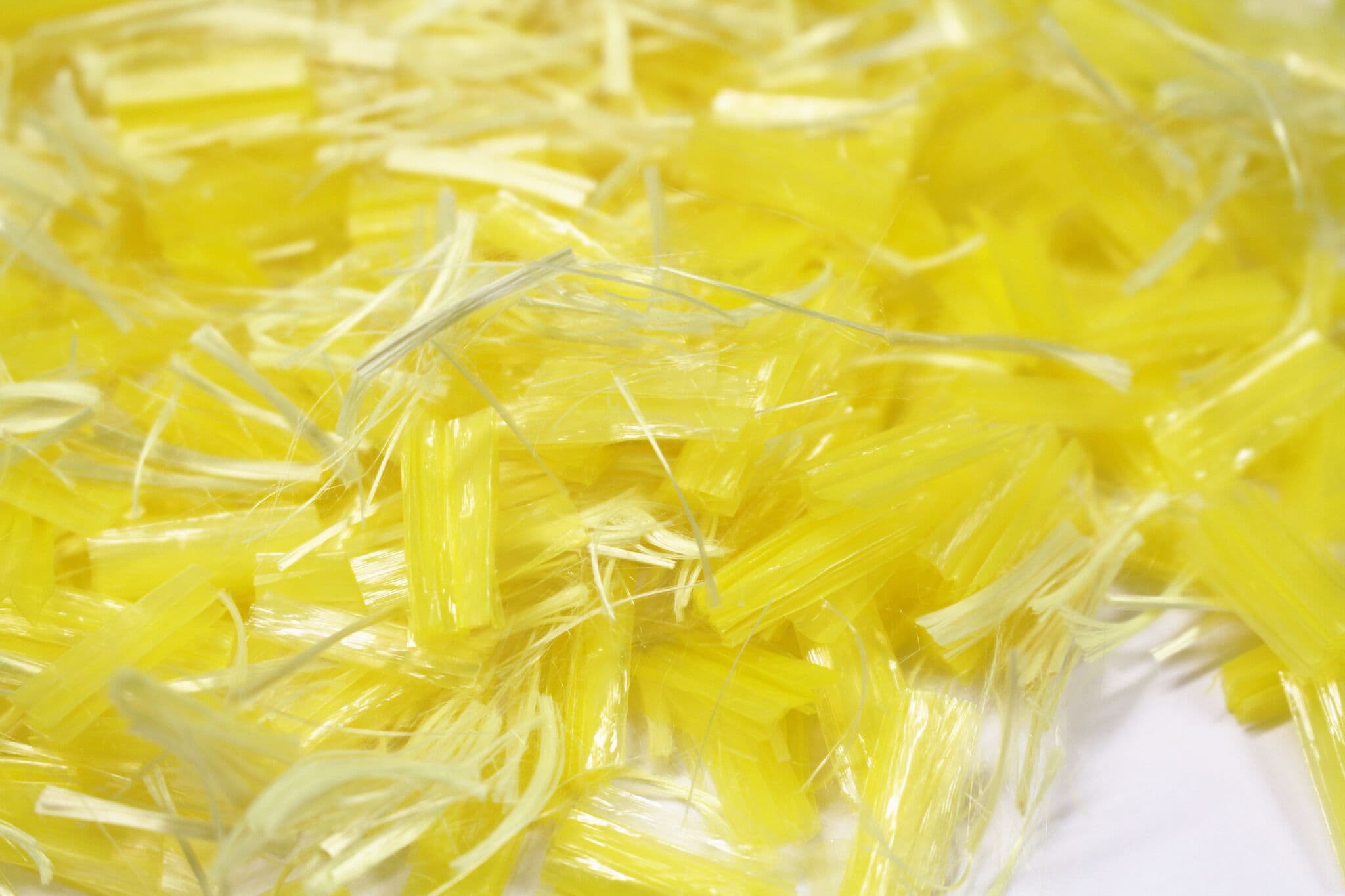
AsphaltX®
2000 filaments per aramid strand — 19 million fibres per tonne of asphalt. Lowest CO₂ footprint, European manufacturing, proven on the N337.
- TypeAramid (Twaron®) + polyolefin fibre blend
- Length± 19 mm
- Tensile strengthTwaron 3000 MPa · polyolefin 483 MPa
- Specific gravityTwaron 1.45 · polyolefin 0.91 g/cm³
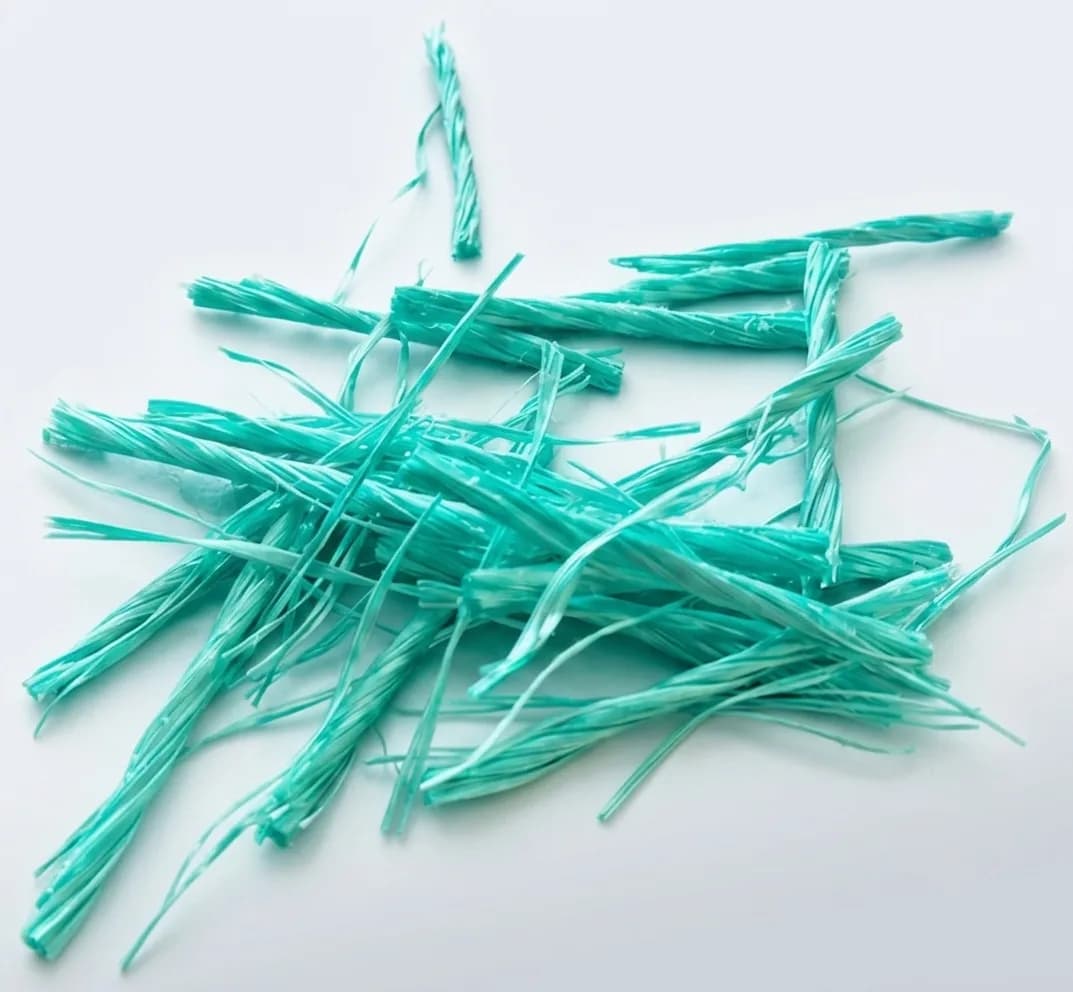 Most chosen
TwistR® GREEN HYBRID
High-performance synthetic macro fibres made from 100% polypropylene. Transforms concrete into a stronger composite material.
- TypeHybrid: twisted monofilament + fibrillating network fibre
- Material100% virgin polypropylene
- Length48 mm
- Dosage2.0 – 6.0 kg/m³
Pallet price on request