Types of reinforcement in concrete: main, distribution, starter bars

An overview of the types of reinforcement in concrete by function, from bottom and top steel to bursting, punching shear and starter bars, with an honest answer for each on whether fibre reinforcement can take over that role.
There are many types of reinforcement in concrete, and the clearest way to group them is by function. Main reinforcement carries the tensile forces in the spanning direction: as bottom steel in the span and as top steel over supports and at cantilevers. At right angles to it lie the distribution bars, which spread the load and hold the main bars in position, while shrinkage and temperature reinforcement keeps cracks from shrinkage and temperature change narrow. Shear links resist shear. On top of that, additional (trimmer) bars, bursting, punching shear and skin reinforcement and starter bars each solve a local problem.
Besides function, reinforcement differs in form: loose bars, mesh, cages and links. That grouping is covered in our overview of forms of concrete reinforcement. This article works through the functions, explains what ribbed expanded metal does at a construction joint and why bed joint reinforcement belongs to masonry, and states for each type whether fibre reinforcement can take over the role. Dutch Fiber Trading supplies concrete fibres; where the answer is no, we say so.
Types of reinforcement at a glance: an overview by function
The table sets the types of reinforcement in concrete side by side: what each one does, where you meet it on a drawing or on site, and whether fibres can do the same job. Which types a structure needs is decided by the structural engineer under EN 1992-1-1 (Eurocode 2) and the National Annex of the country where you build; outside Europe, national codes such as IS 456 in India cover the same functions. The rest of the article explains each row.
Reinforcement made from materials other than steel, such as glass, carbon or basalt fibre bars (FRP), can perform the same functions and falls outside this overview; see carbon, glass fibre and basalt reinforcement.
| Type of reinforcement | Function | Where you find it | Can fibre reinforcement take this over? |
|---|---|---|---|
| Main reinforcement (bottom and top steel) | Carries the tensile forces in the spanning direction | Beams, suspended slabs, walls, foundations | Often yes in ground-bearing slabs and external paving; no in beams, columns and suspended slabs (hybrid at most) |
| Distribution bars (secondary reinforcement) | Run at right angles to the main bars, spread the load and hold the main bars in position | One-way spanning slabs and floors | Often yes in floors and paving; in designed suspended slabs only with the structural engineer |
| Shrinkage and temperature reinforcement | Keeps cracks from shrinkage and temperature change fine and well distributed | Ground-bearing slabs, screeds, paving, walls | Often yes: microfibres in the first hours, macro or steel fibres after that |
| Shear links (stirrups) | Resist shear and hold the cage together | Beams, columns, pad foundations | Not without a design by the structural engineer |
| Additional or trimmer bars | Extra bars where the load is locally higher | Openings, re-entrant corners, point loads, joints between precast planks | Partly: around openings and corners, loose bars often stay in a fibre-reinforced slab |
| Bursting (splitting) reinforcement | Resists the splitting forces under a concentrated load | Bearings, prestressing anchorages, precast | Fibres can limit splitting cracks; replacement only after design |
| Punching shear reinforcement | Stops a column punching through a flat slab | Flat slabs and raft foundations at columns | No, not without the structural engineer |
| Skin reinforcement | Limits crack widths in the side faces of deep beams | Deep beams and girders | No, as a supplement at most |
| Starter bars and continuity bars | Connect pours or precast elements | Wall on slab, column on base, joints between floor units | No: fibres do not cross a construction joint |
| Ribbed expanded metal stop end (not reinforcement) | Permanent stop end that leaves a rough, keyed joint face | Construction joints in slabs, walls and foundations | Not applicable |
| Bed joint reinforcement (masonry) | Reinforcement in the horizontal mortar joints of masonry | Brick and block walls | Not applicable: not concrete |
Main reinforcement: bottom steel and top steel
Main reinforcement, also called primary reinforcement, is the steel that carries the tensile forces in a concrete member. It runs in the spanning direction: concrete is strong in compression but weak in tension, so the main bars sit exactly where the concrete is stretched. The main reinforcement is also the framework to which distribution bars and additional bars are tied. Whether it lies at the bottom, at the top or in both faces depends on how the member bends.
Bottom reinforcement
In a beam or slab resting on two supports, the middle sags and the tension is at the bottom. That is where the bottom reinforcement goes, raised on spacers (chairs) so that enough concrete cover remains below the steel. This is the classic picture of reinforced concrete.
A ground-bearing slab works differently. The subgrade supports the slab over its whole area, and a mesh there mainly controls cracking. Depending on the design, the mesh therefore often sits in the middle or the upper half of the section rather than at the bottom.
Top reinforcement over supports and at cantilevers
Over an intermediate support of a continuous beam or slab, the bending moment reverses (hogging): the tension is now at the top, so top reinforcement is needed. The same applies to a cantilever such as a balcony or canopy, where the tension runs along the top face over the support. Thick raft foundations and heavily loaded slabs often get two layers of mesh, one top and one bottom, so that both faces are reinforced.
Can fibre reinforcement take over the main reinforcement?
Often, yes, in ground-bearing slabs and external paving. There the subgrade carries the load, and structural macro synthetic fibres such as TwistR (dosage 2.0 to 6.0 kg/m³) or steel fibres such as MPWG HT+ 50/0.90 (10 to 35 kg/m³ according to design) often replace the mesh completely. How that works out in an industrial floor is explained under the monolithic industrial floor with fibres.
In beams, columns and suspended slabs the main reinforcement stays steel. Such a member owes its load-bearing capacity to the reinforcement, and a suspended floor slab is reinforced or prestressed to a design. In between lies hybrid reinforcement: fewer bars plus fibres, see the last section.
Distribution bars and shrinkage reinforcement
Distribution bars and shrinkage reinforcement lie across or alongside the main reinforcement and carry little load themselves. Their job is to spread loads and control cracking. These two are exactly the types where fibre reinforcement most often takes over.
What are distribution bars?
Distribution bars, also called distribution steel or secondary reinforcement, run at right angles to the main reinforcement. They spread a (point) load over several main bars, so that no single bar takes it all, and they hold the main bars in place during the pour. You mainly find them in slabs and floors that span in one direction. For such one-way slabs, Eurocode 2 (EN 1992-1-1, clause 9.3.1.1) requires a minimum amount of secondary transverse reinforcement: at least 20 per cent of the principal reinforcement.
In RCC slab practice in India the same pair is simply called main bars and distribution bars. In a welded mesh with bars in both directions, both roles are present at once: one direction acts as main reinforcement, the other as distribution steel. Sheet sizes, laps and the weight of reinforcing bar per metre are covered in our guide to reinforcement mesh.
Shrinkage and temperature reinforcement: controlling cracks
Shrinkage reinforcement does not prevent shrinkage. Concrete shrinks whatever you do; the reinforcement makes sure that shrinkage does not end up in a few wide cracks but in many fine ones that are barely visible. In Eurocode 2 this falls under minimum reinforcement for crack control. In practice it is usually a light mesh in a screed, a ground-bearing slab, external paving or a wall, often called anti-crack mesh.
There are two kinds of shrinkage, each with its own approach. Plastic shrinkage occurs in the first hours, when the fresh concrete loses water at the surface; more on that under plastic shrinkage cracking. Drying shrinkage follows in the weeks and months after.
This is the natural place for fibres. A polypropylene microfibre such as Promicro (12 mm, 0.6 to 1.0 kg/m³, fibre class 1a to EN 14889-2) limits plastic shrinkage cracking in the first hours, a phase in which a mesh hardly works yet. For crack control after that, and as a replacement for the mesh in floors and paving, structural macro fibres such as TwistR or steel fibres are the choice. A microfibre and an anti-crack mesh are therefore not like-for-like substitutes: the microfibre works in the first hours, the mesh or macro fibre in the months after. A microfibre is not structural reinforcement either.
Shear links: shear reinforcement
Shear links (called stirrups in the US and in India) are bent bars that wrap around the main bars of beams, columns and pad foundations. They resist shear and, where needed, torsion, stop the longitudinal bars buckling under compression and hold the cage together during the pour. On a bar schedule they appear as links or shear reinforcement; together with the main bars they form the reinforcement cage.
Can fibres replace shear links? The fib Model Code 2010 gives design rules for the shear capacity of fibre-reinforced concrete without links, and some precast elements with steel fibres are designed that way. In everyday work, however, fibres do not replace links without a design by the structural engineer.
Local reinforcement: trimmer, bursting, punching shear and skin reinforcement
These four types are not placed everywhere, only where a structure has to take something extra locally. That is why the structural engineer shows them as separate bar marks on the drawing.
Additional bars and trimmer bars
Additional bars are extra, local bars on top of the main and distribution reinforcement, at places with a higher or specific load. Normal loads go through the main and distribution steel; the additional bars deal with the exceptions. Typical places are the edges of openings (trimmer bars), re-entrant corners, the zone under a point load (for example a column standing on a suspended slab) and the joints between precast lattice girder planks, where the units meet.
In a fibre-reinforced slab, too, a few loose bars often remain at re-entrant corners and around openings. That is a small, practical example of hybrid reinforcement: the fibres handle the slab as a whole, the bars handle the corner where stress concentrates.
Bursting reinforcement
Under a concentrated compressive force, the force spreads out into the concrete, and across that spread tensile stresses develop that can split the concrete. This happens at the bearings of precast beams, under the anchor plates of prestressing tendons and at the anchorage of heavy bars. Bursting reinforcement (also called splitting reinforcement), often links or small mats close under the load, takes up that bursting force. Eurocode 2 covers it under partially loaded areas and the anchorage zones of prestressing.
Steel fibres limit splitting cracks and are used in precast elements and tunnel segments partly for that reason. A hooked-end drawn steel fibre such as MPZG HT 35/0.55 is an example of a fibre for precast and foundations. Whether fibres may replace the bursting reinforcement in a specific element follows only from a design calculation.
Punching shear reinforcement
A column supporting a flat slab or raft foundation can push through it like a punch. This is called punching shear. Punching shear reinforcement around the column, in the form of links, bent-up bars or prefabricated stud rails, increases that capacity. Alternatives are a thicker slab or a local thickening (drop panel or column head). The structural engineer checks punching to Eurocode 2, clause 6.4. Fibres are no substitute here.
Skin reinforcement
Skin reinforcement consists of longitudinal bars in the side faces of deep beams and girders, distributed over the depth. If the main reinforcement sits only at the bottom, wide cracks can open higher up in the side face; skin reinforcement keeps them narrow. Eurocode 2 (clause 7.3.3) calls for it in beams with a total depth of 1 metre or more where the main reinforcement is concentrated in only a small part of the depth. Fibres are at most a supplement for crack control here, not a replacement.
Starter bars and continuity reinforcement: connecting pours and elements
Continuity reinforcement connects two parts that were not cast in one pour or made as one element. Think of starter bars projecting from a foundation or slab for the wall or column above (often through a short kicker cast with the slab), tie bars across the joints of precast lattice girder planks and hollowcore floors, and reinforcement that continues through a construction joint. The bars lap with the reinforcement of the next part over a calculated lap length. How this works at pad and strip foundations is covered under reinforcement in foundations.
A practical example: the design guideline of a Dutch hollowcore floor manufacturer requires vertical tie reinforcement in every storey from five storeys upwards, with reference to EN 1992-1-1. Horizontal ties there preferably sit in the joint between the floor units. Where new concrete connects to existing concrete, starter bars are drilled in afterwards and bonded with a chemical anchor resin.
Can fibres replace continuity reinforcement? No. Fibres only work within one pour and do not cross a construction joint or element joint. The connection stays steel, even in a fibre-reinforced floor, where a construction joint gets dowel bars or tie bars.
Ribbed expanded metal at a construction joint
Ribbed expanded metal, often sold as rib lath and known in the Netherlands as haringgraatstaal after its herringbone look, is a thin steel sheet with small diamond-shaped openings and pressed-in stiffening ribs. At a construction joint it is fixed as a permanent stop end. It holds back the concrete, lets the starter bars and continuity bars pass through and stays in the work. The rough, keyed face it leaves gives a good bond with the next pour, so the joint face usually needs no further preparation such as scabbling. In Germany, ribbed expanded metal (Rippenstreckmetall) is a common permanent stop end at construction joints (Arbeitsfugen) for exactly that reason. Specifications often call for it at vertical construction joints in foundations, walls and slabs.
Ribbed expanded metal is not reinforcement in itself: it adds nothing to the strength. The same applies to a fibre-reinforced slab with a construction joint as above: the fibres stop at the joint, so the joint gets dowel bars or tie bars. Where construction joints go is decided when you plan the pour sequence, see pouring concrete.
Bed joint reinforcement in masonry: not concrete reinforcement
If you search for joint reinforcement, you usually end up in masonry, not reinforced concrete. Bed joint reinforcement is prefabricated steel reinforcement laid in the horizontal mortar joints of brick or block walls, for example above lintels or in stack-bonded masonry, typically as a welded ladder or truss pattern. The product standard is EN 845-3 and design follows EN 1996-1-1 (Eurocode 6). Fibres play no part in it. The bars that bridge a joint in a concrete floor are called dowel bars.
Which reinforcement can fibre reinforcement replace?
In summary, reinforcement falls into three groups:
• Often completely: distribution and shrinkage reinforcement and the mesh in ground-bearing slabs, external paving, screeds and much precast work. This is where the biggest savings in time and fixing work lie; see fibre concrete versus reinforcement mesh.
• Partly, as hybrid reinforcement: fewer bars plus fibres. Think of trimmer bars that stay at corners and openings, or a retaining wall with bars for the primary bending moments and fibres for crack control. More under hybrid reinforcement.
• Not without the structural engineer: main reinforcement in beams, columns and suspended slabs, shear links, punching shear, skin reinforcement and starter bars.
Fibres are counted structurally through their residual flexural strength after cracking, tested to EN 14651; see how fibre reinforcement works. Two projects show what that means in practice. At the NDSM wharf in Amsterdam, the foundation of the tree and flower planters was designed entirely on TwistR: the steel reinforcement was omitted and a net 1,500 kg of steel was saved. In a greenhouse floor without steel reinforcement in Breezand, fibre-reinforced concrete gave a 29% saving compared with steel.
Which fibre fits depends on the job. TwistR (structural polypropylene macro fibre, 48 mm) replaces the mesh in floors, paving and precast. MPWG HT+ 50/0.90 is intended for heavily loaded floors, foundations and precast, MPZG HT 35/0.55 for precast, foundations and sprayed concrete. Promicro limits plastic shrinkage and is not structural reinforcement. The fibre selector gives a first direction; work out the quantity per m³ with the calculator.
Have your reinforcement drawing checked
If you have a reinforcement drawing or specification, send it with a quotation request. We will look at which bar marks fibres could replace; usually that is the distribution and shrinkage reinforcement or the mesh in a floor or paving. State the application, dimensions and thickness, loads and subgrade, and whether a structural engineer is involved: the engineer makes the decision on the reinforcement design. Prefer to talk it through first? Get in touch.
Frequently asked questions
- What are the types of reinforcement in concrete?
- By function: main reinforcement (bottom and top steel), distribution bars, shrinkage and temperature reinforcement, shear links, and the local types: additional or trimmer bars, bursting, punching shear and skin reinforcement, and starter bars. By form: bars, mesh, cages and links. The function decides where the reinforcement goes, the form how it is supplied and fixed.
- What are distribution bars in a slab?
- Distribution bars run at right angles to the main reinforcement. They spread the load over several main bars and hold the main bars in place during the pour, mainly in slabs that span in one direction. In ground-bearing slabs and external paving, fibre reinforcement can often take over this role.
- What is the difference between main bars and distribution bars?
- Main bars (the main reinforcement) carry the tensile forces in the spanning direction and decide the load-bearing capacity. Distribution bars run across them, spread loads over the main bars and keep them in position. In a one-way slab, Eurocode 2 requires the transverse steel to be at least 20 per cent of the main steel.
- What is the difference between bottom and top reinforcement?
- Bottom reinforcement sits where the tension is at the bottom, in the span between supports. Top reinforcement sits where the tension is at the top: over intermediate supports and at cantilevers. Together they form the main reinforcement.
- What are trimmer bars?
- Trimmer bars are additional, local bars placed around openings in a slab or wall, on top of the main and distribution reinforcement. Similar additional bars go at re-entrant corners, under point loads and across joints between precast planks. In a fibre-reinforced slab, loose bars often still go in at those places.
- What is bursting reinforcement?
- Bursting reinforcement takes up the tensile forces that develop across a concentrated compressive force, for example under bearings and under the anchor plates of prestressing tendons. Without it, the concrete can split there. Steel fibres limit splitting cracks, but replace bursting reinforcement only after design.
- What is punching shear reinforcement?
- Punching shear reinforcement is placed around a column in a flat slab or raft foundation to stop the column punching through the slab. Alternatives are a thicker slab or a drop panel. The structural engineer always checks punching; fibres are no substitute.
- What is skin reinforcement in a beam?
- Skin reinforcement consists of longitudinal bars in the side faces of deep beams and girders that limit crack widths in the sides. Eurocode 2 calls for it in beams 1 metre deep or more. Fibres are at most a supplement.
- What are starter bars?
- Starter bars project from a foundation or slab so that the wall or column cast later can lap onto them. Together with tie bars across precast floor joints and bars through construction joints, they form the continuity reinforcement. Fibres do not cross a joint, so the connection stays steel.
- What is ribbed expanded metal used for at a construction joint?
- Ribbed expanded metal (rib lath) is fixed at a construction joint as a permanent stop end. It holds back the concrete, lets the reinforcement pass through and leaves a rough, keyed face for the next pour. It is not reinforcement itself. More on pour sequences under pouring concrete.
- Is bed joint reinforcement the same as concrete reinforcement?
- No. Bed joint reinforcement lies in the mortar joints of masonry and falls under EN 845-3 and EN 1996-1-1. It is not part of reinforced concrete. Bars that bridge a joint in a concrete floor are called dowel bars.
- Which reinforcement can fibres replace?
- Often completely: distribution and shrinkage reinforcement and the mesh in ground-bearing slabs, paving and screeds, for example with TwistR or steel fibres. Partly, as hybrid reinforcement: fewer bars plus fibres. Not without the structural engineer: main reinforcement in beams and columns, shear links, punching shear reinforcement and starter bars. A microfibre such as Promicro only works against plastic shrinkage.
Share this article
Products mentioned
 Most chosen
TwistR® GREEN HYBRID
High-performance synthetic macro fibres made from 100% polypropylene. Transforms concrete into a stronger composite material.
- TypeHybrid: twisted monofilament + fibrillating network fibre
- Material100% virgin polypropylene
- Length48 mm
- Dosage2.0 – 6.0 kg/m³
Pallet price on request
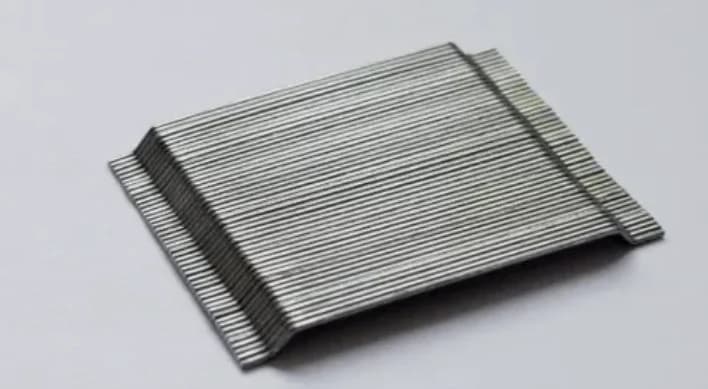
MPZG HT 35/0.55
High-tensile hooked steel fibres with aspect ratio 35/0.55. Maximum anchorage and ductility for heavily loaded structures.
- TypeCold-drawn hooked steel fibre (glued)
- Dimensions35 mm / Ø 0.55 mm
- Tensile strength1345 N/mm² ± 7.5%
- Modulus of elasticity200,000 N/mm²
Pallet price on request
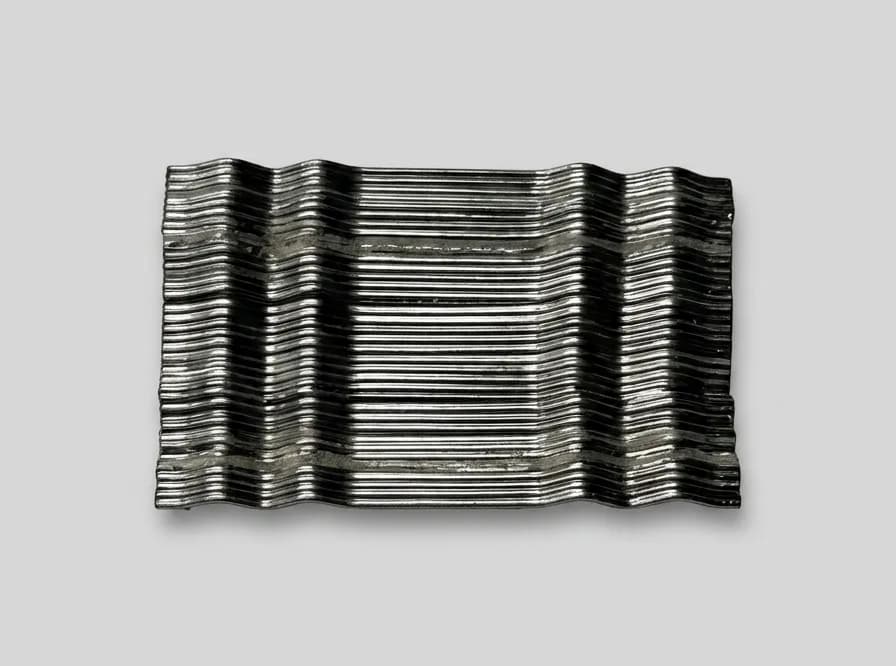
MPWG HT+ 50/0.90
High-tensile hooked steel fibres with aspect ratio 50/0.90. Maximum anchorage and ductility for heavily loaded structures.
- TypeCold-drawn hooked steel fibre (glued)
- Dimensions50 mm / Ø 0.90 mm
- Tensile strength2100 N/mm² ± 7.5%
- Performance class56
Pallet price on request

Promicro
Synthetic PP monofilament micro fibre against plastic shrinkage cracks. Homogeneous dispersion and better surface quality at a low dosage.
- TypePolypropylene monofilament (round cross-section)
- Length12 mm
- Equivalent diameter32 µm
- Linear density6.5 dpf
Pallet price on request