Sustainable asphalt: greener, emission-free paving with fibres

Zero-emission construction is not just about electric plant; the asphalt mix matters at least as much. What makes asphalt sustainable — and how fibre reinforcement and emission-free paving reinforce each other.
Sustainable asphalt is asphalt with a demonstrably lower environmental impact across its entire life cycle: a lower production temperature, a readily recyclable binder, a longer service life and low-emission paving. Fibre reinforced asphalt with penetration-grade bitumen is produced 15-20°C cooler than PMB asphalt; in the European FIBRA project, the PMB mix had an Environmental Cost Indicator (MKI) more than 10% higher, cradle-to-gate.
How do fibres make asphalt greener? Reinforcing fibres such as aramid can take over the strengthening role of the polymers in PMB, so a standard penetration-grade bitumen can be used and the mix leaves the plant 15-20°C cooler. The pavement also resists rutting and cracking for longer, which defers maintenance, and the milled asphalt remains readily recyclable. Zero-emission plant on site then removes the local emissions of paving.
What makes asphalt sustainable?
"Sustainable asphalt" is not a protected term, nor a separate product. In practice, the sustainability of an asphalt pavement is determined by five levers that together make up its environmental impact over the life cycle:
• Production temperature — the biggest energy item sits at the asphalt plant; every degree less heating of aggregate and binder directly saves fuel and CO₂.
• Binder — standard penetration-grade bitumen is less viscous and more readily recyclable than polymer modified bitumen (PMB), and requires a lower mixing temperature.
• Service life — a road surface that lasts longer pushes the next maintenance intervention (with all its production, transport and paving emissions) years further out.
• Recycling — milled asphalt that returns as a high-grade component of new mixes saves primary raw materials; the purer the binder, the better that works.
• Plant and logistics — electric or otherwise non-fossil-powered pavers, rollers and transport reduce emissions on and around the site.
The first four levers sit in the mix, the fifth in the execution. Anyone steering on sustainability therefore looks beyond the plant alone — and that is exactly where fibre reinforcement comes in. The pillar page sustainability, standards and innovation provides the broader framework; below we work through the asphalt side.
Sustainable asphalt types compared
Anyone specifying sustainable asphalt chooses, in practice, from four routes. They differ mainly in production temperature, CO₂ profile and recyclability (values indicative):
• Standard hot mix with penetration-grade bitumen — around 160-170°C; the reference in energy and CO₂ terms; readily recyclable, but more prone to rutting and cracking under heavy or turning traffic.
• PMB asphalt — around 181°C; the highest production temperature and, cradle-to-gate, an Environmental Cost Indicator more than 10% higher than a comparable fibre reinforced mix; the added polymers also hamper high-grade reuse of the milled asphalt.
• Warm mix asphalt — around 100-140°C thanks to foamed bitumen or additives; lower emissions at the plant, while recyclability depends on the chosen binder.
• Fibre reinforced asphalt with penetration-grade bitumen — around 159-165°C, so 15-20°C below PMB; the fibres (for aramid around 0.05%, roughly 500 grams per tonne, depending on mix and application) deliver the strengthening that would otherwise have to come from the polymers, while the standard binder remains readily recyclable.
These routes are not mutually exclusive: a fibre reinforced mix can also be combined with warm-mix techniques. How the temperature chain fits together in detail is covered in our article on the production temperature of fibre asphalt.
Clean and Zero-Emission Construction: what the SEB covenant requires
Zero-emission construction focuses primarily on the plant deployed on site: electric or otherwise non-fossil-powered pavers, rollers and transport vehicles. In the Dutch covenant Schoon en Emissieloos Bouwen (SEB — Clean and Zero-Emission Construction), central government, regional authorities and market parties have agreed on the step-by-step phasing out of fossil-fuelled construction plant, with rising ambitions towards 2030 and beyond.
For road builders and road authorities this means that tenders increasingly include requirements or award advantages for low-emission or zero-emission plant — certainly on Rijkswaterstaat projects and on works in or near nitrogen-sensitive nature areas. Emission-free asphalt paving is thereby shifting from a differentiator to an expectation.
What often stays out of the picture in that discussion: the plant on site is only one link in the chain. Producing the mix at the asphalt plant is the biggest energy item of the whole chain — and it is precisely there that the choice of mix can deliver gains that plant alone cannot reach.
CO2 emissions of asphalt: the gains sit at the plant
The CO₂ emissions of asphalt are dominated by the production phase: drying and heating the aggregate and bringing the binder to working viscosity. An asphalt plant typically turns out hundreds of tonnes per day, so a structural temperature difference weighs heavily.
This is where fibre reinforcement makes its biggest sustainability contribution. Because fibre reinforced asphalt can be produced at a lower temperature with a standard penetration-grade bitumen instead of PMB, the mixing temperature is 15-20°C lower. Within the European FIBRA project this was measured in practice on the A73 near Roermond: the PMB reference was produced at around 181°C, the fibre reinforced mixes at 159-165°C.
The accompanying life cycle assessment made the environmental gain concrete: cradle-to-gate, the PMB mix had an Environmental Cost Indicator more than 10% higher than the fibre reinforced variants, mainly due to the lower production temperature and the better recyclability of the penetration-grade bitumen. And quality held up — all trial sections withstood three months of traffic loading of around 50,000 vehicles per working day without visible damage.
In practice: the zero-emission construction road with aramid fibres
That fibre reinforcement and emission-free paving reinforce each other in practice was demonstrated by the construction of a temporary construction road for a new-build project. There, a base and binder course of asphalt with aramid fibre reinforcement was laid entirely emission-free: the fibre reinforced mix left the plant cooler, and on site zero-emission plant ensured paving without local emissions.
For a construction road in particular, that combination makes sense. The road has to carry heavy construction traffic from day one — the fibres slow rutting and cracking — and is removed again afterwards, after which the asphalt with standard penetration-grade bitumen can be fully milled and reused. Why fibre reinforced asphalt lends itself so well to this application is explained in our article on fibre reinforced asphalt for heavy construction roads.
That the technology is also proven in permanent roads is shown by the Venedijk in Kampen: there, Schagen Infra, commissioned by the municipality of Kampen, incorporated 200 kg of AsphaltX fibres into 400 tonnes of HMA asphalt. The result is a road surface that better resists cracking and rutting — and therefore lasts longer with less maintenance.
Greener asphalt: why fibres plus zero-emission plant deliver more
Where many sustainability measures target a single link in the chain, the combination of fibre reinforcement and zero-emission plant tackles three at once:
• At the source — a 15-20°C lower production temperature at the asphalt plant thanks to penetration-grade bitumen with fibres instead of PMB.
• During transport and paving — no local emissions thanks to electric or otherwise zero-emission plant, in line with the SEB agreements.
• During the use phase — less maintenance thanks to a longer service life, so that the emissions of future maintenance interventions (production, transport, paving, traffic disruption) are avoided or deferred.
That third link is often underestimated, but over a service life of decades it weighs heavily. Every maintenance intervention that is not needed is a complete mini-chain of emissions avoided — from plant to roller.
Sustainable road pavements at major maintenance
For road authorities, major maintenance is the moment at which the sustainability of a road pavement is locked in for the next 15 to 20 years. Anyone who simply specifies the same mix as at the previous intervention leaves the gains of two decades of material innovation on the table.
A sustainable road pavement starts with the question of which mix achieves the longest service life at the lowest production impact. Fibre reinforcement fits in without major intervention: the fibres are added dry to the mix, the asphalt plant does not have to overhaul its recipe and the contractor works with the same machines. The milled asphalt from the old pavement can, moreover, simply return into the new mix — how that ties into the broader circular goals is covered in our article on circular construction with fibre reinforced concrete and asphalt.
For municipalities and provinces making their maintenance programmes more sustainable, the sums per project are small but structural: a slightly higher mix price due to the fibre dosage, set against a lower MKI, a longer service life and fewer future maintenance interventions on road sections that are already under pressure.
What does this mean for your tender or project?
For clients following the SEB covenant or applying their own emission requirements, combining fibre reinforcement with zero-emission plant is a direct way to reduce total environmental impact further than plant alone allows. That is particularly relevant for:
• Projects with an explicit CO₂ or nitrogen reduction target, where the lower production temperature counts at the source.
• Tenders in which environmental performance weighs as an award criterion — with the PCR Asfalt 2026, that environmental performance is calculated uniformly and mandatorily, making the MKI difference between PMB and fibre reinforced asphalt directly visible in the bid.
• Projects near nitrogen-sensitive nature areas, where reduced plant deployment and lower production emissions count double.
Considering fibre reinforced asphalt for a zero-emission or MKI-driven project? With aramid fibres for zero-emission projects such as AsphaltX, virtually nothing changes at the plant or on site: the same installation, the same mixing process, just an added dosing unit. Request a quotation or dosing advice — we are happy to work through the mix side of your sustainability case with you.
Frequently asked questions
- What is sustainable asphalt?
- Sustainable asphalt is asphalt with a lower environmental impact across the entire life cycle. The key factors are the production temperature at the asphalt plant, the type of binder, the service life of the pavement, the recyclability of the milled asphalt and the plant used during paving. Fibre reinforced asphalt with penetration-grade bitumen combines a 15-20°C lower production temperature with a longer service life and a readily recyclable binder.
- How do fibres make asphalt greener?
- Fibres make asphalt greener mainly through what they replace. With aramid fibres (around 500 grams per tonne, depending on mix and application) a standard penetration-grade bitumen can be used instead of polymer modified bitumen, so the mix is produced 15-20°C cooler. In the FIBRA life cycle assessment, the PMB mix scored more than 10% higher on the Environmental Cost Indicator, cradle-to-gate. The fibres also slow rutting and cracking, which defers maintenance, and the milled asphalt stays readily recyclable.
- What is zero-emission construction?
- Zero-emission construction means building without local emissions of CO₂, nitrogen and particulate matter on site, mainly by deploying electric or otherwise non-fossil-powered plant. In the Dutch covenant Schoon en Emissieloos Bouwen (SEB — Clean and Zero-Emission Construction), central government, regional authorities and market parties have agreed on the step-by-step phasing out of fossil-fuelled construction plant towards 2030 and beyond.
- What is emission-free asphalt?
- Strictly speaking, fully emission-free asphalt does not yet exist: production at the asphalt plant always requires energy. In practice, it refers to asphalt that is paved emission-free (with electric plant) and whose mix minimises production emissions. Fibre reinforced asphalt contributes with a production temperature 15-20°C lower than PMB asphalt, while in the FIBRA assessment the PMB mix scored more than 10% higher on environmental cost, cradle-to-gate.
- How much CO2 does fibre reinforced asphalt save?
- In the life cycle assessment of the European FIBRA project, a PMB mix had, cradle-to-gate, an Environmental Cost Indicator more than 10% higher than a comparable fibre reinforced mix with standard penetration-grade bitumen. That gain comes mainly from the 15-20°C lower production temperature and the better recyclability of the binder. The exact saving per project depends on mix, tonnage and transport distances.
- Is fibre reinforced asphalt recyclable?
- Yes. Fibre reinforced asphalt uses a standard penetration-grade bitumen that lends itself better to high-grade reuse than polymer modified bitumen; the milled asphalt can return into new mixes. The aramid fibres are dosed at a very low rate (around 0.05%, roughly 500 grams per tonne, depending on mix and application) and do not stand in the way of reuse. For temporary construction roads, the pavement is fully milled and reused afterwards.
Share this article
Products mentioned
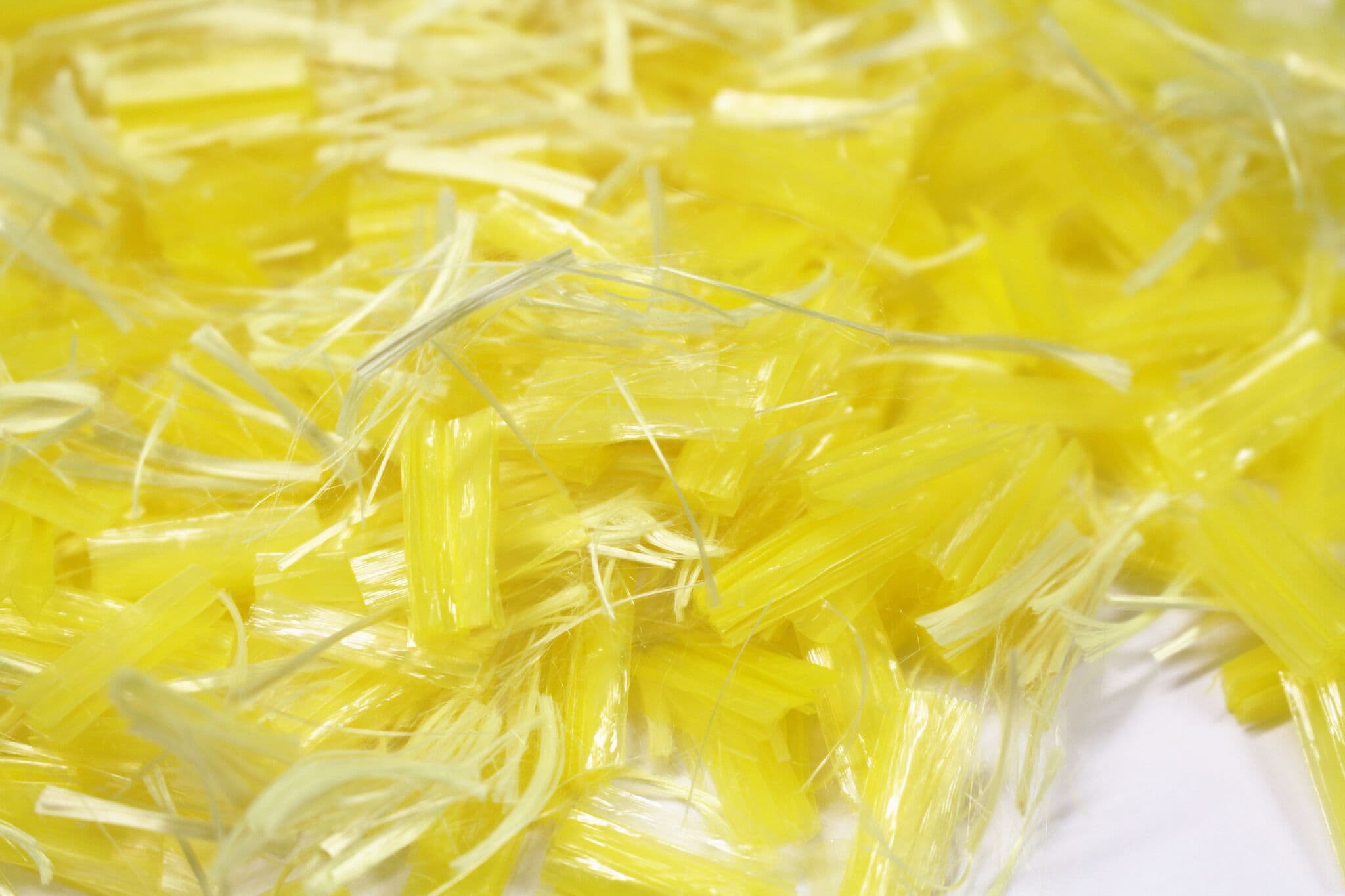
AsphaltX®
2000 filaments per aramid strand — 19 million fibres per tonne of asphalt. Lowest CO₂ footprint, European manufacturing, proven on the N337.
- TypeAramid (Twaron®) + polyolefin fibre blend
- Length± 19 mm
- Tensile strengthTwaron 3000 MPa · polyolefin 483 MPa
- Specific gravityTwaron 1.45 · polyolefin 0.91 g/cm³