Grouted macadam (semi-flexible surfacing): what it is, where it is used and the alternatives

Grouted macadam, or semi-flexible surfacing, is an open-graded asphalt whose voids are filled with a cementitious grout. How it is laid, where it is used, its drawbacks and how it compares with fibre-reinforced asphalt and concrete.
Grouted macadam is a surface course of very open asphalt whose air voids are filled, in a second operation, with a free-flowing cementitious grout. Because it combines the flexibility of asphalt with the stiffness of cement concrete, it is also known as semi-flexible surfacing or semi-flexible pavement; in the Netherlands it is called a *combinatiedeklaag*. Highway authorities and site owners use it where heavy vehicles move slowly, stand still or turn: bus lanes, bus stops, approaches to traffic signals, container terminals and heavily loaded industrial yards.
This article explains how grouted macadam is built up and laid, where it is used and what its drawbacks are. We then set it against two other ways of tackling rutting at the same locations: fibre-reinforced asphalt and a concrete pavement or whitetopping overlay. Dutch Fiber Trading supplies the fibres for those two alternatives, not grouted macadam itself, so you know the perspective this article is written from.
What is grouted macadam?
Grouted macadam consists of two materials, each with its own job. The first is an asphalt mix with plenty of coarse aggregate and little sand or filler, so that a high proportion of air voids remains between the stones after compaction. That open asphalt is the skeleton of the layer. The second is a cement-based grout fluid enough to run into those voids and fill them completely. Once the grout has cured, the layer is dense and far stiffer than ordinary asphalt.
Kiwa, the Dutch testing and certification body that supervises quality assurance on these surfacings in the Netherlands, describes the material as very open asphalt concrete with a high void content, filled in a second operation with a cementitious grout. According to Kiwa, the result combines the flexibility of asphalt with the strength of cement concrete. That pairing of two binders in one layer is what the Dutch name *combinatiedeklaag* (literally 'combination surface course') refers to.
Other names: semi-flexible pavement and grout-filled open asphalt
In the UK the construction has been known as grouted macadam for decades, and UK tenders typically ask for a 'grouted macadam surface course'. In international research the usual term is semi-flexible pavement (SFP), because the layer behaves somewhere between a flexible asphalt pavement and a rigid concrete pavement. You will also see grout-filled open asphalt or cement-grouted asphalt, and in the US resin-modified pavement for a variant with a resin-modified grout. In the Netherlands it is a *combinatiedeklaag*, in German-speaking countries a *halbstarre Deckschicht*, and in France and Belgium a *revêtement semi-rigide*.
Systems are often sold under a brand name, each with its own grout. For the highway authority the principle is the same: an open asphalt skeleton that is sealed with a cement-based filling after it has been laid.
How does grouted macadam work?
In ordinary asphalt, rutting develops because the mix deforms permanently under heavy, slow or stationary wheels: the bitumen softens in warm weather, the stones shift relative to each other and material is pushed sideways. How that is linked to temperature is explained in our article on road heat and soft bitumen.
Grouted macadam tackles that mechanism in two ways. The open asphalt already has stone-on-stone contact, as in porous asphalt: the coarse stones bear directly on one another. The cured grout then fills the pores between those stones. As a result the stones can no longer move and the bitumen has nowhere to flow in hot weather. The outcome is a layer that hardly deforms permanently under standing, braking or turning heavy traffic.
At the same time it remains an asphalt layer: it is laid with a paver, ties in with the surrounding asphalt and has no joint pattern like a concrete pavement. That is exactly the middle ground the term semi-flexible describes.
Grouted macadam or porous asphalt: what is the difference?
Both start from an open, stone-rich asphalt mix, but with opposite aims. In Dutch porous asphalt (ZOAB) the voids (around 20% of the volume) stay open: rainwater drains through the layer and the pores dampen tyre noise. In grouted macadam the voids are only a mould for the grout. Once they are filled, the layer is dense. Grouted macadam therefore does not drain water through the layer and does not give the noise reduction of open asphalt.
Conversely, porous asphalt is not designed for places where heavy vehicles stand and turn: its open structure is vulnerable to surface damage there. Grouted macadam is chosen precisely for those places. What porous asphalt is, how it is maintained and what fibres do against ravelling is covered in our ZOAB article; here we only look at the differences.
| Property | Porous asphalt (ZOAB) | Grouted macadam | Dense asphalt concrete |
|---|---|---|---|
| Air voids after laying | Open (around 20%), stay open | Open skeleton, then filled with cementitious grout | A few per cent at most |
| Drainage | Through the layer | Over the surface | Over the surface |
| Binder | Bitumen | Bitumen plus cured cementitious grout | Bitumen |
| Rutting resistance | Relatively good (stone-on-stone contact) | Very high | Depends on mix and binder |
| Operations | One | Two (asphalt, then grout) | One |
Construction: laying grouted macadam in two operations
Grouted macadam is laid in two operations, with a waiting time between them and afterwards. In outline:
• 1. Sound substrate and lower layers. Grouted macadam is a surface course. It does not fix a foundation problem: if the subgrade settles or the underlying construction is too weak, a stiff surface course will crack as well.
• 2. Lay and compact the open asphalt. The open-graded mix is laid and compacted like an ordinary surface course. Mix design and compaction aim to keep the voids open and interconnected, so that the grout can later reach everywhere.
• 3. Allow to cool. The grout is only applied once the asphalt has cooled sufficiently.
• 4. Pour and work in the grout. The fluid grout is poured over the surface and worked in, for instance with rubber squeegees, until the voids are filled. Surplus grout is removed from the surface so that the upper stones form the running surface.
• 5. Cure. The grout must cure before the surface is opened to traffic. How long that takes depends on the grout and the weather and is set out in the specification or on the grout's product data sheet.
The filling is a pourable grout, not a dry jointing mortar of the kind brushed into the joints of block paving. The difference matters: the grout has to penetrate deep into a network of pores, and only a fluid slurry can do that.
Quality assurance for grouted macadam
Because two materials have to work together in one layer, workmanship is critical. Kiwa points out that design and construction are subject to high requirements, that the surfacing has to perform not only at handover but throughout its service life, and that the work calls for specific expertise. In the Netherlands Kiwa therefore offers supervision from the client's specification through to final inspection:
• beforehand: assessing the design and method statement, the quality plan, CE certificates and other material documentation;
• during construction: checking that the agreed processes are followed and flagging deviations on site;
• during and after construction: demonstrating quality with in-situ measurements, supplemented where necessary by laboratory testing.
In the UK, grouted macadam surface courses are commonly specified as BBA HAPAS approved: the Highway Authorities Product Approval Scheme, run by the British Board of Agrément, includes a section on grouted macadam in its technical specifications. Whatever the country, the lesson for the client is the same: set out in the specification what is required of the open asphalt, the grout, the grouting operation and the testing, and how performance over the service life will be assessed.
Where is grouted macadam used?
According to Kiwa, the material is increasingly used on sites and in situations with heavy loading: container terminals, airfields and some industrial yards, as well as bus lanes, bus stops and the queuing lanes at traffic signals. In the UK it is a familiar surfacing in bus stations and bus depots. What these locations have in common is not only the weight but above all the way the load is applied:
• Bus stop and bus lay-by: every bus brakes, stands and pulls away on the same few square metres. Braking and accelerating create shear forces; standing creates prolonged loading in one place.
• Bus lane: buses follow the same track every time. That channelisation concentrates the load on two narrow strips.
• Approach to traffic signals: lorries and buses stand and pull away, always on a short length of carriageway.
• Container terminal and distribution yard: heavy axles, turning and stationary vehicles, and loads that are parked or stacked for long periods.
• Airfield apron: heavy aircraft moving slowly, turning and standing in the same spot for a long time.
These are the same places where rutting appears first in ordinary asphalt; our article on rutting describes that pattern. For local authorities the combination of bus lane and bus stop will be familiar: see also the section on bus lanes and bus stop bays in our article for highway authorities.
Advantages and disadvantages of grouted macadam
Advantages. Its main strength is very high resistance to rutting and other permanent deformation. The layer is stiff under standing, braking and turning heavy traffic, yet it is laid as an asphalt layer, without the joint pattern of concrete. That also makes it suitable for a locally heavily loaded area within an otherwise ordinary asphalt road, such as a bus stop or a signal approach.
Disadvantages and points to watch. Two operations plus the curing time of the grout mean a longer closure than for an ordinary surface course. The work is specialist and needs tight quality control. The main technical concern is cracking. Research on semi-flexible pavements shows that the asphalt skeleton and the cement grout respond differently to temperature, and that the interface between the two is the weak link; work is therefore under way on more flexible grouts. Swiss research (SUPSI, presented in 2023) on cores from a grout-filled surface course at a bus stop found variable resistance after repeated cycles between above-zero and sub-zero temperatures, partly due to microcracks in the layer. The researchers describe the mechanical behaviour as promising but long-term durability as an open question, and advise taking the local climate into account.
Repairs are also more involved. Ordinary asphalt is planed off locally and resurfaced; with grouted macadam the repair has to be built up again in two operations to achieve the same properties.
| Advantage | Point to watch |
|---|---|
| Very high resistance to rutting | Two operations plus curing time of the grout |
| Stiff under standing, braking and turning heavy traffic | Prone to (micro)cracking under temperature cycling |
| Laid as an asphalt layer, without concrete joints | Specialist workmanship and quality control required |
| Suits locally heavily loaded areas (bus stop, signal approach) | Local repairs more involved than with ordinary asphalt |
Grouted macadam, fibre-reinforced asphalt or concrete?
A highway authority with a rutted bus lane, bus stop or roundabout has more than one option. Besides grouted macadam there are two other solutions to the same problem: fibre-reinforced asphalt, which stays asphalt, and a concrete pavement or whitetopping overlay, which makes the move to concrete. None of the three is best in general; the choice depends on how heavy and how static the load is, how long the site can be closed and how maintenance is organised. The table sets them side by side, followed by the trade-off for each alternative.
| Criterion | Grouted macadam | Fibre-reinforced asphalt (e.g. AsphaltX) | Concrete pavement or whitetopping (e.g. with TwistR) |
|---|---|---|---|
| Build-up | Very open asphalt, then filled with cementitious grout | Standard asphalt mix with fibres added at the plant | Concrete slab, possibly over existing asphalt, with macro fibres |
| Operations | Two, plus curing of the grout | One; open once cooled | Pour, finish, cure |
| Deformation resistance | Very high | Higher than the same mix without fibres | Very high (concrete does not rut) |
| Cracking | Point to watch: microcracks under temperature cycling | Fibres help the asphalt resist cracking | Shrinkage cracking controlled by fibres; joints needed |
| Joints | No joint pattern | None | Yes, joint layout required |
| Repair | Involved | Plane off and resurface like ordinary asphalt | Replace individual slabs or bays |
| Typical location | Bus stops, bus lanes, signal approaches, terminals, airfields | Road sections, roundabouts, junctions, bus lanes at major maintenance | Bus stop bays, bus lanes, junctions where asphalt keeps rutting |
Fibre-reinforced asphalt: stays asphalt, laid in one operation
With fibre-reinforced asphalt the fibres are added to the mix at the asphalt plant. AsphaltX is a fibre blend about 19 mm long, of aramid (Twaron technology) and polyolefin, dosed at 500 g per tonne of asphalt. The mix design stays unchanged, the fibre is suitable for porous asphalt, SMA and dense asphalt, and the aramid does not melt in hot asphalt mixes. AsphaltX is on the Dutch OPWA list (BRL 9320 / NL BSB). The asphalt is laid and compacted in one operation and can reopen to traffic once it has cooled.
On the N337 provincial road between Zwolle and Deventer, monitoring showed 50% less rutting and 30% less cracking with AsphaltX than on the reference section. An example where buses were the deciding factor: in the renovation of the roundabouts next to the bus station in Druten, AsphaltX was used in the binder course because buses there brake, turn and pull away on the same spots again and again. If you are weighing fibres against polymer-modified bitumen, the classic remedy at heavily loaded sites, see our comparison of aramid fibres and PMB.
The trade-off. Fibre-reinforced asphalt is the lighter intervention: it fits into a normal resurfacing scheme, needs no second operation or curing time and is later repaired like ordinary asphalt. It gives the asphalt more resistance to deformation and cracking, but not the stiffness of cement. For road sections, roundabouts, junctions and bus lanes that are being resurfaced anyway, that is often a logical choice. For extreme static loading, such as stacked containers or a bus stop with a very high bus frequency, grouted macadam or concrete remain the heavier-duty options.
Concrete pavement or whitetopping: concrete with macro fibres
Concrete does not deform plastically like asphalt: under standing or slow-moving heavy traffic a concrete slab does not rut, not even in hot weather. A concrete bus stop bay or bus lane is therefore the classic counterpart to asphalt at these locations. With whitetopping a concrete layer is placed over the existing asphalt, so that the old pavement continues to serve as a base.
In that concrete slab, macro fibres control shrinkage and cracking. TwistR is a 48 mm structural macro fibre made of polypropylene, dosed at 2.0 to 6.0 kg/m³. The fibre is non-corrosive and 100% alkali-resistant, carries CE marking and an EPD, and can replace traditional mesh reinforcement in floors and pavements; bus stops and bus lanes are among its applications. The right dosage and slab thickness are determined by the structural engineer for each project.
The trade-off. A concrete pavement is a different construction, with a joint layout, a longer closure and curing before traffic is allowed on it. In return it offers the most reserve for the heaviest and most static loading. Where the asphalt at a bus stop or junction ruts again after every repair, the move to concrete is often the most durable step.
Which solution suits which location?
The trade-off shifts from one location to the next. The table gives a first direction; the final design depends on traffic volume, the existing construction, the subgrade and the closure period that is possible.
In a tender, these routes can be invited as equivalent alternatives or assessed on most-economically-advantageous (MEAT) criteria; what to look out for is covered in our article on tendering fibre-reinforced asphalt.
| Location | What makes the load heavy | Consider |
|---|---|---|
| Bus stop or bus lay-by with high bus frequency | Braking, standing and pulling away in the same place | Grouted macadam or a concrete bus stop bay with macro fibres |
| Bus lane on a road section | Channelised traffic, always the same track | Fibre-reinforced asphalt at major maintenance; grouted macadam or concrete where the rut keeps coming back |
| Roundabout next to a bus station | Turning and braking buses | Fibre-reinforced asphalt (Druten example) |
| Approach to traffic signals | Standing lorries and buses | Grouted macadam or concrete; fibre-reinforced asphalt if the whole junction is being resurfaced |
| Container terminal or distribution yard | Heavy axles, turning, stationary loads | Grouted macadam or concrete pavement; fibre-reinforced asphalt for running lanes and parking areas |
Tackling rutting on a bus lane or yard
If you are considering one of the fibre routes for a bus lane, bus stop, junction or yard, we are happy to think it through with you. Useful to have to hand: the location and type of traffic, the damage pattern (rutting, cracking, ravelling), the existing construction, how long the site can be closed and whether you want to stay in asphalt or move to concrete. Dutch Fiber Trading supplies the fibres; the choice of construction is made together with the contractor and the pavement designer. Request a quote or get in touch.
Frequently asked questions
- What is grouted macadam?
- Grouted macadam is a surface course of very open asphalt whose voids are filled, in a second operation, with a free-flowing cementitious grout. The layer combines the flexibility of asphalt with the strength of cement concrete. It is used on bus lanes, bus stops, approaches to traffic signals, container terminals and heavily loaded yards. In the Netherlands it is called a combinatiedeklaag.
- What is semi-flexible pavement?
- Semi-flexible pavement, or semi-flexible surfacing, is another name for grouted macadam: open asphalt filled with cementitious grout. Its behaviour lies between flexible asphalt and a rigid concrete pavement, hence the name.
- What is the difference between grouted macadam and porous asphalt?
- In porous asphalt the voids stay open, so water drains through the layer and tyre noise is reduced. In grouted macadam those voids are filled with cementitious grout: the layer is then dense and much stiffer, but no longer drains water through the layer.
- Where is grouted macadam used?
- At locations with slow, standing or turning heavy traffic: bus lanes, bus stops and bus stations, approaches to traffic signals, container terminals, airfields and heavily loaded industrial yards.
- Why is grouted macadam used at bus stops?
- At a bus stop every bus brakes, stands and pulls away on the same few square metres. In ordinary asphalt that soon leads to rutting and shoving. Because the grout fills the pores in the open asphalt, the stones cannot move and grouted macadam hardly deforms under that loading.
- How is grouted macadam laid?
- In two operations. First the open asphalt is laid and compacted like an ordinary surface course. Once it has cooled, the fluid cementitious grout is poured over the surface and worked in until the voids are filled, and the surplus is removed. The grout then has to cure before traffic is allowed on it; the time required is given in the specification or the grout's product data sheet.
- What are the disadvantages of grouted macadam?
- Two operations and a curing time, so a longer closure; specialist workmanship with tight quality control; sensitivity to microcracking under temperature cycling, because asphalt and cement grout respond differently to temperature; and local repairs that are more involved than with ordinary asphalt.
- Is fibre-reinforced asphalt an alternative to grouted macadam?
- Sometimes, depending on the location. Fibre-reinforced asphalt stays asphalt, is laid in one operation and increases resistance to rutting: on the N337 AsphaltX gave 50% less rutting than the reference section. It does not, however, provide the stiffness of cement. For the heaviest static loads, such as stacked containers or a busy bus stop bay, grouted macadam or concrete remain the heavier-duty options.
- When is concrete a better choice than grouted macadam?
- When the load is very heavy and static and the asphalt ruts again after every repair, for example at a bus stop bay or a junction with a lot of heavy traffic. Concrete does not deform plastically under standing traffic and has the most reserve, but it needs a joint layout and a longer closure. Macro fibres such as TwistR control shrinkage and cracking in the concrete slab.
Share this article
Products mentioned
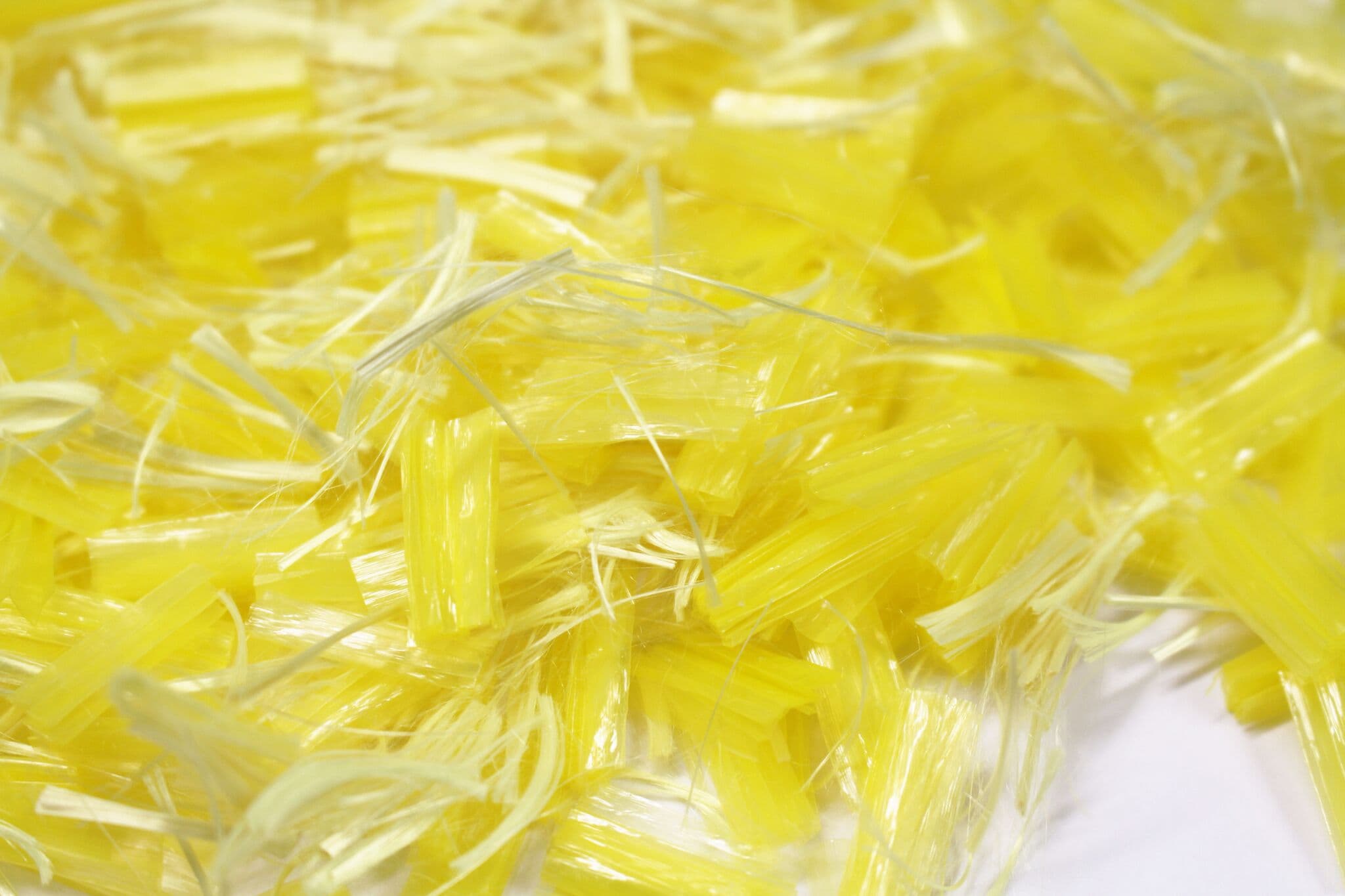
AsphaltX®
2000 filaments per aramid strand — 19 million fibres per tonne of asphalt. Lowest CO₂ footprint, European manufacturing, proven on the N337.
- TypeAramid (Twaron®) + polyolefin fibre blend
- Length± 19 mm
- Tensile strengthTwaron 3000 MPa · polyolefin 483 MPa
- Specific gravityTwaron 1.45 · polyolefin 0.91 g/cm³
 Most chosen
TwistR® GREEN HYBRID
High-performance synthetic macro fibres made from 100% polypropylene. Transforms concrete into a stronger composite material.
- TypeHybrid: twisted monofilament + fibrillating network fibre
- Material100% virgin polypropylene
- Length48 mm
- Dosage2.0 – 6.0 kg/m³
Pallet price on request