Noise-reducing asphalt and fibre reinforcement: what do the measurements say?

Does noise-reducing asphalt stay as quiet when you reinforce it with fibres? CPX measurements on the A73 show what fibre reinforcement does to the acoustic performance of porous asphalt.
Noise-reducing asphalt — such as ZOAB (porous asphalt) and thin noise-reducing surface courses — owes its effect to an open pore structure that absorbs tyre noise. Fibre reinforcement does not compromise that structure: CPX measurements on the A73 showed at most 0.4 dB(A) difference between aramid fibre mixes and the PMB reference — negligibly small and inaudible to road users.
What is noise-reducing asphalt?
Noise-reducing or quiet asphalt is a collective term for asphalt mixes that dampen the contact noise between tyre and road surface. In the Netherlands, three families are common:
• ZOAB (very open porous asphalt) — around 20% void content; standard on national motorways; around 2 to 3 dB(A) quieter than dense asphalt concrete (DAB).
• Two-layer porous asphalt (2L-ZOAB/2L-PA) — a fine top layer on a coarser lower layer; around 4 to 6 dB(A) reduction compared with DAB.
• Thin noise-reducing surface courses — semi-open mixes 2 to 3 cm thick, mainly on provincial and municipal roads; indicatively 2 to 4 dB(A) reduction.
For reference: a reduction of 3 dB(A) corresponds acoustically to a halving of the sound energy — comparable to the effect of halving the traffic volume. For road authorities that must comply with noise production ceilings, the choice of surface course is therefore one of the most powerful levers available.
Why the pore structure is decisive
The noise reduction of an open road surface rests on two mechanisms. First, the interconnected voids absorb part of the rolling noise. Second, they prevent the so-called air pumping effect: on a dense road surface, air is compressed in the tyre tread and released again with a pop, whereas on an open surface that air can escape into the pores. Both effects stand or fall with an intact, open pore structure — a structure that must also be preserved after years of traffic loading.
Does fibre reinforcement compromise the pore structure?
That is the key question for anyone wanting to reinforce noise-reducing asphalt: if fibres were to clog the voids, this would come at the expense of both water drainage and noise reduction. The European FIBRA research into fibre-reinforced asphalt shows this does not happen. The fibre-reinforced porous asphalt mixes on the A73 retained an open structure and an air void content comparable to that of regular mixes, and all sections comfortably met the Dutch water drainage requirement (Becker test).
That is explained by the dosage: aramid fibres are added in the order of ~0.05% of the mix weight — around 500 grams per tonne of asphalt, depending on mix and application. The thin fibres distribute themselves through the bitumen mortar around the stone skeleton and leave the voids between the stones intact. The fibres thus reinforce the mortar, not the pores.
How does a CPX measurement on a road surface work?
In the Netherlands, the acoustic performance of a road surface is usually measured with the Close Proximity method (CPX), standardised in ISO 11819-2. A measurement vehicle or trailer with standardised tyres drives over the road surface at a fixed reference speed — on motorways usually 80 or 100 km/h — while microphones around 20 centimetres from the tyre tread register the tyre–road noise. Because the microphones sit close to the source, CPX measures virtually only the rolling noise — engine noise and ambient noise play hardly any role.
The result is a noise level in dB(A) per road section, usually reported for light vehicles (CPXP) at a reference speed. This makes different mixes and road sections objectively comparable, and lets an authority track the ageing of a noise-reducing road surface over the years.
CPX results from the A73: fibres versus PMB
Within the FIBRA project, BAM and Rijkswaterstaat laid a trial section on the A73 near Roermond in 2020 with four variants of the same two-layer porous asphalt top layer (2L-PA 8): a reference with polymer modified bitumen (PMB), a reference with pen-grade bitumen and cellulose fibre, a mix with PAN fibre and a mix with aramid fibre (Twaron, 0.05%). Twelve weeks after construction, the acoustic performance of all sections was measured with the CPX method. You can read the full research set-up in the A73 practical case with all FIBRA results.
The CPXP values for light vehicles on the nearside lane:
• Reference with PMB — 92.8 dB(A)
• Reference with cellulose fibre — 92.9 dB(A)
• Aramid fibre — 92.5 dB(A)
On the offside lane, the levels were consistently around 1.2 dB(A) lower — around 91.3 dB(A) for both the PMB reference and the aramid mix. That difference between the lanes is linked to the more intensive (heavy) traffic on the nearside lane, which abrades the bitumen film on the stone surface faster — an effect unrelated to the chosen reinforcement type. The PAN fibre section also did not deviate noticeably from the references.
What do those figures mean?
The maximum difference between the aramid mix and the PMB reference is 0.3 to 0.4 dB(A) — in favour of the fibre variant, but so small that it falls within the measurement uncertainty of the CPX method. For comparison: a difference of 1 dB(A) is barely perceptible to the human ear. The conclusion of the research is therefore clear: fibre reinforcement has no negative effect on the acoustic performance of a porous asphalt road surface. If you choose aramid fibres that leave the pore structure intact, you give up nothing of the noise reduction the mix was designed for.
Retaining acoustic performance over the service life
A noise-reducing road surface is at its quietest immediately after construction. After that, the performance gradually declines: pores clog with dirt and wear debris, and the bitumen mortar ages, hardens and loses stones at the surface (ravelling). It is precisely this ageing mechanism that fibres act on: they keep the mortar in the stone skeleton flexible and cohesive for longer, so ravelling sets in later.
The expectation from the FIBRA research is therefore that fibre-reinforced mixes retain their acoustic performance better over a longer period than unreinforced mixes — although that is an effect that only becomes fully measurable after years. The A73 sections are being monitored long-term for this, with planned inspections in year 2 and year 5, in addition to Rijkswaterstaat's regular monitoring programme. You can read more about how fibres protect the mortar in the overview on the fibre-reinforced asphalt pillar.
What does this mean for projects with noise requirements?
Along national motorways, statutory noise production ceilings have applied since 2012, and municipalities and provinces factor the road surface type into their noise models and noise action plans via a surface correction. In all those frameworks, the choice of surface course counts directly towards the permissible noise envelope of a road.
For road authorities working with those noise requirements — for instance alongside residential areas or within Rijkswaterstaat's network — the practical conclusion is: choosing fibre reinforcement instead of PMB is no concession on acoustic performance. Both routes deliver a comparably quiet road surface, while the fibre variant has demonstrable side benefits. The aramid mix on the A73 was produced at around 165 °C versus around 181 °C for the PMB reference, and scored more than 10% lower on the Environmental Cost Indicator (MKI) at cradle-to-gate level. The full trade-off between the two routes is set out in the comparison of aramid fibres versus PMB.
For tenders in which both noise and MKI count in the MEAT assessment, fibre-reinforced noise-reducing asphalt therefore cuts both ways: equivalent acoustics and a lower environmental score.
Applying fibre-reinforced quiet asphalt
Would you like to apply fibre reinforcement in noise-reducing porous asphalt or a thin low-noise surface course? AsphaltX aramid fibres are based on the same Twaron technology as the fibres from the FIBRA research and, with 2,000 filaments per strand, distribute evenly through the mix — without modifications to the asphalt plant or paving equipment. On the N337 between Zwolle and Deventer, this approach has been applied in Dutch practice on a provincial road.
Unsure which approach suits your mix design and noise requirement? Our specialists will run the numbers with you free of charge in a project-specific quotation.
Frequently asked questions
- Is fibre-reinforced porous asphalt as quiet as porous asphalt with PMB?
- Yes. CPX measurements on the A73 within the FIBRA project showed at most 0.3 to 0.4 dB(A) difference between the aramid fibre mix and the PMB reference — within the measurement uncertainty and inaudible. Fibre reinforcement is acoustically equivalent to polymer modified bitumen. Read the full measurement set-up in the A73 practical case.
- What is a CPX measurement of a road surface?
- A CPX measurement (Close Proximity, ISO 11819-2) measures tyre–road noise with microphones right next to a rolling reference tyre on a measurement vehicle or trailer. Because the microphones sit close to the source, virtually only the rolling noise is measured. The result in dB(A) makes road surfaces and mixes objectively comparable and lets you track the ageing of noise-reducing asphalt.
- How much quieter is porous asphalt than ordinary asphalt?
- Single-layer porous asphalt (ZOAB) is around 2 to 3 dB(A) quieter than dense asphalt concrete (DAB); two-layer porous asphalt achieves around 4 to 6 dB(A) reduction and thin noise-reducing surface courses indicatively 2 to 4 dB(A). For reference: a 3 dB(A) reduction corresponds to a halving of the sound energy. See also what ZOAB is exactly.
- Do fibres clog the pores of noise-reducing asphalt?
- No. Aramid fibres are dosed around ~0.05% of the mix weight (around 500 grams per tonne, depending on mix and application) and distribute through the bitumen mortar around the stone skeleton. The voids remain open: the fibre-reinforced A73 sections comfortably met the Dutch water drainage requirement and retained an air void content comparable to regular porous asphalt.
- Which fibre is suitable for quiet asphalt?
- For noise-reducing asphalt, aramid fibres are the best-substantiated choice: they were tested in two-layer porous asphalt in the FIBRA research with acoustic performance equivalent to PMB, and leave the pore structure intact. AsphaltX is based on this Twaron technology and requires no modifications to production or paving equipment.
Share this article
Products mentioned
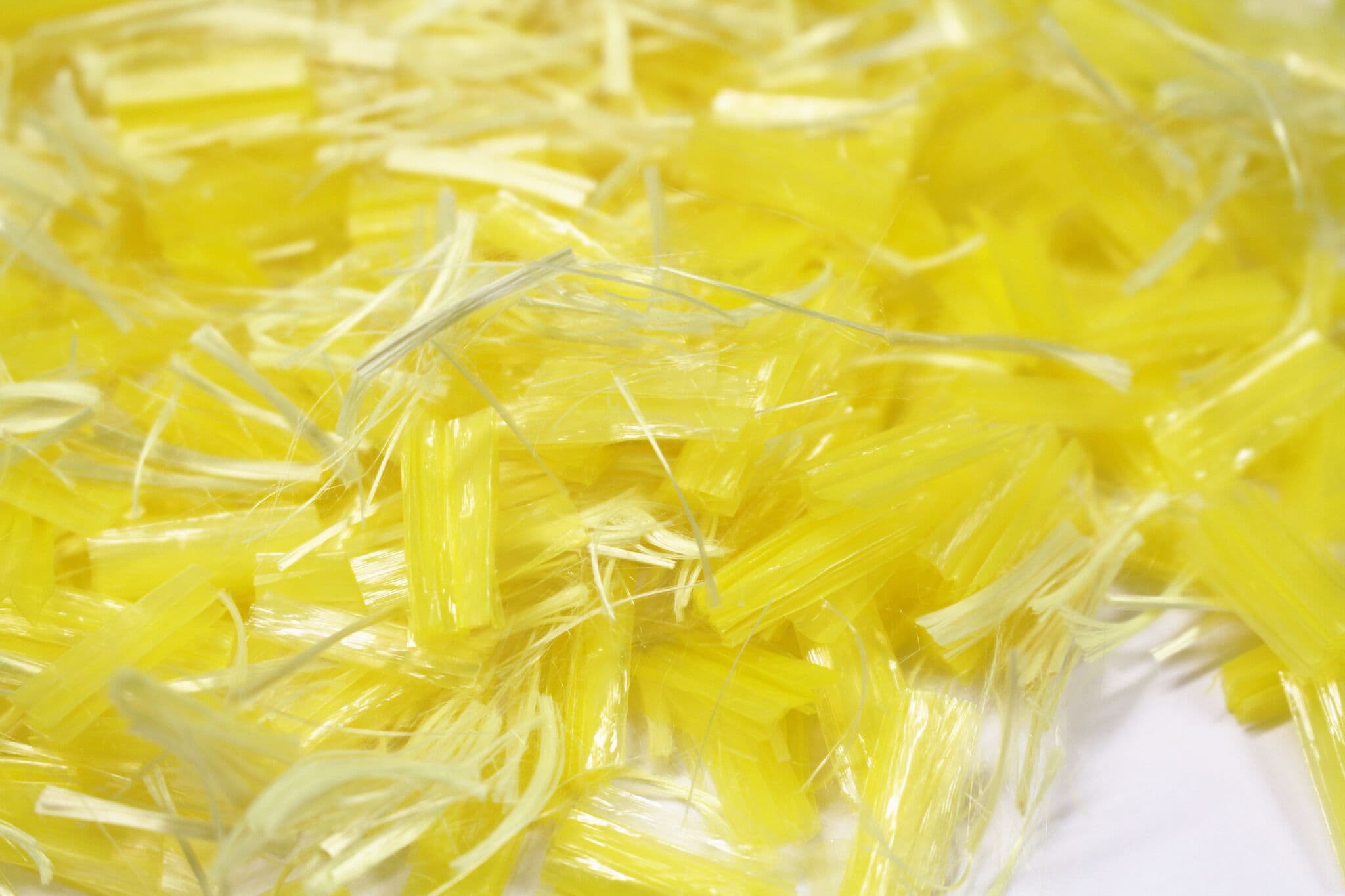
AsphaltX®
2000 filaments per aramid strand — 19 million fibres per tonne of asphalt. Lowest CO₂ footprint, European manufacturing, proven on the N337.
- TypeAramid (Twaron®) + polyolefin fibre blend
- Length± 19 mm
- Tensile strengthTwaron 3000 MPa · polyolefin 483 MPa
- Specific gravityTwaron 1.45 · polyolefin 0.91 g/cm³