Asphalt temperature: production, laying and the fibre advantage

From 160-185°C in the mixer to the minimum rolling temperature on the road: all the relevant asphalt temperatures in one overview — and why fibre reinforced asphalt can run 15-20°C cooler.
Asphalt is produced at around 160-185°C (hot mix) or 100-140°C (warm mix). During laying, the mix must stay warm enough to compact: below around 90-100°C, dense asphalt can no longer be rolled properly. Fibre reinforced asphalt with penetration-grade bitumen can be produced at 159-165°C — 15-20°C lower than asphalt with PMB (around 181°C).
What temperature is asphalt during production and laying?
From mixer to opening for traffic, asphalt passes through a series of temperature windows. The most important values at a glance (indicative; the exact window depends on mix type and binder):
• Hot mix asphalt (production) — 160-185°C; standard penetration-grade bitumen sits at the bottom of that range, polymer modified bitumen (PMB) at the top.
• Warm mix asphalt (production) — 100-140°C, made possible by foamed bitumen or additives.
• Laying temperature behind the paver — around 130-160°C; in this window the mix is profiled and rolling begins.
• Minimum compaction temperature — around 90-100°C for dense mixes; below that the mix no longer closes up and voids remain.
• Opening for traffic — only once the layer has cooled to below around 50°C, in practice after some 2-4 hours for a typical surface course thickness.
Every link in the chain — transport, paving, rolling — draws on the heat the asphalt plant has put into the mix. The laying temperature of asphalt is therefore not an isolated figure, but the remainder of the production temperature minus the cooling losses along the way.
Why is temperature so decisive for asphalt?
Bitumen is a visco-elastic material: the warmer, the more fluid. At production temperature it behaves like a liquid that coats every stone; at outdoor temperature it is a tough adhesive that holds the aggregate in place. Everything that happens between mixer and roller — mixing, pumping, paving, compacting — requires the binder to be sufficiently fluid. If the temperature drops too far, the mix stiffens, can no longer be compacted and the result is a layer with too many voids that ravels and cracks prematurely.
A frequently asked question is what the melting point of asphalt is. Strictly speaking, asphalt has no melting point: bitumen has no sharp transition from solid to liquid, but softens gradually. The reference used is the softening point of the binder (ring-and-ball method), which for common penetration-grade bitumen lies around 45-55°C. That is why a road surface can become soft and prone to rutting during a heatwave — when the surface rises above 50°C — while it only becomes truly workable at production temperatures.
Hot mix, warm mix and low-temperature asphalt
Virtually all Dutch asphalt has traditionally been hot mix: produced at 160-185°C. That takes a lot of energy — the aggregate must be dried and heated, the bitumen brought to working viscosity — and that energy dominates the environmental impact of the production phase.
Warm mix asphalt (WMA) lowers the production temperature to around 100-140°C. This can be done with foamed bitumen (water that makes the bitumen foam temporarily and thereby improves coating), with organic or chemical additives, or with a combination of these. Clients such as Rijkswaterstaat increasingly steer tenders towards such lower production temperatures, because every degree less directly saves energy and CO₂ at the asphalt plant.
Low-temperature asphalt is therefore not a separate product, but a collective term for techniques serving the same goal: achieving the same road performance from a cooler-produced mix. Fibre reinforcement fits in that same list, via a different route: not modifying the binder, but removing the need for the hot PMB.
The fibre advantage: 15-20°C lower than PMB
Polymer modified bitumen contains added polymers (usually SBS) that make the binder tougher and more flexible — but also considerably more viscous. To mix PMB well and distribute it evenly over the aggregate, 180-185°C is quickly needed in practice. Fibre reinforced asphalt combines a standard penetration-grade bitumen (for example 70/100) with fibres that deliver the mechanical reinforcement the polymers would otherwise have to provide. That penetration-grade bitumen is naturally less viscous and therefore mixes well at a lower temperature. How the two routes compare further is covered in the comparison of aramid fibres versus PMB.
The fibres themselves require no high temperature: they are added dry to the aggregate, well before the binder goes in. In an aramid fibre such as AsphaltX, the temperature behaviour is even deliberately two-fold: the polyolefin carrier melts at around 110°C and helps distribute the fibres through the mix, while the Twaron aramid, with a melting point above 450°C, comfortably withstands any common production temperature. The fibre thus works as an asphalt fibre without any change to the recipe: the same plant, the same mixing process, just a dosing step added.
The most concrete figures come from the A73 near Roermond, where four mixes were produced and laid side by side within the European FIBRA project:
• Reference with PMB (Styrelf) — around 181°C.
• Reference with pen-grade bitumen + cellulose fibre — around 160°C.
• Aramid fibre (Twaron 1080, 0.05%) + pen-grade bitumen — around 165°C.
The difference between the PMB reference and the fibre reinforced mixes is therefore 15-20°C. All the details of the trial design and monitoring are in the A73 case study with the FIBRA results.
What does a lower production temperature deliver?
Less energy and CO₂. An asphalt plant typically produces hundreds of tonnes per day; heating the aggregate and binder is the largest energy item. A structural difference of 15-20°C therefore adds up to a substantial saving on fuel and the associated CO₂ emissions. In the FIBRA life cycle assessment, the PMB mix had a more than 10% higher environmental impact (environmental cost indicator, MKI) at cradle-to-gate level than the fibre reinforced mixes; over the full life cycle that difference narrowed to less than 4%. That MKI gain only becomes more relevant with the PCR Asphalt 2026, because environmental performance is then calculated uniformly and mandatorily.
A better working environment. A lower laying temperature means fewer fumes and aerosols during application — directly relevant to the health of road workers who handle the material daily. The field tests on the A73 also showed that the cooler fibre mixes were easier to work by hand than the hotter PMB mix.
A stronger sustainability case. For projects with emissions requirements, the advantage stacks up: fibre reinforcement at a lower production temperature cuts emissions at the source, before any zero-emission equipment even arrives on site. How that combination works out is covered in the article on laying zero-emission asphalt with fibres.
Does the lower temperature come at the cost of quality?
No — provided binder and temperature are matched. The FIBRA field tests showed no negative effect of the lower production temperature on the compactability or the laboratory production of the fibre reinforced mixes. That is logical: a penetration-grade bitumen is at its correct working viscosity at 160-165°C, just as PMB is at 181°C. The combination of binder type and temperature is internally consistent; nothing is produced "too cold" — a binder is used that simply needs less heat.
On the road, too, the performance held up: all four A73 mixes comfortably met the Dutch requirements for water drainage, evenness and abrasion resistance, and after three months of traffic loading (around 50,000 vehicles per working day) all sections were free of visible damage.
Laying asphalt in the cold: minimum temperature and cooling time
At the other end of the spectrum, the outdoor temperature comes into play. Two practical questions keep coming up.
What is the minimum temperature for laying asphalt?
As a rule of thumb, a minimum air and substrate temperature of around 5°C is maintained for surface courses; thicker base and binder courses are less sensitive because they retain their heat longer. More important than the freezing point itself is the cooling rate: a thin surface course of 25-30 mm loses heat so quickly in cold and wind that the compaction window shrinks to a few minutes. Laying asphalt in frost is therefore avoided in principle for surface courses; only with measures — thicker layers, insulated transport, more rolling directly behind the paver — can work at low temperatures be justified. Wind is often a greater enemy than the thermometer: a strong wind at 5°C cools a surface course faster than still weather at 0°C.
How long is the drying time of asphalt?
Strictly speaking, asphalt does not "dry" — there is no chemical curing as with concrete. What happens is cooling: as soon as the binder drops below around 50°C, it is stiff enough to carry traffic. For a typical surface course of 4-5 cm, that takes some 2-4 hours, depending on layer thickness, weather and wind; thicker constructions retain their heat longer and need more time. Heavy or turning traffic (manoeuvring lorries, forklifts) is better kept off for longer, and road markings are usually only applied once the surface has fully cooled and is clean.
Temperature as a design choice in your project
Anyone who knows the temperature chain of asphalt can also steer it. The biggest lever sits at the asphalt plant: the choice between PMB and a fibre reinforced mix with penetration-grade bitumen determines 15-20°C of production temperature in one go, with the associated energy, emissions and MKI gains. With AsphaltX, that happens without any recipe change: 500 grams of fibre per tonne of asphalt (around 0.05%, depending on mix and application), applicable in porous asphalt, SMA and dense asphalt. More background on the technology can be found in our knowledge centre on fibre reinforced asphalt; if you would like to know what this means for a specific job, request a quotation or dosage advice — we are happy to run the numbers with you.
Frequently asked questions
- At what temperature is asphalt laid?
- Asphalt arrives behind the paver at around 130-160°C and is rolled immediately afterwards. Compaction must be complete before dense mixes drop below around 90-100°C; below that the mix no longer closes up. Fibre reinforced asphalt with penetration-grade bitumen is produced at around 159-165°C, PMB mixes at around 181°C — the window on the road is comparable, the start is cooler.
- Can you lay asphalt in frost?
- For surface courses, laying asphalt in frost is avoided in principle: as a rule of thumb, a minimum air and substrate temperature of around 5°C applies. Thin layers cool so quickly in cold and wind that the compaction window shrinks to a few minutes. Thicker base and binder courses retain heat longer and can, with measures (insulated transport, immediate rolling), also be laid at lower temperatures.
- How long must asphalt cool before traffic can drive on it?
- Asphalt does not cure but cools: as soon as the binder drops below around 50°C, the layer can carry traffic. For a surface course of 4-5 cm, that usually takes 2-4 hours, depending on layer thickness, weather and wind. For heavy or turning traffic, such as manoeuvring lorries, a longer wait is common, and markings only follow on a fully cooled surface.
- What is the melting point of asphalt?
- Asphalt has no sharp melting point: bitumen softens gradually as it warms up. The measure used is the softening point of the binder, around 45-55°C for common penetration-grade bitumen — which is why a road surface can soften during a heatwave. The fibres in fibre reinforced asphalt sit far above that: the aramid in AsphaltX only melts above 450°C.
- What is warm mix asphalt?
- Warm mix asphalt (WMA) is asphalt produced at around 100-140°C instead of the usual 160-185°C, using foamed bitumen or additives. That saves energy and CO₂ at the asphalt plant. Fibre reinforcement is a complementary route to lower temperatures: replacing PMB with penetration-grade bitumen plus fibres already lowers the production temperature by 15-20°C.
Share this article
Products mentioned
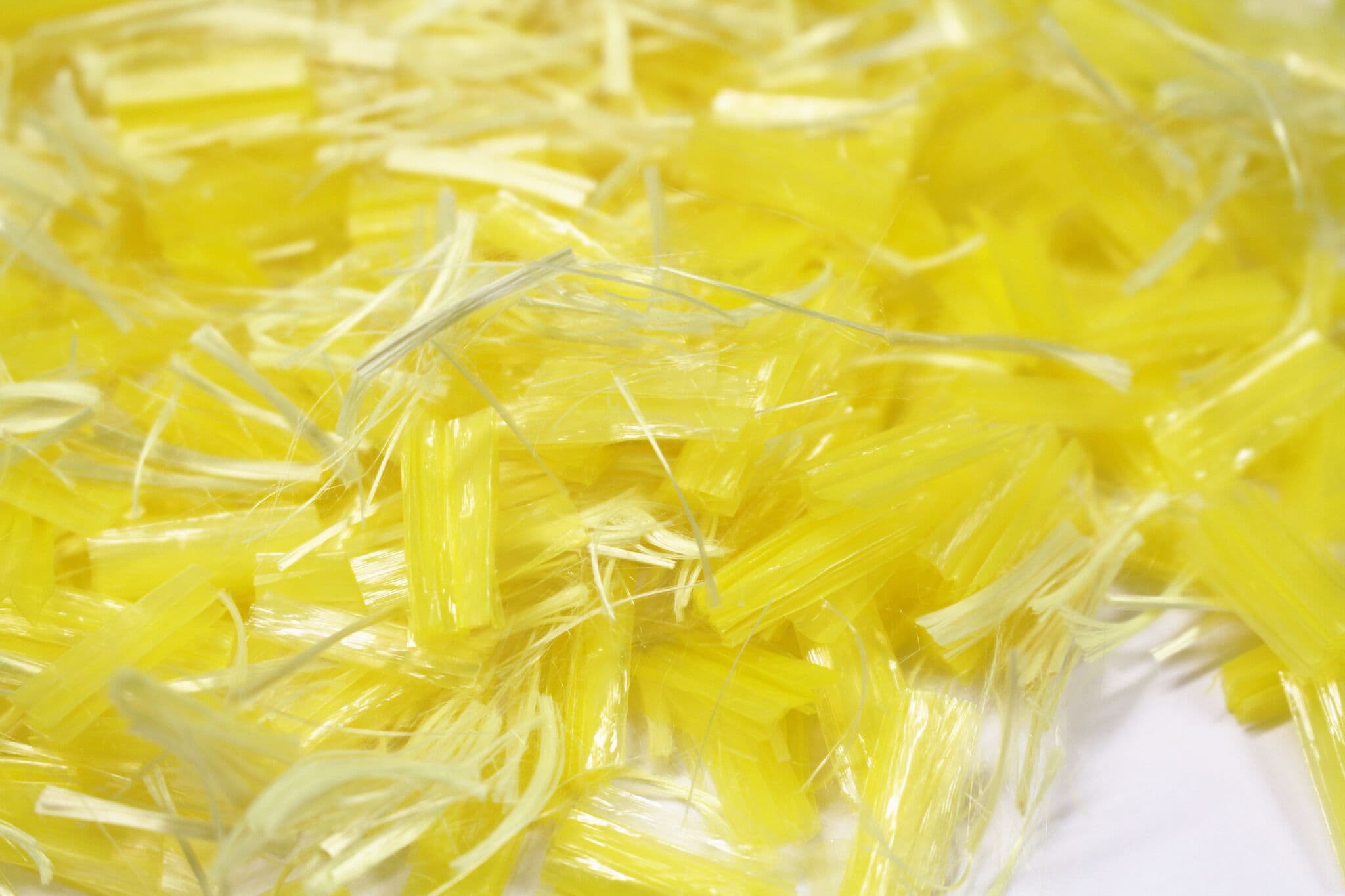
AsphaltX®
2000 filaments per aramid strand — 19 million fibres per tonne of asphalt. Lowest CO₂ footprint, European manufacturing, proven on the N337.
- TypeAramid (Twaron®) + polyolefin fibre blend
- Length± 19 mm
- Tensile strengthTwaron 3000 MPa · polyolefin 483 MPa
- Specific gravityTwaron 1.45 · polyolefin 0.91 g/cm³