PCR Asphalt 2026: what the new environmental performance standard means

The PCR Asphalt 2026 calculates the environmental performance of asphalt mixes uniformly from now on. That makes the sustainability advantage of fibres demonstrable in black and white.
The PCR Asphalt 2026 is the revised set of Product Category Rules that determines how the environmental performance (MKI value) of asphalt mixes is calculated uniformly. The standard was published on 1 July 2026 and formally takes effect on 1 January 2027. For fibre-reinforced asphalt, this means advantages such as a lower production temperature and better reuse now count in black and white in tenders.
What are Product Category Rules (PCR)?
Product Category Rules (PCR) are product-group-specific calculation rules for life cycle assessments (LCAs). They translate the generic, national Assessment Method for the Environmental Performance of Construction Works (Bepalingsmethode) into one concrete product category — in this case asphalt. Where the Assessment Method establishes which environmental effects count and how heavily, the PCR establishes how you apply those rules to an asphalt mix: which process steps you include, how you account for the energy consumption of the asphalt plant, and how you value reuse at the end of the service life.
The result of such a calculation is a single figure: the Environmental Cost Indicator (MKI), expressed in euros of notional environmental cost per tonne or per square metre of asphalt. That MKI value forms the basis for inclusion in the Dutch National Environmental Database (NMD) and for awarding on sustainability in tenders. How that MKI-based awarding works exactly is explained in MKI and DuboCalc: how fibre reinforcement counts in your tender.
Without a uniform PCR, the MKI value of asphalt from different suppliers cannot be compared fairly: each producer could choose its own assumptions. The PCR Asphalt turns demonstrably sustainable asphalt into a measurable, verifiable quantity instead of a marketing claim.
Timeline: from publication to mandatory application
• 1 July 2026 — publication of the PCR Asphalt 2026 by the Technical Content Committee of the Bituminous Works Group (Bouwend Nederland), drawn up with clients, producers and LCA experts.
• Second half of 2026 — a six-month transition period: asphalt producers update their LCAs, have them verified and prepare the NMD product cards for their mix portfolios.
• 1 January 2027 — the standard formally takes effect. From that moment, new LCAs for asphalt mixes are drawn up according to the PCR Asphalt 2026 and assessed via the supplemented NMD verification protocol.
For contracting authorities, that date is the logical turning point to explicitly request MKI values according to the 2026 version in their tender documents.
Why has the PCR Asphalt been revised?
The previous PCR version lagged behind standards development and practice. The update to the 2026 version was needed for three reasons:
• alignment with the revised Assessment Method 2.0 and its associated weighting set;
• incorporation of recent insights from the sector and from standards development;
• more clarity for contracting authorities and market parties.
That last reason weighs heavily. Municipalities and provinces together manage the largest share of the Dutch asphalt road network, but rarely have in-house LCA expertise to assess environmental performance themselves. A clear, externally assessed calculation method gives them a level playing field: every bidder calculates with the same rules, and the outcomes are mutually comparable.
What changes specifically in the PCR Asphalt 2026?
Six changes are directly relevant to anyone working with asphalt mixes and environmental performance:
• Revised EA model — a simpler and more consistent way to account for the energy consumption of asphalt production, with explicit room for Warm Mix Asphalt (WMA). Mixes produced at a lower temperature now see that advantage reflected more precisely in their score.
• Updated Module D — an improved approach to the reuse potential of asphalt at the end of its service life. Reuse of asphalt (milled asphalt as a raw material for new mixes) is thereby valued more realistically.
• Simplified construction phase — low-emission equipment during execution is easier to calculate.
• Decoupled sector reference mixes — these are now published separately rather than within the PCR itself, so they can be updated in the interim.
• New mix categories — including SMA with 30% recycled content (PR), and uniform treatment of warm mix and hot mix asphalt.
• Supplemented NMD verification protocol — specifically aimed at assessing LCAs drawn up according to this PCR.
Together, these changes deliver more transparency and a better comparable environmental performance of asphalt between mixes, producers and bids.
What does the PCR Asphalt 2026 mean for fibre-reinforced asphalt?
The revision directly affects the business case for fibre-reinforced asphalt. Two elements matter most.
A lower production temperature counts more clearly
Fibre-reinforced mixes with a standard penetration bitumen can usually be produced at a lower temperature than mixes with polymer modified bitumen (PMB) — in practical tests on the A73, for instance, around 20 °C lower than the PMB reference mix. Every degree less heating energy saves gas and therefore emissions. With the revised EA model and the explicit place for warm mix asphalt, that temperature advantage is now processed more consistently in the MKI score, instead of disappearing into generic assumptions.
Replacing PMB with fibres becomes objectively comparable
Traditionally, asphalt is reinforced with PMB or with reinforcement grids. Both have a drawback: PMB is harder to recycle (which now counts more heavily via the updated Module D), and reinforcement grids require an extra work pass. Aramid fibres such as AsphaltX, fibre-reinforced asphalt with demonstrably lower environmental costs, offer an alternative: dosed at around 500 grams per tonne of asphalt (~0.05%, depending on mix and application), they reinforce the mix without an extra work pass and without compromising the reuse potential. How that trade-off works out technically is explained in the comparison of aramid fibres versus PMB.
With one uniform calculation method, clients can now compare this difference objectively: not on the basis of brochures, but on the basis of verified MKI values per mix.
Worked example: MKI value of a fibre mix versus a PMB mix
How does such a comparison work out in practice? The European FIBRA research into fibre-reinforced asphalt delivered the best substantiation to date. An indicative index comparison based on those LCA results (reference PMB mix = index 100):
• Cradle-to-gate (raw materials + production) — PMB mix: 100; aramid fibre mix: below 90. The PMB mix had the highest environmental impact in the FIBRA LCA, with more than 10% difference in MKI compared with the aramid variant.
• Cradle-to-grave (including maintenance and end of life) — the difference between the mixes narrows to less than 4%, because the slightly longer service life of fibre-reinforced mixes partly compensates for the production impact.
• Per year of service life — here the picture becomes most favourable for fibres: a longer maintenance cycle means less frequent milling and resurfacing, and thus lower environmental costs per year the road is in place.
Note: these are indicative ratios from a single research programme, not a guaranteed outcome for every mix. The exact MKI value of asphalt depends on recipe, recycled content, production temperature and transport distances — precisely the variables the PCR Asphalt 2026 now has calculated uniformly.
Demonstrably sustainable asphalt in tenders
With the PCR Asphalt 2026 as a clear basis, it becomes easier for municipalities and provinces to treat environmental performance as an award criterion of equal standing alongside price. Functional specification — on performance requirements such as maximum MKI score, maximum production temperature and minimum service life — gives the market room to offer the best answer with fibre reinforcement, recycled content or warm mix. What to look out for as a client is set out in tendering fibre-reinforced asphalt: what to watch for.
For the product choice itself there is a second safeguard alongside the MKI: the approval of additives. An aramid fibre on the OPWA list has been assessed for environmental soil quality within the framework of BRL 9320 and NL BSB, so asphalt plants can process the fibre within the listed range without additional leaching research. The combination — an approved additive plus a verified MKI value according to the new PCR — makes a mix's sustainability claim solid from both sides.
For road builders and asphalt plants, the mirror image applies: investments in fibre reinforcement and lower production temperatures translate from 2027 into a demonstrably better environmental score, with a direct link to the National Environmental Database — and thus into a notional discount when awards are based on MKI.
How to prepare
The transition period until 1 January 2027 is intended for preparation. Specifically, we recommend:
• Calculate in good time what the new Module D and the revised EA model mean for your current mix portfolio, certainly if you already work with fibre-reinforced mixes.
• In tenders where environmental performance counts, ask for comparison on the basis of the new PCR, so all bidders calculate with the same rules.
• Document production temperatures and reuse percentages now, so the switch to the new calculation rules goes smoothly later.
• Considering fibre reinforcement to lower your MKI value? Request a quotation or put your mix and application to us — we will gladly help calculate the dosage and the expected environmental gain.
Sources
• Bouwend Nederland, "Nieuwe versie PCR Asfalt 2026 verschenen", 1 July 2026.
• Nationaal Platform Duurzame Wegverharding (NPDW), "Asfalt duurzaam inkopen met vernieuwde PCR-richtlijn voor milieuprestaties".
• CEDR FIBRA project, Deliverable 6.2 "Exploitation Strategy Plan" and Deliverable 5.1 "Scaling up of the production process and implementation of test sections", 2021.
Frequently asked questions
- What is the PCR Asphalt 2026?
- The PCR Asphalt 2026 is the revised set of Product Category Rules that establishes how the environmental performance of asphalt mixes is calculated in a life cycle assessment. The standard translates the Dutch national Assessment Method for the Environmental Performance of Construction Works into asphalt practice and forms the basis for MKI values, inclusion in the National Environmental Database and awarding on sustainability in tenders.
- When does the PCR Asphalt 2026 take effect?
- The PCR Asphalt 2026 was published on 1 July 2026 and formally takes effect on 1 January 2027. The intervening six months are a transition period in which asphalt producers can update their LCAs and have them verified. From 2027, new LCAs for asphalt mixes are drawn up according to these calculation rules and assessed via the supplemented NMD verification protocol.
- What is the MKI value of asphalt?
- The Environmental Cost Indicator (MKI) expresses the total environmental impact of an asphalt mix as a single amount of notional environmental cost, calculated across multiple environmental effects such as CO₂ emissions, acidification and resource depletion. The lower the MKI value, the more sustainable the mix. In DuboCalc, a lower MKI translates directly into a notional discount on the bid price in tenders.
- Does warm mix asphalt count in the new PCR?
- Yes. The revised EA model in the PCR Asphalt 2026 explicitly accommodates Warm Mix Asphalt and accounts for energy consumption more consistently than before. Mixes produced at lower temperatures — for instance fibre-reinforced mixes with penetration bitumen, which in practical tests could run around 20 °C lower than a PMB reference — now see that energy advantage reflected more precisely in their MKI score.
- Does fibre reinforcement lower the MKI value of an asphalt mix?
- It can, provided it is applied well. In the FIBRA LCA, the aramid fibre mix scored more than 10% better on MKI cradle-to-gate than the PMB reference mix, and over the whole life cycle an advantage of a few per cent remains — quite apart from the longer maintenance cycle. Fibres such as AsphaltX also avoid PMB, which simplifies the reuse of the asphalt at the end of its service life.
Share this article
Products mentioned
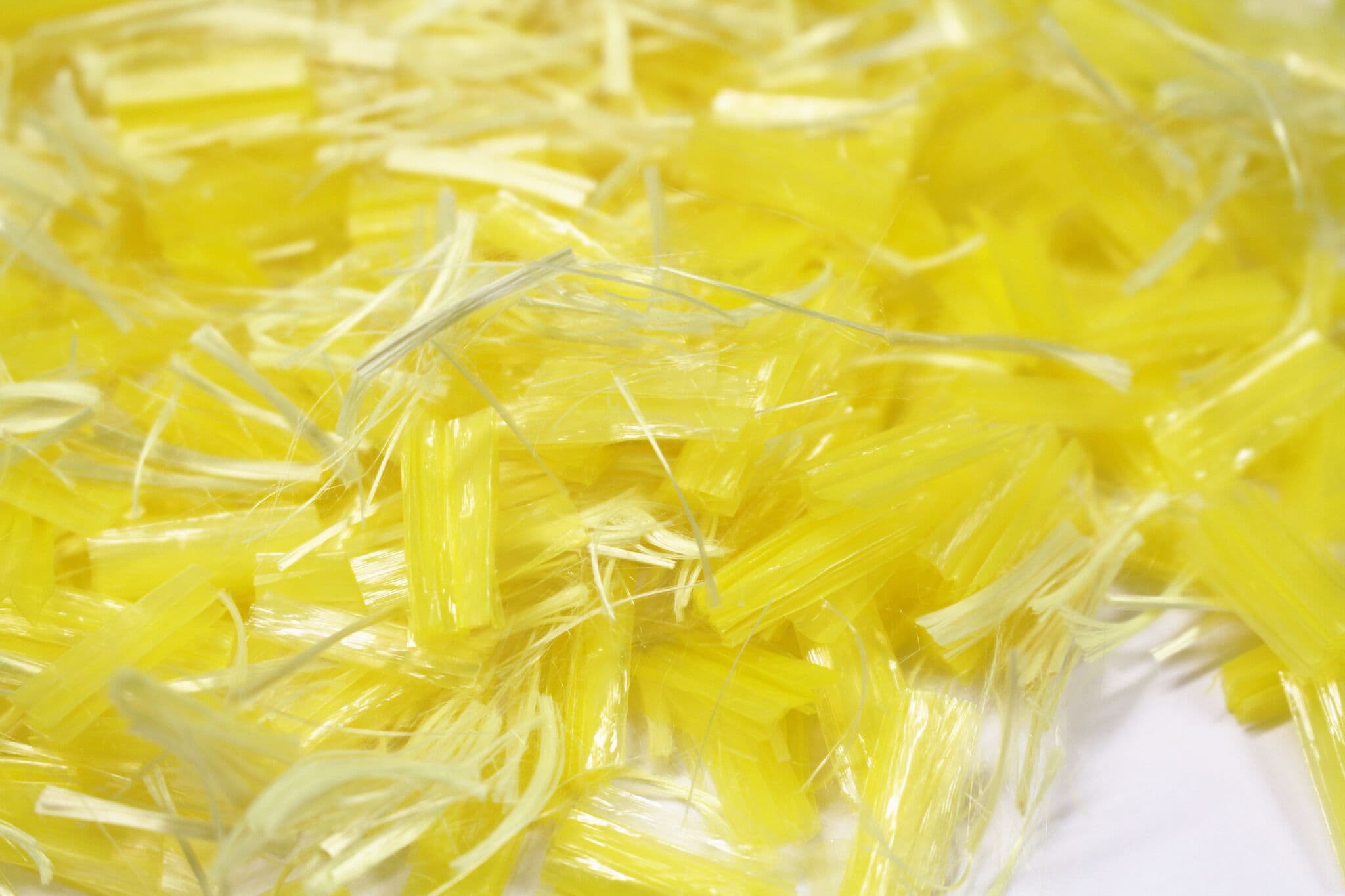
AsphaltX®
2000 filaments per aramid strand — 19 million fibres per tonne of asphalt. Lowest CO₂ footprint, European manufacturing, proven on the N337.
- TypeAramid (Twaron®) + polyolefin fibre blend
- Length± 19 mm
- Tensile strengthTwaron 3000 MPa · polyolefin 483 MPa
- Specific gravityTwaron 1.45 · polyolefin 0.91 g/cm³