Underfloor heating and the screed: thickness, reinforcement and fibres

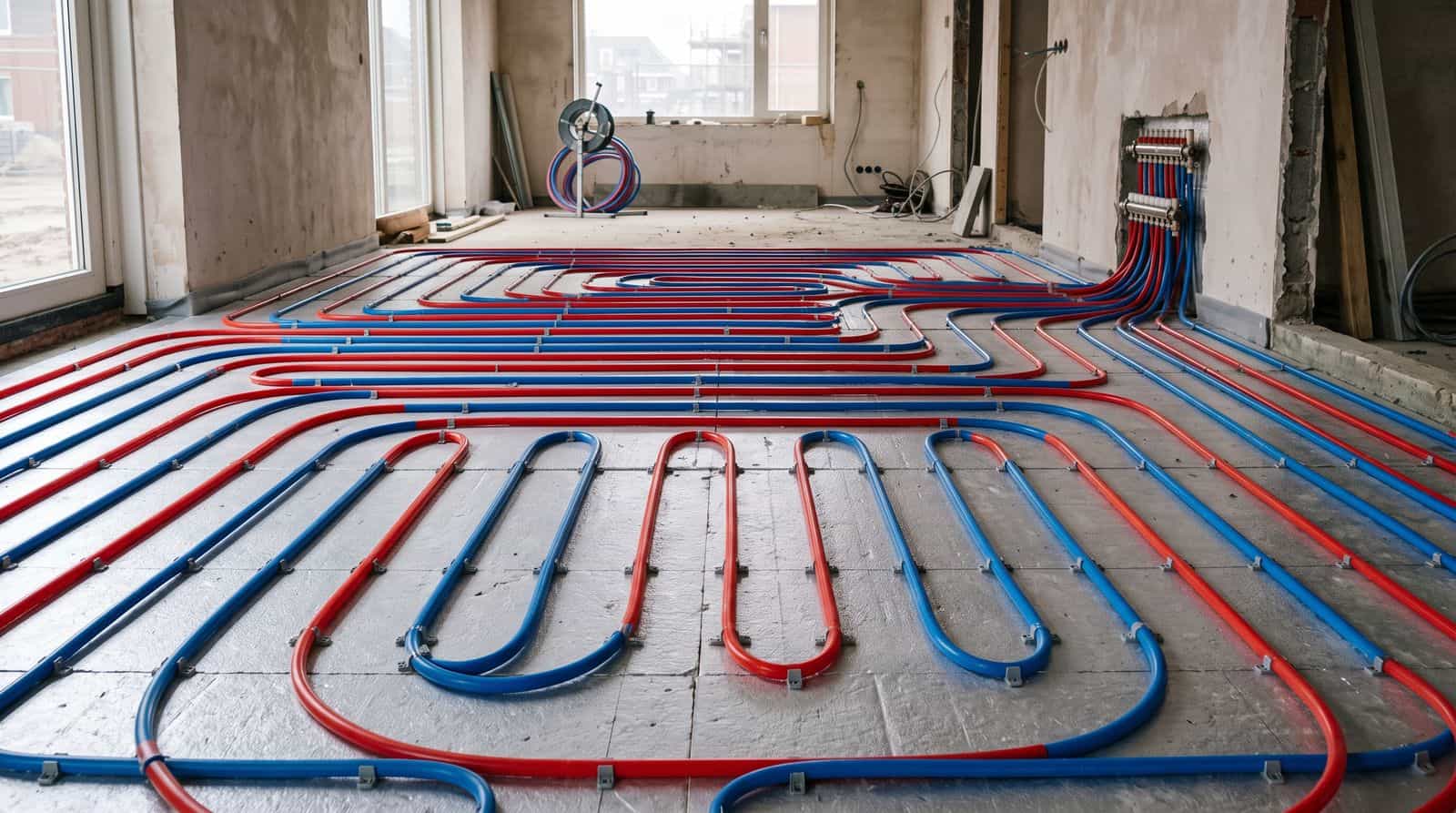
How thick does the screed on underfloor heating need to be, and do you choose reinforcement mesh or fibres? Guide thicknesses, the 20 mm cover rule and the heat-up protocol at a glance.
A screed on underfloor heating is preferably executed as a fibre-reinforced sand cement or flowing screed with at least around 20 mm of cover above the pipes; executed as a floating screed, the total thickness thus usually comes to 70–80 mm. Fibre reinforcement is the standard here, because thermal cycles and the resilient insulation layer considerably increase the cracking risk.
Why underfloor heating increases the cracking risk
Unlike a regular floor, a floor with underfloor heating goes through continuous thermal cycles: when the heating starts up the screed warms, and when it switches off it cools again. That movement is not negligible. A cement-bound screed expands by around 0.010–0.012 mm per metre per degree of temperature rise; with an 8-metre floor bay and 20 °C of warming, you are quickly looking at 1.6 to 2 mm of length change — with every heating cycle, again and again. That repeated expansion and contraction comes on top of the regular hardening and drying shrinkage of the concrete or sand cement mortar.
Added to that, underfloor heating floors almost always lie on an insulation layer as a floating screed. The floor therefore has less support than a construction poured directly onto a firm substrate, and is more susceptible to deformation and cracking. For that reason, specialised flooring companies apply a hard rule: with a cement screed combined with underfloor heating, fibre reinforcement is always used, regardless of other design choices.
The fibres absorb the stress that arises from the combination of shrinkage and thermal movement. They bridge micro-cracks the moment they form and thus prevent small cracks from growing into wide, visible ones. In some mixes, fibres also contribute to better heat conduction, which benefits the efficiency of the underfloor heating itself.
How thick does the screed on underfloor heating need to be?
The thickness of a screed on underfloor heating follows from three layers: the pipes themselves (usually 16–20 mm outside diameter), the minimum cover above them and an execution margin. Most of the stress concentrates just above the pipework; therefore maintain at least around 20 mm of cover there. Common guide values per floor type:
• Floating sand cement screed with underfloor heating — guide value 70–80 mm total thickness; thinner than 65 mm only with crack-control reinforcement combined with fibres.
• Power-floated concrete floor with underfloor heating — from around 70 mm, measured including the underfloor heating pipes, usually with a low-shrinkage concrete mix plus fibre reinforcement.
• Flowing screed (anhydrite) on underfloor heating — can be thinner than sand cement thanks to its higher flexural strength; follow the supplier's instructions here.
• Cover above the pipes — at least around 20 mm, in every floor type.
Watch out for crossing pipes: where pipes cross each other there is locally less cover and thus a greater cracking risk. That calls for a slightly thicker floor or extra attention in the laying plan, regardless of the chosen reinforcement type. The general thicknesses, mix ratios and drying times for screeds without underfloor heating can be found in our article on the sand cement screed; below we stick to what underfloor heating makes different.
Reinforcement mesh or fibres with underfloor heating?
Traditionally, steel mesh or reinforcement nets lie in the screed, and with underfloor heating they often have a mainly practical role: the pipes are fixed to them. As reinforcement, however, such a mesh only performs when it lies at the correct height in the cross-section — and precisely that is hard to guarantee in a thin screed full of pipes. A mesh lying at the bottom or directly on the insulation does structurally little.
Fibre reinforcement works differently: the fibres are homogeneously distributed throughout the entire volume of the mortar, including the critical zone directly above the pipes. Nothing needs to be cut, tied or set on spacers, and no reinforcement can start to rust. For the site, that means a faster cycle and less labour; the full comparison of lead time and cost is covered in fibre concrete versus reinforcement mesh. In some cases a fibre-reinforced floor also needs less mixing water than a mesh-reinforced floor, which can contribute to a shorter drying and walk-on time — relevant for scheduling tiling or parquet work.
When do you combine fibres with crack-control reinforcement?
Fibres and a mesh are not mutually exclusive; the layer thickness and the insulation layer determine the choice:
• Floating screed thinner than 65 mm — combine crack-control reinforcement (a fine mesh) with fibres. The mesh limits the crack width once the floor actually cracks, while the fibres control cracking throughout the volume.
• Floating screed on a firm, barely compressible insulation layer — fibre reinforcement alone can suffice, because the insulation barely deforms and the reinforcement mainly needs to limit the regular shrinkage.
• Power-floated concrete floor from around 70 mm — a low-shrinkage concrete mix with fibre reinforcement is the common, cost-efficient solution here.
If a mesh is applied alongside fibres, the rule of at least around 20 mm of cover above the pipework continues to apply in full.
Which fibre do you choose for a screed with underfloor heating?
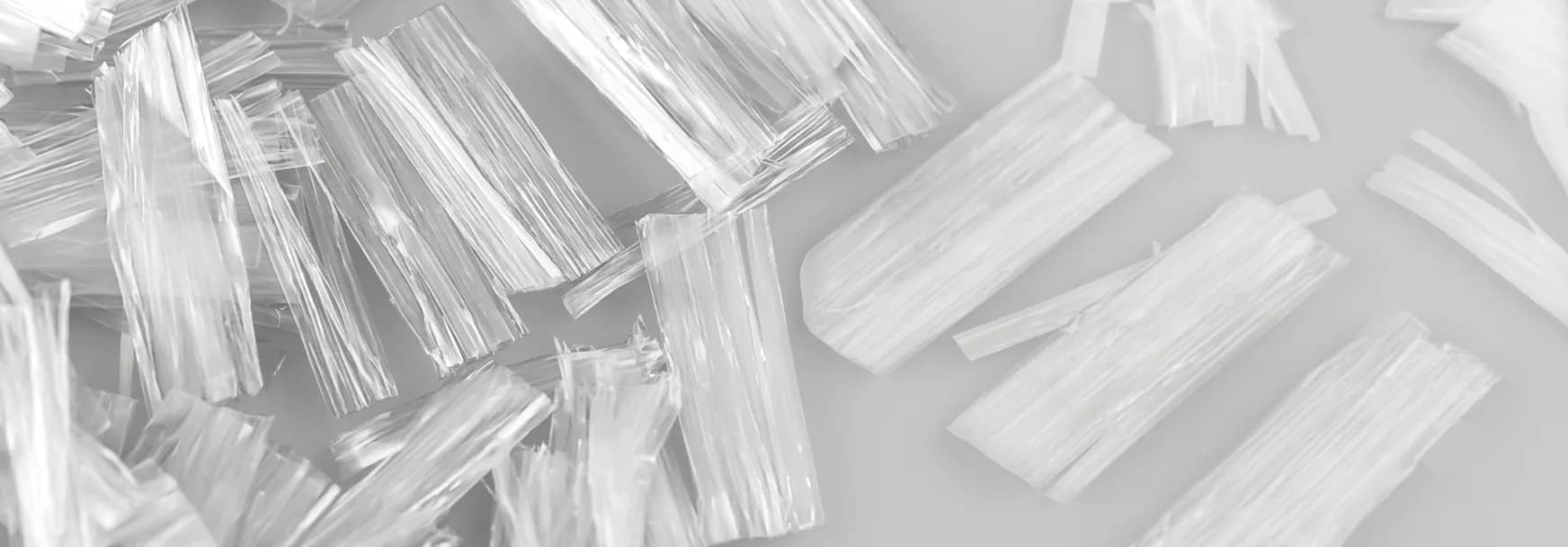
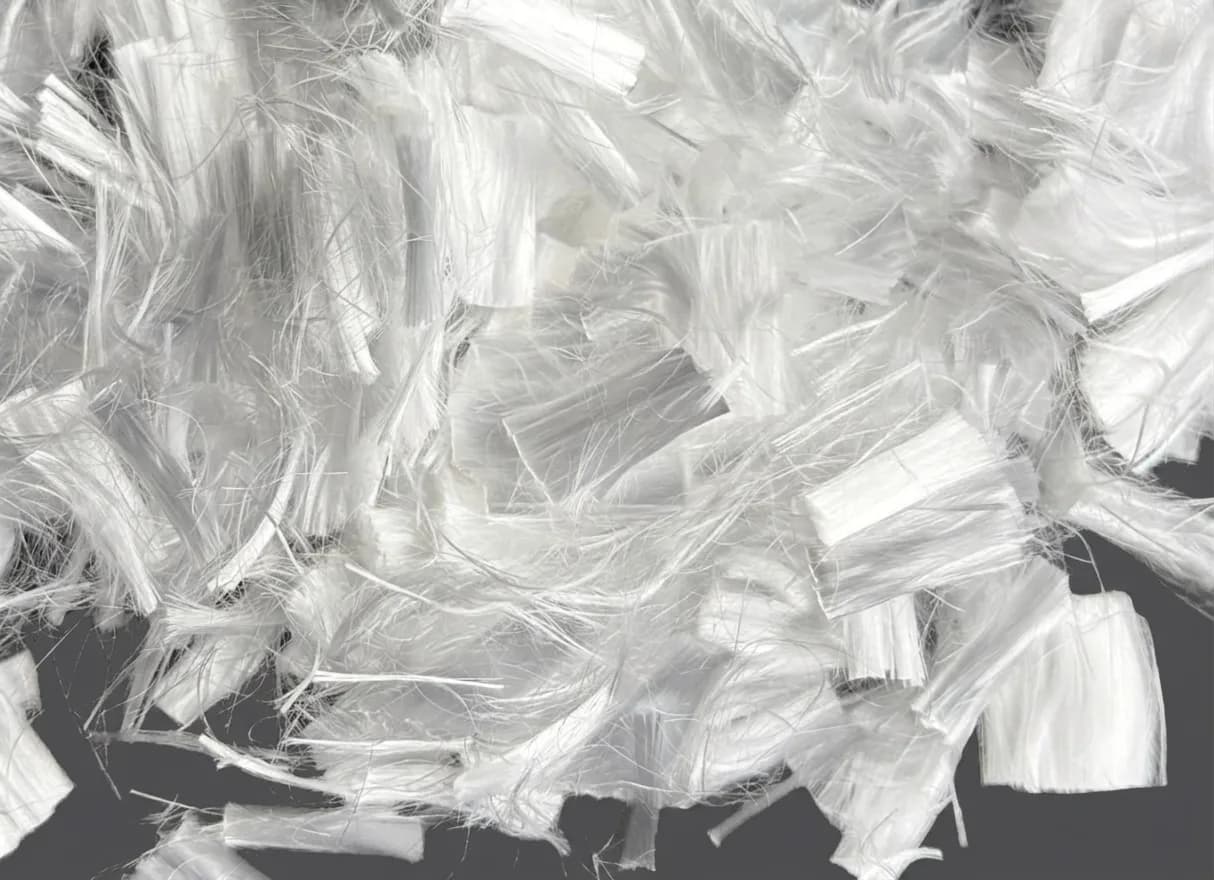
For screeds, the aim is controlling shrinkage cracks, and polypropylene micro fibres are the first choice for that. Profib is a fibrillated PP fibre for floating screeds and sand cement mortar: in the mixer, the fibre fans out into a net structure that bonds into the mortar. Promicro is a monofilament shrinkage fibre for screeds with underfloor heating that prevents plastic shrinkage cracks in the first hours after laying and improves surface quality. The guide dosage for this type of micro fibre is usually around 0.9 kg per m³ of mortar, depending on mix and application.
It is precisely those first hours that are critical with underfloor heating floors: the mortar lies on a non-absorbent insulation layer and dries mainly via the surface, which increases the risk of early drying cracks. How you recognise and prevent that mechanism is covered in preventing plastic shrinkage cracks.
One caveat: fibres in a screed are crack-control reinforcement, not a replacement for structural reinforcement. If the floor contributes structurally, a calculation by the structural engineer always belongs with it.
Heat-up protocol: to operating temperature in steps
However well the floor is reinforced, heating up too fast can still cause cracking — even with fibres. Therefore always heat up gradually according to a fixed protocol. A common heat-up protocol for a cement-bound screed looks like this:
• Step 1 — wait at least 28 days after laying before switching on the underfloor heating (for anhydrite flowing screeds a shorter period often applies; follow the supplier's instructions).
• Step 2 — start with a water temperature of 20 to 25 °C.
• Step 3 — raise the water temperature by no more than 5 °C per day up to the maximum design temperature (usually around 40–45 °C).
• Step 4 — hold that maximum temperature for at least 24 hours, so the floor warms through evenly and residual moisture can escape.
• Step 5 — bring the temperature back down in steps of 5 °C per day.
• Step 6 — check the residual moisture content before applying the floor finish; only then follows tiling, resin flooring or parquet work.
Record the completed protocol (date and temperature per step). Floor finishers and insurers almost always ask for it in damage disputes.
Chape on underfloor heating: the Belgian practice
In Belgium the sand cement screed is called a chape, and for chape on underfloor heating the same rules apply as above: a guide thickness of 70–80 mm for a floating build-up, at least around 20 mm of chape above the pipes and a gradual heat-up protocol after at least 28 days of drying. The fibre choice is identical too — fibrillated or monofilament PP fibres at around 0.9 kg per m³ of mortar. Belgian chape layers have long worked with fibres in the chape as standard; combining it with underfloor heating is the rule there rather than the exception.
From floor design to delivery
For a screed on underfloor heating it thus comes down to three decisions: the thickness (guide value 70–80 mm floating, at least 20 mm cover), the reinforcement (fibres as standard, combined with crack-control reinforcement below 65 mm) and the heat-up protocol. If you are unsure about the fibre type or dosage for a specific project, send the build-up — area, layer thickness, insulation type and finish — with your quotation request; you will receive advice with a dosage per m³ within two working days. More floor- and sector-specific articles can be found in the pillar applications and target groups.
Frequently asked questions
- How thick does a screed on underfloor heating need to be?
- For a floating sand cement screed with underfloor heating, use a guide value of 70–80 mm total thickness, with at least around 20 mm of cover above the pipes. Thinner than 65 mm is only possible with crack-control reinforcement combined with fibres. Flowing screeds can be thinner; follow the supplier's instructions there. General thicknesses without underfloor heating are in the article on the sand cement screed.
- Is steel mesh or reinforcement netting mandatory with underfloor heating?
- No. With underfloor heating, a mesh often serves mainly as a fixing grid for the pipes; as reinforcement it only works at the correct height in the cross-section. Fibre reinforcement sits homogeneously throughout the mortar and is therefore the standard. Only for floating screeds thinner than 65 mm is crack-control reinforcement recommended, in combination with fibres.
- How long to wait before heating up after laying the screed?
- With a cement-bound screed, wait at least 28 days after laying. Then heat up gradually: start with water at 20 to 25 °C and increase by no more than 5 °C per day up to around 40–45 °C, hold that temperature and bring it back down in steps of 5 °C. Heating up too fast causes cracking, even in a fibre-reinforced floor.
- Which fibres do you use in a chape with underfloor heating?
- Polypropylene micro fibres are the first choice for chape and sand cement screeds with underfloor heating: fibrillated (Profib) or monofilament (Promicro), with a guide dosage of around 0.9 kg per m³ of mortar, depending on mix and application. They control shrinkage cracks throughout the entire volume, including the critical zone directly above the pipes.
- Why does a screed with underfloor heating crack despite reinforcement?
- The most common causes: heating up too fast (more than 5 °C per day), too little cover above crossing pipes, a floor that is too thin on a compressible insulation layer, or missing edge insulation causing the floor to become trapped as it expands. Reinforcement limits crack width, but does not correct these execution errors — the heat-up protocol always remains essential.
Share this article
Products mentioned
Profib
Fibrillated PP micro fibre for plastic shrinkage crack control, strong in sand-cement screeds. Disperses homogeneously through the concrete.
- TypePolypropylene (fibrillated tape)
- Length12 mm
- Number of fibres per kg100,000
- Tensile strength370 MPa
Pallet price on request
Promicro
Synthetic PP monofilament micro fibre against plastic shrinkage cracks. Homogeneous dispersion and better surface quality at a low dosage.
- TypePolypropylene monofilament (round cross-section)
- Length12 mm
- Equivalent diameter32 µm
- Linear density6.5 dpf
Pallet price on request
Also read
- Sand cement screed: thickness per type, drying time, mix ratio, cost and crack control with shrinkage fibre
- What is a floating screed? Build-up, thickness, insulation and reinforcement
- Fibre concrete vs reinforcement mesh: the difference in time and cost