Cycle path surfacing: red asphalt, coloured coating or concrete?

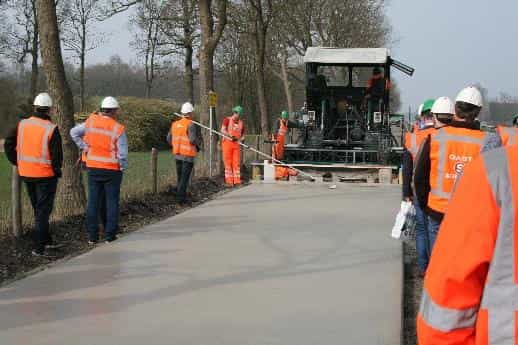
Cycle path surfacing compared: red asphalt, coloured coatings or concrete coloured throughout. Plus cycle track construction, the choice between asphalt and concrete, resurfacing and what a cycle path costs.
Cycle path surfacing is the top layer of the pavement, the part cyclists actually ride on. In the Netherlands that is usually a red asphalt surface course 25 to 35 mm thick (red thanks to iron oxide pigment), a thin coloured coating or surface dressing on existing asphalt, or, on a concrete cycle path, the concrete itself, often left grey and sometimes coloured red throughout. With coloured surfacing the difference lies in where the colour sits and how long it lasts: a coating wears and has to be renewed periodically, red asphalt keeps its colour through the full surface course until that course is worn out, and in coloured concrete the pigment runs through the whole slab.
Which surfacing suits a cycle path depends on what lies beneath it. That is why this article also covers cycle track construction in asphalt and in concrete, the choice between the two, resurfacing and the cost of building a cycle path. It is written for highway authorities, local councils, engineering consultants and contractors, with Dutch practice as the reference and notes on UK and Irish guidance where it differs. For the wider role of fibres in highway maintenance, see fibre reinforcement for municipalities.
Coloured surfacing for cycle paths: red asphalt, coating or concrete
There are three common routes to a coloured cycle path surface. They differ in where the colour sits, how thick the layer is and how much maintenance it needs. The table sets them side by side; each option is explained below.
| Cycle path surfacing | Where the colour sits | Thickness (indicative) | Maintenance and repair | Best suited to |
|---|---|---|---|---|
| Red asphalt (e.g. AC 8 surf or red SMA) | Pigment throughout the surface course | 25-35 mm surface course | New red surface course at major maintenance; patching needs red as well as black asphalt | New asphalt cycle path or surface course replacement on sound lower layers |
| Coloured coating or red surface dressing | Thin layer on the surface | A few millimetres | Renew periodically; wears first where traffic is heaviest | Restoring colour on otherwise sound asphalt, crossings, highlighted sections |
| Concrete coloured throughout | Through the full depth of the slab | Slab thickness (see construction) | Little maintenance; inspect the joints | New concrete cycle path or white topping over worn asphalt |
Red asphalt: the pigmented surface course
With red asphalt the colour is part of the surface course itself. The asphalt plant mixes a red iron oxide pigment into a fine surface course. In Dutch contracts that is usually AC 8 surf (a thin asphalt concrete surface course with an 8 mm maximum aggregate size) or a red stone mastic asphalt such as SMA-NL 11 red, laid 25 to 35 mm thick. Specifications typically call for 3 to 5% pigment. Ordinary black bitumen is often used; a pale or clear synthetic binder makes the red brighter.
Red asphalt means a separate production run at the plant, so small quantities are relatively expensive and not always available at short notice. Patch repairs in black asphalt leave a patchwork. In 2024 the municipality of Dijk en Waard applied a red coating instead of red asphalt to several cycle paths in Heerhugowaard, partly because red asphalt with clear binder was becoming harder to source and because working with it can be unhealthy. The price of coloured asphalt is also clearly higher than that of black asphalt.
Coloured coatings and red surface dressing
A cycle path coating is a thin coloured layer on existing asphalt, usually thermoplastic or resin-based, sometimes with coloured aggregate broadcast into it for skid resistance. A red surface dressing is a similar treatment in which coloured chippings are rolled into a binder film. Both are quick to apply and suit restoring the colour and visibility of an otherwise sound cycle path, or colouring only crossings, junctions and highlighted sections.
Evidence on service life is mixed. Dijk en Waard expects its coating to last longer than red asphalt but also expects the bright colour to fade; the Dutch Cycling Embassy, by contrast, describes paint and coatings as a short-term solution that fades within a few years. There is no single reliable figure: it depends on the product, the substrate and the traffic, and a coating wears first where use is heaviest. Ask the supplier about the guarantee period and the skid resistance. Bear in mind that a coating does not cure cracking, ravelling or deformation in the asphalt below.
Concrete coloured throughout
On a concrete cycle path the pigment goes into the concrete mix. The colour then runs through the whole slab, so wear never exposes a grey layer underneath. Red concrete does look lighter and less saturated than red asphalt, and in the early period efflorescence can dull the colour. A trial panel or reference sample, concrete from a single plant and consistent curing prevent colour differences between sections.
Pigment and fibres both go into the mixer, so a coloured fibre-reinforced concrete cycle path needs no extra step on site. The same approach works on an existing asphalt cycle path: with white topping, a red-coloured concrete layer can be placed over the old asphalt.
Why are Dutch cycle paths red?
Dutch cycle paths are red for recognition: the colour shows at a glance that the path belongs to cyclists and sets it apart from the carriageway. The tradition goes back to the late 1970s, when Tilburg chose red for a demonstration cycle route in 1977.
It is not compulsory. In the Netherlands the red colour has no legal meaning: what makes a cycle path a cycle path in law is the traffic sign. A red strip on the carriageway without a cycle symbol is an advisory cycle lane (fietssuggestiestrook), not a cycle path. Many Dutch authorities therefore choose to colour only crossings and conflict points, or to leave concrete paths grey. If you opt for a red coating, set requirements for skid resistance too, because a slippery surface is a hazard for cyclists in the wet.
Red cycle lane surfacing in the UK and Ireland
In England, coloured surfacing is not a legal requirement for cycle lanes or tracks. Active Travel England refers designers to section 6.7 of LTN 1/20 (Cycle Infrastructure Design), recommends a single colour for cycle infrastructure within one highway authority area, and points out that any coloured material must provide adequate skid resistance and that maintenance costs may be higher. Some authorities have adopted a policy of coloured surfacing for all cycle routes; elsewhere red is often limited to junctions, crossings and other highlighted sections.
The DMRB standard CD 239 for footway and cycle track pavement design states that coloured surfacing can be used to emphasise the presence of a cycle track. In August 2026 Northern Ireland issued interim requirements (DEM 196/26) for red surface course on cycle tracks: thin surface course systems (TSCS) with a clear synthetic polymer-modified binder, natural red aggregate and red pigment to RAL 3013 (tomato red). In Ireland, according to IrishCycle, the NTA Cycle Design Manual of 2023 made red surfacing the standard for new segregated cycle facilities, whereas Dublin's Clontarf to City Centre scheme, too far advanced for the new standard, uses red only across major junctions. Check the current version of the guidance that applies to your authority before you specify.
Cycle track construction: from subgrade to surface course
A cycle path consists of a sand bed or subgrade, a sub-base, if needed a binder course, and the surface course. On a concrete path the slab is surface course and structural layer in one. Two examples from recent Dutch contracts show what this looks like in practice; they are examples, not a standard. In the UK the corresponding design standard is DMRB CD 239, and asphalt cycle tracks typically get a fine dense surface course such as AC 6 dense surf.
A Dutch municipal guideline for road pavement construction (2022) gives this build-up for a segregated asphalt cycle path: 30 mm AC 8 surf, red with 3% pigment, on 70 mm AC 22 base and 150 mm of recycled mixed aggregate (menggranulaat) 0/31.5. The guideline uses asphalt for cycle paths as standard, unless utilities run beneath the path. Its design life is at least 15 years for the surface course, 25 years for the other asphalt layers and 45 years for the sub-base. Other contracts vary around these values: red surface courses of 25 to 35 mm, binder or base courses of 55 to 80 mm and a sub-base of 150 to 350 mm of recycled aggregate.
A 2025 cross-section drawing from the province of Groningen shows the concrete alternative: a concrete cycle path pavement 180 mm thick, 210 mm at vehicle crossovers and accesses, in C30/37 concrete with exposure class XF4 and CEM III/B cement, on a sand bed. XF4 is the EN 206 exposure class for concrete that is highly saturated during freezing and exposed to de-icing salts, exactly the situation of a cycle path that is gritted in winter. In Flanders concrete cycle paths are even more common; a 2021 road design in Ghent, for example, specifies 20 cm of cement concrete on 15 cm of lean concrete.
Design for the heaviest load, not for the bicycle. If gritters, sweepers, cherry pickers for tree work or the occasional lorry use the path, the build-up should follow from a pavement design with calculation. For concrete, that calculation sets the slab thickness and the reinforcement.
| Layer | Asphalt cycle path (municipal guideline, 2022) | Concrete cycle path (province of Groningen, 2025) |
|---|---|---|
| Surface course | 30 mm AC 8 surf, red (3% pigment) | The concrete is surface course and structural layer in one |
| Binder or structural layer | 70 mm AC 22 base | 180 mm C30/37 concrete, XF4 (210 mm at accesses) |
| Sub-base | 150 mm recycled mixed aggregate 0/31.5 | Sand bed |
| Under heavier loading | Pavement design with calculation | Calculate thickness for the axle loads of maintenance vehicles |
Asphalt or concrete for a cycle path?
The choice of cycle path pavement comes down to the situation. Asphalt is the default in many Dutch municipalities, and in the UK the Mineral Products Association notes that asphalt has become increasingly recognised as the most appropriate surfacing for cycleways. It gives a very smooth, comfortable ride, can open to traffic shortly after laying and is easy to dig up when cables or pipes run beneath it. On the other hand, asphalt is vulnerable to tree roots and fatigue, the surface course needs periodic replacement, and red asphalt has become harder to source.
A concrete cycle path needs little maintenance and has a long service life. Municipalities that choose concrete for segregated cycle paths often cite the near absence of maintenance and the resistance to root heave. The drawbacks are the curing time before the path can open, the joints (barely noticeable when well executed) and the extra effort of breaking out the slab for cables and pipes.
The difference in construction cost need not be large. In an estimate by the Frisian municipality of Waadhoeke for a cycle path about 2,050 metres long and 3 metres wide, the asphalt and concrete options came out almost the same, around €255,000 to €260,000 excluding VAT. Concrete is normally more expensive to build than asphalt; here the memo preferred concrete because it could be laid directly on the stable subgrade.
| Criterion | Asphalt | Concrete |
|---|---|---|
| Ride quality | Very smooth, no joints | Smooth; joints need good workmanship |
| Tree roots | Vulnerable to root heave | Much less vulnerable |
| Maintenance | Surface course replaced periodically | Little; inspect joints and edges |
| Cables and pipes beneath | Easier to open up and reinstate | More laborious; often a reason to choose asphalt or modular paving |
| Opening to traffic | Shortly after laying | Once the concrete has cured |
| Colour | Red in the surface course or via a coating | Coloured throughout, or grey |
| Reinforcement | Not applicable | Unreinforced with joints, with mesh or with macro fibres |
Paving slabs and precast cycle path panels
Modular paving (slabs or block paving) has become less common on Dutch cycle paths. A 2014 memo from the Dutch Cyclists' Union (Fietsersbond) in the Zaanstreek region put the construction and maintenance of modular paving at about 50% more than asphalt, citing a 1995 CROW publication (an old source). Modular paving is easy to lift, though, which is why precast concrete panels are sometimes used locally where tree roots push up the surface.
Concrete cycle path without mesh: macro fibres and shrinkage fibres
A concrete cycle path can be built in three ways: unreinforced with joints, with steel mesh reinforcement, or with fibres. On lightly loaded pavements, structural synthetic macro fibres can replace the mesh. TwistR is such a macro fibre: 48 mm long, made of polypropylene, dosed at 2.0 to 6.0 kg/m³ according to the datasheet. The fibre is added at the batching plant or on site and is distributed throughout the slab.
For a cycle path this brings three benefits. No mesh has to be laid and supported on chairs, which saves a lot of manual work on a long, narrow path. Synthetic fibres do not corrode, which matters in an XF4 environment with de-icing salt. And the fibres provide residual strength after cracking: if a crack does form, they hold it together. That residual strength is determined to EN 14651. Fibre type and dosage always follow from a calculation by the structural engineer, and fibres do not replace the joints: a fibre-reinforced concrete cycle path still gets sawn or expansion joints. For when synthetic fibres are the right choice and when steel is better, see synthetic fibre concrete.
A second risk arises in the first hours after placing. A narrow strip of concrete in sun and wind dries quickly at the surface, which can lead to plastic shrinkage cracks. A micro fibre such as Promicro (polypropylene, 12 mm, 0.6 to 1.0 kg/m³, Class Ia to EN 14889-2) limits these cracks and improves surface quality, which shows immediately on coloured concrete. Promicro is not structural reinforcement and proper curing remains essential; more on this in preventing plastic shrinkage cracks.
Concrete cycle paths with macro fibres have already been built. For the cycle path renovation near Sexbierum in Friesland (2019, Province of Friesland, carried out by Schagen Infra), a concrete pavement was chosen with 1,900 kg of TwistR GREEN HYBRID fibres on a load-bearing sub-base. According to the project data, project costs came out about 25% lower.
Cycle path resurfacing: new surface course, coating or white topping
When resurfacing a cycle path, the first question is not what colour the new surface will be, but where the damage comes from. Establish the cause with a visual inspection, cores and, if necessary, deflection testing, then choose the lightest measure that actually solves the problem. The table gives the usual measure for each type of damage; for preserving and replacing asphalt surface courses see also asphalt maintenance.
Where root heave is the cause, the damage returns unless the roots are guided or shielded. In Haarlem, along the Rijksstraatweg, precast concrete panels were laid at the spots with root heave, while the asphalt was renewed elsewhere.
| Type of damage | Likely cause | Suitable measure |
|---|---|---|
| Faded colour, polished or lightly ravelled surface | Wear of surface course or coating | New coating or surface dressing, or a new red surface course |
| Bumps and cracks above tree roots | Root heave | Break out locally, guide or shield the roots; concrete or panels at root locations |
| Crazing, longitudinal cracks or deformation that keep returning | Asphalt fatigue on a sound sub-base | White topping with fibre concrete over the existing asphalt |
| Settlement, ponding, high deflections | Sub-base or subgrade exhausted | Reconstruction, for example as a new fibre-reinforced concrete cycle path |
White topping: a concrete overlay on the old asphalt
If cracking and deformation return after every surface course replacement while the sub-base is still sound, white topping is an alternative to reconstruction. A fibre-reinforced concrete layer is placed over the existing asphalt, which stays in place as the foundation. Along the N344 near Barneveld, a 12 cm layer of fibre concrete was laid over the existing asphalt in 2019, with project costs about 25% lower.
Along the N355 in Friesland, white topping was applied to a cycle path in 2018 as a European first: a thin concrete layer with TwistR macro fibres, placed directly on the existing asphalt for the Province of Friesland. The technique, layer thickness and preconditions are set out in white topping: fibre concrete over asphalt.
What does a cycle path cost to build?
The cost of a cycle path depends above all on how much of the existing construction can be kept. Earthworks and sub-base, width and length, kerbs and edge restraints, colour and any cables and pipes that have to be diverted all add to it. The figures below reflect Dutch market prices in euros.
• Asphalt cycle path: indicatively €30 to €60 per m², laid, excluding VAT, earthworks and kerbs (2026 prices). A detailed price table per application is given in what asphalt costs per m².
• Concrete versus asphalt: in the Frisian estimate mentioned above, both options came out almost the same; converted (our own calculation), that is about €42 per m².
• Colour: according to the Dutch Cycling Embassy, coloured asphalt costs about 40% more than black; colouring only the top 2 cm or so limits the extra cost to around 10 to 20% (an indication from an article to which a supplier of coloured asphalt contributed).
• Complete new segregated cycle path: including earthworks, this is usually budgeted per kilometre. A 2025 estimate by the Fietsersbond in North Holland assumes about €0.33 million per kilometre for a segregated cycle path alongside a distributor road (50 to 80 km/h).
For a fibre-reinforced concrete cycle path the fibre cost is easy to work out: dosage times slab thickness times price per kilo. For a 180 mm slab and the TwistR dosage range (2.0 to 6.0 kg/m³), 0.36 to 1.08 kg of fibre goes into each m²; at €7.50 per kg excluding VAT that is €2.70 to €8.10 per m². The required dosage follows from the calculation. For a first indication, use the fibre calculator.
Fibre-reinforced concrete cycle path: how to proceed
For a new concrete cycle path or white topping we need four things: the heaviest load (including maintenance vehicles), the subgrade or the condition of the existing asphalt, the intended layer thickness and the colour (grey or red). With these, we draw up the fibre recommendation together with your structural engineer. Reference sheets for the cycle paths along the N344 and N355 are available on request. Request a quotation with your project details.
Frequently asked questions
- What is the best surface for a cycle path?
- That depends on what lies beneath it. If only the colour or the surface is worn, a coating, surface dressing or new red asphalt surface course is enough. If cracks keep returning while the sub-base is sound, a fibre-reinforced concrete layer via white topping is the more durable option, coloured red throughout if required. If the sub-base is exhausted, reconstruction is needed, for example as a new concrete cycle path with fibres.
- Why are Dutch cycle paths red?
- For recognition: the red colour sets the cycle path apart from the carriageway. The tradition started with a demonstration route in Tilburg in 1977. There is no legal obligation; in the Netherlands a cycle path is a cycle path because of the traffic sign. A red strip on the carriageway without a cycle symbol is an advisory cycle lane.
- Is red surfacing required for cycle lanes in the UK?
- Not in England: Active Travel England states that coloured surfacing is not a legal requirement for cycle lanes and tracks, and refers to section 6.7 of LTN 1/20 for where colour helps. It recommends one colour per highway authority area and adequate skid resistance. Northern Ireland issued interim requirements for red surface course on cycle tracks in 2026.
- How thick is the surface course of a cycle path?
- On asphalt the surface course is usually 25 to 35 mm, for example 30 mm of red AC 8 surf on a binder course. A coating or surface dressing is a few millimetres thick. On a concrete cycle path the whole slab is the surface course, 180 mm in a recent Dutch provincial contract, for example.
- How thick should a concrete cycle path be?
- That follows from a calculation based on the heaviest load and the subgrade. Examples from contracts: 180 mm of C30/37 XF4 concrete on a sand bed, 210 mm at accesses (province of Groningen, the Netherlands), and 20 cm of cement concrete on 15 cm of lean concrete (Ghent, Belgium). If maintenance vehicles use the path, have the thickness calculated.
- Is a concrete cycle path better than asphalt?
- Not always. Concrete wins on maintenance, service life and resistance to root heave. Asphalt wins when cables and pipes need to be accessed and when the path has to open quickly. In construction cost the two can come out almost the same, as a Dutch municipal estimate showed.
- What does a cycle path cost per m²?
- In the Netherlands, indicatively €30 to €60 per m² for an asphalt cycle path, laid, excluding VAT, earthworks and kerbs (2026 prices). Concrete can come out similar in construction cost, and a coloured surface costs extra. A price table per application is given in what asphalt costs per m².
- How long does a red coating on a cycle path last?
- There is no fixed period: it depends on the product, the substrate and the traffic. A coating wears first in busy spots such as crossings and bends. Ask the supplier about the guarantee period and the skid resistance, and check that the asphalt beneath is sound.
- What is the difference between a coloured coating and a surface dressing?
- A coating is a thin coloured layer of resin or thermoplastic material on the asphalt. A surface dressing is a binder film with (coloured) chippings rolled into it. Both restore colour and grip, but neither repairs damage in the layers below.
- What does XF4 mean for a concrete cycle path?
- XF4 is an exposure class in EN 206 for concrete that is highly saturated with water during freezing and exposed to de-icing salts. That is the situation of a cycle path that is gritted in winter. The class sets requirements for the concrete mix, such as a maximum water/cement ratio and a minimum strength class.
Share this article
Products mentioned
 Most chosen
TwistR® GREEN HYBRID
High-performance synthetic macro fibres made from 100% polypropylene. Transforms concrete into a stronger composite material.
- TypeHybrid: twisted monofilament + fibrillating network fibre
- Material100% virgin polypropylene
- Length48 mm
- Dosage2.0 – 6.0 kg/m³
Pallet price on request
Promicro
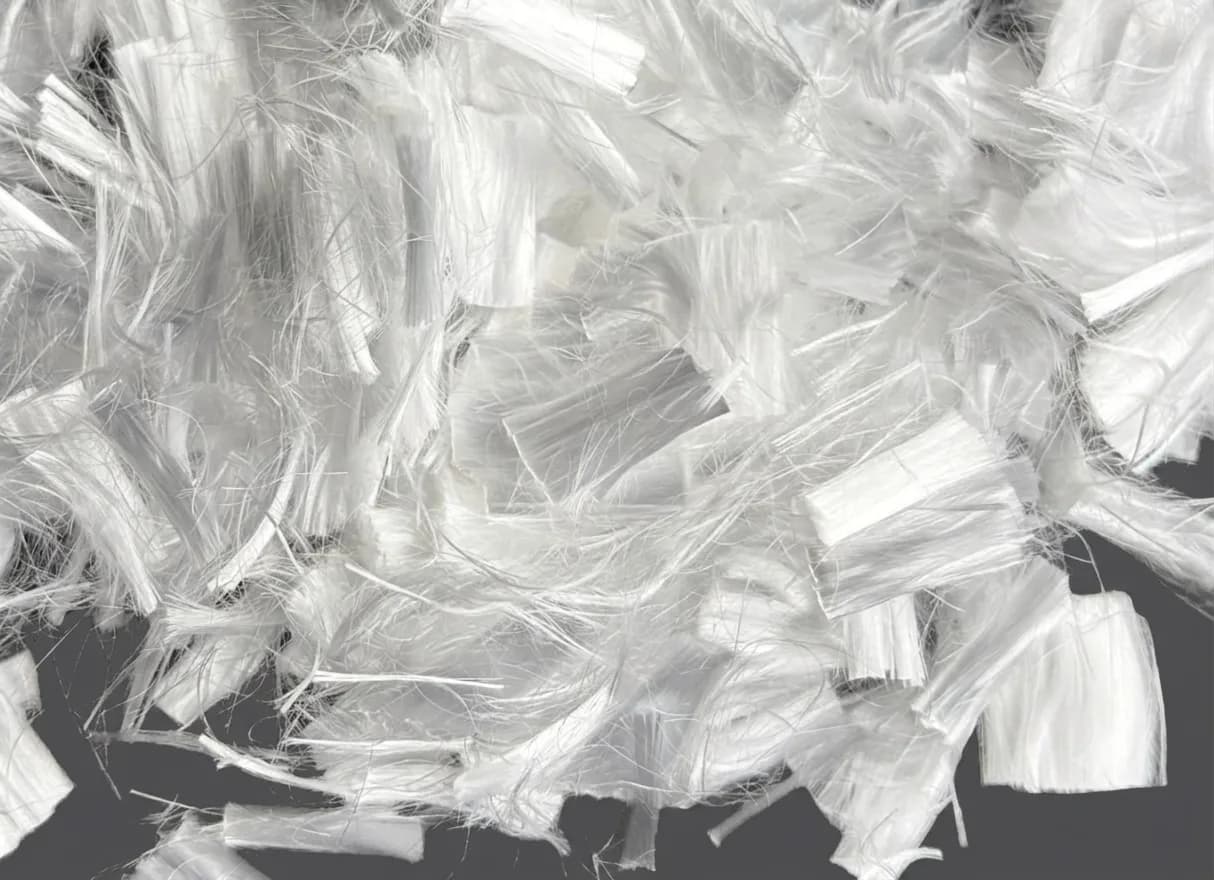
Synthetic PP monofilament micro fibre against plastic shrinkage cracks. Homogeneous dispersion and better surface quality at a low dosage.
- TypePolypropylene monofilament (round cross-section)
- Length12 mm
- Equivalent diameter32 µm
- Linear density6.5 dpf
Pallet price on request